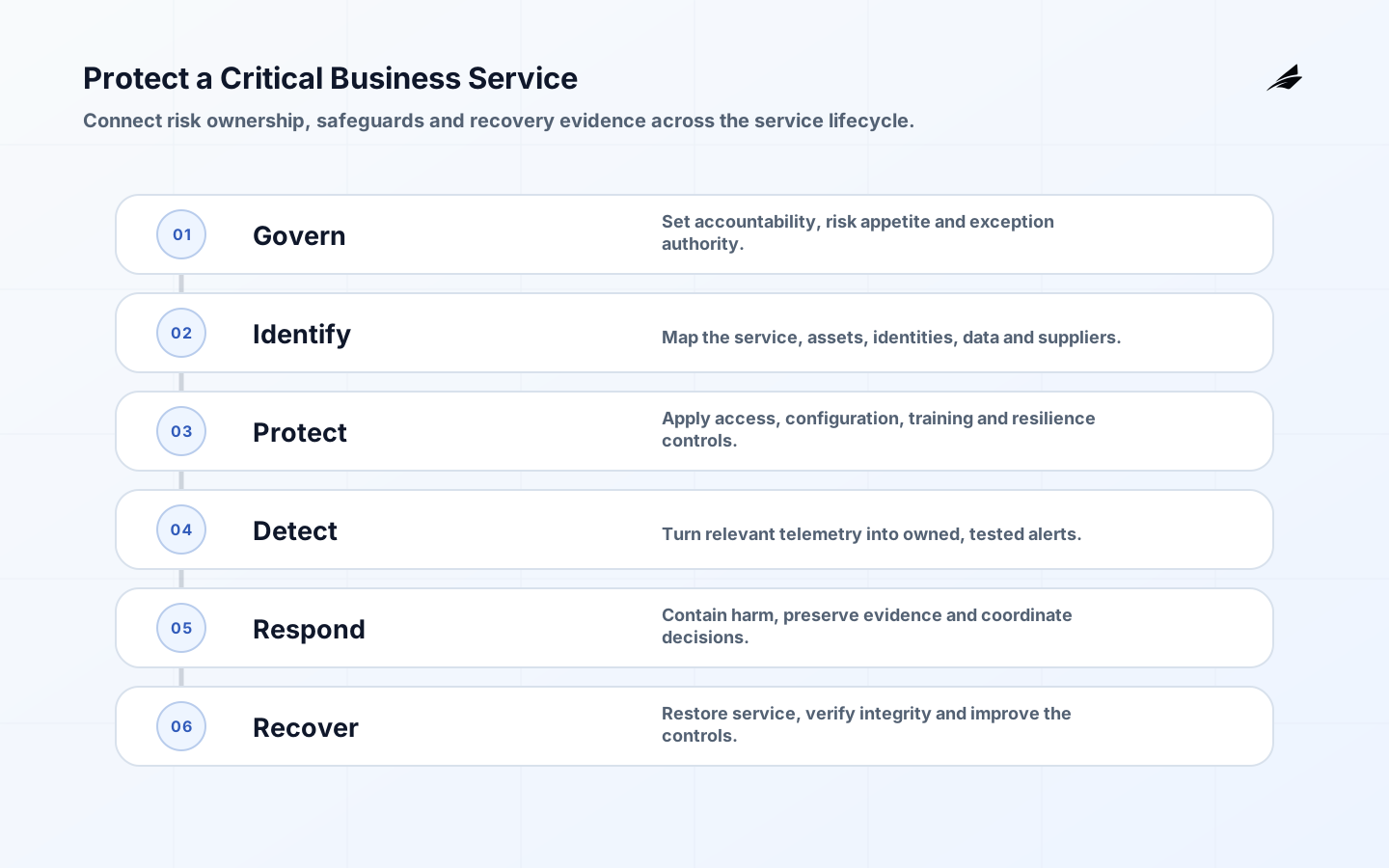
Enterprise cybersecurity is not a catalogue of appliances or subscriptions. It is a managed capability for deciding which business services matter, how they could be harmed, which safeguards are proportionate, and how the organization will detect and recover when prevention fails. The practical questions below help executives, technology owners, security teams and procurement leaders turn a broad security mandate into an owned programme of work.
What should enterprise cybersecurity solutions cover?
A complete programme spans governance, asset and data understanding, protective controls, detection, response and recovery. That lifecycle follows NIST CSF 2.0, which added Govern to Identify, Protect, Detect, Respond and Recover. The framework describes outcomes rather than prescribing products, so organizations can choose controls that fit their sector, obligations, architecture and risk appetite.

Coverage should include employees, contractors, service identities, endpoints, networks, applications, cloud accounts, data stores, operational technology where relevant, suppliers and the software delivery chain. Inventory alone is insufficient. Each critical service needs a business owner, technical owner, data classification, dependencies, recovery objective and an agreed escalation path. Unknown ownership is itself a risk because alerts, vulnerabilities and access reviews otherwise wait for someone to volunteer.
| Capability | Decision it supports | Minimum evidence |
|---|---|---|
| Govern | Which risks receive funding and acceptance? | Risk owners, policies, profile, exceptions and review minutes |
| Identify | What must be protected and what depends on it? | Service, asset, identity, data and supplier inventories |
| Protect | How is misuse or compromise constrained? | Access policy, secure configuration, backups and training records |
| Detect | How will abnormal activity become an owned case? | Telemetry coverage, detection logic, triage rules and tests |
| Respond | Who contains, communicates and makes legal decisions? | Runbooks, contact trees, exercises and preserved evidence |
| Recover | How will services and confidence be restored? | Recovery objectives, tested restores and improvement actions |
Where should an enterprise start?
Start with business services, not a tool comparison. Select a small number of services whose disruption, disclosure or manipulation would cause material harm. Map the people, systems, data and suppliers required to deliver each service. Then describe the current and target security outcomes in a CSF profile. This exposes priorities such as unmanaged privileged access, incomplete logs or untested recovery without pretending every control has equal urgency.
- Confirm executive accountability and the forum that can accept residual risk.
- Map critical services to assets, identities, data, third parties and recovery dependencies.
- Record applicable legal, regulatory and contractual obligations with named counsel or compliance owners.
- Measure current control coverage and effectiveness; do not equate license ownership with protection.
- Choose a first improvement wave that reduces a material attack path and can be verified.
- Define evidence, exception expiry and operating ownership before implementation starts.
Does zero trust mean replacing the network?
No. NIST defines zero trust as removing implicit trust based only on location or ownership and making access decisions around subjects, devices and resources. Existing network controls still matter, but being on an internal network is not sufficient authorization. A sensible migration improves identity, device signals, resource policy and telemetry around selected workflows while legacy and newer controls coexist.
For example, an enterprise can begin with administrative access to a finance platform. It can require phishing-resistant authentication where feasible, managed-device posture, time-limited privilege, approval for sensitive roles and logs that join identity, device and resource context. This is a concrete access-control improvement, not a claim that purchasing one gateway makes the organization zero trust.
How should buyers compare security products and providers?
Evaluate the operational outcome and the total control chain. A detection platform depends on usable telemetry, maintained rules, triage capacity and response authority. An identity product depends on clean directories, lifecycle processes and application integration. Ask suppliers how the product is secured by default, how vulnerabilities are handled, what audit evidence is available, how data is isolated and retained, and how the organization can export data or exit.
| Evaluation area | Questions to ask | Risk signal |
|---|---|---|
| Fit | Which threat scenario and service does this improve? | Benefits stated only as generic visibility |
| Identity and data | How are tenant data, administrators and service accounts isolated? | Shared privileged access or unclear boundaries |
| Secure development | How are builds protected and vulnerabilities remediated? | No documented disclosure or update process |
| Operations | Who tunes, monitors and responds, at what times? | Alerts delivered without an accountable workflow |
| Resilience | What happens during supplier or connectivity failure? | No degraded mode, export or recovery plan |
| Evidence and exit | Can we obtain logs, configurations and records in usable formats? | Proprietary lock-in around essential evidence |
NIST's cybersecurity supply-chain guidance is useful in procurement because it connects supplier practices to enterprise risk management. Contract terms still need legal review. Security teams should verify technical claims through architecture review, configuration inspection, a limited proof and, where proportionate, independent testing. A certificate or questionnaire response is evidence, not a substitute for understanding the service.
How should a security rollout be staged?
Use a controlled sequence: establish the baseline, design the target, prove the control on a bounded service, expand by risk, and transfer it into routine operations. Define rollback before enforcing access changes. During a pilot, monitor authentication failures, denied legitimate requests, telemetry gaps, response workload and user support. Expand only when the control works under normal and adverse conditions.
- Baseline: record coverage, exposure, alert flow, recovery performance and known exceptions.
- Design: map policy decisions, integration dependencies, failure modes and evidence retention.
- Pilot: use representative users and systems, including administrators and non-human identities.
- Verify: test expected access, denied access, logging, alert routing, recovery and rollback.
- Expand: sequence critical services and retire conflicting controls deliberately.
- Operate: assign patching, tuning, access review, incident and supplier-management routines.
What risks and measures matter most?
Common programme risks include tool overlap, blind spots between teams, excessive privilege, unsupported systems, noisy alerts, fragile integrations, untested backups and supplier concentration. Control owners should track both coverage and effectiveness. The percentage of endpoints reporting is useful, but only if sample tests show that relevant behavior generates an actionable alert. The percentage of applications behind single sign-on is useful, but privileged, break-glass and service accounts also need review.
Measures should connect to decisions: critical-service asset coverage; privileged access reviewed on schedule; high-risk vulnerabilities past agreed remediation dates; detection scenarios tested successfully; time from validated incident to containment; restore tests meeting business recovery objectives; and expired exceptions closed. Trend these by service and severity. Avoid rewarding raw alert volume or vulnerability counts, which can encourage noise rather than risk reduction.
How can leadership verify that controls work?
Assurance should combine design review, configuration evidence and direct testing. Design review asks whether the control addresses the stated threat and covers the full service path. Configuration evidence shows that the intended policy is deployed to the relevant assets and identities. Testing demonstrates behavior: a prohibited action is blocked, a material event becomes an owned alert, a compromised credential can be contained, or a restore meets the agreed business objective. None of these forms of evidence is sufficient alone.
Build an assurance calendar around risk rather than the annual audit. High-impact access paths may need continuous monitoring and frequent sample tests; recovery exercises may run on a schedule tied to service criticality; supplier evidence can be refreshed at renewal and after material service changes. Findings need severity, owner, due date and a decision when remediation is deferred. Temporary compensating controls should state what they cover and when they expire.
Independent assessment can add confidence where consequences or obligations justify it, but the scope must match the decision. A narrow penetration test does not assess governance, response or recovery. A control audit may not reproduce an adversarial path. Leadership should understand the question each assessment answers, the systems and period covered, exclusions, and whether remediation was retested. The goal is traceable confidence, not a collection of reports.
Present assurance to leadership as decisions, not a wall of control statuses. Show which critical services were tested, which scenarios passed, where evidence is missing, what material findings remain and who accepted any delay. Include trend and scope so a green result from a narrow sample is not mistaken for broad coverage. This allows investment to follow exposed business risk and gives control owners a clear reason to improve evidence quality.
Where testing could disrupt production, use a representative environment, controlled window and approved safety plan, then document the limits of inference. Schedule a controlled production confirmation when the remaining uncertainty is material and record its owner.
- Link each test to a critical service, threat scenario and control owner.
- Retain reproducible evidence without collecting unnecessary sensitive data.
- Track failed and overdue tests separately from controls that were never assessed.
- Report residual risk and business impact alongside technical findings.
- Feed incident and exercise lessons back into architecture, policy and training.
Key takeaways
- Organize security around critical business services and explicit risk ownership.
- Use a framework such as NIST CSF 2.0 to define outcomes without turning it into a product checklist.
- Treat identity, device, workload and data context as inputs to access decisions.
- Buy an operated control chain, including evidence, response and exit, rather than isolated features.
- Roll out in verified waves and measure effectiveness, recovery and residual risk.
Frequently asked questions
Can an enterprise outsource cybersecurity?
It can outsource monitoring, testing, engineering or specialist response, but not accountability for business risk. Internal owners must set priorities, authorize containment, manage legal and regulatory duties, and verify supplier performance. Contracts should define access, evidence, incident notification, subcontractors, resilience and exit.
How many security tools does an enterprise need?
There is no useful universal number. Prefer the smallest coherent set that covers required outcomes and can be operated well. Consolidation may reduce integration and training burden, but concentration can increase supplier and outage risk. Decide from control coverage, effectiveness, architecture and operating cost.
Does compliance prove that the enterprise is secure?
No. Compliance can establish required controls and evidence at a point in time. Threats, configurations and dependencies change continuously. Combine compliance work with scenario testing, vulnerability management, detection validation, exercises and risk review.
How often should the programme be reviewed?
Operational signals may need daily attention, while risk and control reviews can run monthly or quarterly depending on impact. Material incidents, acquisitions, architecture changes, new obligations and supplier changes should trigger additional review rather than waiting for the calendar.
Conclusion
Effective enterprise cybersecurity makes risk decisions visible and controls testable. It connects governance to critical services, builds explicit access and recovery paths, and gives operators evidence they can act on. The strongest roadmap is not the one with the most products; it is the one that reduces meaningful exposure, survives failure and can show leadership what improved and what risk remains.