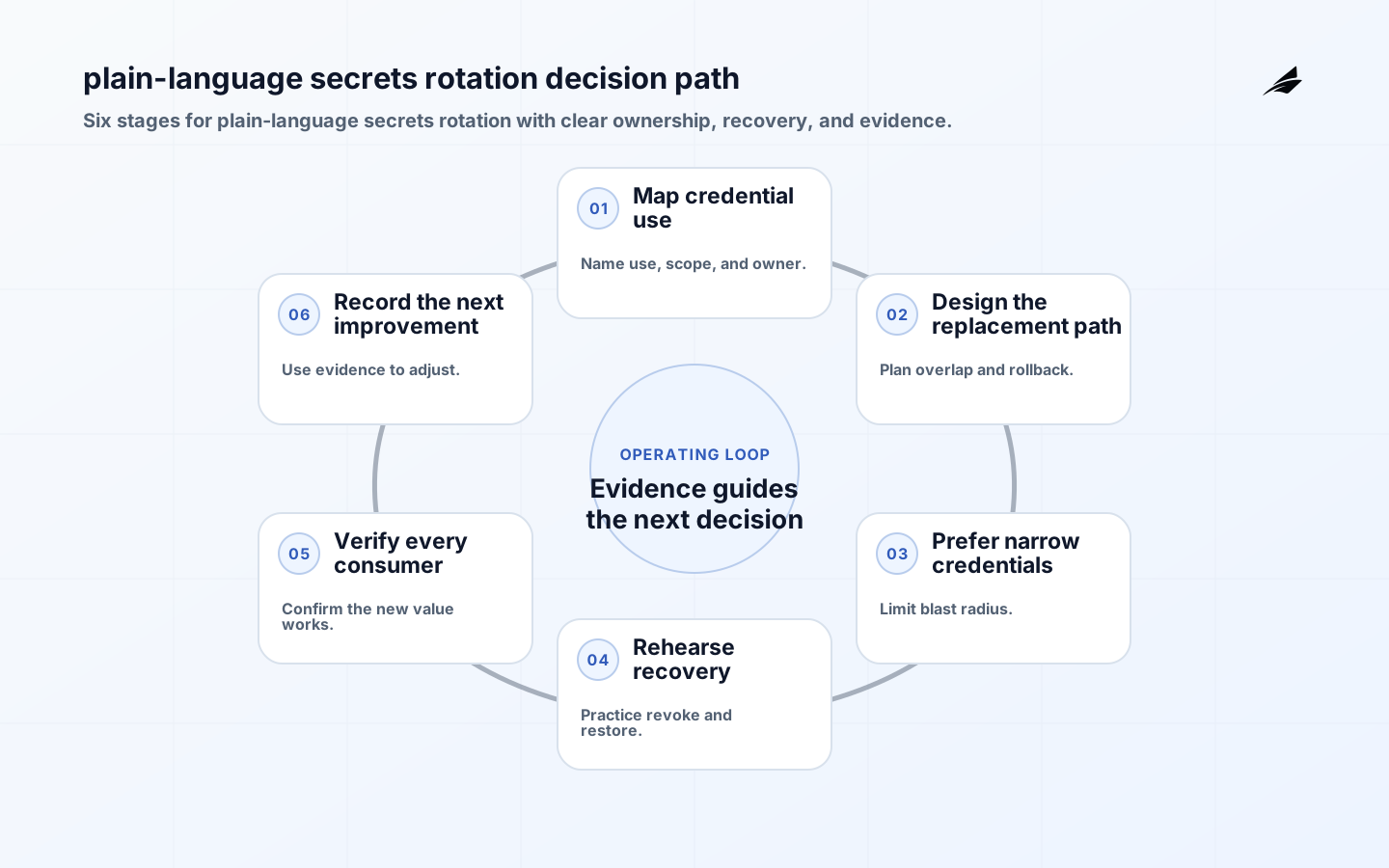
Secrets rotation is the controlled replacement of credentials so a leaked, overused, or long-lived secret has a smaller window of value. It is not merely a calendar reminder. Good rotation includes an inventory, a consumer-aware change sequence, monitoring, revocation, and a recovery plan that works when the secret system itself is under stress.
Know which secrets exist and why — plain-language secrets rotation
Inventory secrets by function: database credentials, API keys, signing keys, certificates, service tokens, webhook secrets, recovery credentials, and CI variables. For each, record the owner, consumers, privilege, location, creation method, expiry, dependencies, and last successful rotation. The OWASP Secrets Management Cheat Sheet emphasizes centralized storage, provisioning, auditing, rotation, and lifecycle management because a secret copied across repositories and tools cannot be reliably controlled.
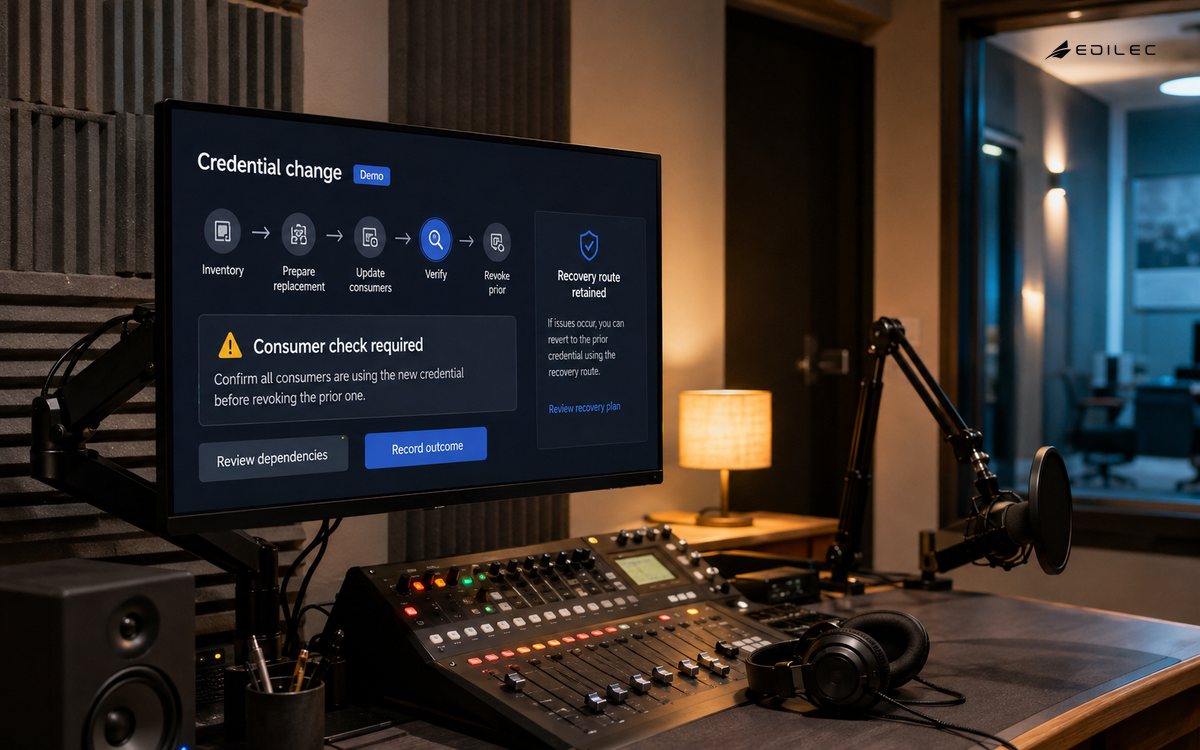
Design the sequence before the secret is widely used. For a credential that can overlap, create a new version, distribute it through the approved path, confirm every consumer, then revoke the old version. For a credential that cannot overlap, use a maintenance plan, dependency coordination, and an explicit rollback decision. Avoid shared human credentials; they make attribution, revocation, and safe rotation much harder.
| Design decision | Question to answer | Evidence |
|---|---|---|
| Secret type | Rotation approach | Primary risk |
| Database credential | Dual credential cutover | An untracked job fails after revocation |
| API key | New key, consumer migration, old key revoke | Key copied into unmanaged configuration |
| Signing key | Planned key set and verification overlap | Consumers cannot validate new signatures |
Design rotation before issuing credentials — plain-language secrets rotation
Prefer short-lived, scoped workload identities when the platform supports them. They do not remove lifecycle work, but they limit the value of a copied credential and reduce the number of long-lived strings humans must handle. NIST SP 800-57 treats generation, storage, distribution, use, and destruction as lifecycle concerns for keying material; the same discipline helps with operational secrets.
- Avoid: Rotating a credential without knowing every application, job, and vendor that uses it.
- Test for: Keeping a long overlap period that defeats the point of revocation.
- Do not accept: Logging tokens or placing them in tickets, chat, shell history, or source control.
Use short-lived and scoped credentials where possible — plain-language secrets rotation
The practical standard for credential lifecycle management is not a perfect diagram or a successful demonstration. It is whether the control still makes the intended decision when data is incomplete, a dependency is slow, an operator is rushed, or an attacker chooses the least protected path in the plain-language secrets rotation context. Use focused tests for denial, stale state, unusual volume, and recovery. Keep the result with the change record so later reviewers can see what was expected and what was actually verified for this plain-language secrets rotation context.
| Operating signal | What it may reveal | First investigation |
|---|---|---|
| Event | Evidence to collect | Action |
| Scheduled rotation | Consumer confirmation and old-version revocation | Close only after monitoring period |
| Suspected leak | Use by time, actor, and network | Replace and investigate immediately |
| Secret-store outage | Break-glass use and service impact | Use tested recovery procedure |
Rehearse compromise and recovery — plain-language secrets rotation
Practice a compromise response. Know how to identify consumers, issue a replacement, revoke the old secret, search for exposure, review use, and validate service health. Do not put the only emergency credential in the same unavailable system needed to retrieve it. Break-glass access should be tightly controlled, time-bounded, logged, and exercised. A rotation that succeeds only in a calm maintenance window is not sufficient for an incident.
Use a short review cadence for the parts of credential lifecycle management that can cause material harm: privileged access, exception paths, high-value data, and emergency changes. The NIST Cybersecurity Framework 2.0 is helpful for plain-language secrets rotation as an organizing model because it links governance, protection, detection, response, and recovery. The goal is a control that a named owner can explain, test, and improve rather than a setting no one revisits in the plain-language secrets rotation context.
Implementation details that matter — plain-language secrets rotation
Rotation automation should be idempotent and observable. A job that retries after a network timeout must determine whether the new secret was created, distributed, or activated before issuing another one. Use version identifiers and state transitions that operators can inspect. Emit a narrow audit event for creation, consumer update, validation, revocation, and failure. That lets a responder distinguish a stalled rollout from a duplicate credential and reduces the temptation to bypass the process with a hand-edited configuration file.
Secret consumers need a safe refresh mechanism. Some applications can reload a credential without restart; others need a connection pool drain, rolling restart, or scheduled maintenance. Document the behavior for each class and test it at expected scale. A rotation policy that assumes instantaneous refresh may cause an outage, while one that allows indefinite old-secret use leaves exposure unresolved. Align the grace period with the consumer’s demonstrated update behavior and remove it when the final consumer has confirmed the new version.
Detection complements prevention. Scan code, build artifacts, tickets, logs, and public repositories for known secret patterns, but treat a detection as an incident until scope is known. Immediately assess whether the value is active, which permissions it grants, and whether it was copied beyond the first location. Revoke or replace when appropriate, then investigate why the approved storage path was bypassed. The objective is to reduce recurrence through usable tooling and clear ownership, not to make developers hide evidence of a mistake.
External vendors and integrations often set the practical rotation limit. Put credential expiry, notification, emergency contact, and replacement API behavior into the integration record. Ask whether the provider supports multiple active keys, scoped keys, automatic expiry, audit events, and customer-initiated revocation. Where a third party cannot support safe replacement, record the compensating control and review date. This gives founders an honest view of dependency risk instead of a policy that claims every secret rotates on schedule while critical partner credentials remain permanent.
Practical Takeaways
- Tie secrets rotation decisions to a bounded action and a named owner.
- Make enforcement happen in a trusted service or policy boundary, not in a browser or a document in the plain-language secrets rotation context.
- Treat exceptions, recovery, and observability as part of the design from the start in the plain-language secrets rotation context.
- Use representative negative tests and review evidence after changes, not only before launch in the plain-language secrets rotation context.
Secrets rotation FAQ
Is secrets rotation a one-time implementation? No. The initial design establishes a baseline, but systems, identities, dependencies, and risks change in the plain-language secrets rotation context. Review it whenever a high-impact workflow changes and use incidents or recurring exceptions as evidence that the operating model needs adjustment for this plain-language secrets rotation context.
What should be measured first for secrets rotation? Start with the decision it protects, then measure successful and denied actions, exception volume, corrective work, and the time required to establish what happened in the plain-language secrets rotation context. Those signals reveal whether secrets rotation is supporting the intended workflow or simply moving risk to a less visible path.
How should a small team start with secrets rotation? Choose one high-consequence workflow, map its current inputs and failure states, assign an owner, add the smallest dependable control, and test both normal and adverse cases in the plain-language secrets rotation context. That bounded work creates evidence for the next secrets rotation decision without claiming the entire estate can be redesigned at once.
Secrets rotation policy should be based on exposure and capability, not a single calendar interval. A narrowly scoped credential with automatic expiry and no human visibility may require a different approach from a broad vendor API key, a certificate private key, or a disaster-recovery credential. Set the interval, monitoring, and test cadence from the blast radius and evidence of consumer behavior. Keep a record of rotation failures and time-to-revoke because these reveal dependencies that policy alone cannot fix. When a team requests an exception, require a concrete migration plan, a compensating control, and a date for review. This makes exceptions visible engineering work instead of permanent operational debt.
Make ownership visible at handoff time. When a service changes teams or a vendor contract changes, transfer its secret inventory and rotation responsibility explicitly. This is a simple control with large benefits: abandoned credentials often persist because no one realizes a still-running job, integration, or recovery procedure belongs to them.
For every rotation run, retain a concise completion record: previous version retired, replacement consumers verified, monitoring window observed, and owner sign-off. This makes a later incident investigation far faster and demonstrates that the procedure changed access rather than merely creating another active credential.
Conclusion
Secrets rotation is dependable when it maps to real work, uses authoritative inputs, makes a defensible decision at the point of action, and leaves an evidence trail for review. Start with one bounded workflow, make the recovery path real, and expand only after the team can explain what the control prevented, what it allowed, and who owns the next decision in the plain-language secrets rotation context.
Make the credential lifecycle visible — plain-language secrets rotation
In plain language, secrets rotation is the planned replacement of a credential before its value or exposure becomes unacceptable. The important questions are which applications use it, what it can do, and how an operator proves the replacement is active.
Prefer reversible cutovers — plain-language secrets rotation
Prefer a cutover that can be observed and reversed within a defined window. Short-lived or narrowly scoped credentials reduce the blast radius, but they still require consumer discovery, deployment coordination, and a clear response when a new value is rejected.
Treat compromise recovery as a normal path — plain-language secrets rotation
Exercise compromise recovery separately from routine expiry. The team should know how to identify affected consumers, revoke access, preserve incident evidence, and restore service without copying a secret into an uncontrolled channel.
Questions for the plain-language secrets rotation review — plain-language secrets rotation
What does the credential lifecycle reveal? — plain-language secrets rotation
Retain the inputs, decision, owner, outcome, and recovery record that matter for plain-language secrets rotation. Make the record useful to the next operator, not just to the person who designed the control in the plain-language secrets rotation context.
How can replacement stay reversible? — plain-language secrets rotation
Choose one outcome measure for plain-language secrets rotation and pair it with failure, exception, and recovery measures. Review segments that expose a blocked role, dependency, or workload.
When should recovery practice change? — plain-language secrets rotation
For credential recovery, change the practice when compromise rehearsal reveals an unsafe channel or unclear owner; update the runbook and exercise it again.
Conclusion: operate plain-language secrets rotation with evidence
Reliable plain-language secrets rotation is a maintained operating practice. Keep the boundary explicit, make the difficult path recoverable, and give every material exception an owner and a review date in the plain-language secrets rotation context.
For adjacent Edilec guidance on plain-language secrets rotation, compare API rate limiting engineering notes, the zero-trust operations checklist, and the production secrets-rotation guide. This comparison is selected for The Plain-language Guide to Secrets Rotation.
Source context: OWASP Secrets Management Cheat Sheet; NIST SP 800-57 Part 1: Recommendation for Key Management; OWASP Key Management Cheat Sheet; OWASP Logging Cheat Sheet; Understanding Autorotation in Azure Key Vault.