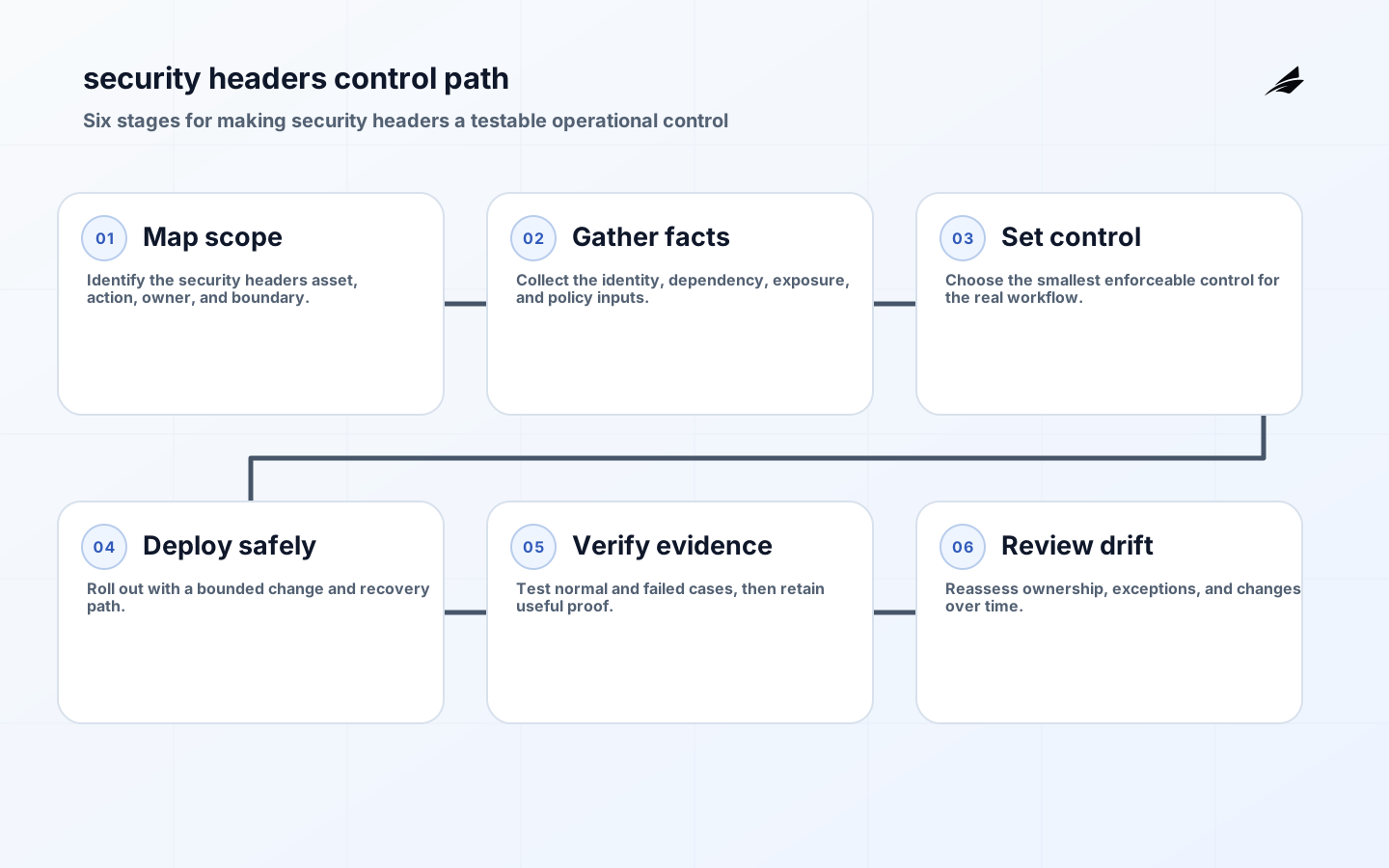
Security headers tell the browser which behaviors a web application expects and which it refuses to permit. They can reduce exposure to cross-site scripting, clickjacking, content-type confusion, insecure transport, and unintended data disclosure, but they are not a universal security switch. The right header set follows the application's actual browser boundary: which origins serve scripts and media, whether the site may be embedded, whether cookies are used, which APIs receive requests, and whether legacy pages require an incremental migration. Start with an inventory rather than copying a one-line configuration from another site.
Inventory browser boundaries before setting security headers
Content Security Policy is the most design-intensive header because it constrains where executable and display content may come from. Begin with a report-only policy, observe violations, and remove unsafe inline scripts or broad host allowances rather than normalizing them. Prefer nonces or hashes for legitimate inline code when a rewrite is not immediately possible. Define script, style, image, connect, frame, form, and base directives according to the application. A policy that allows every source is largely a reporting decoration; a policy that blocks core flows without a rollout plan creates pressure to disable it.

| Decision point | Practical choice | Evidence to retain |
|---|---|---|
| Header or directive | Primary purpose | Rollout check |
| Content-Security-Policy | Constrain allowed browser content and connections. | Observe report-only violations before enforcement. |
| Strict-Transport-Security | Require future HTTPS use in supporting browsers. | Confirm HTTPS readiness for the configured domain scope. |
| X-Content-Type-Options | Prevent MIME-type guessing. | Check static and error responses. |
| frame-ancestors | Control which origins may embed the page. | Test approved and unapproved embedding contexts. |
Design security headers controls that can be enforced
Use HTTPS everywhere and apply Strict-Transport-Security only after confirming that the domain and required subdomains are ready for persistent HTTPS use. HSTS tells browsers to prefer secure transport on later visits; it does not fix an insecure first connection by itself. Configure secure cookie attributes and avoid mixing HTTP and HTTPS origins. Set X-Content-Type-Options: nosniff to reduce MIME guessing, and use frame-ancestors in CSP to control embedding. Modern controls should be chosen from current browser behavior, not a legacy header checklist.
- Model script, connection, frame, form, and media origins before configuring CSP.
- Use report-only CSP to learn, then remove unsafe dependencies.
- Enable HSTS only after HTTPS readiness is verified for the intended scope.
- Set headers at the delivered response path, including errors and redirects.
- Review third-party sources as ongoing trust decisions.
Operate security headers as a controlled change
Security headers complement session security and server-side authorization; they do not replace either. A strong CSP cannot make an authorization flaw safe, and an HttpOnly cookie cannot prevent a malicious site from making every kind of cross-site request. Treat headers as browser controls in a layered design. Keep the configuration close to the deployment boundary, version it, and test it across the CDN, reverse proxy, application, and error responses so one path does not silently omit protections.
Work through a security headers example
A useful rollout starts with a customer portal. Capture all script, API, font, image, and frame sources in a report-only CSP; classify each violation as expected, unsafe, or obsolete; then fix the application or narrowly allow the justified source. Test login, account changes, payment flows, file upload, and browser back-button behavior with the enforced policy. Include error pages and redirected endpoints, which frequently have different headers from the main application. Move to enforcement only when the expected user paths are covered.
Test and verify security headers
Test headers with real response inspection, not an application framework setting alone. Verify every status class and host, check whether a caching layer changes values, and use browser developer tools to observe CSP behavior. Attempt to embed a protected page from an unapproved origin, submit a form to an unexpected destination, load a deliberately disallowed script in a test environment, and request an HTTP URL after HSTS is established. The desired result is a clear browser block and a server-side record where reporting is configured.
| Test or review | Expected behavior | Escalate when |
|---|---|---|
| Test | Expected browser behavior | Failure signal |
| Disallowed script | Browser refuses execution under enforced CSP. | A broad policy permits arbitrary source loading. |
| Unapproved frame | The target page refuses embedding. | A login or admin page can be framed by another site. |
| Error response | Baseline headers remain present. | A proxy-generated error bypasses policy. |
| New third party | Violation is visible before a broad allowance. | A vendor is added without review. |
Measure and govern security headers
Measure policy coverage, report-only violations, missing-header responses, disallowed-source trends, and exceptions by application. Treat a sudden rise in violations as a release or dependency signal to investigate, not as noise to suppress. Review third-party script dependencies because each one expands the browser trust boundary. A small, maintained allowlist is safer than an inventory of vendors nobody remembers approving.
Govern the headers through shared platform defaults plus application-specific review. Platform teams can provide secure transport, baseline content-type protection, and safe embedding defaults; product teams must own the content sources and workflow consequences. Document the reason for any unsafe CSP allowance and give it an expiry or remediation plan. This makes a restrictive policy sustainable rather than a temporary hardening exercise.
A further operational consideration for security headers is that CORS and CSP solve different browser problems, so allowed cross-origin reads, credential use, preflight behavior, and cache variation need their own review. Give this boundary a named owner and a regular review point. The useful evidence is not a generic attestation; it is a record that identifies the system, decision, and observed result. When the expected control does not hold, the response should be visible and bounded so people do not improvise an unreviewed workaround. This detail is often where a policy becomes an operating practice.
Reliable security headers depends on recognizing that third-party scripts execute within the page's trust boundary and therefore need an owner, business purpose, dependency review, and retirement path. Put the rule near the system that can enforce it and make the supporting workflow accessible to legitimate users. Document the inputs, authority, failure response, and recovery owner before relying on automation. That level of specificity helps teams distinguish a true requirement from a historical convenience, and it leaves a reviewer with enough context to assess whether the control still fits the current service.
In a mature security headers program, CDNs, ingresses, applications, and error handlers can each alter headers, so deployment checks should inspect representative public responses across those layers. Test the condition through the same path used in production, including an expected failure and a recovery step. Capture concise evidence, then review it when a dependency, team, or threat assumption changes. This keeps the design connected to actual behavior instead of allowing a diagram or written rule to stand in for a control that nobody has recently exercised.
The governance implication for security headers is that CSP reports can contain sensitive context and should be access-controlled, normalized, and routed to the page owner for a specific corrective action. Establish an owner who can make the necessary tradeoff, a time limit for exceptions, and an escalation path for material risk. A short, well-maintained decision record is more useful than a broad policy document because it tells operators what to do when the normal path cannot be followed and how the organization will return to it.
Header policies should be reviewed whenever a page changes its rendering model. A move to a new analytics provider, rich text editor, payment component, or embedded support tool can alter script, frame, form, and connection behavior. Making this review part of change planning prevents emergency broad allowlists and gives developers a clear route to integrate new content safely.
Legacy headers and browser quirks should be retired deliberately. Keep current controls focused on supported browser behavior and documented application risks, rather than preserving a long list of settings with unknown purpose. A smaller policy that is tested and owned is easier to maintain. When compatibility requires an exception, capture the affected client population and a date to reassess it.
Header hardening benefits from a clear ownership boundary between platform and application teams. The platform can ensure that secure transport and baseline protections reach every response, while application owners confirm that content, frames, forms, and third-party connections reflect intended behavior. Joint response tests make this division concrete. When a violation occurs, the responsible team can investigate the source quickly instead of debating whether the proxy, framework, or page is supposed to set the policy.
Key takeaways
- Model script, connection, frame, form, and media origins before configuring CSP.
- Use report-only CSP to learn, then remove unsafe dependencies.
- Enable HSTS only after HTTPS readiness is verified for the intended scope.
- Set headers at the delivered response path, including errors and redirects.
- Review third-party sources as ongoing trust decisions.
Frequently asked questions
Should every site use the exact same CSP? No. A policy must fit the site's actual content and integrations. A shared baseline is useful, but application sources and workflows require review.
Do security headers replace secure coding? No. They add browser-side constraints and defense in depth. Server-side validation, authorization, and secure session handling remain essential.
Conclusion
In conclusion, security headers are effective when they encode a web application's real trust boundaries. Inventory those boundaries, roll CSP out with observation and repair, apply transport and embedding controls carefully, and verify every delivered response. The browser then becomes a useful enforcement partner instead of a source of configuration surprises.