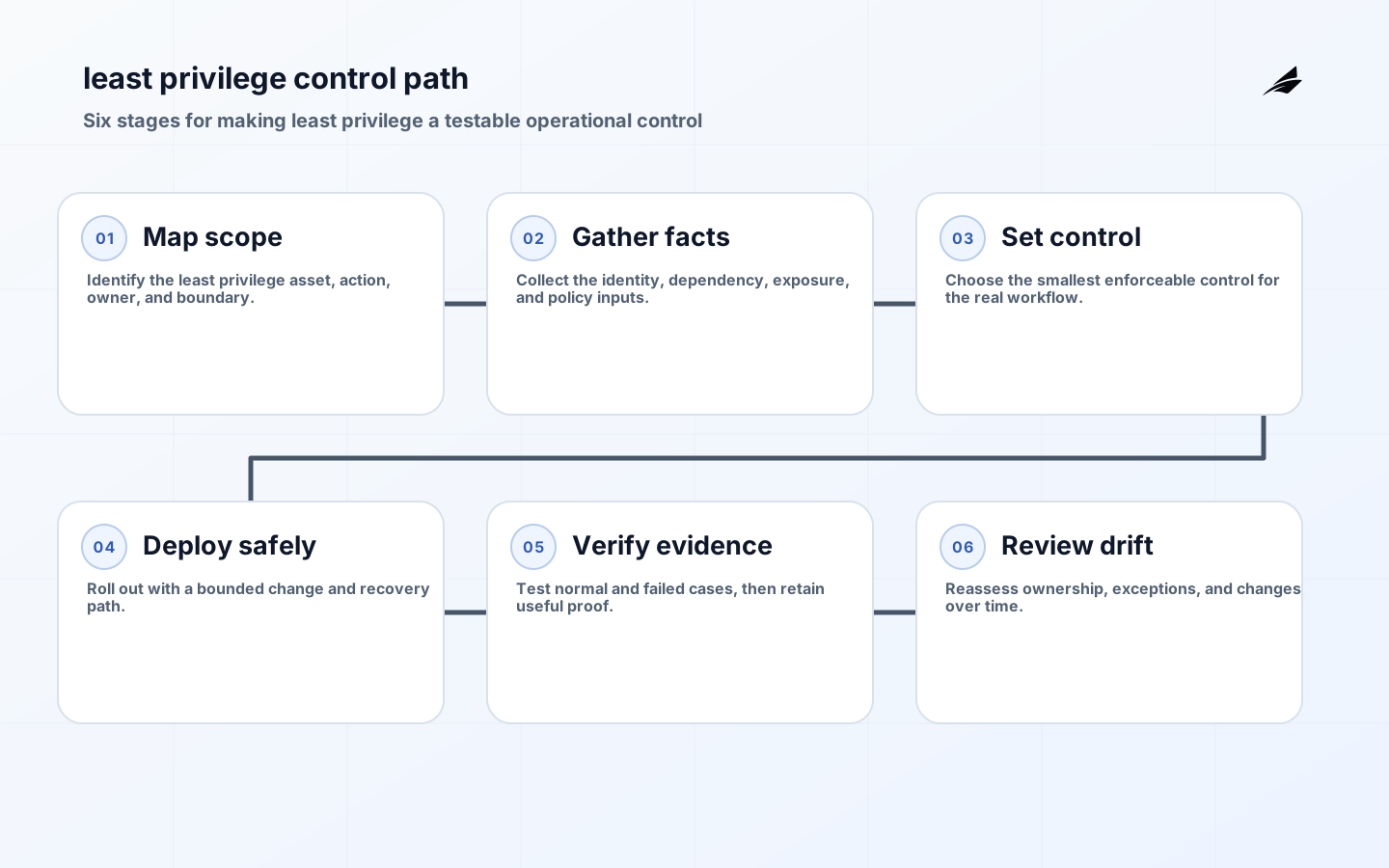
Least privilege is not a promise that every permission will be tiny. It is a disciplined answer to a specific question: what authority does this person, service, or automated job need to complete a legitimate task now, and what should stop being available afterward? Broad access feels efficient until a compromised account, accidental command, or unclear handoff turns it into a large blast radius. Start with protected resources and routine work, not role names. Map the actions that create, read, change, export, approve, administer, or delete each resource, then determine which actors truly perform them.
Start least privilege with real work and protected resources
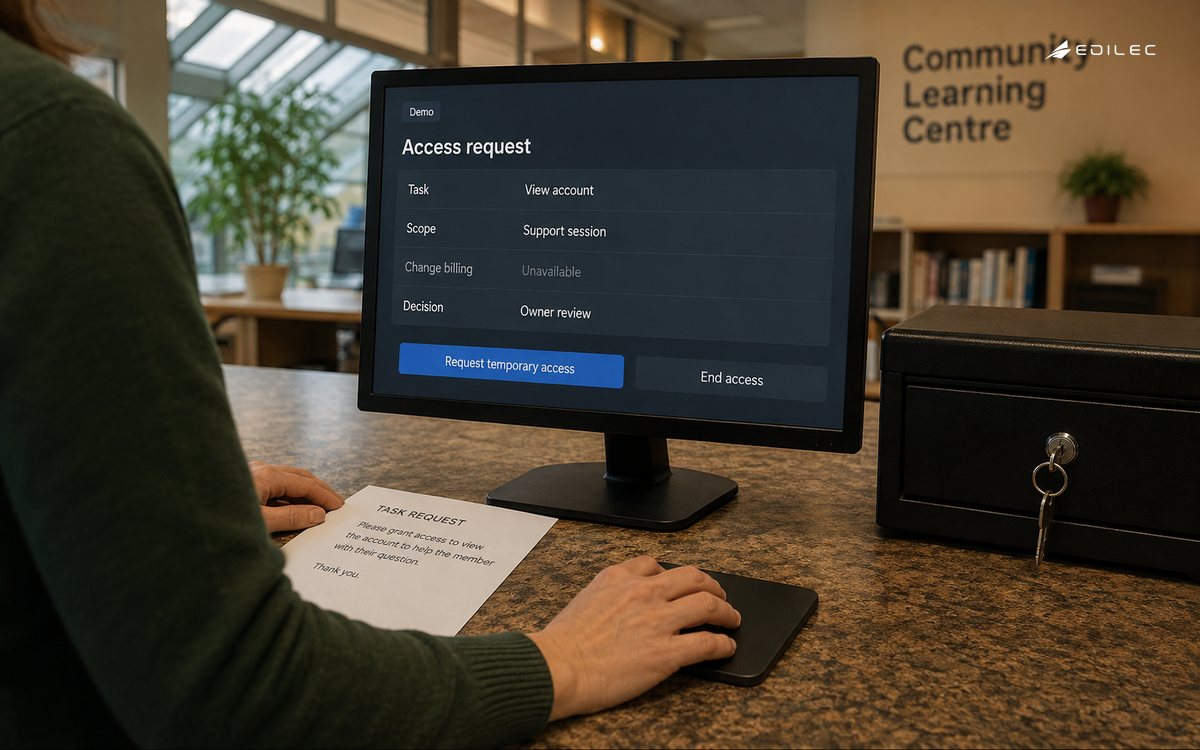
Build permissions from capabilities rather than job-title folklore. A support specialist may need to view a customer account but not modify billing; a deployment service may deploy one environment but not change organization-wide identity policy. Distinguish human and workload identities, production and non-production resources, and read, write, administer, and delegate authority. The model should be comprehensible enough that an owner can explain a grant during review. When it is not, hide complexity behind a smaller number of tested policy primitives rather than granting a catch-all role.
| Decision point | Practical choice | Evidence to retain |
|---|---|---|
| Identity | Needed capability | Avoid |
| Support specialist | View assigned customer case data. | Tenant-wide export or billing administration. |
| Deployment workload | Deploy an approved artifact to one environment. | Human console or organization identity administration. |
| Security responder | Time-bound investigation access. | Permanent ownership of production resources. |
| Database service | Connect to its own schema with defined operations. | Shared superuser credentials. |
Design least privilege controls that can be enforced
Default-deny is the foundation. New identities should receive no access until a system owner or governed workflow assigns a justified capability. Use groups or policy attributes for repeatable workforce access and avoid direct grants that accumulate invisibly. For exceptional work, time-bound just-in-time elevation is usually clearer than a permanent powerful role. It creates a natural place for reason, approval, expiry, and later review. The same principle applies to service accounts: scope credentials to a workload and resource rather than sharing a broad integration identity.
- Describe permissions as actions on named resource classes.
- Separate human, workload, production, and non-production authority.
- Prefer governed groups or policies over accumulating direct grants.
- Make elevated access time-limited and attributable.
- Review unused, orphaned, and high-impact access on a stated cadence.
Operate least privilege as a controlled change
Access reviews are where the model meets reality. Give reviewers a focused decision: who has which capability, against what resource class, through which entitlement, and what recent use or business reason supports it? A giant export of raw permissions is not a review interface. Escalate orphaned grants, inactive accounts, nested group paths, and permissions with no accountable resource owner. Revocation should be a normal and tested workflow, not a disruptive event that teams avoid because it may break an unknown dependency.
Work through a least privilege example
Consider a build pipeline that deploys to production. It may need read access to the exact artifact, permission to assume a narrowly scoped deployment role, and the ability to write deployment status. It does not need human console access, user-management authority, or broad database reads. Test the pipeline with the intended role, then deny an unrelated operation deliberately. This makes the boundary visible before a security incident discovers that the deployment identity could do far more than release software.
Test and verify least privilege
Least privilege also reduces the impact of vulnerability management gaps. A vulnerable component running with limited authority gives an attacker fewer useful options than the same component running as an administrator. That does not make patching optional; it makes the system more resilient while remediation is underway. Record denials and privilege changes so teams can distinguish a genuine need from a broken implementation or a user accustomed to overbroad access.
| Test or review | Expected behavior | Escalate when |
|---|---|---|
| Review signal | Interpretation | Action |
| Unused powerful grant | Authority may be stale or hidden behind automation. | Confirm dependency or remove with a recovery owner. |
| Direct assignment | The grant may bypass the normal model. | Migrate to a governed entitlement or justify it. |
| Overdue elevation | Temporary access has become standing access. | Expire and require a new decision. |
| Denied required action | Policy may be too narrow or the workflow undocumented. | Investigate the task before widening authority. |
Measure and govern least privilege
Measure standing privilege, age of elevated grants, overdue reviews, number of direct assignments, unused entitlements, and time to disable access after a role change. Analyze these by high-value resource, not only as an enterprise total. A falling permission count can conceal risk if ownership is unclear or critical services still hold unrestricted credentials. Pair the numbers with a sample of real access decisions and a recovery test for a wrongly removed entitlement.
Govern the program with resource owners who can approve access and attest to its necessity. Define an emergency route for outages, but bind it to an identity, expiry, and retrospective review. When organizational structure or service architecture changes, revisit the access model instead of copying old groups into a new system. Least privilege succeeds when it becomes how teams ship and support work, not an annual cleanup campaign.
A further operational consideration for least privilege is that each high-value role needs allowed, denied, and manipulated-resource integration tests because a generally valid role can still be unsafe against the wrong target. Give this boundary a named owner and a regular review point. The useful evidence is not a generic attestation; it is a record that identifies the system, decision, and observed result. When the expected control does not hold, the response should be visible and bounded so people do not improvise an unreviewed workaround. This detail is often where a policy becomes an operating practice.
Reliable least privilege depends on recognizing that entitlements should describe responsibility and resource scope rather than a transient reporting line or one person's memory, with a named owner and review cadence. Put the rule near the system that can enforce it and make the supporting workflow accessible to legitimate users. Document the inputs, authority, failure response, and recovery owner before relying on automation. That level of specificity helps teams distinguish a true requirement from a historical convenience, and it leaves a reviewer with enough context to assess whether the control still fits the current service.
In a mature least privilege program, access requests need the capability, resource, duration, reason, and approver so a vague request for administration does not create an unintelligible broad grant. Test the condition through the same path used in production, including an expected failure and a recovery step. Capture concise evidence, then review it when a dependency, team, or threat assumption changes. This keeps the design connected to actual behavior instead of allowing a diagram or written rule to stand in for a control that nobody has recently exercised.
The governance implication for least privilege is that legacy privilege reduction needs a narrow, expiring recovery route so a single outage cannot be used to restore permanent superuser access. Establish an owner who can make the necessary tradeoff, a time limit for exceptions, and an escalation path for material risk. A short, well-maintained decision record is more useful than a broad policy document because it tells operators what to do when the normal path cannot be followed and how the organization will return to it.
Workload identity review is as important as workforce access review. Service-to-service permissions often outlive a feature because they are hidden in infrastructure configuration and rarely appear in human offboarding workflows. Inventory the calling workload, target resource, token or role, and observed use. Remove or narrow identities that no longer correspond to a running business function.
Permission documentation should show the intended denial path as well as the allowed path. When a user legitimately needs an action they do not have, the system should offer an accountable request or escalation route. That preserves productivity while keeping the access boundary visible. Without it, teams often solve a local problem by sharing credentials or adding an overly broad standing role.
Least privilege improves when permissions are treated as a product surface with owners, tests, and change history. A new service capability should identify the resource boundary and expected actors before a generic administrator permission is reused. This creates a natural design review that catches overbroad access while the feature is still small. It also makes later cleanup cheaper, because entitlement names and decisions explain their purpose instead of requiring archaeology through old tickets.
Review outcomes should improve the model. When a request repeatedly needs the same narrow capability, create a governed entitlement rather than approving a series of one-off grants. When an entitlement is never justified, remove it. This feedback keeps the authorization system aligned with how work is actually performed.
Key takeaways
- Describe permissions as actions on named resource classes.
- Separate human, workload, production, and non-production authority.
- Prefer governed groups or policies over accumulating direct grants.
- Make elevated access time-limited and attributable.
- Review unused, orphaned, and high-impact access on a stated cadence.
Frequently asked questions
Does least privilege slow down incident response? It can speed response when emergency access is predesigned, attributable, time-bound, and followed by review instead of being improvised under pressure.
Is read-only access always low risk? No. Read access to customer, financial, or security data can be highly sensitive. Assess the resource, scope, and export paths.
Conclusion
In conclusion, least privilege makes authority deliberate, bounded, and reviewable. Begin with real tasks and resources, default to no access, use temporary elevation for exceptions, and make removal ordinary. The resulting design limits blast radius while giving legitimate work a clear, supportable path.