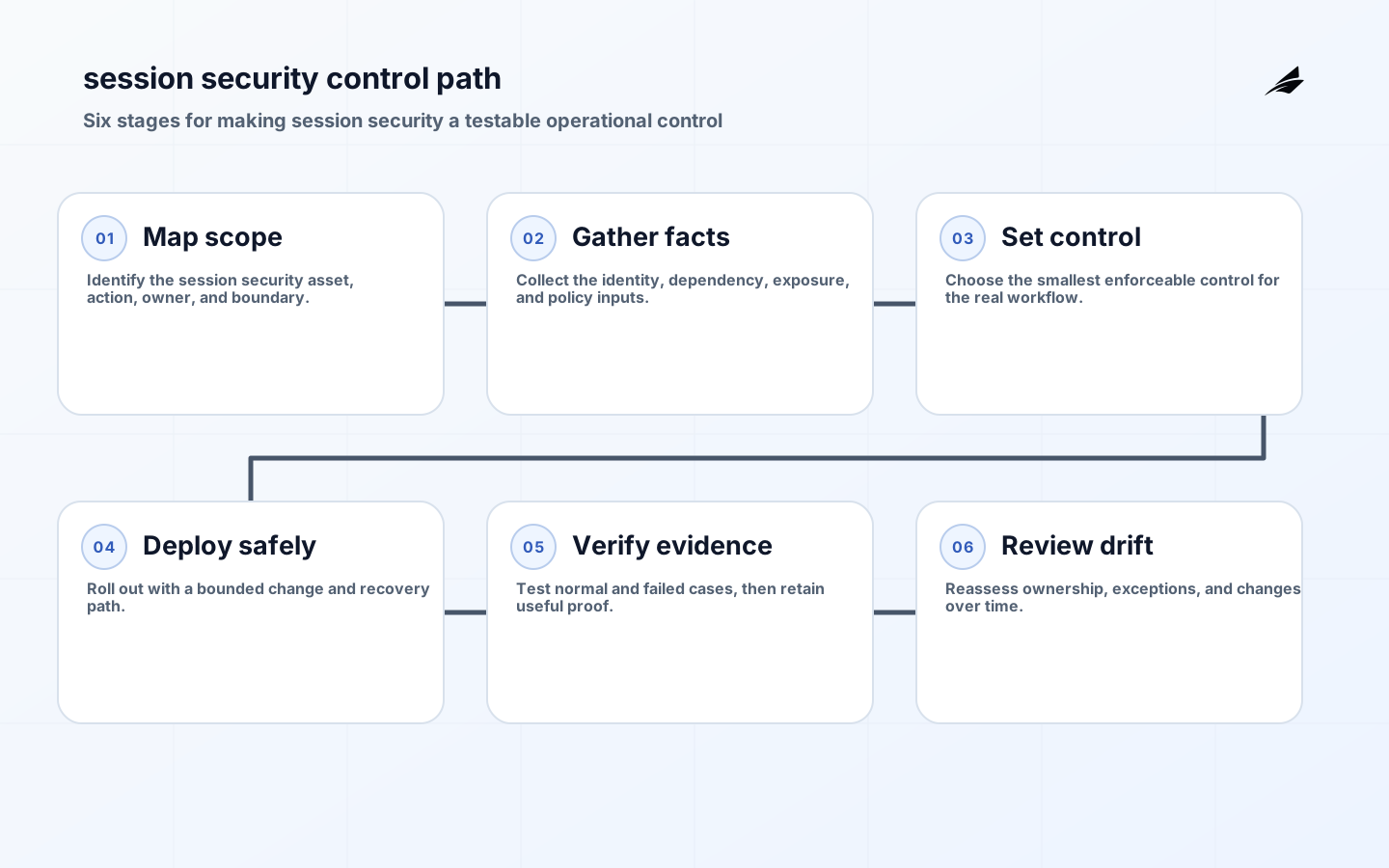
Session security begins after a user has proved identity. The application still has to decide how it recognizes that user on later requests, how long the authority lasts, what changes require a fresh check, and how the session stops being useful. A session identifier is a bearer capability: anyone who obtains it may be treated as the user until the server rejects it. Treat the session boundary as a first-class security design, especially where actions affect money, personal data, access control, or administration. Authentication strength at login cannot compensate for a session that is easy to steal, fixate, or keep alive indefinitely.
Model the session boundary after authentication
Use a session identifier with sufficient unpredictability and transmit it only over protected channels. For browser sessions, set Secure, HttpOnly, and an appropriate SameSite attribute on cookies; scope Domain and Path narrowly. Do not put a long-lived browser session token in URLs, page content, or persistent client-side storage merely for convenience. Keep server-side session state or a reliable revocation mechanism when the risk requires fast invalidation. The client should hold a reference to authority, not a bundle of excessive trust that the server cannot control.
| Decision point | Practical choice | Evidence to retain |
|---|---|---|
| Lifecycle point | Control | Purpose |
| Before login | Keep pre-authentication state separate. | A supplied identifier cannot be fixed into the account. |
| After login | Regenerate the session identifier. | The authenticated session has new authority. |
| Sensitive action | Require step-up verification when warranted. | A stolen routine session is insufficient. |
| Logout or reset | Revoke server-side state or session family. | Previously issued references stop working. |
Design session security controls that can be enforced
Regenerate the session identifier after login, privilege elevation, password reset, or another material authentication event. This mitigates session fixation and avoids carrying pre-authentication state into a stronger session. Set both idle and absolute expiration based on the workflow. An idle timeout reduces exposure on an unattended device; an absolute timeout limits a session that is periodically active. Reauthentication or step-up verification should protect a sensitive action even when a routine session remains valid. This is especially important for secure admin panels.
- Use high-entropy session identifiers and protect their transport.
- Regenerate identifiers when authentication strength or privilege changes.
- Set server-enforced idle and absolute expiry rules.
- Require fresh authentication for high-impact actions.
- Test revocation across every client and downstream endpoint.
Operate session security as a controlled change
Bind session behavior to meaningful signals carefully. Device or network context can inform risk decisions, but brittle fingerprinting can lock out legitimate users and is not a substitute for server-side authorization. Detect impossible changes, unusual concurrent use, or a newly enrolled authenticator, then choose a proportionate response such as reauthentication, notification, or revocation. The exact control should reflect the harm of a false accept and the harm of a false reject. Document what will trigger session termination so support and users understand the recovery path.
Work through a session security example
Test the lifecycle with a real browser and an API client where both exist. Sign in, copy a pre-login identifier, complete login, and verify that it is no longer accepted. Change a password or revoke a session and confirm that active requests receive the designed response. Check behavior across tabs, device sign-out, idle expiration, network reconnection, and a token refresh race. The common production defect is not a missing cookie flag; it is an adjacent endpoint that accepts an old credential or fails to participate in revocation.
Test and verify session security
Defend the routes that consume the session. For cookie-authenticated state changes, protect against cross-site request forgery using the framework's established mechanism and verify Origin or Referer as an additional signal where suitable. Use a content security policy and output encoding to reduce the chance that cross-site scripting can act within an authenticated browser context. Never rely on a client-side timer or hidden user-interface state to end authority; the server must validate expiration and authorization on every protected operation.
| Test or review | Expected behavior | Escalate when |
|---|---|---|
| Case | Expected result | Failure to investigate |
| Identifier fixation | Pre-login identifier is rejected after sign-in. | The same identifier becomes authenticated. |
| Password change | Existing sessions follow the stated revocation policy. | Old sessions retain sensitive authority. |
| CSRF attempt | State-changing request lacks valid site context or token. | Browser automatically performs a protected action. |
| Idle expiry | Server rejects use after the timeout. | A client-side countdown is the only control. |
Measure and govern session security
Monitor session security without recording session identifiers. Track issuance, rotation, failed validation, revocation, reauthentication, and suspicious concurrency using privacy-conscious identifiers. Investigations need an actor, session family or opaque reference, event time, action, and result. Correlate these records with authentication and authorization evidence so a responder can see whether a session was created normally and what it accessed afterward.
Govern the policy by classifying workflows. A low-risk read-only dashboard may have different idle and absolute limits than an account-recovery or payout workflow. Publish the decision and revisit it after a new client type, identity provider, or device-management model changes the threat surface. Exceptions should be explicit, time-limited, and tested, because a permanent 'remember me' setting often becomes a long-lived unreviewed credential.
A further operational consideration for session security is that browser and native clients require consistent issuance, expiry, revocation, and reauthentication semantics even though their secure storage mechanisms differ. Give this boundary a named owner and a regular review point. The useful evidence is not a generic attestation; it is a record that identifies the system, decision, and observed result. When the expected control does not hold, the response should be visible and bounded so people do not improvise an unreviewed workaround. This detail is often where a policy becomes an operating practice.
Reliable session security depends on recognizing that concurrent session rules should be deliberate, with session-family revocation and tested races for refresh, sign-out, password change, and device removal. Put the rule near the system that can enforce it and make the supporting workflow accessible to legitimate users. Document the inputs, authority, failure response, and recovery owner before relying on automation. That level of specificity helps teams distinguish a true requirement from a historical convenience, and it leaves a reviewer with enough context to assess whether the control still fits the current service.
In a mature session security program, engineering telemetry, support captures, proxy logs, and crash reports must redact session identifiers so diagnostic systems do not become bearer-token stores. Test the condition through the same path used in production, including an expected failure and a recovery step. Capture concise evidence, then review it when a dependency, team, or threat assumption changes. This keeps the design connected to actual behavior instead of allowing a diagram or written rule to stand in for a control that nobody has recently exercised.
The governance implication for session security is that federated logout behavior needs an explicit user experience because local and identity-provider sessions do not necessarily end together. Establish an owner who can make the necessary tradeoff, a time limit for exceptions, and an escalation path for material risk. A short, well-maintained decision record is more useful than a broad policy document because it tells operators what to do when the normal path cannot be followed and how the organization will return to it.
Cookie and token configuration should be verified in the deployed environment after every material identity or infrastructure change. Framework defaults, proxy behavior, and cross-domain routing can alter what the browser receives. A simple automated response check plus an authenticated browser test catches many regressions before users do. Include non-success responses, which are often served by a different component.
Account recovery deserves a session decision of its own. After a recovery action, decide which existing sessions survive, which credentials rotate, what the customer is told, and how a legitimate but interrupted device regains access. These choices should be consistent with the harm the recovery process is meant to address, rather than inherited accidentally from a generic logout implementation.
Session policy should be understandable in product terms as well as protocol terms. Users and support teams need to know what a password reset, sign-out-all-devices action, recovery event, or inactivity timeout actually changes. Clear behavior reduces unsafe support exceptions and makes suspicious-session reports easier to investigate. Technical implementation still belongs at the server boundary, but consistent user communication is part of the control because it shapes how people respond when authority appears to persist unexpectedly.
Finally, test the support workflow for session complaints. Staff should be able to identify the session event, follow the documented revocation path, and explain the expected recovery without requesting a reusable credential or disabling a protective rule. This closes the gap between protocol design and the human process that maintains it.
Key takeaways
- Use high-entropy session identifiers and protect their transport.
- Regenerate identifiers when authentication strength or privilege changes.
- Set server-enforced idle and absolute expiry rules.
- Require fresh authentication for high-impact actions.
- Test revocation across every client and downstream endpoint.
Frequently asked questions
Are JWTs automatically safer than server sessions? No. Both designs need secure issuance, validation, expiry, and revocation planning. The deciding question is whether the system can limit and withdraw authority when needed.
Should every user reauthenticate frequently? Use fresh authentication where action risk justifies it. Arbitrary prompts can train users to ignore security signals and harm the workflow.
Conclusion
In conclusion, session security is lifecycle management for a bearer capability. Issue it safely, regenerate it at trust transitions, limit its lifetime, protect the requests that use it, and revoke it in a way the server can enforce. That discipline keeps a successful login from becoming open-ended authority.