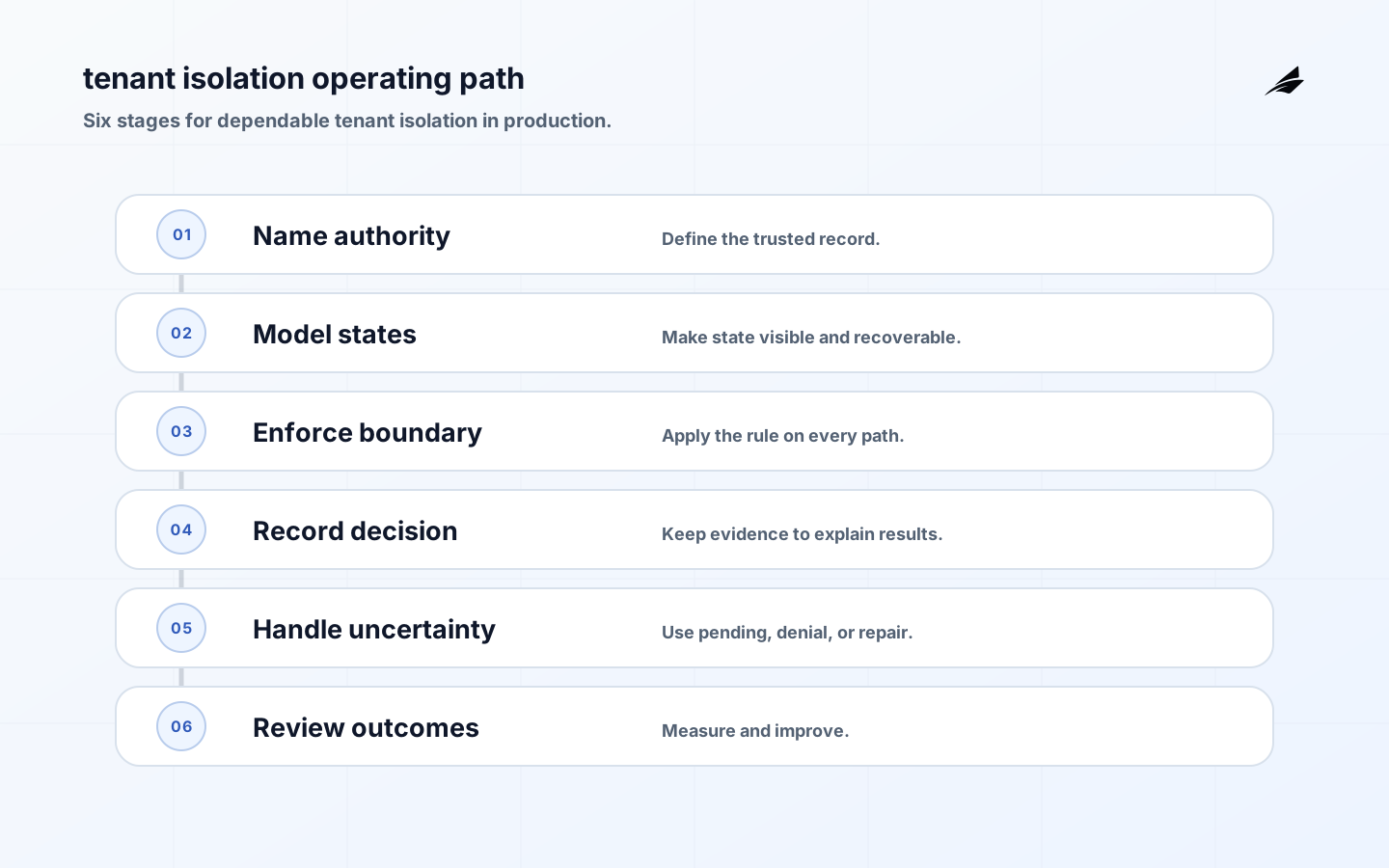
Tenant isolation changes meaning when a service moves from a small test population to customers with valuable and sometimes regulated data. A tenant identifier must remain correct through requests, database queries, caches, files, search indexes, queues, exports, analytics, and support access. Production assurance is therefore broader than choosing a partitioning pattern. It includes a trusted context, consistent enforcement, migration discipline, failure behavior, and a response plan for the possibility that a boundary was crossed.
Validate tenant isolation through a complete operating case
Use this production transition guide to validate tenant isolation with one complete operating case before widening the scope. Delivery teams should trace one customer journey from first intent through an authorized state change, durable value, support visibility, and a measurable product outcome. Begin with the customer job, tenant and user identity, entitlement, workflow state, support history, and release decision, cross each policy and dependency boundary, and finish in a durable state that a customer or operator can recognize. Record the expected state at every handoff, who may change it, and which evidence proves that the next step was justified. This walkthrough gives product, engineering, security, and support a shared acceptance case instead of allowing each team to assume that another layer owns the transition. Use representative roles, realistic timing, and the constraints that exist during an ordinary operating day.
The production transition guide should also test a second tenant isolation case that deliberately challenges the design. Include a missing entitlement, repeated action, delayed integration, incomplete onboarding step, or support intervention. The purpose is not to demonstrate that every dependency always succeeds; it is to prove that the service can stop safely, preserve useful evidence, and expose the next responsible action. Review completion state, time to value, exception reason, support action, release cohort, and recurring product use together so the team can distinguish a policy refusal from bad input, a software defect, a delayed dependency, or an operator decision. A useful result is specific enough for a support or incident owner to act without reconstructing the entire journey from unrelated logs and messages.
Turn both cases into release evidence for tenant isolation. Keep the input conditions, expected states, observed result, decision owner, and unresolved exceptions in one reviewable record. Define the recovery action in advance: return the tenant to a clear state, preserve the customer record, route the right support action, and confirm that normal work can resume. Re-run the same cases after a material policy, interface, data, model, infrastructure, or entitlement change so that improvements do not silently weaken an earlier control. For this production transition guide, readiness means that the normal path is usable, the failure path is understandable, and ownership remains visible after launch rather than ending when implementation work is declared complete.
- Choose one representative tenant isolation journey and state the customer or operator result in plain language.
- Capture the customer job, tenant and user identity, entitlement, workflow state, support history, and release decision as evidence, with a named owner for each consequential handoff.
- Exercise a missing entitlement, repeated action, delayed integration, incomplete onboarding step, or support intervention before broader exposure and verify that the safe state is visible.
- Review completion state, time to value, exception reason, support action, release cohort, and recurring product use after release and assign every unresolved exception to a person and date.
Test tenant isolation at every execution boundary
Tenant isolation must survive more than an ordinary browser request. Review identity, storage, asynchronous work, exports, and operator actions as one control system before the product serves broader customer data.
| Isolation boundary | Evidence to inspect | Acceptance decision |
|---|---|---|
| Identity and tenant context | Authenticated identity, selected tenant, role, session state, and server-side policy result. | Reject any request whose tenant authority cannot be established independently. |
| Data access | Query filters, object ownership, cache keys, search indexes, and generated file paths. | Prove that reads and writes cannot cross a tenant through omitted context. |
| Jobs and integrations | Queued payload, webhook destination, retry key, service credential, and correlation record. | Keep tenant context intact through delayed, repeated, and out-of-order execution. |
| Incident containment | Affected tenant scope, access revocation, evidence preservation, notification owner, and restoration test. | Contain the smallest defensible scope and verify isolation again before recovery. |
Key takeaways
- Resolve tenant context from trusted identity and request metadata, not a user-editable field.
- Choose an isolation model that matches data sensitivity, scale, and recovery needs.
- Enforce scope in repositories, jobs, caches, search, files, exports, and operator tools.
- Test empty, missing, conflicting, and stale tenant context as security failures.
- Make migrations and repairs prove which tenant each record belongs to.
- Keep evidence that supports detection, investigation, notification, and restoration.
Establish a trusted tenant context
Resolve tenant membership from authenticated identity, service-to-service credentials, and an explicit account relationship. Treat a tenant id supplied by the browser as a request for a context that still needs authorization. Carry the resolved context through the request and make it available to every data-access boundary. If identity and requested tenant disagree, fail closed and record the reason without revealing another tenant's existence. A worker should receive a signed or otherwise trusted scope, not infer tenant ownership from a payload that can be replayed or modified.
| Path | Required boundary | Failure to prevent |
|---|---|---|
| Request and API | Resolve and authorize tenant before data access. | Cross-tenant response. |
| Database | Apply scope in every query and mutation. | Unfiltered record access. |
| Cache and search | Partition keys and query filters by tenant. | Stale or mixed result. |
| Jobs and exports | Persist scope with the job and validate at execution. | Wrong-tenant processing or file. |
| Support tools | Require purpose, scope, and server-side recheck. | Unreviewable disclosure. |
Choose and document the isolation model
Shared tables with tenant keys, separate schemas, and separate databases each create different operational responsibilities. The important production question is not which model sounds strongest; it is whether the team can enforce, monitor, migrate, back up, restore, and delete data without losing the boundary. Document the owner of tenant assignment, the source of truth, the expected behavior when a key is missing, and the controls that prevent a record from changing tenants accidentally. The OWASP Authorization Cheat Sheet is a useful reference for explicit server-side authorization.
Enforce scope beyond the database
Database filtering cannot protect a file URL, a cache entry, or a search document that was indexed without tenant scope. Build tenant identity into cache keys, object paths, index fields, queue messages, analytics dimensions, and export jobs. Validate it again when data is read or work is executed, because a long-lived object can outlive the session that created it. Never use a global fallback for missing scope in a customer-facing path. If a maintenance operation must cross tenants, give it a separate authority, a bounded target set, and a reviewable record.
Follow tenant ownership through the data lifecycle
Isolation decisions need to survive more than a normal read request. Define how tenant ownership is assigned at creation, preserved during updates, represented in derived data, and removed during deletion. A file generated for one account should carry enough protected context for the download service to re-check its audience. A search index should be rebuilt with tenant scope rather than treated as an authoritative copy. Analytics may use aggregated information, but the aggregation boundary and access rules still need an owner.
Be especially careful with shared caches and reusable service objects. A cache hit must be safe even when two requests arrive close together or a process handles different accounts in sequence. Clear scope when a request ends, and make tests fail if a repository is called without the required context. For asynchronous work, keep tenant scope beside the business identifier and validate both before execution. These small constraints remove convenient defaults that are difficult to detect after a boundary failure.
- Assign ownership before a record can enter a shared store.
- Carry scope into derived files, indexes, events, and job records.
- Re-check authorization when a delayed artifact is requested.
- Verify deletion and restore behavior for primary and derived data.
Make migrations tenant-aware
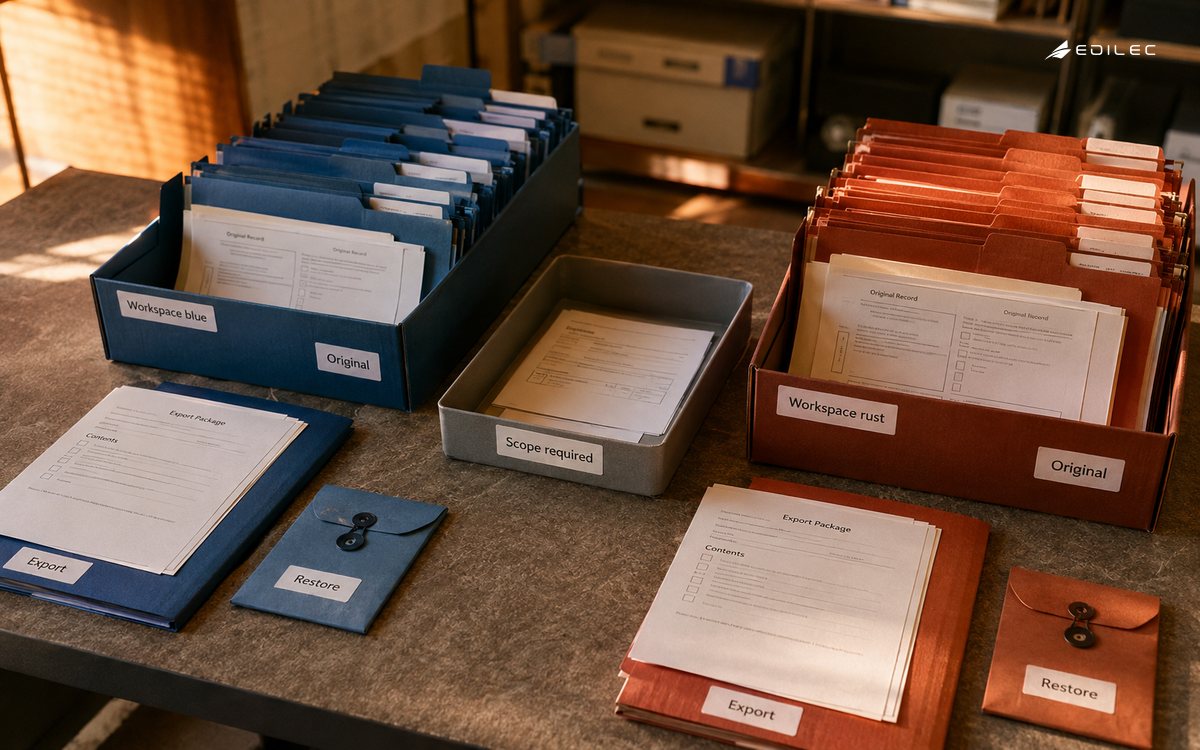
Migrations, backfills, imports, and repair scripts are common places for isolation assumptions to disappear. Require every batch to carry an explicit tenant scope, record the source and destination, and stop when a row has an unexpected owner. Prefer small, restartable units with durable progress and a reconciliation report. Verify that backups, restores, replication, and deletion workflows preserve the same ownership model. A successful migration is not only one that finishes; it is one that can show where each affected record went.
Plan for suspected boundary failure
Define the first response when a cross-tenant result is suspected. Name who can disable a route, pause a worker, revoke a link, preserve evidence, and begin scope analysis. Keep customer communication separate from technical speculation, but do not delay containment while the team searches for a perfect explanation. Record the affected service, time window, tenant set, query or command, evidence collected, and decisions made. The NIST Secure Software Development Framework is a relevant reference for integrating secure development and operational response.
Keep boundary evidence useful and restrained
Log tenant scope, actor or service, resource type, action, result, policy version, correlation identifier, and relevant source event. Do not place customer payloads or secrets in logs merely to make an investigation easier. The OWASP Logging Cheat Sheet gives practical direction for protected, purposeful records. OpenTelemetry documentation can help trace tenant context from the edge through database access, queues, and file generation. Alert on missing scope, conflicting scope, unexpected cross-tenant joins, and access patterns that do not match the service's role.
Test the boundary continuously
Use unit and integration tests that assert tenant filtering, then add end-to-end checks for shared infrastructure. Exercise a cache hit after switching accounts, a stale signed URL, a replayed job, a search query with no scope, a failed authorization lookup, and a support user with legitimate access to one tenant but not another. Include migrations and exports in the test plan. Review sampled production traces and records for scope consistency, because a green test suite cannot reveal a new path that bypassed the established repository.
Anticipate trust-changing failures
The dangerous cases are often ordinary: a user belongs to two tenants, an administrator changes membership during a request, a job payload is copied from another account, a cache key omits one segment, or an export continues after access is revoked. Also test account deletion, tenant rename, region failover, partial restore, and a service that receives an empty context. Decide whether each case should deny, hold, or require reconciliation. A predictable failure protects trust better than a convenient fallback that hides the missing fact.
Handle membership changes during work
Tenant membership is not static. A user may be invited, removed, transferred, or granted access to another account while a browser tab, export, or job remains active. Re-check membership at sensitive operations and define what happens to work that was authorized before the change. A revocation should prevent new access without leaving a partially completed job in an ambiguous state. Keep the original scope and decision time so an investigation can distinguish a valid earlier action from a later unauthorized one.
Support and administrators need the same discipline. A person with broad account access should still select a tenant purpose and target before inspecting records. When a user belongs to several tenants, make the active context explicit in every high-impact view. This reduces mistakes caused by familiarity and makes an unusual access pattern easier to investigate.
Frequently asked questions
Is a separate database always necessary?
No. A shared model can be appropriate when scope is enforced consistently and the team can prove its backup, restore, migration, and monitoring behavior. Separate infrastructure does not remove the need to authorize requests, workers, exports, and operator actions.
What should be measured first?
Start with denied or missing-scope requests, boundary-test results, failed tenant-aware jobs, unexpected data joins, and time to contain a suspected incident. Sample successful requests too, since isolation is about correct allows as well as correct denials.
For delivery teams working on tenant isolation, this operating signal should connect customer outcomes, tenant state, entitlements, release controls, support actions, and operating cost to evidence an accountable owner can inspect. For adjacent decisions, continue with Edilec's Multi-tenant SaaS Architecture: Production Boundaries That Hold and Feature Flags in Production: Safe Release and Rollback. In this production review, move beyond the operating signal only after the owner can show the accepted result, the exception path, and the signal for another review.
Conclusion
Tenant isolation in production is a chain of decisions that must remain correct across every representation of customer data. Resolve context from trusted authority, enforce it at each boundary, make migrations and recovery tenant-aware, and retain evidence that supports containment. With those practices in place, the isolation model is something the team can operate and prove, not just something documented in an architecture diagram.