Billing workflow state, safety, and recovery begin with a bounded operating question. Reconcile billing workflow changes against the original record. Review billing workflow evidence with product, engineering, and support for a practical guide.
Billing workflows are not a feature label or a vendor setting. They coordinate agreement versions, meter events, invoice calculations, payments, and corrections as a product-engineering decision system. A sound design defines the states, evidence, ownership, and recovery path that let the workflow survive late, duplicated, and disputed events.
Define the billing workflows decision
For billing workflows, the relevant facts are agreement, price version, usage event key, invoice period, payment result, and entitlement state. Put an owner and effective time beside each fact.
| Decision area | Question to settle | Evidence to retain |
|---|---|---|
| Authority | Which record decides the billing workflows outcome now? | Owner, version, source identifier, and effective time. |
| Scope | Who, which account, and which resource are affected? | Actor or system, target, environment, and correlation key. |
| Failure | What happens when data is late, absent, or inconsistent? | Safe state, visible explanation, retry path, and escalation owner For Billing Workflows for SaaS Product Engineering, the owner records the observed state before choosing the next action in review pass 3. |
| Exception | Who can override the normal result? | Purpose, approver, narrow scope, expiry, and reversal action For Billing Workflows for SaaS Product Engineering, the owner records the observed state before choosing the next action in review pass 3. |
Model Billing Workflows facts and transitions
For billing workflows, map the normal progression, cancellation or removal, retry, reconciliation, and manual correction paths.
Review billing workflows design choices
For billing workflows, Distinguish a customer agreement from a payment-provider object. The agreement can retain commercial intent and effective dates even if provider identifiers change or a migration occurs. That separation makes it possible to reconcile a billing case across systems and to explain a historical charge using the terms that were valid at the time, rather than today’s catalog labels.
Metered products need a written stance on finality. Decide when a usage period is preliminary, when it closes, how late events are treated, and whether a correction creates a new adjustment rather than rewriting an old invoice. Publish enough of that policy for customers to understand a changing total. Internally, retain the raw event, aggregation version, and correction reason so finance and engineering can compare the same facts.
Manual money movement deserves its own control surface. A credit, refund, write-off, or plan correction should capture a business reason and, when appropriate, a separate approval. Avoid allowing a support note to become the only evidence for a financial change. Reconciliation should surface exceptions early, but it also needs an owner who can decide whether the next step is a technical repair, a customer conversation, or a booked adjustment.
The customer experience must not pretend that payment and product access always change at the same instant. Show pending payment, grace, and restored-access states explicitly. Link the message to the action available to the customer, such as updating a card or contacting an account owner. This preserves trust while the internal workflow receives and reconciles asynchronous provider events.
Implement one narrow Billing Workflows path
Do not record credentials or unrelated personal data. In billing, give every mutation a business event identifier and do not let a provider delivery directly overwrite a calculated result. Reconciliation can then detect whether an input was seen, whether it affected the ledger, and whether an entitlement changed. That lineage is the shortest route to correcting a charge without inventing a second undocumented version of the truth.
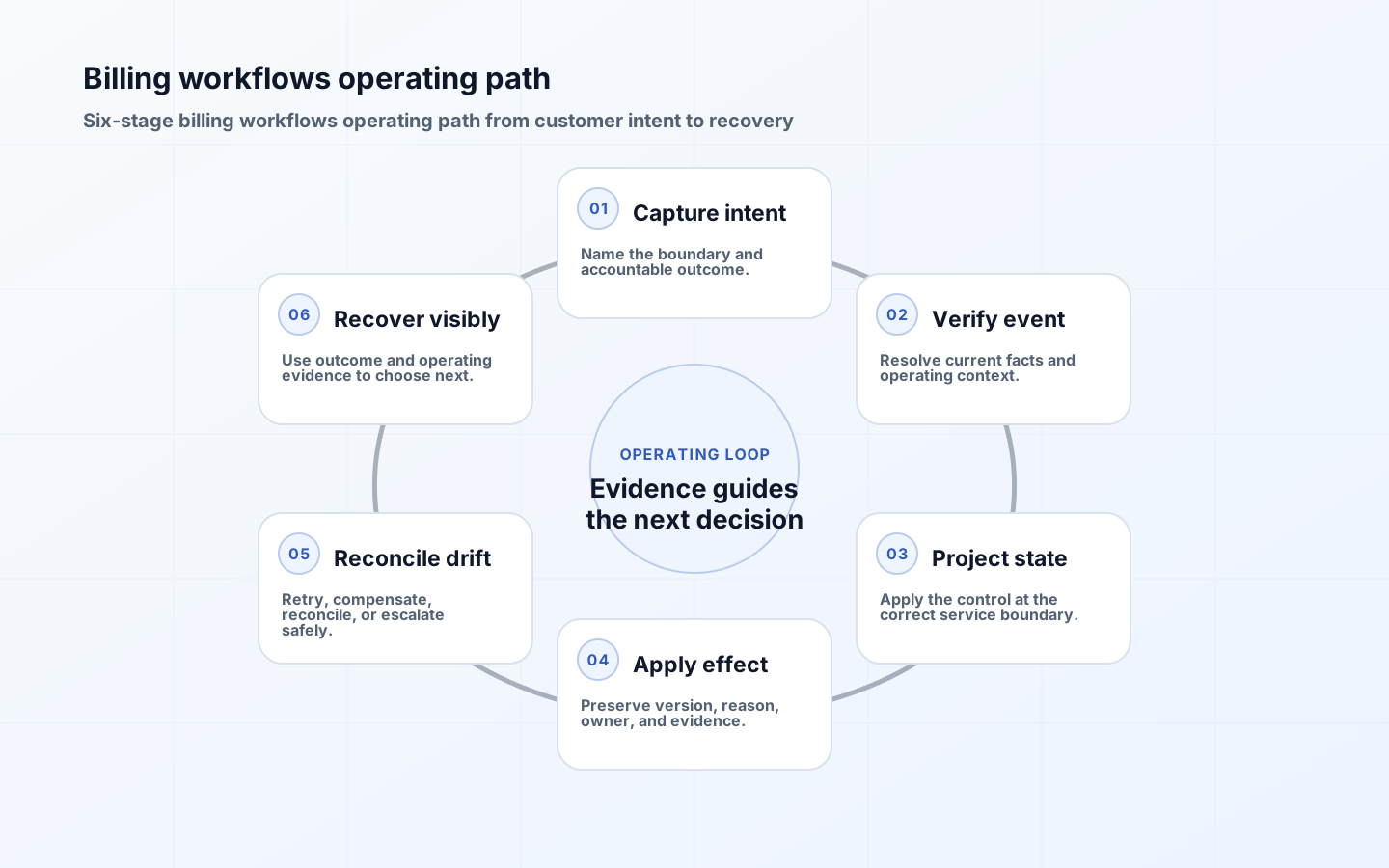
- Write billing workflows rules in plain language before encoding them.
- Attach an effective time and accountable owner to every state transition For Billing Workflows for SaaS Product Engineering, the owner records the observed state before choosing the next action in review pass 2.
- Make the consequential server-side boundary enforce the decision For Billing Workflows for SaaS Product Engineering, the owner records the observed state before choosing the next action in review pass 3.
- Give manual corrections a narrow scope, approver, expiry, and audit record For Billing Workflows for SaaS Product Engineering, the owner records the observed state before choosing the next action in review pass 2.
- Keep the customer-visible state aligned with the authoritative record For Billing Workflows for SaaS Product Engineering, the owner records the observed state before choosing the next action in review pass 3.
Verify Billing Workflows adverse and recovery cases
Use a replay suite for duplicate, delayed, out-of-order, and manually corrected payment events.
| Scenario | Expected behavior | Review signal |
|---|---|---|
| Normal request | The decision follows the current authoritative record. | Outcome, scope, rule or version, and correlation identifier For Billing Workflows for SaaS Product Engineering, the owner records the observed state before choosing the next action in review pass 3. |
| Delayed or duplicate input | Processing converges without repeating the business effect For Billing Workflows for SaaS Product Engineering, the owner records the observed state before choosing the next action in review pass 3. | Suppression or reconciliation record tied to the source event For Billing Workflows for SaaS Product Engineering, the owner records the observed state before choosing the next action in review pass 3. |
| Missing prerequisite | The system uses the documented safe state and a clear resolution route For Billing Workflows for SaaS Product Engineering, the owner records the observed state before choosing the next action in review pass 2. | Reason code, work queue, or targeted alert. |
| Approved correction | The action is attributable, limited, and reversible where possible For Billing Workflows for SaaS Product Engineering, the owner records the observed state before choosing the next action in review pass 3. | Actor, purpose, approval, effective time, and expiry. |
Operate billing workflows with evidence
For billing workflows, watch for duplicate webhooks, late events, plan changes, partial refunds, and unreconciled records.
Billing state and recovery review
Make the normal path and exception path explicit for billing workflow state, safety, and recovery.
Treat billing workflow state, safety, and recovery as an operating system rather than a screen.
Use a small scenario review before expansion. For billing workflows, name the decision boundary and its owner.
Keep customer language aligned with system state for billing workflows for saas product engineering.
| Decision area | Control to apply | Evidence to retain |
|---|---|---|
| Scope | Name the supported boundary for billing workflow state, safety, and recovery | Approved scope and exclusions |
| Authority | Use trusted facts and current context | Source, version, and timestamp |
| Action | Enforce at the service that commits the result | Allow or deny reason |
| Recovery | Retry, compensate, reconcile, or escalate | Correction and review record |
The primary references for this decision are Stripe: Using webhooks with subscriptions, Stripe API: Idempotent requests, Stripe: Subscription invoices, OpenTelemetry observability primer, NIST SP 800-218 Secure Software Development Framework.
For related planning, See How Operations Leaders Should Think About Billing Workflows, How Product Teams Should Think Pricing Gates, Pricing Gates from First Principles: Make Access Rules Predictable.
Billing workflows: practical takeaways
- Billing workflows are dependable when the authority, scope, and safe failure behavior are explicit.
- Version facts and rules so an outcome can be explained after conditions change For Billing Workflows for SaaS Product Engineering, the owner records the observed state before choosing the next action in review pass 2.
- Test denial, delay, retry, reconciliation, and correction rather than only success For Billing Workflows for SaaS Product Engineering, the owner records the observed state before choosing the next action in review pass 2.
- Use a small operating review with accountable signals and an escalation route For Billing Workflows for SaaS Product Engineering, the owner records the observed state before choosing the next action in review pass 2.
- For Billing Workflows for SaaS Product Engineering, consult adjacent product context only at a documented boundary.
Frequently asked questions about billing workflows
For billing workflows, keep this review grounded in the specific authority, scope, and recovery path described above. For example, a late usage event should create a documented adjustment decision, not silently mutate a closed invoice that a customer has already downloaded.
For billing workflows for saas product engineering, test a scheduled change before treating the first release as complete.
A practical example for billing workflows for saas product engineering is normal capacity assumptions stop holding.
Ownership is clearer when billing workflows for saas product engineering separates the promise from the mechanism.
When an event is late, name the accountable owner and the person who can pause or correct the workflow.
When an event is late, define what the workflow covers, its supported states, and its boundary. During normal handling, verify permissions, validation, and safe defaults before a state changes.
During normal handling, retain the source, version, decision, and resulting state so the outcome can be reconstructed.
A practical example for billing workflows is a revoked permission.
When an event is late, test how the workflow returns to a correct state and how the affected person is informed. During normal handling, test how the workflow returns to a correct state and how the affected person is informed.
In a recovery drill, define what the workflow covers, its supported states, and its boundary. During normal handling, name the accountable owner and the person who can pause or correct the workflow.
When an event is late, measure the customer or operator outcome, exception rate, and recovery effort.
When an event is late, verify permissions, validation, and safe defaults before a state changes.
For billing workflows, test an unexpected load spike before treating the first release as complete.
A practical example for billing workflows is a delayed dependency.
In a recovery drill, verify permissions, validation, and safe defaults before a state changes.
When a billing request is denied, explain the resulting state and record the owner and recovery path for any follow-up.
Compare a successful invoice transition with a boundary case such as a late usage event or duplicate webhook. During a measured rollout, retain the source, version, decision, and resulting state so the outcome can be reconstructed.
During normal handling, define what the workflow covers, its supported states, and its boundary. During normal handling, name the accountable owner and the person who can pause or correct the workflow. In a support review, test how the workflow returns to a correct state and how the affected person is informed.
Use a recovery or reconciliation drill as a concrete operating test for billing workflows. In a recovery drill, test how the workflow returns to a correct state and how the affected person is informed.
Compare a successful billing transition with a boundary case such as a failed payment or delayed webhook. During a measured rollout, test how the workflow returns to a correct state and how the affected person is informed.
During normal handling, verify permissions, validation, and safe defaults before a state changes. During normal handling, name the accountable owner and the person who can pause or correct the workflow. In a support review, name the accountable owner and the person who can pause or correct the workflow.
Use a recovery or reconciliation drill as a concrete operating test for billing workflows. In a recovery drill, name the accountable owner and the person who can pause or correct the workflow.
Compare a successful billing transition with a boundary case such as a disputed charge. During a measured rollout, name the accountable owner and the person who can pause or correct the workflow.
During normal handling, retain the source, version, decision, and resulting state so the outcome can be reconstructed. During normal handling, verify permissions, validation, and safe defaults before a state changes. In a support review, measure the customer or operator outcome, exception rate, and recovery effort.
Use a recovery or reconciliation drill as a concrete operating test for billing workflows. In a recovery drill, measure the customer or operator outcome, exception rate, and recovery effort.
Compare a successful billing transition with a boundary case such as a corrected usage total. During a measured rollout, measure the customer or operator outcome, exception rate, and recovery effort.
During normal billing handling, verify the recovery path for corrections and document who owns it when an event arrives late or a customer disputes a charge.
Conclusion
Billing workflows remain trustworthy when they are run as a sequence of accountable decisions rather than a configuration detail. In this case, the decisive details are the billing workflows facts and controls, not a generic implementation label.
Evidence for “Billing Workflows for SaaS Product Engineering” is grounded in Stripe: Using webhooks with subscriptions, Stripe API: Idempotent requests, Stripe: Subscription invoices, OpenTelemetry observability primer, NIST SP 800-218 Secure Software Development Framework; each source informs a specific decision, test, or operating trade-off described in this guide.