Feature flags let a team alter selected runtime behavior without shipping a new build, but that flexibility creates a second control plane. Every flag has an audience, a default, an owner, a dependency, a failure mode, and a removal date. When those facts are implicit, flags become invisible product forks: a bug report cannot be reproduced, a customer gets a different workflow than expected, and a harmless experiment quietly becomes a permanent authorization rule.
Why Feature Flags Matter
A release flag can reduce deployment risk by limiting exposure and enabling a rapid rollback. It does not make the underlying change safe by itself. A risky database migration, sensitive permission change, or costly external call still needs its own controls. Treat the flag as a decision point that chooses among already safe paths. Its purpose, scope, and measurement should be clear enough that an on-call engineer can decide whether changing it is the right incident response.
Name flags by intent rather than implementation trivia. For example, 'enable-new-invoice-export-for-pilot' conveys a bounded audience and outcome; 'use-v2' does not. Separate release flags, experiment flags, operational kill switches, and entitlement rules. They have different expected lifetimes and approval standards. A temporary release flag should not become the product's only enforcement mechanism for a paid capability.
Choose the Flag Contract
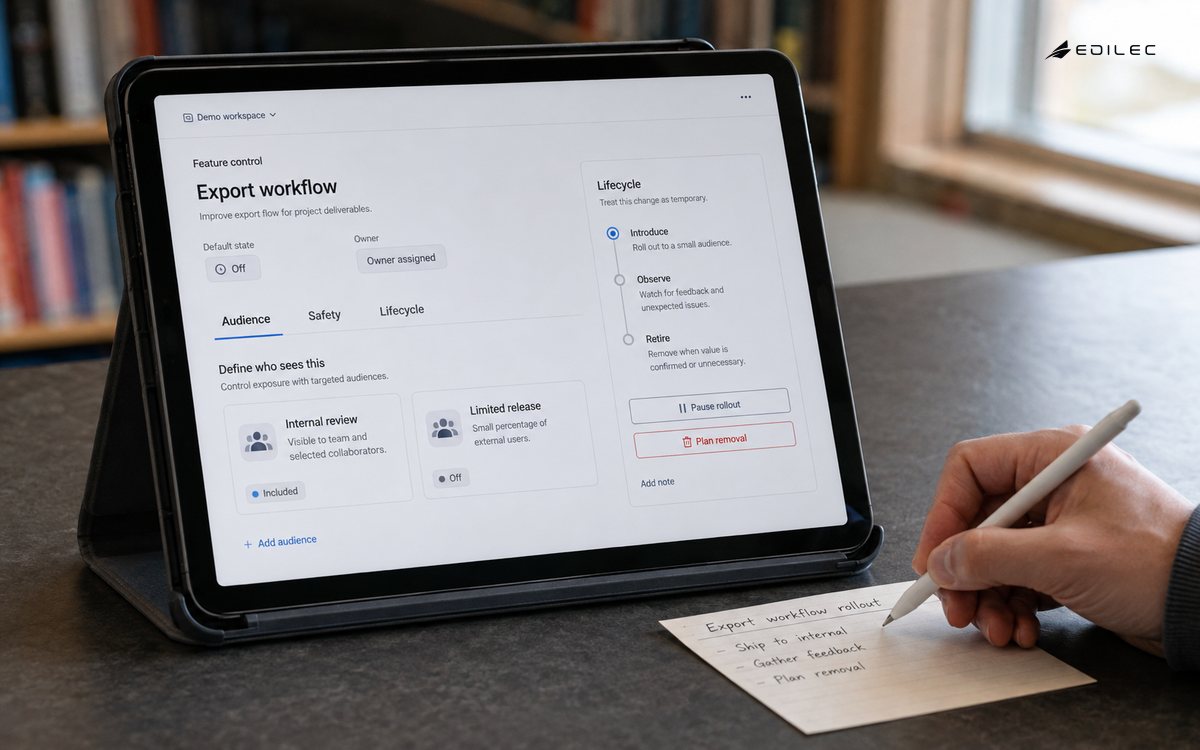
For each flag, record the owner, type, default, intended audience, evaluation context, start and expiry dates, expected metric, and rollback action. Keep sensitive targeting inputs out of the browser where possible. The evaluation context should use stable identifiers such as workspace ID, plan, or a deliberately selected cohort, rather than mutable display names. A vendor-neutral client contract such as OpenFeature can separate application code from a particular flag provider, but it does not replace governance.
| Flag type | Appropriate use | Retirement expectation |
|---|---|---|
| Release | Gradual exposure of completed code. | Remove after the new path is fully adopted. |
| Experiment | Measure a bounded product hypothesis. | End when the decision threshold is reached. |
| Kill switch | Disable a failing dependency or costly action. | Review regularly; preserve only if operationally justified. |
| Entitlement | Select capabilities from a server-side policy. | Use a durable policy model, not a casual experiment flag. |
Decide where evaluation occurs. Client-side evaluation can improve interface responsiveness for non-sensitive presentation changes, but it exposes configuration and cannot protect an API. Server-side evaluation is required for actions with commercial, privacy, or security consequences. Some systems use both: the server enforces access while the client uses the same decision to avoid showing an unavailable control. The two must agree on defaults during an outage.
Target With Care
Roll out by a stable cohort and set the initial population small enough to inspect. A canary may be internal staff, designated pilot workspaces, or a percentage based on a stable hash. Do not use a random value on every request; users would oscillate between experiences and telemetry would be hard to interpret. Document exclusion groups for regulated customers, support accounts, or critical workflows where a trial is inappropriate.
Feature flag targeting is an authorization-adjacent system. Limit who can create, edit, approve, and delete flags. Changes to a production flag should produce an audit event containing the actor, old rule, new rule, reason, and affected environment. Require review for rules that expose sensitive data or alter pricing. A polished dashboard is not sufficient evidence when configuration can change customer behavior in seconds.
Instrument and Release
Emit evaluation telemetry that explains the decision without storing unnecessary personal data: flag key, variation, rule identifier, SDK or service version, workspace-safe cohort identifier, and error state. Correlate it with request failures, latency, and the product outcome the flag was meant to affect. Observability should distinguish 'flag unavailable, default applied' from 'rule evaluated false'; these conditions demand different operational responses.
| Signal | What it answers | First action |
|---|---|---|
| Error rate by variation | Did the new path regress reliability? | Pause or roll back the affected cohort. |
| Outcome metric | Did the change help the intended user task? | Compare a pre-stated guardrail and decision threshold. |
| Evaluation fallback | Is the flag service unavailable or stale? | Confirm the safe default and investigate dependency health. |
| Expired flag count | Is temporary control becoming debt? | Assign removal work to the owning team. |
Before widening a rollout, simulate the failure of the flag service and verify defaults for every consequential path. A client should not grant access because it cannot reach configuration, and a kill switch should remain usable under the incident it was designed to mitigate. Test the combination of related flags as well; two individually harmless flags may select an unsupported path when enabled together.
Retire Flags With Discipline
The most important lifecycle stage is removal. Once a release decision is final, delete the old code path, configuration, tests that only served it, and obsolete documentation. Leaving a flag in place extends the number of system states that engineers must reason about. Keep an inventory with expiry reminders and an owner accountable for a decision: remove, extend with a new rationale, or convert the rule into a durable product policy.
Example: Incremental Export
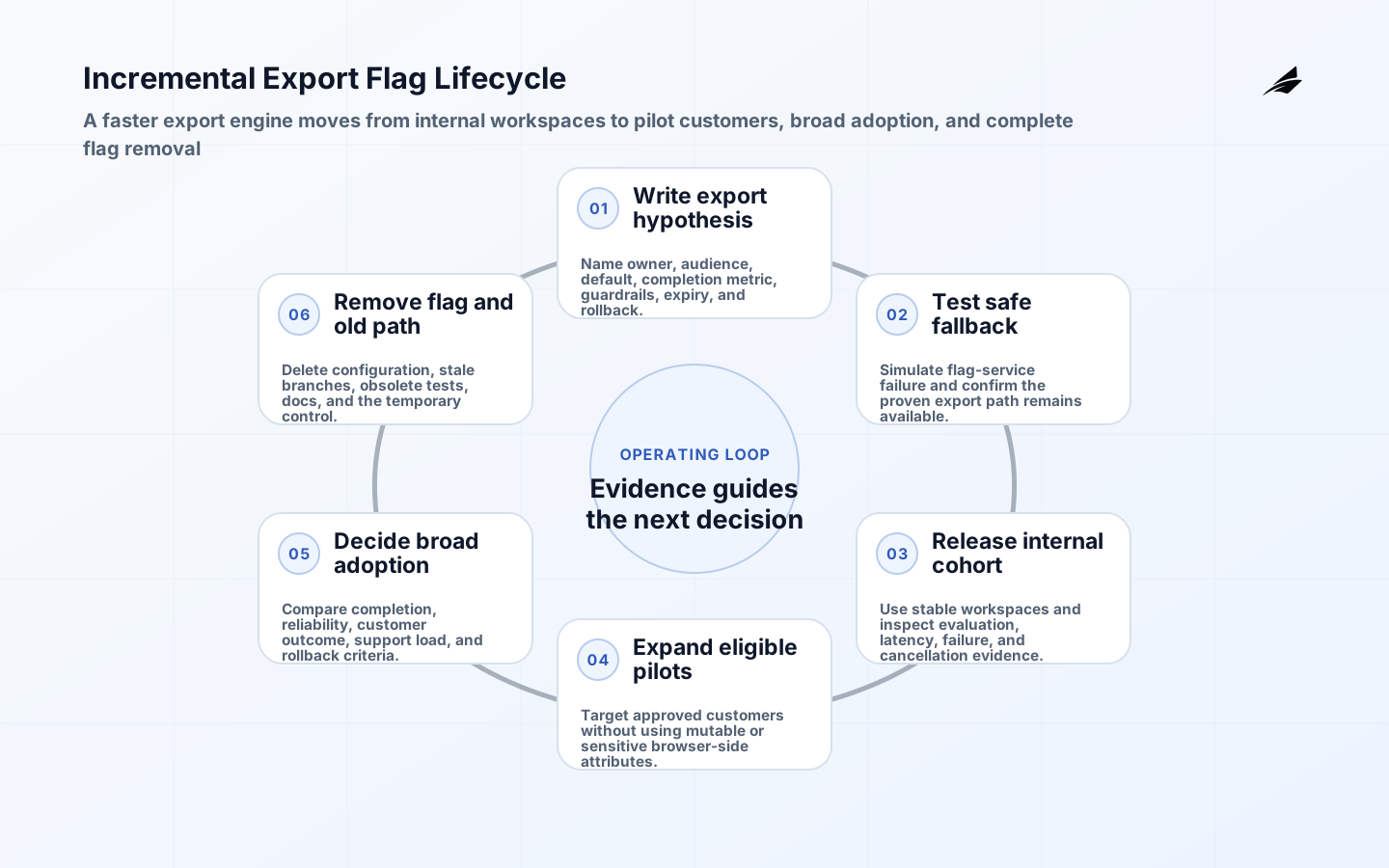
Suppose an analytics product introduces a faster export engine. A release flag begins with two internal workspaces, targets five pilot customers after support confirms eligibility, and records completion time, export failures, cancellation rate, and support contacts. The server evaluates the flag before submitting a job; the browser merely reflects the selected path. A high error rate or a file-integrity alert triggers an operational kill switch. When the new engine is stable, the team deletes the legacy branch and flag.
For a wider release practice, the feature flag strategy guide helps connect flag governance to product decisions. The useful review question is simple: if this flag changed during an incident, would the on-call engineer know its customer scope, safe default, and the metric that says the change helped?
Review the Flag Portfolio
Maintain a simple portfolio view of production flags: owner, repository or service, environments, type, default, target count, creation date, planned removal date, and current decision. This makes forgotten configuration visible before it becomes a release surprise. Review interactions between flags in the same workflow, especially where one flag changes data written by another. The goal is not paperwork for every boolean; it is a reliable answer when an engineer asks which runtime choices can affect a customer path today.
During an incident, use flags with the same change discipline as a production deployment. State the hypothesis, affected cohort, expected safety effect, approver if required, and observation window. Record the exact rule before and after the change. Once the incident resolves, decide whether the flag should be reset, refined into a permanent operational control, or removed. This turns emergency flexibility into learning instead of accumulating unexplained alternate behavior.
Make flag configuration testable outside the provider interface. Contract tests can assert that code handles each expected variation, integration tests can exercise the safe default, and a deployment check can verify that a required kill switch exists in production. Treat unknown or malformed values as an explicit error path rather than quietly coercing them. The result is a feature-flag system that remains understandable when tooling changes, a provider is unavailable, or a new engineer encounters an old branch during an urgent repair.
Avoid using a flag to conceal unresolved product design. If users need a different experience because of geography, contract terms, data residency, or role, first decide whether the distinction belongs in a durable domain policy. A flag is appropriate for controlled transition; it is a poor substitute for a model that customers and support teams can understand over years. Review long-lived flags for this smell. Converting the decision into a named policy often simplifies tests, configuration, reports, and customer communication at the same time.
Coordinate flags across services through a clear ownership boundary. If a browser, API, worker, and notification service all respond to the same rollout, they need compatible evaluation context, defaults, and version expectations. Publish a small contract rather than copying a rule into four repositories. Test a mixed-deployment window, because some instances may receive new code before others. This avoids a common rollout defect where one component creates a record under a new behavior while another cannot read or process it until an unrelated deployment catches up.
Keep a short operator note beside high-impact flags: what changes, who is affected, the first signal to watch, and the fastest safe reversal. This reduces the time spent decoding configuration during an outage and makes handoffs between teams more reliable.
Review that note whenever the flag's target rule changes.
Key Takeaways
- Give every flag an owner, purpose, audience, default, expiry, and rollback rule.
- Evaluate sensitive decisions on the server and log configuration changes.
- Measure variation outcomes and operational fallback separately.
- Delete temporary flags and dead branches once the decision is complete.
Frequently Asked Questions
Are feature flags useful for small teams? Yes, when a change benefits from a bounded release or a quick operational response. The governance can be lightweight, but the owner and removal date still matter. Can flags replace automated deployment safety? No. They complement tests, review, observability, and rollback practices; a flag only controls which prepared path receives traffic.
Conclusion
Feature flags are valuable when they shorten the feedback loop without hiding the system's state. A disciplined contract, secure targeting, useful telemetry, and timely cleanup let teams release progressively while keeping customer experience and incident response understandable.
Sources
For implementation options, see the OpenFeature introduction, OpenTelemetry documentation, the OWASP ASVS, and the Google SRE Workbook on monitoring.