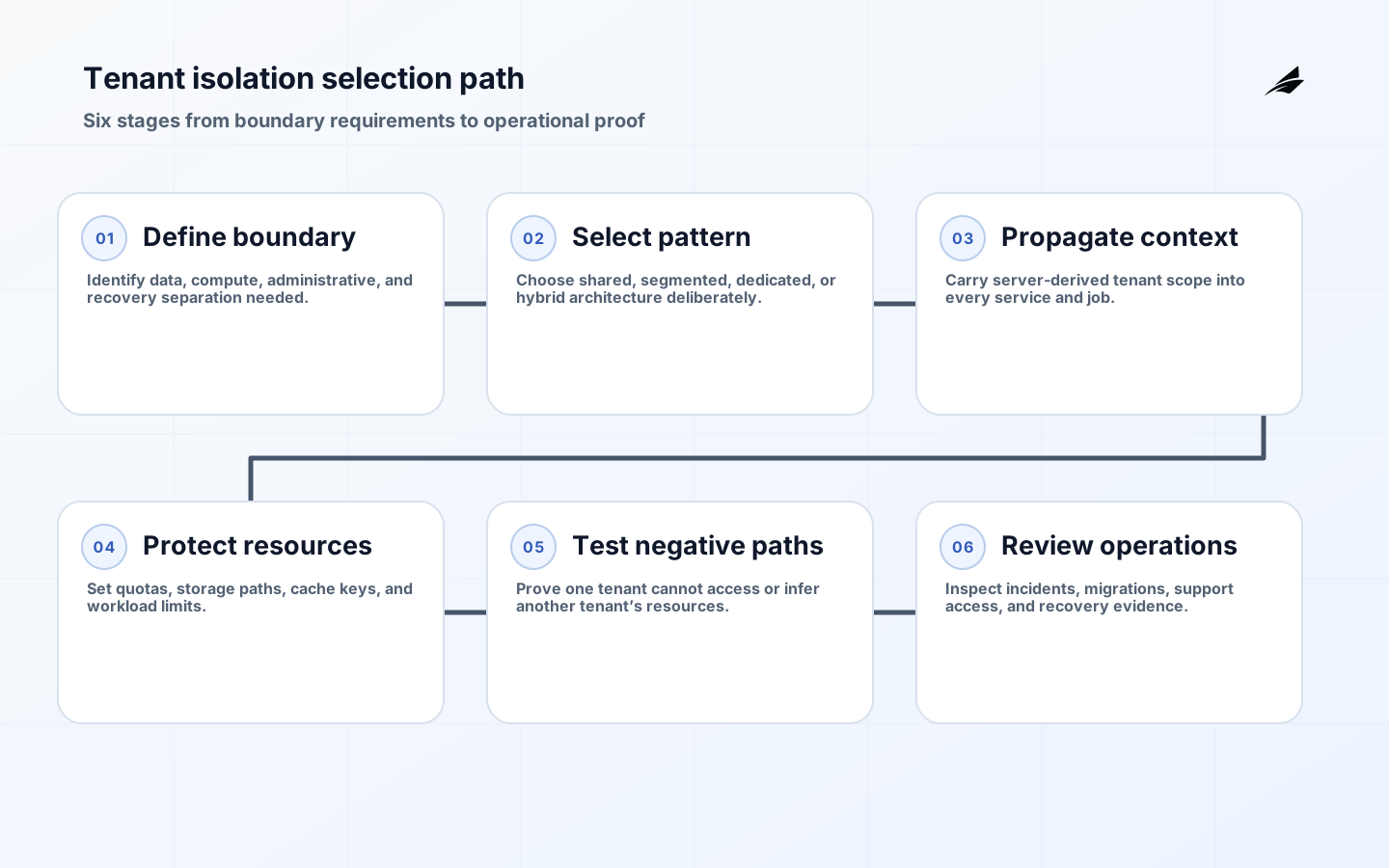
Tenant isolation is the set of technical and operating controls that stop one customer’s data, actions, and resource consumption from affecting another customer in ways the service did not intend. It is not synonymous with a separate database, although separate infrastructure can be part of the answer. A shared application can enforce a strong boundary through authenticated identity, tenant-scoped authorization, careful query construction, resource controls, logs, backups, and operational review. Conversely, a customer-per-database design can still leak through a shared cache, support tool, export job, or administrator role. The correct pattern depends on data sensitivity, regulatory and contractual needs, volume variance, latency, recovery objectives, engineering maturity, and what customers can reasonably verify. Start from the required outcome and threat model, not from the architecture diagram that happens to be fashionable.
Choose the tenant boundary deliberately
Ask what must be isolated: records, encryption keys, compute, queues, search indexes, network paths, audit trails, or support access. A customer asking for “dedicated” may mean a dedicated key or predictable compute performance rather than a completely separate application stack. Translate the request into observable controls and service commitments. Shared tables with a tenant discriminator can be efficient, but every access route must enforce that discriminator and database-level controls may be appropriate as defence in depth. Separate schemas or databases can reduce blast radius and simplify deletion or restore, while adding provisioning, migration, connection-management, and fleet-observability cost. Dedicated deployments offer the strongest separation but can slow upgrades and make operational consistency harder. Document why a pattern is adequate for each customer tier, and revisit the decision as usage, risk, or contract terms change.
| Pattern | Strength | Cost and watchpoint |
|---|---|---|
| Shared tables with tenant key | Efficient operations and pooled capacity. | Every query, cache key, and job must carry tenant scope. |
| Separate schema or database | Smaller data blast radius and clearer recovery units. | Provisioning and migrations become a fleet-management problem. |
| Dedicated deployment | Strongest infrastructure separation and customization scope. | Higher cost, slower upgrades, and greater configuration drift risk. |
| Hybrid tiering | Matches controls to customer needs. | Requires explicit routing and support procedures across tiers. |
Enforce tenant context through the whole system
The tenant boundary begins at authentication but cannot end there. Resolve a caller’s tenant membership and role on the server, then carry the resulting scope into authorization, data access, cache keys, asynchronous messages, file storage paths, search filters, and telemetry. Do not accept an arbitrary tenant identifier from the browser as authority. For background jobs, store the tenant context with the work item and reject a worker that cannot establish it. For analytics and exports, require explicit tenant filters and test that an empty filter never means “all customers.” Separate object storage prefixes and encryption context where the platform supports it, and avoid logs that include unrestricted record payloads. The multi-tenant implementation plan provides related delivery detail for teams turning these requirements into a work plan.
Account for cost, capacity, and noisy neighbours
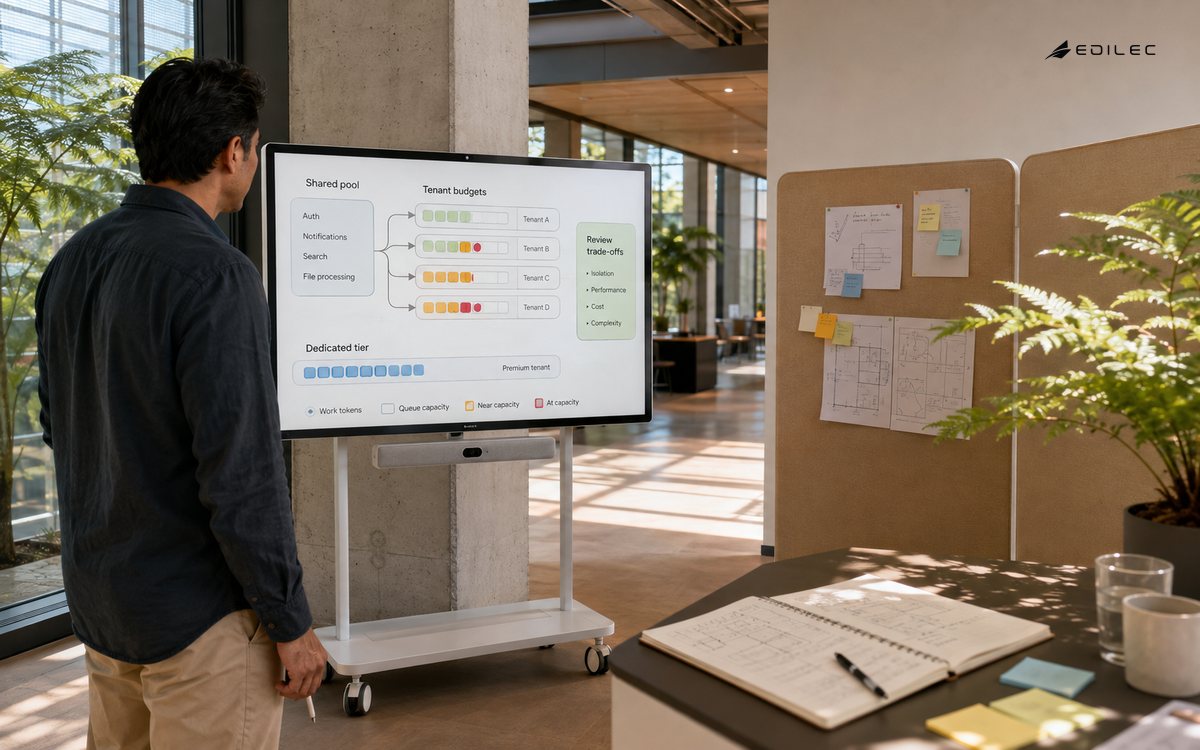
Isolation has an economic side. Shared infrastructure enables pooled utilization, but it must not let a high-volume customer consume the latency, queue capacity, or rate limits required by another. Set resource budgets at the tenant level where possible: concurrent work, requests per interval, storage, scheduled exports, or expensive search queries. Decide whether a burst is queued, throttled, billed, or moved to a dedicated tier. Measure those choices with tenant-labelled metrics that do not expose customer identities in broad dashboards. Capacity planning should consider the largest plausible tenant and correlated peaks, not only average usage. A separate environment may buy predictability, but it also creates another upgrade path, monitoring target, backup schedule, and incident surface. Include that operational cost in commercial pricing rather than treating it as an invisible engineering favour.
| Scaling question | Signal to inspect | Decision |
|---|---|---|
| Is one tenant dominating work? | Per-tenant queue wait and request volume. | Throttle, queue, or move workload to a higher tier. |
| Can recovery remain scoped? | Restore tests and backup identifiers. | Define a tenant-level recovery process or accept broader impact. |
| Are migrations predictable? | Version distribution and failed migrations. | Automate rollout waves and rollback checks. |
| Does support preserve the boundary? | Impersonation and export audit events. | Use scoped tooling and time-bounded elevated access. |
Prove the boundary in testing and operations
A tenant isolation claim needs evidence beyond a design review. Build automated negative tests: user A cannot read, update, export, search, or infer the existence of tenant B’s resources. Include direct API calls, browser routes, pagination, object downloads, cached pages, scheduled jobs, webhooks, and failure paths. Run the tests on representative roles and in environments that resemble production configuration. During incidents, make tenant scope visible in alerts and runbooks so responders can determine affected customers without broad data access. Review access denials, cross-tenant query attempts, export volume, failed context propagation, and unusual resource use. Then test recovery: can the team restore or delete one tenant without mistakenly operating on all? The multi-tenant readiness checklist is a good place to record this evidence before a major rollout.
- Define which data, compute, and administrative actions require separation.
- Select a pattern based on observable risk and operating cost.
- Carry server-derived tenant scope into every synchronous and asynchronous route.
- Budget shared resources so one customer cannot silently degrade others.
- Use negative tests and incident evidence to validate the boundary continuously.
Plan migrations with the tenant boundary in mind
Schema changes, tier migrations, and new storage systems are common moments for isolation regressions. Build migration plans that identify the tenant unit, the source and target records, validation checks, rollback condition, and customer communication requirement. Run the process on representative tenants, including one with a large volume, unusual configuration, and a failed previous job. Never use an unscoped maintenance command in production when a tenant-specific operation is possible. If a broad operation is unavoidable, require a second reviewer, a dry-run count, and a durable record of the selected scope. Compare source and target counts, permissions, encryption context, and user-visible behavior before declaring success.
Procurement and support also need a clear boundary story. Document what isolation pattern each service tier uses, which controls are shared, how incident scope is determined, and what recovery commitment is realistic. Do not imply a dedicated environment when the customer is receiving logical isolation on shared infrastructure; both can be valid offerings, but they are different promises. Give support a procedure for responding to a suspected boundary issue: preserve evidence, restrict risky access, identify affected tenants, involve the security owner, and communicate based on verified facts. The quality of that response is part of the isolation design, because an uncertain boundary during an incident can multiply the harm.
Document the identity model at the same level of detail as the storage model. Users may belong to several workspaces, support operators may have a break-glass route, and integrations may act for a tenant without representing a person. Define how the system resolves an active tenant, how a user switches context, which role applies to a resource, and what happens when membership changes during a long-running action. Test those transitions around invitations, mergers, account suspension, and deprovisioning. A strong database boundary cannot repair an ambiguous identity boundary, and identity mistakes are often the earliest route to a cross-tenant incident.
Make tenant context visible in developer ergonomics. Provide a tested library or middleware that resolves the active tenant and applies the standard authorization and logging fields, rather than asking every feature team to remember a sequence of filters. Code review should flag unscoped repository methods, broad administrative queries, and cache keys that omit the tenant. For analytical queries, separate operational aggregation from access to identifiable customer records, and require an approved purpose for cross-tenant comparisons. This is not bureaucracy for its own sake; a safe default removes the chance that a rushed implementation accidentally creates the one endpoint or worker that bypasses the boundary. The safer path should also be the easiest path to write and test.
- Resolve tenant membership on the server from authenticated identity.
- Require explicit tenant scope in repository, cache, storage, and job helpers.
- Treat a missing tenant filter as a denial, never as all customers.
- Apply resource budgets before a noisy workload harms another tenant.
- Test exports, search, pagination, and retries for cross-tenant leakage.
- Document the incident and recovery process for a suspected boundary failure.
Key takeaways
- A separate database is a pattern, not a complete isolation strategy.
- The boundary must survive caches, jobs, exports, search, and support work.
- Dedicated capacity has real lifecycle and operational cost.
- Per-tenant limits protect both performance and commercial clarity.
- Negative testing is the most direct evidence that a boundary holds.
Frequently asked questions
Does every enterprise customer need a separate database?
No. The right requirement may be a dedicated key, regional storage, scoped backup recovery, predictable capacity, or a documented shared-service boundary. Choose the control that meets the actual risk and contract, then make its limitations explicit.
Is row-level security enough?
It is a valuable defence for data queries, but it does not cover every system path. You still need tenant-aware authorization, cache and storage design, job context, support controls, exports, telemetry, and tests that exercise the whole route.
Conclusion: isolation is an operating commitment
Choose tenant isolation as a business and engineering commitment, then carry it through the software and the work of running it. A credible boundary is visible in query policy, queue design, resource budgets, support procedure, recovery tests, and incident evidence. That breadth is what lets a SaaS platform scale customers without diluting the promise each customer bought.