Multi-tenant Architecture in Production: What Changes for SaaS Teams
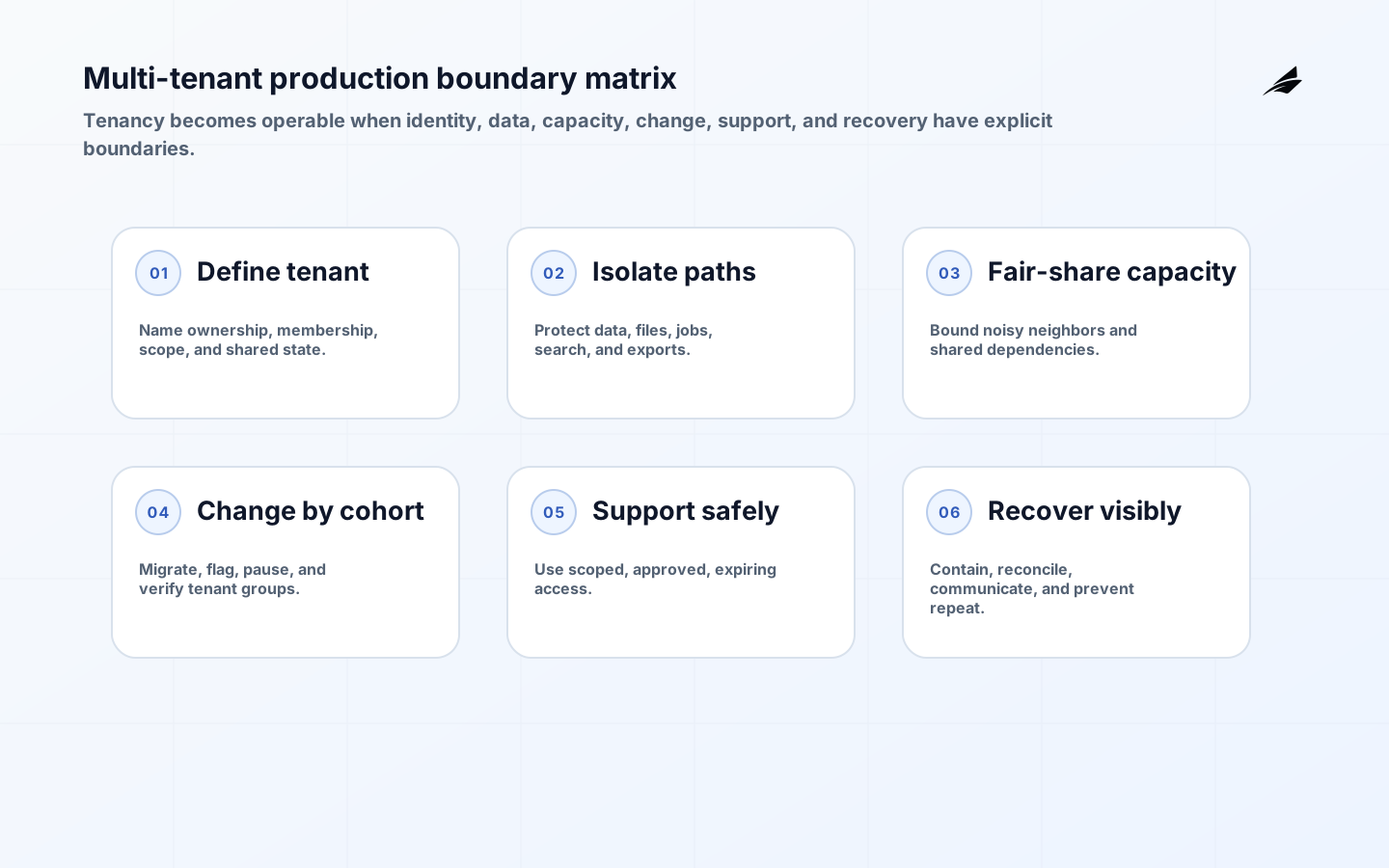
Multi-tenant architecture is not just a choice between one database per customer and a shared database. It is the set of rules that keep a tenant's data, authority, workload, support experience, and cost from becoming ambiguous as the product grows. A prototype can rely on a request parameter and a developer's memory. Production needs a tenant identity that survives every service boundary, a tested isolation model, a response to noisy neighbors, and a support process that cannot accidentally cross customer boundaries. The AWS SaaS tenant-isolation guidance is a useful official reference because it treats tenant-aware operations as an architectural concern rather than a database detail.
Set the tenant boundary in business terms
Start by stating what a tenant owns and what it shares. Include users, workspaces, records, files, integrations, usage, plan entitlements, and operational limits. Decide whether a person may belong to multiple tenants and whether a workspace is a tenant, a child of one, or a collaboration boundary. Keep the decision visible in the domain model. A tenant ID added late to tables does not guarantee isolation if search, cache, event, export, and support paths ignore it. The PostgreSQL row security policies are useful for framing enforceable predicates; use the same discipline to name who can make a cross-tenant decision.
Separate identity from membership
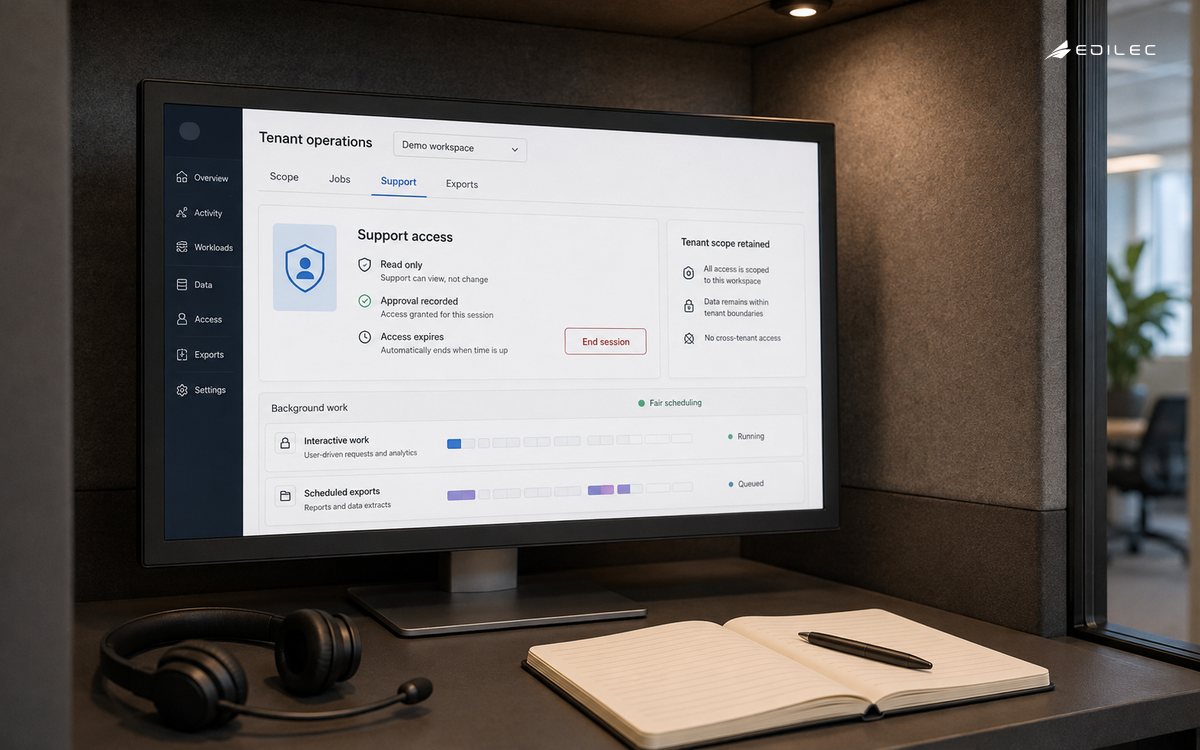
A user account is not automatically a tenant member with the same role everywhere. Model membership, role, invitation state, and scope explicitly. A support agent may have a time-limited, audited view of one tenant without becoming a normal member. A service account may access selected records for an integration but not use the customer interface. Every request should carry authenticated identity and resolved tenant context, then enforce the relationship at the data and action boundary.
| Boundary | Decision | Evidence |
|---|---|---|
| Tenant | What records, users, and integrations belong to the tenant? | Domain model and tenant ownership tests. |
| Membership | Can one identity join multiple tenants and with which roles? | Membership, invitation, and removal history. |
| Support | What temporary access is allowed and why? | Approval, scope, expiry, and audit event. |
| Service | Which workload may act for which tenant? | Token scope, policy, and request context. |
| Export | How are tenant records isolated in files and jobs? | Job identity, filters, and verification result. |
Choose isolation deliberately
Isolation can exist at the database, schema, row, service, storage, cache, queue, or deployment layer. A shared table with a tenant predicate may be efficient, but the predicate must be hard to omit and tested across reads, writes, background jobs, reports, search indexes, and exports. Separate databases can reduce blast radius but increase migrations, cost, and operational coordination. A useful design records the threat, consequence, recovery need, and expected scale behind the choice. Do not describe an architecture as isolated without naming which paths have been verified.
- Where is tenant context established, validated, and carried across asynchronous work?
- Can a cache key, object path, search index, or export omit tenant scope?
- How are cross-tenant aggregates or benchmarks explicitly authorized?
- What happens when a tenant is suspended, deleted, or moved between service tiers?
- Can support investigate an incident without broad permanent access?
- How will a restore or migration prove that tenant records stayed separated?
Plan for noisy neighbors and fairness
A tenant can affect another through request volume, large imports, expensive queries, file processing, queue depth, or a shared downstream provider. Define per-tenant quotas, concurrency limits, prioritization, and backpressure where the product consequence justifies them. Rate limiting alone may protect an API while a background job still consumes every worker. OpenTelemetry semantic conventions provides useful guidance for consistent telemetry; add tenant, plan, region, and workload class only when access and cardinality are controlled. The goal is to explain who is affected and why, not to collect a tenant label in every log without an action.
| Pressure point | Control | Signal |
|---|---|---|
| API requests | Tenant-aware rate and concurrency limit. | Latency, rejection, and queue depth by tenant. |
| Background work | Fair scheduling and bounded worker claims. | Age and runtime by job class and tenant. |
| Storage | Quota, lifecycle, and large-object policy. | Growth, failed writes, and retention exceptions. |
| Shared dependency | Circuit breaker, bulkhead, and fallback. | Dependency errors and affected tenant cohort. |
| Cost | Usage attribution and plan-level guardrails. | Cost per tenant, unallocated spend, and margin risk. |
Make environments and migrations tenant-safe
Production changes often touch every tenant at once. Use versioned migrations, compatibility windows, backfills that can pause, and a way to identify tenants that have not completed a transition. Preview and test data must not resemble a live tenant in a way that can confuse operators. Vercel deployment documentation offers useful context for deployment environments, but the critical SaaS decision is how a release reaches tenants: all at once, by cohort, by region, or by plan. Record the rollout owner, stop condition, tenant scope, and rollback or forward-fix path.
Example: a shared analytics workspace
Imagine a reporting product where each tenant has workspaces, users, data connectors, dashboards, and scheduled exports. The tenant boundary governs source credentials, raw data, dashboard definitions, export recipients, and usage. A user can belong to two tenants but must choose the active context before opening a dashboard. A scheduled export carries tenant and workspace identity, and its object path is checked before delivery. A support session is approved for one tenant and expires. Usage reporting separates shared platform cost from direct connector and storage usage. These rules create operational clarity that a single tenant_id column cannot provide by itself.
Test the paths humans forget
Tenant isolation tests should cover normal application requests plus forgotten paths: password resets, email links, webhooks, imports, retries, scheduled jobs, search, caches, logs, notifications, analytics, data exports, and support tooling. Create adversarial tests where a valid user changes the tenant ID, reuses an object ID, follows a stale link, or submits a job after membership removal. Preserve enough audit evidence to investigate without exposing payloads unnecessarily. A production claim is credible when the team can show the test matrix, failed cases, owners, and re-test date.
Roll out multi-tenant behavior safely
Start with a tenant inventory and a representative set of small, large, active, dormant, and unusual customers. Measure request volume, data size, job mix, integration count, and support access before changing the architecture. Use a cohort release with feature flags or tenant allowlists, but ensure the flag itself is tenant-scoped and auditable. The Stripe usage-based billing reference is a helpful official source for treating account and billing records as explicit API objects; apply the same precision to tenant entitlements and usage. Keep a manual pause and a customer communication plan for migrations that alter behavior.
Review production failure modes
The most damaging failures are cross-tenant reads, shared caches, asynchronous jobs that lose tenant context, exports delivered to the wrong recipient, support access without expiry, and a noisy tenant that degrades everyone. Another is billing and entitlement state that diverges from the tenant record, causing either premature restriction or unbounded access. Treat these as system behaviors, not isolated defects. A recovery plan should cover containment, affected-tenant identification, evidence preservation, customer notification, correction, and a test that prevents recurrence.
- Tenant context is resolved once and enforced again at sensitive data and action boundaries.
- Background work, webhooks, exports, caches, and search preserve tenant scope.
- Support access is approved, limited, logged, and automatically expired.
- Large or expensive tenants cannot consume all shared capacity without a visible control.
- Migrations can pause and identify incomplete tenants without corrupting mixed versions.
- Billing, usage, entitlements, and access have a reconciliation path.
Measure isolation and operating fairness
Track authorization denials, suspected scope defects, support-access events, queue age by tenant, tail latency, error rate, storage growth, migration completion, export failures, and cost per tenant or workload. Watch both aggregate health and the worst affected cohort. A flat average can hide one customer whose jobs always time out. Review whether plan limits correspond to real capacity and customer value; artificial limits that do not protect a dependency create friction without fairness. Use metrics to choose an architecture change or an operating action, not as a decorative dashboard.
Tenancy principles for production teams
- Define tenant ownership, membership, support, service, and export boundaries explicitly.
- Choose isolation by consequence, recovery, scale, and operational evidence—not fashion.
- Carry tenant context through background work, caches, search, storage, and exports.
- Design fairness controls for shared capacity before a noisy neighbor appears.
- Roll out migrations by cohort with a pause condition and reconciliation path.
- Measure scope safety, tail performance, cost, and customer impact together.
Multi-tenant architecture questions answered
Is one database per tenant always safer?
Not automatically. It can reduce some blast radius, but it also introduces provisioning, migration, backup, cost, and observability complexity. Safety depends on the full set of access and recovery paths.
Can a tenant key alone protect data?
No. Tenant context must also survive caches, jobs, search, files, webhooks, reports, exports, support tools, and service-to-service calls, with tests and runtime checks at important boundaries.
When should a team split a tenant out?
Use evidence such as isolation consequence, predictable capacity, regulatory need, performance behavior, recovery objectives, or customer value. A split should remove a known constraint and include an operating plan.
Conclusion: make tenancy an operating contract
A multi-tenant platform is ready for production when a tenant boundary survives the paths customers do not see: jobs, exports, search, support, billing, migrations, and restores. Test those paths with realistic cohorts and make the owner of each control explicit. For related decisions, compare the workspace models guide, usage reporting guide, and SaaS MVP guide. Tenancy is trustworthy when a customer can remain separate and fairly served while the product changes underneath it.