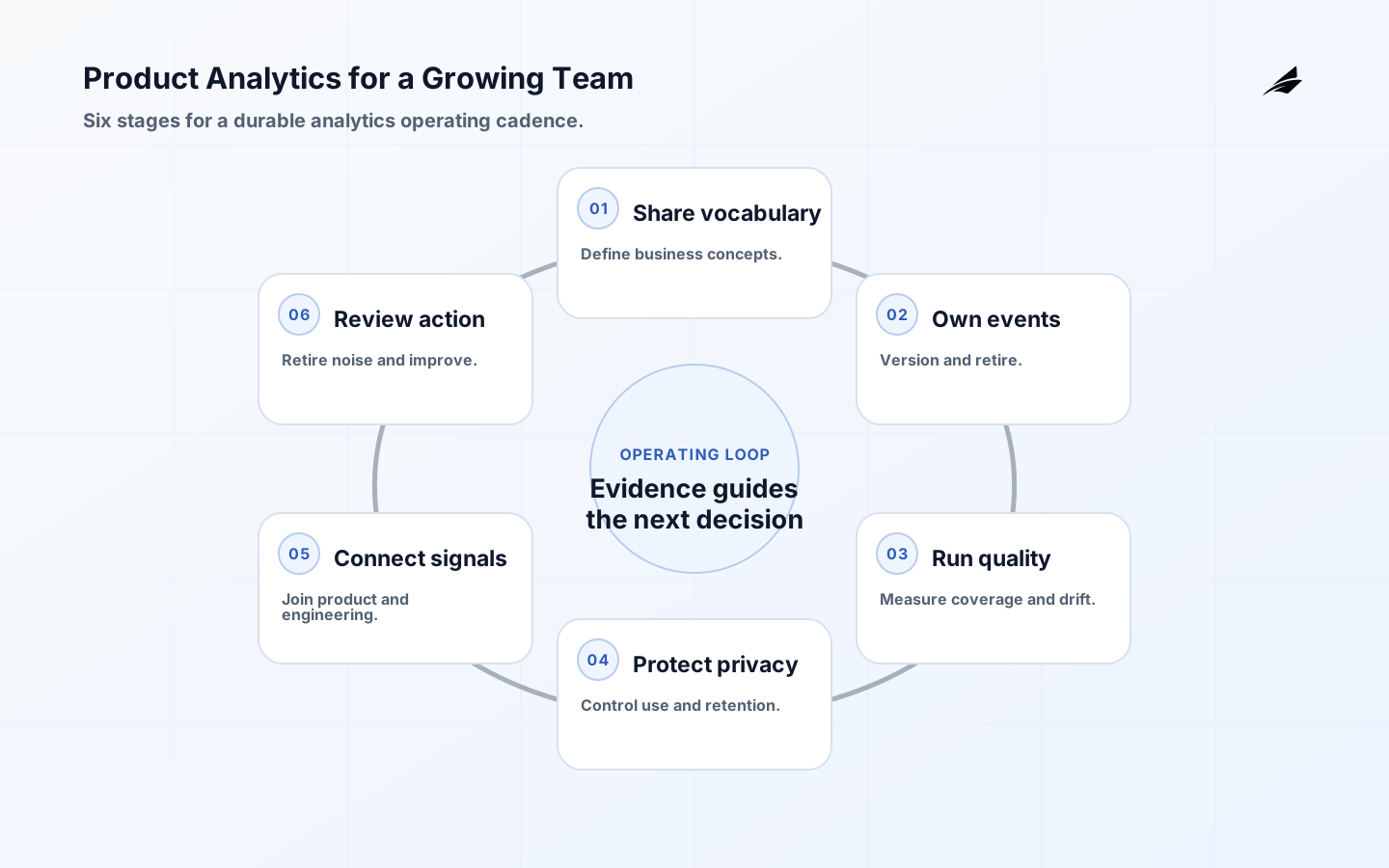
Product analytics gets harder as a team grows because questions, releases, customer segments, and definitions multiply faster than the original tracking plan. The first event list may have been enough for one product manager and one engineer; it becomes ambiguous when several squads own different surfaces and leadership compares numbers across accounts. A growing team needs a durable operating model: a small vocabulary, a source of truth, named metric owners, quality checks, privacy boundaries, and a review cadence that turns evidence into product action. OpenTelemetry semantic conventions and CloudEvents provide useful interoperability ideas, but they do not replace a decision about what your product means by activation, retention, adoption, or success.
Establish a shared vocabulary
Define a small set of business concepts before adding more events. Name the account, actor, workspace, resource, workflow, outcome, cohort, and lifecycle state. Publish definitions with examples and counterexamples. Activation should not mean “visited the dashboard” for one team and “completed a first workflow” for another. Treat names and properties as an interface that product, engineering, marketing, support, and finance can read. When a definition changes, record the effective date and whether historical data is backfilled. A common vocabulary reduces arguments in planning meetings and makes it easier for a new team member to understand what a metric can and cannot prove.
| Concept | Definition to publish | Example evidence |
|---|---|---|
| Activation | First durable value event | Project created and shared |
| Adoption | Repeated use of a capability | Three successful runs in 14 days |
| Retention | Return to a defined workflow | Active in week four |
| Expansion | Increase in entitled value | Additional workspace or seats |
Govern the event model
Use an event contract with stable naming, actor and account context, object, action, event time, received time, source, version, and result. Prefer events that describe a meaningful outcome over a long list of implementation clicks. Keep raw observations, derived metrics, and business definitions separate so a correction in one layer does not silently rewrite the others. CloudEvents offers a useful reference for event context and transport-neutral metadata; adapt it to your product. Keep a registry or catalog with an owner, schema status, privacy classification, and deprecation date. An event without an owner becomes a permanent cost.
Run a quality loop
Analytics quality is a service-level concern. Monitor ingestion freshness, event volume by client and release, required-field coverage, duplicate rate, rejected payloads, identity-join coverage, and metric query latency. Put a sample event beside each important dashboard so support can compare expected and observed shape. When a mobile release changes event behavior, annotate the timeline. When a schema is invalid, quarantine it with a reason instead of quietly coercing it into a plausible value. Review quality weekly with the metric owners; a growing team cannot rely on one analyst noticing every broken chart.
| Signal | Threshold discussion | Owner action |
|---|---|---|
| Freshness | How old can evidence be? | Investigate transport or transformation |
| Coverage | Which outcomes have a matching record? | Fix missing instrumentation |
| Drift | Which fields changed shape? | Version and communicate |
| Usage | Is the metric used for a decision? | Retire or improve it |
Scale privacy and access with the team
More analysts and integrations create more ways for sensitive behavior data to spread. Classify fields, limit access by role and account scope, define retention, and avoid raw customer content in logs or event properties. NIST’s Privacy Framework helps structure the conversation around identifying, governing, controlling, communicating, and protecting privacy risk. Create a process for new fields: purpose, necessity, audience, retention, and deletion or correction behavior. Treat exports and notebooks as part of the data boundary. The right question is not merely whether the warehouse is secure; it is whether each use of the data is proportionate to the decision it supports.
Connect product and engineering signals
A product metric needs technical context when behavior changes. Correlate a release, experiment, incident, or performance regression with the relevant product outcome. Use logs, metrics, and traces for engineering diagnosis and product events for behavior; join them carefully rather than using one signal for every purpose. OpenTelemetry’s conventions can help align service attributes, but do not put tenant-sensitive content into high-volume telemetry. A shared review can ask whether a drop in activation came from a confusing workflow, a failed API, a slow import, or a change in event capture. That is more actionable than a chart by itself.
Create an operating cadence
Use a lightweight rhythm: product owners review decision metrics, engineers review collection health, privacy owners review new uses, and support reviews customer-impacting anomalies. Keep a decision log with the metric, evidence, action, and revisit date. Retire dashboards that no longer change work. When teams disagree, go back to the definition and source of truth rather than adding another metric. A useful cadence makes analytics part of product operations, not a specialist service that produces a report after the roadmap has already been decided.
Key takeaways
- Publish definitions so teams measure the same business concept.
- Give every important event and metric an owner and lifecycle.
- Monitor quality and privacy as operating concerns, not cleanup work.
- Connect product evidence to engineering context without collapsing the signals.
- Use a review cadence to retire noise and act on trustworthy evidence.

The OpenTelemetry semantic conventions help a growing team share telemetry vocabulary, while the NIST Privacy Framework structures privacy risk decisions. Use the NIST Secure Software Development Framework for accountable change practices, the CloudEvents specification for event context, and the OWASP Logging Cheat Sheet for disciplined diagnostic evidence.
Frequently asked questions
How large should an event catalog become?
As small as possible while answering named decisions and supporting diagnosis. Every event should have meaning, an owner, quality expectations, and a reason to retain it.
Who owns product analytics?
Product owns the decision and definition; engineering owns reliable collection; privacy and security own their controls; support needs a usable diagnosis path.
When should a metric be retired?
Retire it when it no longer changes a decision, duplicates a better measure, cannot be trusted, or carries more privacy and maintenance cost than value.
Conclusion
Growing teams need product analytics that stays understandable after several people, services, and customer segments begin changing it. The first discipline is a shared vocabulary. Define business terms such as activated, retained, invited, completed, and recovered with an owner, an authoritative source, and examples of edge cases. A common word without a common rule produces dashboards that appear aligned while answering different questions. Give every important event a lifecycle. Its owner should maintain meaning, required context, version, quality expectations, and a retirement date. Keep a catalogue that shows who consumes the event and which decisions depend on it. When a definition changes, mark the effective boundary and explain how old and new values should be compared. Deprecation is product work; leaving obsolete signals alive shifts cost to every future analyst and engineer. Run quality as a recurring operating loop. Check collection coverage, event age, missing identifiers, unexpected values, duplicate records, schema compatibility, and agreement with the system of record. Route failures to an owner with a due date. Review a sample of raw and transformed evidence after releases instead of trusting a green pipeline status. A team can only improve a metric when it can tell whether a change reflects user behavior, instrumentation drift, or a broken join. Scale privacy and access with the organization. Classify event fields, limit joins, protect exports, set retention, and make deletion or correction flow through derived products. Give product, engineering, privacy, security, and support distinct responsibilities. Support staff may need to diagnose a metric without browsing customer content; the design should make that possible. Record why a sensitive field exists and revisit the reason when the decision changes. Connect product evidence with engineering signals carefully. A trace can explain latency, a service metric can reveal capacity, and a product event can show a user outcome, but they should not be collapsed into one ambiguous measure. Use correlation identifiers and consistent time semantics to investigate a path. Keep the authoritative business result separate from technical evidence, then join them deliberately for a question that benefits from both. A useful cadence has a lightweight weekly review for broken or drifting signals, a release review for contract changes, and a periodic portfolio review for event retirement and privacy cost. Bring an example that worked, an example that misled, and an example that could not be answered. Decide whether to fix the source, clarify the definition, change the interface, or stop measuring. This keeps analytics connected to action instead of turning the catalogue into an archive. As the team grows, make ownership visible in the tools people already use: event documentation, dashboards, alerts, incident notes, and change records. A new engineer should be able to learn which number to trust and how to challenge it. A product leader should be able to see which decisions have evidence and where uncertainty remains. The mature state is not maximum instrumentation; it is a shared ability to make and review decisions with evidence that remains explainable. Anchor the team’s cadence in product analytics before the first build, analytics in production, and tenant isolation for a growing team. The first two connect vocabulary to decisions and production evidence; the third keeps scope, privacy, and support access in the operating conversation. Reading them together helps a growing team avoid treating a catalogue, a pipeline, or a dashboard as the owner of meaning. A durable cadence has a small set of named reviewers, a visible queue of quality issues, and a retirement habit. It should make the next decision easier, not merely produce another report. When a metric no longer changes work, the team should be able to remove it with the same care used to introduce it.
Growing teams need product analytics that is understandable, governed, and connected to action. Build a shared vocabulary, own the event model, measure quality, protect privacy, and review decisions together. Durable analytics is an operating habit as much as a data pipeline.