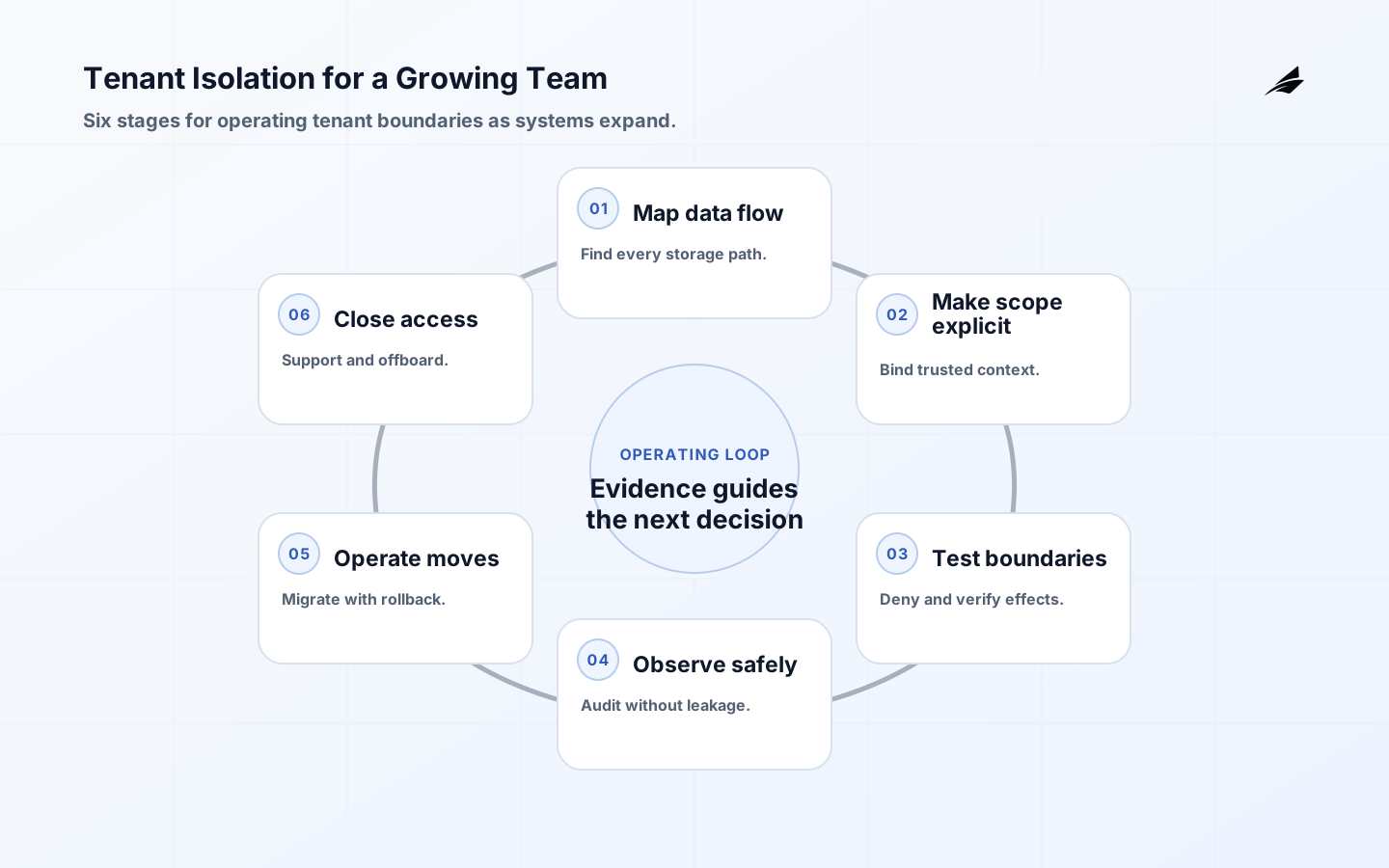
Tenant isolation for a growing team is less about choosing one database pattern and more about keeping a promise across an expanding system. New services introduce new tokens, queues, caches, search indexes, exports, dashboards, and support tools. A feature may pass its own tests while a background worker or log sink still crosses tenant boundaries. AWS’s SaaS guidance treats isolation as a layered concern; OWASP’s authorization guidance reinforces that checks belong on the server and should follow least privilege. The field-guide mindset is practical: map the boundary, identify where context can be lost, test denied paths, observe unusual access, and make changes reversible.
Map the system by data flow
Draw the path from identity to API, service, database, cache, queue, worker, file store, search, analytics, support, and backup. For each boundary, state where tenant context comes from, how it is validated, how it is propagated, and what happens when it is missing. A single trusted context object is useful, but do not let a caller set it without server verification. Include batch jobs and migrations; they often run with broader privileges than request handlers. The map should show cross-tenant operations explicitly, such as platform billing or abuse review, with approval and audit requirements.
| System layer | Tenant question | Evidence |
|---|---|---|
| API | Does membership authorize the resource? | Denied request and audit event |
| Worker | Does the job carry verified scope? | Job context and result |
| Cache | Can one key collide across tenants? | Scoped key and eviction test |
| Export | Who approved the data boundary? | Manifest, owner, and expiry |
Make tenant context explicit
Pass tenant scope as a verified server-side value, not a UI convention. Bind it to the authenticated principal, membership state, resource relationship, and authorization decision. For machine identities, scope credentials to the tenant or job where possible and reject mismatched payloads. Name the behavior for a missing or ambiguous context: deny, quarantine, or route to a review queue. Avoid silent defaults because a default tenant is a data leak waiting for a new code path. When users belong to several tenants, make the selected scope visible and require server confirmation on every sensitive action.
Test as the system grows
Keep a two-tenant test fixture with similar names, different roles, separate files, and resources that share IDs or labels. Run it through every new feature and service. Try altered path IDs, omitted context, stale membership, replayed jobs, cross-tenant search, cache reuse, bulk export, webhook delivery, and support impersonation. Assert that the request is denied and that no side effect occurs. Add a test for privileged database or service roles; PostgreSQL row security can be bypassed by roles with appropriate privileges, so the application and operations model must account for that. Treat failed isolation tests as release blockers.
| Test family | Attack or failure | Expected result |
|---|---|---|
| Read | Change resource identifier | Deny without data difference |
| Write | Replay job under another tenant | Reject and retain reason |
| Indirect | Reuse cache or search key | No cross-tenant result |
| Privileged | Use support or migration role | Approved scope and audit |
Observe the boundary without leaking data
Operational signals should identify scope and action without copying customer content into every log. Track denied requests, unusual tenant switching, cross-scope mismatches, export volume, support access, policy changes, queue failures, and restore checks. OpenTelemetry’s observability primer helps teams use logs, metrics, and traces for different diagnostic needs. Apply access and retention rules to telemetry itself. An alert should tell the responder which tenant, service, action, and policy were involved, while avoiding sensitive payloads. Keep an audit trail for exceptional access and make it visible to the customer or internal reviewer according to the product’s trust model.
Operate migrations and tenant moves
Growing systems move tenants between shards, plans, regions, or service versions. Model the move as a workflow with preflight counts, source and destination, pause or dual-write behavior, verification, and rollback. Check files, jobs, search, caches, analytics, and notifications, not just primary rows. A resource transfer needs the same discipline: authorized owner, approval, history, and post-move access checks. Keep a customer-visible status for long operations and a support runbook for partial completion. The safest migration is one that can explain what has moved, what is still pending, and what the system will do if the process stops halfway.
Design support and offboarding
Support teams need to solve problems without becoming an invisible cross-tenant superuser. Use time-bound, purpose-bound access with approval, narrow scope, visible banners, and an audit record. Define how recordings, exports, screenshots, and temporary copies are handled. For offboarding, decide how sessions, API keys, integrations, queued work, files, backups, and analytics are treated. A tenant marked inactive is not necessarily erased. Document legal, contractual, and operational retention separately from access suspension. Review the process with security, support, and customer operations so the controls work under pressure.
Key takeaways
- Map tenant context across every data path as services multiply.
- Make scope explicit, verified, and denied when ambiguous.
- Test indirect stores, jobs, support tools, migrations, and privileged roles.
- Observe boundary events without copying sensitive customer content.
- Treat moves, support access, and offboarding as isolation workflows.
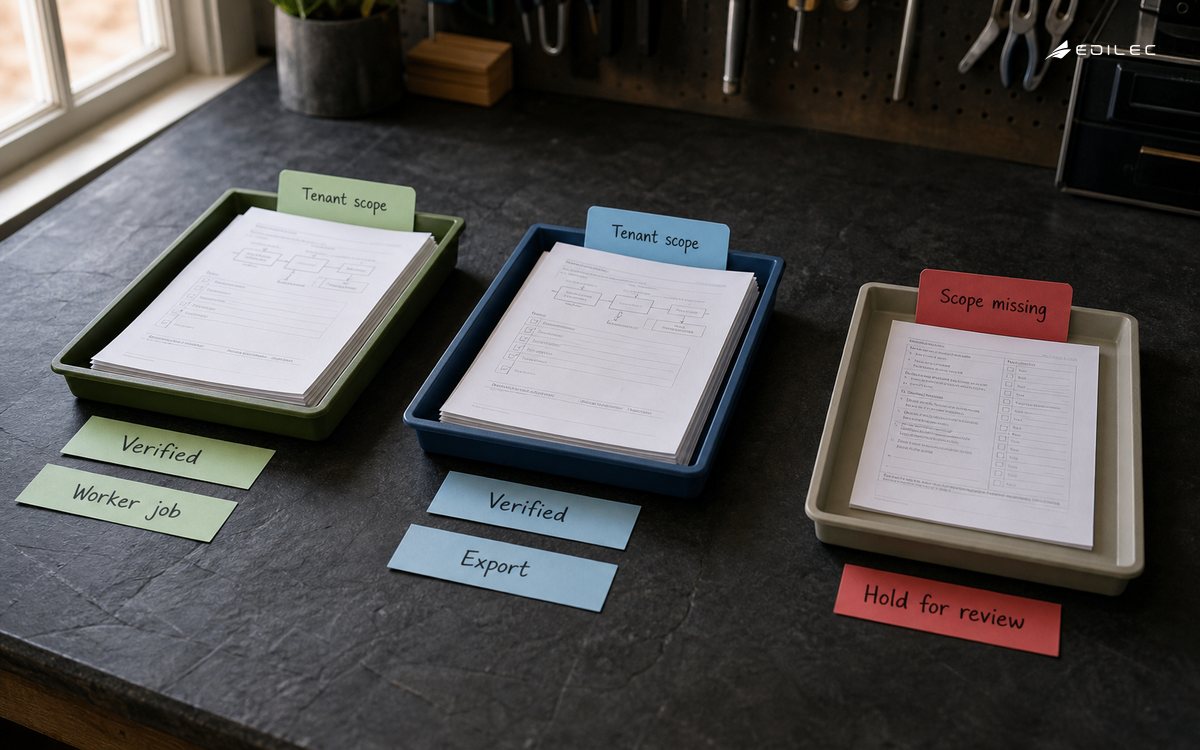
The AWS tenant-isolation guidance frames isolation as a continuing operating responsibility. The OWASP Authorization Cheat Sheet supports server-side checks, the NIST Secure Software Development Framework supports verifiable development practices, the OpenTelemetry observability primer separates diagnostic signals, and PostgreSQL row security policies show one enforcement layer. Apply each reference to the boundary and evidence the product actually needs.
Frequently asked questions
How often should tenant isolation tests run?
Run core tests in every change that affects authorization or data flow, and maintain a broader boundary review as new services, stores, and support tools are introduced.
Can logs contain tenant IDs?
They can when needed for diagnosis, but scope, access, retention, and payload minimization still apply. Tenant context should not become a license to copy customer content.
What makes tenant-aware support safe?
Use explicit approval, narrow scope, expiry, visible purpose, and an audit trail. Avoid permanent broad impersonation privileges.
Conclusion
Tenant isolation becomes harder as a growing team adds services, background jobs, data products, support tools, integrations, and migration paths. Start with a data-flow map that follows tenant context from login through APIs, workers, storage, caches, search, exports, analytics, notifications, backups, and deletion. Mark the authoritative source of scope at each boundary. This map turns “multi-tenant” from a deployment label into a set of testable responsibilities. Make context explicit and difficult to lose. Separate user identity, organization membership, tenant scope, resource ownership, and support purpose. Pass only the context a component needs, validate it against an authoritative relationship, and reject ambiguous requests. Do not infer scope from a mutable client field, a queue name, or a record that has already crossed a trust boundary. When context is absent, the safe result is a visible denial or a review state, not a best-effort lookup. Test the system as it changes. Add boundary checks for new routes, tables, workers, caches, search indexes, file stores, and administrative commands. Use fixtures with similar tenants and attempt altered identifiers, delayed membership changes, replayed jobs, bulk actions, and indirect access. Verify that denied work has no side effect in another tenant. Run focused tests on every relevant change and schedule broader flow reviews when the architecture or support model expands. Observe access without exporting customer content. Capture actor, intended scope, resource, policy version, result, and correlation context with minimization and controlled retention. Make diagnostic access purpose-bound, approved, time-limited, and visible. Support should be able to investigate a customer issue without becoming an invisible superuser. Review logs, traces, metrics, exports, and alerts for accidental cross-tenant context, and treat a logging leak as a boundary defect even when the data API is correct. Migrations and tenant moves need their own operating procedure. Define the source and destination owner, read and write permissions during transition, handling for in-flight jobs, cache invalidation, search updates, billing implications, and rollback. Use a cohort, reconcile counts and relationships, then finalize with a recorded decision. Offboarding should close memberships, revoke service access, remove derived copies where policy requires, and preserve only the records that must remain. Make each state observable to support and the customer-facing product. Ownership should be distributed but not ambiguous. Engineering owns enforcement and test coverage; security reviews the threat model and privileged routes; support owns the safe diagnostic routine; data teams own derived access; product owns the customer promise. Use an incident path that can identify what happened, what was exposed or prevented, which mitigations are active, and who approves restoration. The evidence should survive staff changes and service boundaries. A growing team is ready to extend the model when a new contributor can trace scope, run the denial tests, use the support path, and explain recovery without private context. If a shortcut appears repeatedly, redesign the interface or policy instead of normalizing the exception. Tenant isolation is maintained through habits: explicit context, adversarial tests, minimized evidence, reversible change, and a clear end to privileged access. Use tenant isolation before the first build, product analytics in production, and product analytics for growing teams to test the edges of the map. The first guide challenges the architectural boundary, the second exposes derived and diagnostic data paths, and the third supplies a cadence for ownership as the team expands. Together they show why a tenant context that is correct in one API can still leak through a worker, cache, export, dashboard, or support shortcut. The operating review should include a fresh contributor performing a denied request, a support investigation, a tenant move, and an offboarding check. Preserve the evidence, close temporary authority, and record the next boundary review. That routine is what lets the team grow without making isolation depend on memory.
Tenant isolation remains trustworthy when a growing team can trace scope through the whole system and prove both allowed and denied behavior. Map the data flow, test indirect paths, observe carefully, and make exceptional access and migrations explicit. That is how isolation becomes an operating capability rather than a promise in an architecture diagram.