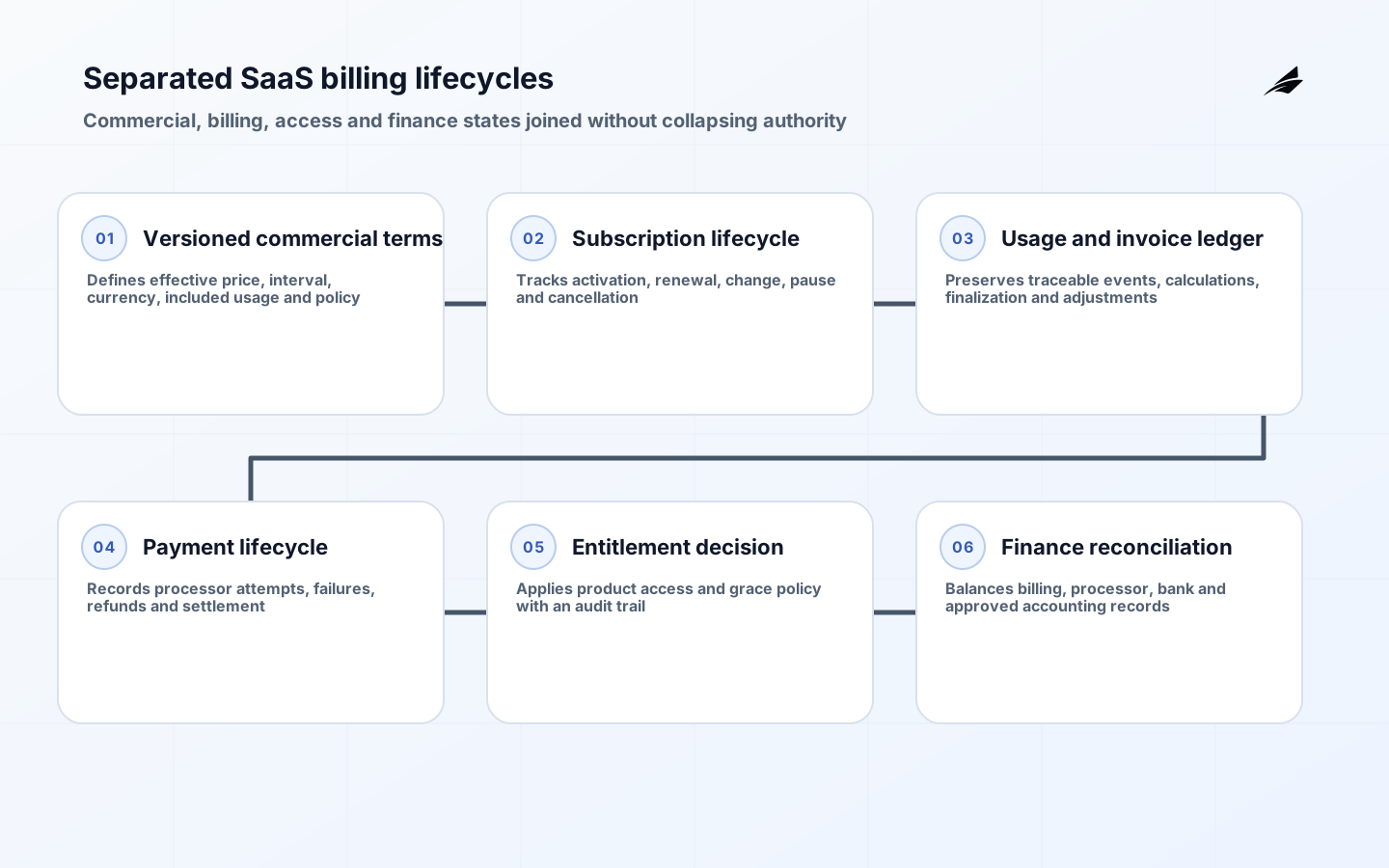
SaaS billing is not one status field or a payment-provider integration. It is a set of linked lifecycles for commercial terms, subscription, entitlement, usage, invoice, payment, credit and accounting treatment. Many failures begin when those concepts are collapsed: a payment timeout removes access, a plan rename rewrites history, or a retried webhook grants twice. Durable billing design gives each lifecycle an authority, records transitions, expects asynchronous delivery and reconciles customer-facing state with financial records. Accounting, tax and card obligations require qualified advice for the company's facts and jurisdictions.
Mistake 1: treating billing as a single status
A subscription can be active while an invoice is open; an invoice can be finalized while payment is pending; a payment can fail without immediate entitlement removal; a credit can alter amount due without rewriting the original invoice. Model these states separately and define the allowed transitions. Keep stable identifiers linking customer, account, subscription, price version, invoice, payment attempt and entitlement decision. Show users the state they need, but preserve richer operational state for support and finance. Avoid making a provider object the only internal domain model.
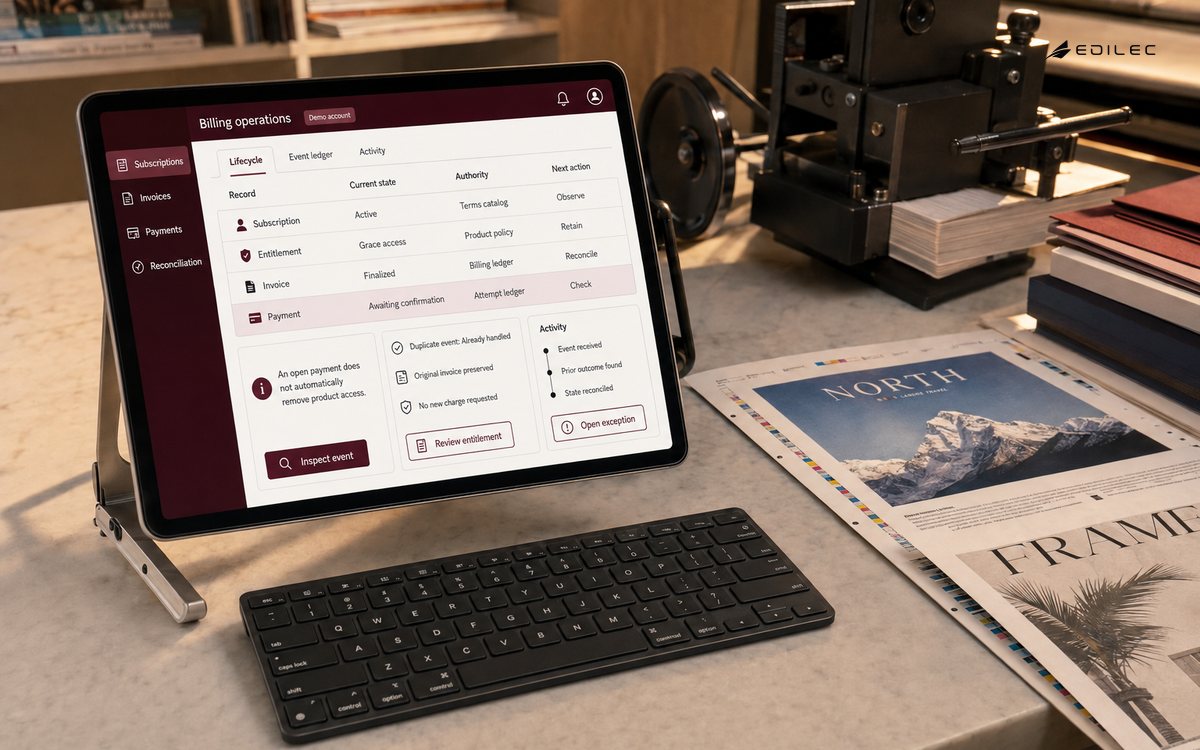
Version commercial terms. A price, billing interval, included quantity, currency, tax behavior and entitlement bundle belong to an effective version, not a mutable plan name. Decide what happens at upgrade, downgrade, pause, cancellation and renewal, including proration and effective time. Store the terms used to generate each invoice. Do not recalculate historical documents from today's catalog. Product, finance, support and engineering should approve worked lifecycle examples before implementation because ambiguity appears at boundaries, not in the happy-path monthly renewal.
| Lifecycle | Authority | Must not be inferred from |
|---|---|---|
| Commercial terms | Versioned product and price catalog | Current display name alone |
| Subscription | Billing domain with effective dates | Latest payment result |
| Entitlement | Product policy using subscription and grace rules | A provider dashboard status alone |
| Invoice | Finalized billing document and adjustments | Current cart or mutable catalog |
| Payment | Processor plus internal payment-attempt ledger | Webhook arrival order |
| Accounting | Finance-approved ledger and recognition policy | Product access state |
Mistake 2: assuming events arrive once and in order
Webhooks and queues are asynchronous notifications, not a perfectly ordered transaction log. Providers retry when endpoints fail, and different event types may arrive out of order. Verify signatures and timestamps according to provider guidance, persist the event identifier and raw reference, then process idempotently. Acknowledge only after durable receipt if the design requires later processing. Use a state transition based on authoritative object data, not arrival order. Keep a dead-letter or exception queue with replay controls and enough context for support.
User-initiated writes also need safe retry behavior. HTTP defines some methods as idempotent, while POST is not inherently so. For create or charge-like operations, accept a unique request key scoped to the account and operation, store the first completed outcome and reject reuse with a different payload. Enforce database uniqueness on the business effect. Idempotency does not replace reconciliation: a timeout can leave the caller uncertain, an external provider may complete after a local failure, and bugs may bypass the intended key.
Mistake 3: making usage untraceable or mutable
For usage-based billing, define the billable event, source, unit, account, event time, received time, unique identifier and correction method. Keep raw events immutable where practical and derive aggregates reproducibly. Validate negative, late, future and duplicate usage explicitly. Provider documentation may impose timing and value constraints, so design collection around the actual contract. Display estimated usage and explain cutoff behavior to customers. A dashboard total should connect to the source events and price version that will produce the invoice.
Do not silently edit metered history. Corrections should be append-only reversals or adjustments with reason, actor and linkage to the original event, subject to the processor's supported behavior. Reconcile source event counts and quantities to transmitted, accepted, aggregated and invoiced values. Segment reconciliation by tenant, meter and period so one large total cannot hide offsetting errors. Define late-arrival policy before launch: which period receives the event, when an invoice is reopened or credited, and who approves material customer impact.
| Failure mode | Detection | Durable fix |
|---|---|---|
| Duplicate invoice or charge | Same business key has multiple effects | Idempotency plus database uniqueness |
| Out-of-order event | Transition conflicts with current version | Version checks and authoritative-state reconciliation |
| Unbilled usage | Source quantity exceeds accepted quantity | Event ledger with stage-by-stage balancing |
| Wrong entitlement | Access differs from grace and subscription policy | Dedicated entitlement decision and audit |
| Unfinalized invoice | Invoice age exceeds expected state | State-age alert and owned exception queue |
| Ledger mismatch | Processor settlement differs from internal totals | Independent daily reconciliation and investigation |
Mistake 4: coupling product access directly to payment
Entitlement is a product decision informed by subscription and payment state, not a raw webhook side effect. Define effective start, renewal, trial, grace, suspension, cancellation and restoration rules. Consider the consequence of removing access during a processor outage or expired card update. High-value accounts may require controlled override. Cache entitlement only with bounded staleness and invalidation, and make the server enforce it. Record the policy version and facts behind each consequential access transition so support can explain and correct it.
Handle plan changes as workflows. Calculate the proposed effect, show it to the authorized customer administrator, obtain confirmation, execute idempotently and reconcile provider plus internal state. Protect against concurrent changes. Invitations, role updates and account transfer should not accidentally allow an unauthorized person to buy or cancel for a tenant. Test access after failed upgrade, disputed payment, refund, chargeback and cancellation at period end. Customer communication should distinguish payment action required from immediate product availability.
Mistake 5: treating processor delegation as complete control
Hosted payment components can reduce direct handling of card data, but PCI DSS scope depends on the actual implementation and responsibilities. Review the current standard and validation obligations with qualified parties. PCI SSC's payment-page guidance addresses script authorization, integrity and tamper detection relevant to e-commerce threats. Protect webhook secrets, API keys and administrative access; use least privilege and separate test from live credentials. Avoid logging cardholder data, secrets or full sensitive payloads. Monitor changes to payment-page scripts and provider configuration.
Billing records are not automatically accounting records. Finance should define invoice numbering, credits, taxes, refunds, settlement, foreign exchange and the interface to the general ledger. Revenue recognition under standards such as Topic 606 depends on contracts and performance obligations, not simply cash receipt; involve qualified accounting professionals. Engineering should provide immutable references, effective dates, adjustment history and exports that support approved policy. Reconcile billing subledger, payment processor, bank settlement and general ledger at a cadence based on risk and volume.
Repair and release billing workflows safely
- Map commercial, subscription, entitlement, invoice, payment and accounting lifecycles separately.
- Trace representative upgrades, failures, refunds, disputes and cancellations end to end.
- Introduce stable identifiers, versioned terms and idempotent transition handlers.
- Build independent reconciliation before changing customer-facing authority.
- Replay historical events in a non-production environment and compare outcomes.
- Pilot by account cohort with finance and support daily review.
- Retire old jobs and credentials only after complete-period balancing.
Use a deterministic scenario suite with dates, terms, usage, events and expected final records. Cover month and year boundaries, leap day where relevant, time zones, retries, concurrent changes, provider outage, late usage, refund and chargeback. Contract-test provider integration in sandbox but recognize sandbox behavior does not prove live settlement. In a shadow run, compute new invoices or entitlements without applying them and compare to the current system. Investigate every material difference and have finance approve migration and cutover evidence.
Production monitoring should focus on state age and reconciliation, not only request errors. Track webhook receipt and processing lag, invoices stuck before finalization, payment-attempt outcomes, entitlement mismatches, unbilled usage, credits, settlement differences and administrative overrides. Provide support with a protected timeline that links customer-visible state to internal and provider references. Never ask staff to repair billing by editing database rows without a governed command that validates transition, records reason and remains reconcilable.
Key takeaways
- Separate subscription, entitlement, invoice, payment and accounting state.
- Version prices and terms so historical documents remain explainable.
- Expect duplicate and out-of-order events; process idempotently and reconcile.
- Keep usage events traceable from source through invoice and correction.
- Treat card security, tax and accounting as shared work with qualified specialists.
Frequently asked questions
Should the payment provider be the system of record?
It is authoritative for provider-managed payment and billing objects, but the product still needs its own stable account mapping, commercial policy, entitlement decision, event processing and reconciliation. Avoid uncontrolled duplication while retaining the domain evidence needed to operate and migrate.
Can webhook processing happen synchronously?
Small handlers may process quickly, but durable receipt followed by asynchronous idempotent work is often more resilient. Follow provider timeout and retry guidance. The key requirement is that failures are visible, replay is safe and final state is reconciled.
How long should a payment grace period be?
There is no universal answer. Product, finance and risk owners should set it from contract terms, customer impact, collection behavior and fraud risk. Encode and version the policy, communicate it clearly and test all transitions.
When should a company buy rather than build billing?
Buy commodity invoicing, payment and tax capabilities when a provider fits the required markets and models; build the product-specific catalog, entitlement and integration logic that differentiates the service. Compare lifecycle cost, control, portability and operational responsibility, not feature count alone.
Conclusion
Reliable SaaS billing is a network of controlled ledgers and state machines. The fix for recurring billing incidents is rarely another conditional around a payment status. Separate lifecycles, version terms, make effects idempotent, retain traceable usage and reconcile independently. Give support and finance a complete timeline, and release changes through shadow calculation and bounded cohorts. With those foundations, customer access, invoices, cash and accounting can remain aligned even when networks retry, providers fail and commercial terms evolve.