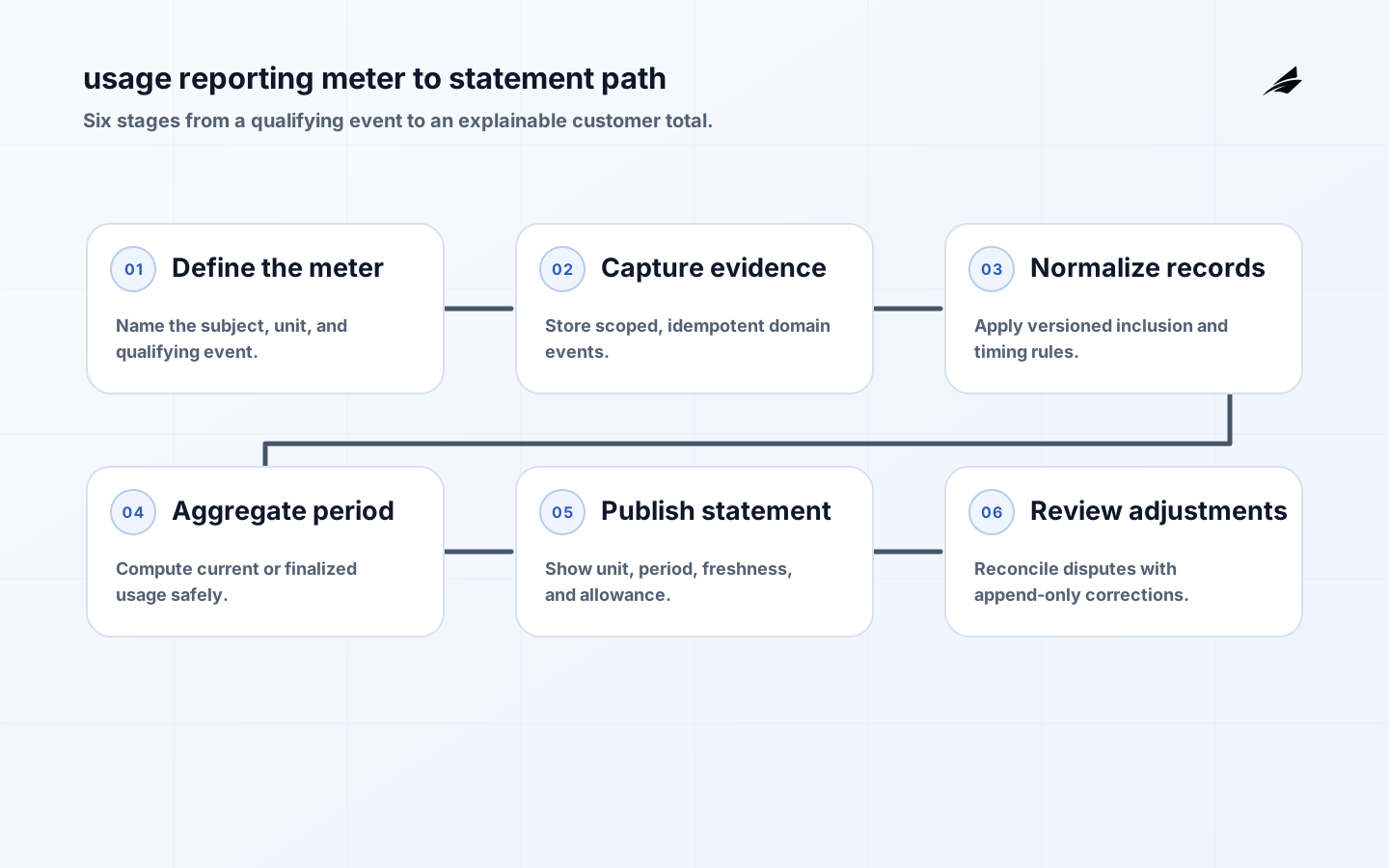
Usage reporting is the customer-visible expression of a metering contract. It may support invoicing, plan limits, capacity planning, customer success, or a simple product dashboard, but it must answer the same basic questions: what was counted, for whom, over which period, at what time, and how can an unexpected number be explained? A counter that looks plausible but cannot be reconstructed creates commercial and operational risk.
Why Usage Reporting Matters
The word 'usage' hides different measurements. A monthly active user, an API request, a completed document, a gigabyte stored, and model tokens each need different event boundaries and aggregation rules. Decide whether an attempted action counts, a successful action counts, a reserved capacity counts, or an adjusted record counts. That definition belongs in product terms that customers can understand, not only in a warehouse query maintained by one engineer.
Usage data may drive a customer limit or invoice, so it should not be treated like informal analytics. A late event, duplicate delivery, clock skew, changed unit, or cross-tenant aggregation can produce a dispute. Build a meter that preserves source evidence and calculation versions. The reporting layer can then show a simple total while operators retain a path to trace it back to the underlying domain events.
Define the Meter Contract
For every meter, document the subject, unit, qualifying event, exclusion rule, time basis, aggregation window, rounding policy, correction process, and owner. Keep the event identifier, workspace scope, occurrence time, ingestion time, and schema version. If a customer can use several workspaces under one commercial account, define whether reporting aggregates those workspaces and how that mapping changes over time. A billing relationship is not a reason to guess at data ownership.
| Meter question | Example decision | Why it prevents disputes |
|---|---|---|
| What is counted? | A successfully completed export, not an attempted click. | Sets a verifiable event boundary. |
| Whose usage is it? | The workspace that owned the job at execution. | Avoids attribution by mutable user profile. |
| When does it count? | The event's occurred time in UTC. | Handles delayed ingestion consistently. |
| How are corrections made? | Append an adjustment with a reason. | Preserves the original evidence and calculation history. |
Choose event capture close to the domain outcome. An API gateway can count requests, but it cannot always know whether a processing job succeeded or whether a retry is a new billable action. The service that completes the work can emit the qualifying event with the best context. Use durable delivery where loss would affect commercial records, and make consumers idempotent. A meter should be able to ignore a duplicate without losing the diagnostic evidence that it arrived twice.
Build a Reconcilable Pipeline
Separate raw events, normalized usage records, period aggregates, and published statements. Raw events preserve what the system observed; normalized records apply the meter contract; aggregates answer product and billing queries; statements present the approved result to a customer. This separation lets a team fix a transformation or rule and recompute an affected period without rewriting history. It also provides a bounded place to apply authorized credits or corrections.
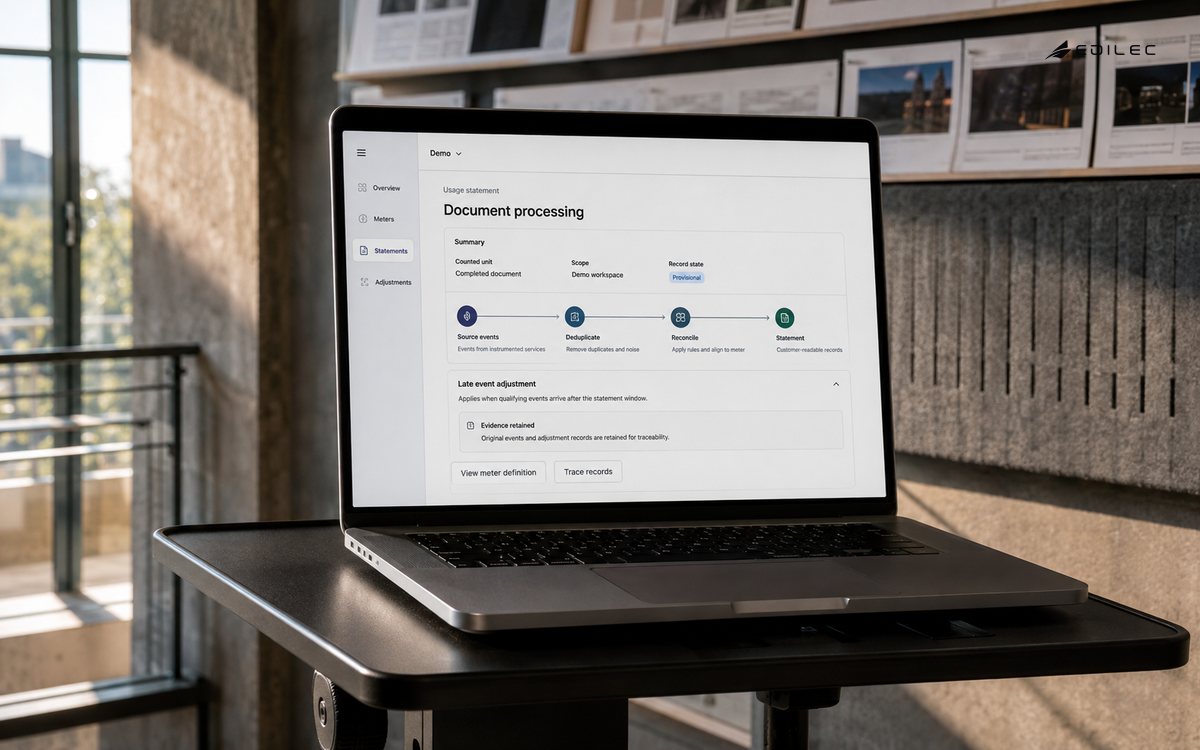
Use a closing process for periods. Some products allow late events to update a current estimate, then freeze an invoice-ready period with documented cutoffs and adjustment rules. Others show only near-real-time operational usage. Do not blend those promises accidentally. Label whether a number is estimated, final, pending, or corrected, and preserve the calculation version. A customer should not need to infer why yesterday's total changed.
Present Usage Clearly
A customer-facing report should state the meter name, unit, period, current total, included allowance where relevant, data freshness, and an explanation route. Show a drill-down only when it helps the customer verify the number without exposing sensitive internal telemetry. For a limit, warn before the threshold and explain the consequence of crossing it. Do not surprise users with a hard denial after a hidden counter has already reached the boundary.
| Report state | What the customer sees | Operational meaning |
|---|---|---|
| Current estimate | Usage so far and last update time. | Late records may still arrive. |
| Finalized period | Approved total and calculation date. | Ready for billing or formal review. |
| Corrected record | Adjustment and effective impact. | An auditable rule or support action changed the result. |
| Unavailable data | Explicit freshness issue and next update. | Do not display a misleading zero. |
Test meters with duplicate events, missing events, retries, late arrivals across a period boundary, tenant migrations, changing plan terms, and manual adjustments. Construct fixtures where the correct answer is known and run them through the same aggregation path used in production. Reconciliation should compare domain records, raw meter events, aggregates, and any downstream billing export. Sampling a few high-usage and low-usage customers catches mistakes that aggregate health checks can miss.
Monitor and Resolve
Monitor event lag, duplicate rate, rejected schema records, aggregate freshness, reconciliation differences, adjustment volume, and customer questions about usage. When a dispute occurs, make the investigation reproducible: identify the meter definition and version, the subject, the period, raw qualifying events, adjustments, and published statement. A support response can then explain the result or correct it with evidence, rather than escalating every question to the data team.
Example: API Usage
An API platform bills for successful document-processing jobs. The worker emits a domain event only after a document reaches a terminal successful state, including workspace ID, job ID, occurred time, unit count, and schema version. The metering service deduplicates by job ID and maintains current-period aggregates. The customer dashboard shows the current estimate, allowance, last update, and a list of recent completed jobs. At period close, late events become explicit adjustments rather than silently changing a finalized invoice.
The usage-based reporting guide is a useful companion when commercial and operational reporting need to agree. Use it to bring product, finance, data, and support together around one meter definition before exposing a number to customers.
Review Meter Integrity
Before a meter becomes a contract term, run a shadow period. Calculate usage with the proposed logic alongside the current method or a manual reference, investigate material differences, and publish the expected treatment of edge cases. Ask customer-facing teams whether they can explain the unit in ordinary language. A technically exact counter is still a poor product measure if the buyer cannot predict what behavior increases it or how to verify an unexpected total.
Plan for historical change explicitly. If a unit changes, a service is replaced, or a tenant moves to a new commercial account, preserve the previous meter definition and its effective dates. Avoid recomputing a closed statement under a new rule without an adjustment record. Migration scripts should produce reconciliation output for affected subjects, and finance should sign off on the sample. This discipline keeps reporting credible when product architecture and pricing evolve at different speeds.
Set ownership for the full meter lifecycle, not only the dashboard. A domain team should own the qualifying event, a platform or data team should own delivery and aggregation reliability, finance should approve invoice-facing interpretations, and support should have a bounded dispute tool. Review responsibilities when a meter crosses a new product boundary. This shared model helps teams distinguish a pipeline incident, a business-rule question, and a customer-specific adjustment, so each issue reaches the person equipped to resolve it.
Protect usage reports from avoidable access mistakes. Customer-facing views should show only the active commercial subject, while internal aggregate reports should separate tenant-scoped operations from broader business analysis. Do not leak a customer's activity through ranking, benchmarking, or error messages. For APIs that expose usage, authorize both the caller and the workspace or billing account, and rate-limit expensive drill-downs. Metering data can reveal sensitive operating patterns even when it contains no free-form customer content.
Document the customer-facing vocabulary before publishing a new meter. Explain the unit, when it is recorded, whether retries count, how the period closes, what happens after a correction, and where a customer can seek clarification. Put the same definitions in sales enablement and support material. A transparent explanation can prevent disputes that no amount of back-end precision will solve after the fact. It also forces the team to resolve ambiguous rules while changes are still inexpensive and before an invoice turns them into a commitment.
Add a pre-release meter review to changes that can alter volume: retry behavior, batch sizing, a new API version, or a migration. The team should state whether the change affects the qualifying event, unit, timing, or customer report, then test the answer with known fixtures.
Publish the review outcome with the release record so finance, support, and engineering can trace the reason for any later usage shift.
Key Takeaways
- Define the qualifying event, subject, window, and correction rule in product language.
- Preserve raw evidence, normalized records, aggregates, and statement versions separately.
- Label estimates, final totals, and corrections honestly.
- Make every customer-facing number traceable through a reproducible dispute path.
Frequently Asked Questions
Can analytics events be used for billing? Sometimes, but only when their completeness, idempotency, retention, and correction behavior meet the commercial meter's requirements. Informal click tracking rarely does. Should usage update in real time? Only if the product can support a reliable current estimate. Otherwise show a clear freshness time and choose a reporting cadence that customers can trust.
Conclusion
Usage reporting is dependable when it makes the meter contract visible and auditable. Carefully defined events, traceable aggregates, honest report states, and a practical correction path let customers and operators share the same account of what happened.
Sources
For supporting patterns, consult OpenTelemetry, Stripe Billing, the Google SRE Workbook on monitoring, and the AWS Well-Architected SaaS Lens.