Network Observability in Production: Signals and Response
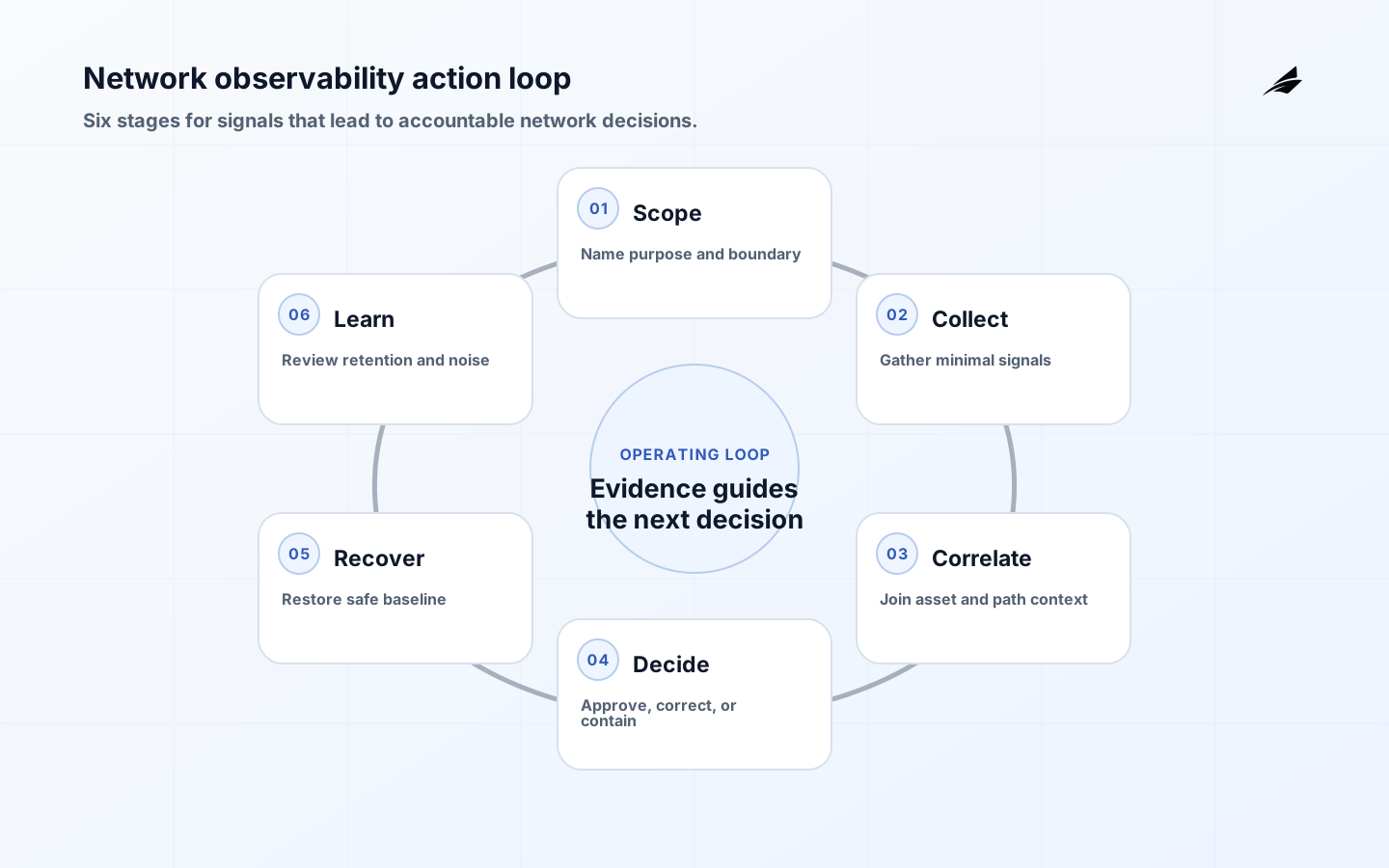
Network observability moves into production when it stops being a technical option and becomes an operating commitment. The question for IT managers is not whether the technology can be demonstrated; it is whether network behaviour across devices, sites, and operational boundaries can support explain service impact quickly enough to support a safe technical and operational response through ordinary change, failure, and handoff. For network observability, a credible plan makes the outcome, authority, evidence, and recovery route explicit. For network observability, it also gives operators a way to challenge a misleading result without needing the original implementation team. For network observability, this guide focuses on those production decisions: define the useful boundary, make the architecture inspectable, put controls around consequential actions, and learn from the cases that do not behave as planned.
Choose the network questions worth answering
Network observability is not a promise to collect every packet forever. It is the ability to answer useful questions about reachability, path, performance, change, and impact for a named service or asset group. Define the critical journeys first: device to gateway, gateway to broker, operator workstation to supervisory service, or remote support session. For each, decide which evidence is needed, who may see it, how long it is retained, and what response it enables.
For network observability, the scope statement should include an owner, a measurable outcome, the systems it touches, the constraints it cannot violate, and a condition for stopping or escalating. For network observability, that discipline keeps a connected-operations initiative from absorbing every adjacent problem. For network observability, it also gives procurement, security, and site teams a concrete basis for review: they can inspect the stated behaviour rather than infer it from a product diagram. The implementation choices should be checked against NIST SP 800-82 Rev. 3: Guide to Operational Technology Security and NIST IR 8259: Foundational Cybersecurity Activities for IoT Product Manufacturers; these sources are useful for framing capabilities and constraints, while local process and safety requirements still decide the final control.
| Decision area | Question to settle | Evidence before release |
|---|---|---|
| Outcome | What decision does network observability improve? | Named user, action, timing, and success measure |
| Authority | Who may change, approve, or override it? | Role, approval path, and retained decision record |
| Data | What source is authoritative? | Identifier, time basis, quality rule, and owner |
| Failure | What happens when a dependency is unavailable? | Safe state, escalation route, and recovery test |
Trace network evidence from packet to decision
Combine complementary evidence: device and interface metrics, flow or connection records, DNS and identity context where appropriate, configuration and change events, and application-level signals. Synchronised time and durable identifiers make those sources correlatable. Keep collection pathways separate enough that a network incident does not also erase the evidence needed to diagnose it. NIST log-management guidance provides a sound basis for planning collection, normalisation, retention, and analysis.
In a network observability design, make interfaces readable by people who must support them. For network observability, each boundary should expose a stable identifier, the relevant time, a quality or delivery state, and a correlation reference that ties one component's record to the next. For network observability, avoid hiding recovery behind a generic retry. For network observability, a retry is only safe when repeating the operation cannot create a second business or operational effect. For network observability, NIST SP 800-92: Guide to Computer Security Log Management is a useful reference for planning the collection and retention of the evidence needed to reconstruct an important event.
Protect capture, access, and response authority
Observation can expose sensitive topology, destinations, and user activity. Apply role-based access, minimum collection, protected transport, retention limits, and audit records to the observability system itself. Validate time sources and collector health; an attractive dashboard built on skewed clocks can create a false incident narrative. Integrate change records so responders can distinguish a new fault from an intended policy or configuration change.
| Control | Why it matters | Practical test |
|---|---|---|
| Identity and access | Limits who or what may act. | Attempt an unauthorised request and confirm it is denied and recorded. |
| Change management | Makes altered behaviour reviewable. | Trace a production change to an owner, reason, and approval. |
| Integrity check | Prevents silent corruption or substitution. | Send malformed, stale, or unexpected input through the boundary. |
| Recovery path | Prevents improvised high-risk fixes. | Rehearse rollback or isolation with the responsible operational role. |
Turn path changes into owned investigations
Measure coverage of critical paths, telemetry freshness, collector loss, time skew, baseline latency and loss, unexpected destination changes, configuration drift, and mean time to form a supportable hypothesis. Avoid presenting one health score as truth. A degraded link, a delayed broker, and a rejected credential can look similar to a user but need different evidence and owners.
For network observability, a metric is useful when it changes a decision. For network observability, agree which person reviews each signal, how often, what range is normal, and what action follows an exception. For network observability, pair technical measures with a sample of real cases so that apparent improvement is not masking a new manual workaround. For network observability, NIST SP 800-61 Rev. 2: Computer Security Incident Handling Guide is valuable here because recovery is a coordinated process of analysis, containment, restoration, and learning, not a dashboard state.
Expand coverage only after signal review
Select a small number of high-value journeys and map their expected path before installing broad collection. Capture a baseline through normal production and a planned change, then rehearse a diagnosis with network and operations staff. Add data sources only when they shorten a real investigation or improve a decision. This keeps cost and privacy proportional to the operational benefit.
For this network observability rollout, before broad release, document the acceptance evidence for the bounded path: expected inputs, expected outputs, access constraints, known limitations, support contact, and rollback trigger. For network observability, keep the first rollout small enough that people can inspect individual outcomes. For network observability, this makes the next expansion a decision based on observed behaviour rather than confidence in a presentation or a single test environment.
Handle blind spots, overload, and recovery
During an incident, preserve the relevant time window, configuration state, and correlation identifiers before sampling changes. Record the hypothesis and the action taken; a responder should be able to distinguish observed fact from an inference. After restoration, test whether the chosen signals would expose the same issue earlier next time. Improve the missing evidence, not only the alert threshold.
For network observability, make the recovery procedure proportionate to consequence. For network observability, lower-risk cases may be automatically retried with a cap and a visible reason; higher-consequence cases should pause, preserve evidence, and call a responsible person. For network observability, the key is to preserve a trustworthy history of what was observed and what was decided. For network observability, that record supports users in the moment and lets the team improve the boundary, not merely close the ticket.
Review observability with network operators
Conduct an observability review around a recently difficult incident or planned network change. Give responders the evidence they would have had at the time and ask which question each source answers, which timestamps are trustworthy, and where access or retention blocks a needed investigation. The goal is not a larger dashboard. It is a shorter path from symptom to a supportable hypothesis, with enough context to distinguish configuration drift, connectivity failure, identity trouble, and application delay.
Keep an investigation worksheet for each critical journey with expected path, normal ranges, relevant collectors, timestamp source, and access owner. It gives responders a repeatable starting point and exposes gaps before a major outage requires an improvised search.
Review permissions for packet, flow, and configuration evidence during calm periods. Delayed approval for diagnostic access can turn a short interruption into a long, speculative investigation.
Create a signal contract for network paths
Production network observability should answer an operational question such as “which approved path is failing?” or “which new route increases risk?” Avoid collecting every possible packet or metric without a retention, access, and response decision. NIST SP 800-92 supports deliberate log management, and OpenTelemetry semantic conventions provide a shared vocabulary for signals that must be joined across services. NIST SP 800-61 Rev. 2 is useful when an observation must move from detection into containment and recovery.
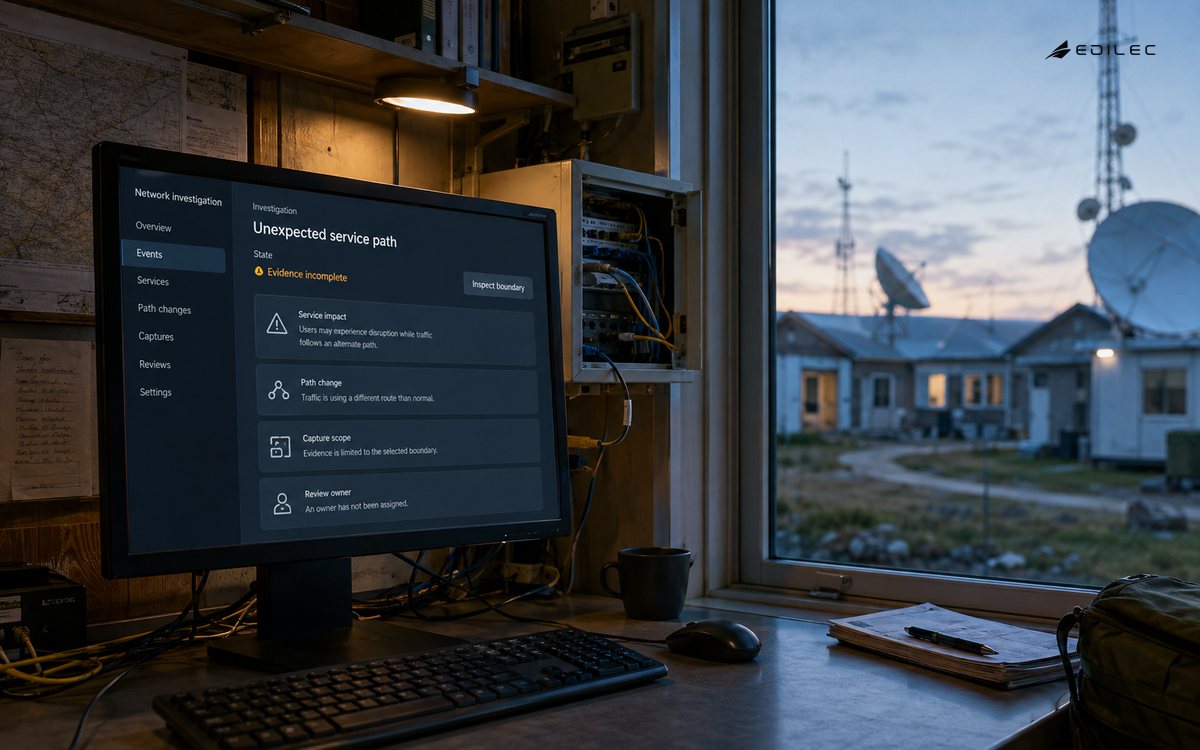
Example: an unexpected east-west path between services
Suppose a new device begins contacting a controller subnet. The useful record includes the device identity, source and destination zones, protocol, first-seen time, change context, rule decision, and owner. A high-volume deny count alone is not a success metric: it may signal a broken dependency, an unmanaged asset, or a scan. Route the observation to the team able to verify the asset and either approve, isolate, or correct it. Record the decision and expiry when a temporary permit is granted.
| Signal | Question it should answer | Action it enables |
|---|---|---|
| New asset | What appeared, where, and who owns it? | Inventory, verify, or isolate. |
| New path | Which zones or services now communicate? | Review policy and change context. |
| Denied flow | Is this expected work or a broken dependency? | Correct, contain, or document exception. |
| Recovery signal | Has the safe baseline returned? | Resume service and close the incident. |
Use Network Segmentation for Connected Systems: Trust Zones and Recovery for segmentation decisions, What Changes When Protocol Selection Moves into Production for protocol trade-offs, and Device Identity for Connected Systems: Credentials and Lifecycle for identity context. Observability becomes actionable when those three questions—boundary, protocol, and identity—can be answered in the same investigation.
For device-facing context, NIST IR 8259 Rev. 1 helps teams ask whether an observed device can provide the identity, update, and support information needed for a useful investigation.
Network-observability takeaways
- Start with critical service journeys and the questions they must answer.
- Correlate flow, device, configuration, identity, and application evidence.
- Protect observability data as sensitive operational information.
- Monitor collector and clock health alongside the network.
- Use baselines to identify meaningful deviations.
- Capture incident evidence before changing the conditions being investigated.
Network observability questions
Is network observability the same as network monitoring? Monitoring often reports known measures; observability joins evidence to investigate changing or previously unknown behaviour.
Do teams need full packet capture? Not always. Use the least invasive evidence that answers the decision, with escalation options for deeper investigation.
How do we avoid surveillance concerns? Set an explicit purpose, minimise collection, constrain access and retention, and audit use of sensitive data.
Related network operations reading
For adjacent operating decisions, read What Changes When Protocol Selection Moves into Production, IoT Telemetry Decisions That Matter before the First Build, and Edge Gateways: An Implementation Checklist That Holds Up. For network observability, together, these guides help teams connect the immediate implementation choice to the surrounding data, security, and service responsibilities.
Conclusion: make network evidence actionable
Network observability earns its place in connected operations when the team can explain the outcome, boundary, trust model, operating signals, and recovery route in plain language. For network observability, start with one consequential path, retain evidence at each handoff, and let real operating results determine the next investment. That approach leaves IT managers with something more durable than a feature: a system people can run and improve under pressure.