What Changes When Edge Computing Moves into Production
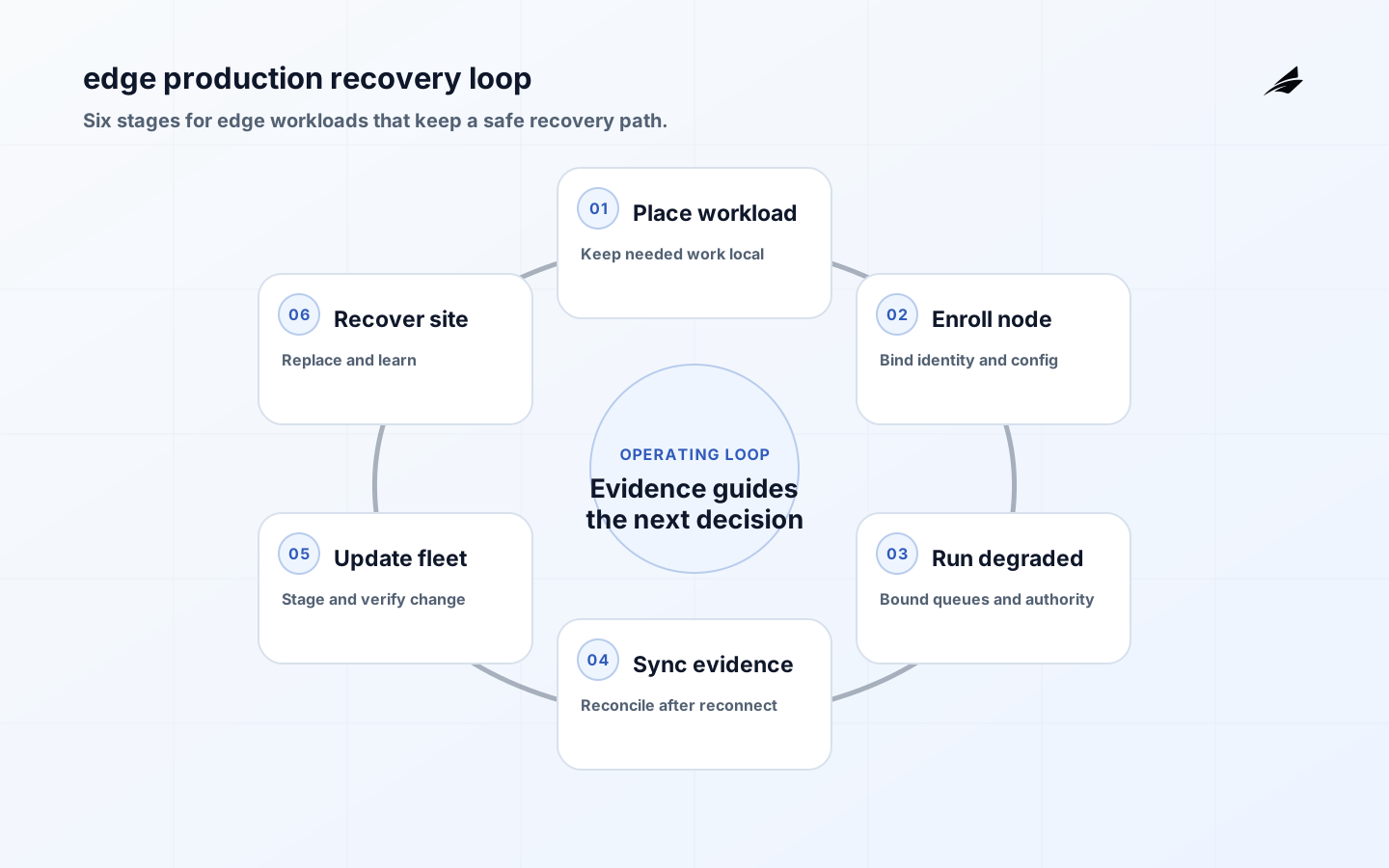
Edge computing changes production operations because computation, storage, identity, and recovery are distributed across physical sites. The design question is not whether a node can run a workload near a device; it is whether the organization can define local authority, keep the process safe when the link is unavailable, update a fleet consistently, and explain what happened later. A production edge deployment is therefore a service boundary with a site procedure, not only a faster endpoint.
Define the edge computing production scope
Use edge computing when a local decision has a clear latency, bandwidth, privacy, resilience, or integration reason. That is narrower than saying a site has poor connectivity. Write the local outcome, the maximum acceptable delay, the data that may leave the site, and the safe behavior during disconnection. Without this boundary, teams reproduce cloud services at every site and inherit a difficult fleet-management problem without a measurable benefit.
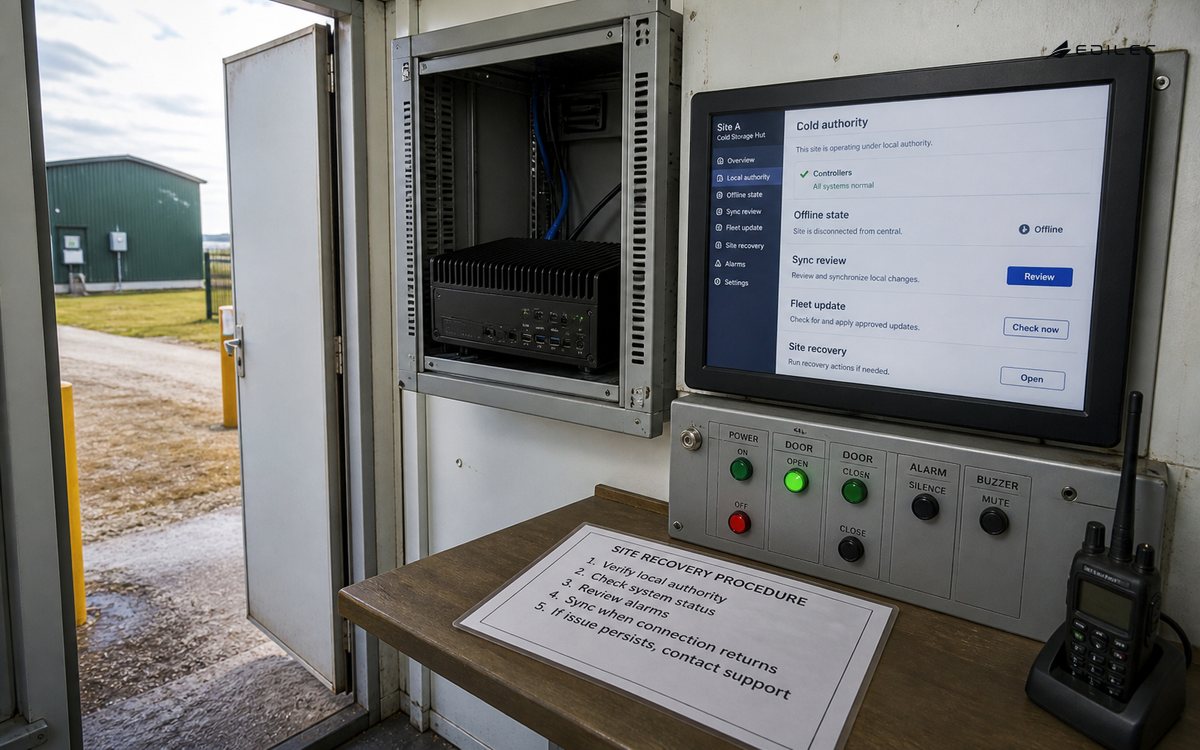
The edge scope statement should name an owner, measurable outcome, touched systems, hard constraints, and a stop or escalation condition. For this deployment, NIST SP 800-82 Rev. 3 and NIST IR 8259 frame the OT and IoT capability boundary; local process and safety requirements decide the final control. Procurement, security, and site teams should review the stated safe state instead of inferring behavior from a product diagram.
| Decision area | Question to settle | Evidence before release |
|---|---|---|
| Outcome | What decision does edge computing improve? | Named user, action, timing, and success measure |
| Authority | Who may change, approve, or override it? | Role, approval path, and retained decision record |
| Data | What source is authoritative? | Identifier, time basis, quality rule, and owner |
| Failure | What happens when a dependency is unavailable? | Safe state, escalation route, and recovery test |
Expose State at Every Edge Boundary
A sound edge design distinguishes local state from replicated state. Identify what must be authoritative at the site, what can be cached, what events must be forwarded later, and which actions require a remote authority. Package workloads so that configuration, version, identity, and dependencies are explicit. Local storage needs retention and recovery rules; a disk filling during an extended outage is an expected operating condition, not a rare edge case.
In an edge computing design, make interfaces readable by people who must support them. Each boundary should expose a stable identifier, the relevant time, a quality or delivery state, and a correlation reference that ties one component's record to the next — when the queue fills. Avoid hiding recovery behind a generic retry. A retry is only safe when repeating the operation cannot create a second business or operational effect — after a staged update. NIST SP 800-92: Guide to Computer Security Log Management is a useful reference for planning the collection and retention of the evidence needed to reconstruct an important event — across remote sites.
Bound Local Authority and Remote Change
Treat every gateway or edge node as a managed asset with a unique identity, least-privilege service accounts, signed software, and a way to revoke access. Keep local operator access constrained and recorded. NIST's IoT manufacturer activities and operational-technology guidance offer a useful reminder: lifecycle capabilities such as inventory, configuration, update, and incident response must exist before fleet size makes manual care implausible.
| Control | Why it matters | Practical test |
|---|---|---|
| Identity and access | Limits who or what may act. | Attempt an unauthorised request and confirm it is denied and recorded. |
| Change management | Makes altered behaviour reviewable. | Trace a production change to an owner, reason, and approval. |
| Integrity check | Prevents silent corruption or substitution. | Send malformed, stale, or unexpected input through the boundary. |
| Recovery path | Prevents improvised high-risk fixes. | Rehearse rollback or isolation with the responsible operational role. |
Read Edge Health as Process Evidence
Track workload version spread, connection-loss duration, queued-event age, storage headroom, restart rate, clock skew, and remote-management success. Pair these with an outcome measure, such as local decision latency or prevented production interruption. A healthy edge fleet is not one that never disconnects; it is one whose disconnected behaviour is expected, observable, and recoverable.
For edge computing, a metric is useful when it changes a decision. Agree which person reviews each signal, how often, what range is normal, and what action follows an exception — during heartbeat loss. Pair technical measures with a sample of real cases so that apparent improvement is not masking a new manual workaround — for the degraded state. NIST SP 800-61 Rev. 2: Computer Security Incident Handling Guide is valuable here because recovery is a coordinated process of analysis, containment, restoration, and learning, not a dashboard state — before fleet expansion.
Expand the Fleet One Verified Site at a Time
Pilot one site and one bounded function. Exercise cold start, network loss, delayed reconnection, expired credentials, full local storage, and a failed update before expansion. Capture a support runbook that tells a site technician what they can safely inspect or restart and when to stop. Use the pilot to decide what must be automated before the next ten sites, not merely to prove a demo.
For this edge computing rollout, before broad release, document the acceptance evidence for the bounded path: expected inputs, expected outputs, access constraints, known limitations, support contact, and rollback trigger. Keep the first rollout small enough that people can inspect individual outcomes — at the edge node. This makes the next expansion a decision based on observed behaviour rather than confidence in a presentation or a single test environment — during a cloud outage.
Make Disconnection and Replacement Routine
When an edge node fails, protect the process first and then collect its evidence. Decide whether it can return to a known-good version, must be replaced, or should stay isolated until inspection. Reconcile locally queued records only with durable identifiers and timestamps; blindly replaying actions can duplicate a business effect. A replacement procedure should provision identity, configuration, and software without relying on tribal knowledge.
For edge computing, make the recovery procedure proportionate to consequence. Lower-risk cases may be automatically retried with a cap and a visible reason; higher-consequence cases should pause, preserve evidence, and call a responsible person — before local authority is granted. The key is to preserve a trustworthy history of what was observed and what was decided — in the replacement runbook. That record supports users in the moment and lets the team improve the boundary, not merely close the ticket — when the queue fills.
Review the Edge Service at the Site Boundary
An edge review should include the site technician, service owner, security lead, and the team that consumes later-synchronised data. Put the node into the conditions it will actually see: weak connectivity, a power interruption, a full disk, and an unavailable remote management plane. Confirm what continues locally, what queues, and what becomes unsafe to attempt. The resulting evidence should be a usable site procedure and a fleet-level decision, not an assumption that central support can always intervene.
Record a site acceptance checklist with local dependencies, capacity limits, permitted support actions, last successful recovery rehearsal, and replacement prerequisites. This is more valuable than a generic platform diagram because it tests the conditions that make each deployed node supportable.
Key takeaways
- Put a local outcome and safe disconnected state at the centre of the design.
- Separate authoritative site state from cache and later replication.
- Manage edge nodes as a fleet, not as bespoke servers.
- Test storage pressure and reconnection as normal conditions.
- Give site staff a narrow, documented support role.
- Expand only after the pilot has a repeatable replacement path.
Frequently asked questions
Is edge computing always faster? It can reduce round-trip delay, but the useful question is whether local processing improves a required decision or resilience outcome.
What should happen when the cloud is unavailable? The answer depends on the process; specify which local actions continue, which are queued, and which must stop safely.
How is an edge node updated? Use an authenticated, staged procedure with version evidence, health checks, and rollback rather than an untracked remote change.
Edge Deployment Context
For adjacent operating decisions, read What Changes When Offline Sync Moves into Production, What Changes When Protocol Selection Moves into Production, and Industrial Dashboards Decisions That Matter before the First Build. Together, these guides help teams connect the immediate implementation choice to the surrounding data, security, and service responsibilities — after a staged update.
Operate the edge as a recoverable service
A site outage example
Imagine an edge node that buffers production telemetry while the central service is unavailable. The node should keep a bounded, encrypted queue, preserve event and configuration identity, continue only the local functions it is authorized to run, and expose a clear degraded state to site staff. When connectivity returns, reconciliation must use durable identifiers and an explicit ordering rule; blindly replaying commands can duplicate a business effect. The replacement procedure should restore identity, approved software, configuration, time synchronization, and workload health in a known order, with evidence at each handoff.
Signals of Edge Service Degradation
A production edge review should include queue age and capacity, stale heartbeats, software-version drift, certificate expiry, clock offset, rejected updates, local disk pressure, and time to replace a failed node. Pair these with process signals such as missed telemetry, unsafe transitions, or manual workarounds. Central dashboards must distinguish “healthy,” “not reporting,” and “last known healthy” so a disconnected site is not mistaken for an operating one. Use a small pilot to rehearse a network outage, a failed update, and a hardware replacement before multiplying sites.
- Define the local safe state and the functions that must stop.
- Bound local storage and state what is shed when it fills.
- Use unique identity and versioned desired configuration.
- Make updates staged, observable, and reversible.
- Rehearse replacement with the people who support the site.
Edge Operations and Security References
Use NIST SP 800-82 Rev. 3: Guide to Operational Technology Security, NIST IR 8259: Foundational Cybersecurity Activities for IoT Product Manufacturers, NIST SP 800-92: Guide to Computer Security Log Management, NIST SP 800-61 Rev. 2: Computer Security Incident Handling Guide as reference points for the control, data, accessibility, security, or operating semantics relevant to this decision. These references frame edge controls; the site safe-state contract decides which local actions may continue. They help the team name assumptions, choose evidence, and make a review concrete enough that another person can verify what the system is expected to do — across remote sites.
Related Guides for Edge Reliability
For adjacent decisions, continue with What Changes When Offline Sync Moves into Production, What Changes When Protocol Selection Moves into Production, Industrial Dashboards Decisions That Matter before the First Build, then compare the definitions, ownership boundaries, and recovery behavior before widening the implementation.
Conclusion
Edge computing earns its place in connected operations when the team can explain the outcome, boundary, trust model, operating signals, and recovery route in plain language. Start with one consequential path, retain evidence at each handoff, and let real operating results determine the next investment — during heartbeat loss. That approach leaves IT managers with something more durable than a feature: a system people can run and improve under pressure — for the degraded state.