Device Identity in Production: Lifecycle and Access Controls
Device identity is the basis for deciding which connected system may publish telemetry, receive a command, access an asset, or participate in a tenant's workflow. In a prototype, a device name or shared credential may seem sufficient. In production, identity must survive manufacturing, provisioning, installation, replacement, fleet growth, credential rotation, network changes, and retirement. It must also be understandable to support staff. NISTIR 8259A gives a concrete baseline for device cybersecurity capabilities; use it to connect credential state to ownership, maintenance, and retirement evidence.
Define what identity must authorize
Do not treat authentication as a complete identity model. First list the actions a device or gateway may take: publish a measurement, read configuration, request a firmware update, trigger an actuator, or prove a maintenance event. Each action needs a subject, resource, scope, state condition, and audit expectation. A device may be allowed to publish to its own telemetry topic but not read another asset's history. A gateway may act for a group of devices but should not silently acquire their full authority. NIST SP 800-63B is useful for separating authenticator lifecycle from the application authorization decision.
Separate device, asset, and organization identity
A device is a physical or logical endpoint. An asset is the thing being monitored or controlled. An organization, tenant, site, or customer owns a business relationship. They can change independently. A sensor may be replaced while the asset history continues; an asset may move between sites; a contractor may operate equipment without owning it. Store these relationships with effective dates and authority. Avoid putting tenant meaning into a certificate subject or mutable device label. The identity system should answer both “which credential spoke?” and “which business object did that action concern?”
| Identity layer | Example | Control to define |
|---|---|---|
| Endpoint | A sensor, gateway, or controller credential. | Authentication, rotation, and proof of possession. |
| Device record | Model, firmware, serial, status, and capabilities. | Lifecycle state and allowed protocol behavior. |
| Asset | Motor, vehicle, meter, or installed unit. | Relationship, location, and business history. |
| Organization | Customer, tenant, site, or operator group. | Ownership, scope, and data boundary. |
| Actor | Technician, service, or delegated workload. | Human or workload authority and audit context. |
Design provisioning as a controlled lifecycle
Provisioning should establish identity, initial trust, ownership, capabilities, and a path for support. Record who or what enrolled the device, where it was intended to operate, which policy version applied, and when the credential became active. Avoid a process where production credentials are copied into a spreadsheet or shared across a batch. If manufacturing and installation are separate, create a handoff that preserves chain of custody. AWS IoT Fleet Provisioning illustrates the enrollment mechanics; your operating model must still name who can activate, pause, reassign, or retire an endpoint.

- Unique identity and credential reference without exposing secret material in general tooling.
- Device model, serial, firmware, capability set, and expected protocol behavior.
- Intended customer, site, asset relationship, and installer or enrolling authority.
- Activation time, policy version, initial health check, and approval where required.
- Recovery path for failed enrollment, duplicate identity, or device that arrives at the wrong site.
- An explicit state for pending, active, suspended, retired, and revoked.
Rotate credentials without losing the business record
Credential rotation is a lifecycle operation, not only a security task. Support a transition where an old and new credential can be recognized for a bounded period, then revoke the old one. Bind the new credential to the same device record only after proof and policy checks. Keep credential identity separate from device identity so rotation does not create a new asset history or conceal a compromise. Monitor failed authentication, unusual source changes, unexpected protocol use, and devices that never complete rotation. The TLS 1.3 specification can inform channel authentication and key changes, but the platform must define how a credential maps to permitted topics, commands, tenants, and state.
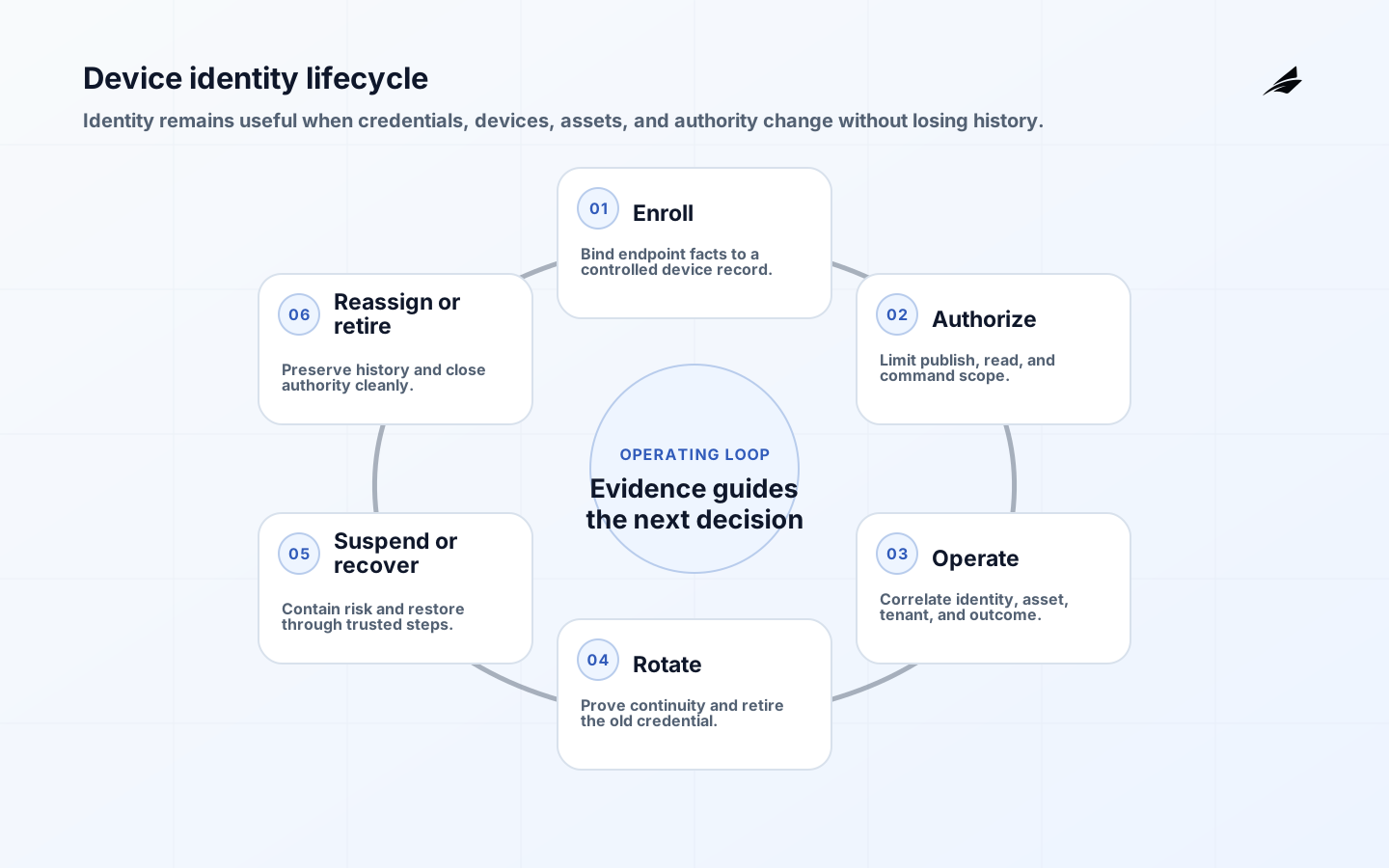
| Lifecycle event | Required decision | Evidence |
|---|---|---|
| Enroll | Who is allowed to create or activate an identity? | Actor, source, device facts, and policy version. |
| Rotate | How does the endpoint prove continuity? | Old/new reference, time window, and result. |
| Suspend | Which risk or operational event pauses access? | Reason, owner, affected scopes, and notification. |
| Reassign | Can the device move to another asset or tenant? | Effective date, approvals, and history boundary. |
| Retire | How are credentials revoked and data preserved? | Revocation result, final state, and retention decision. |
Authorize by scope and current state
Use least privilege at the action level. A telemetry publisher should not automatically receive configuration write access. A device that is active for one site should not publish to another tenant because a topic prefix was constructed incorrectly. Check identity, tenant, resource, capability, firmware status, and current lifecycle state at the service boundary. For high-consequence commands, require additional conditions such as a current assignment, operator confirmation, safety interlock, or online verification. Make policy failures observable without revealing sensitive details to an untrusted endpoint. Authorization is a runtime decision; a valid credential can still be out of scope.
Make the identity architecture observable
The identity path should connect enrollment, credential use, authorization, telemetry, commands, and lifecycle changes. Capture enough context to investigate a disputed action: device identity, credential reference, asset and tenant, policy result, command or topic, source network where appropriate, timestamps, and outcome. RFC 5280 is a precise reference for certificate validity and chain context; pair that with application evidence that explains scope, asset relationship, and the final decision. Keep secrets out of traces and avoid collecting more location or payload detail than the support decision needs.
Handle replacement and compromise
Replacement is common in physical fleets. Decide whether a replacement inherits the asset relationship, configuration, calibration, or only the service plan. Preserve the old endpoint as retired or compromised rather than deleting it. If a credential is suspected to be exposed, suspend it quickly, limit dependent actions, rotate or re-enroll through a trusted path, and review recent activity. A gateway compromise may affect many device identities, so model group impact and a safe recovery sequence. Keep the business record honest: a new endpoint should not make an old unauthorized action look as though it came from the replacement.
Move identity into production in stages
Start with inventory and lifecycle states before adding complex policy. Pick one device class and prove enrollment, normal telemetry, authorized command, rotation, suspension, replacement, and retirement. Test a device with an incorrect site, an expired credential, an old firmware version, duplicated identifiers, and a gateway that reconnects after a long outage. Use a manual approval for high-risk operations while evidence is still thin. TLS 1.3 can ground channel-security behavior, but acceptance should be based on your operators' ability to recover a device without bypassing the identity system.
Review identity failure modes
Watch for shared credentials, mutable identifiers, implicit tenant mapping, untracked replacements, overbroad gateway authority, credentials that never rotate, and revoked devices that remain visible as healthy. Another failure is a policy that is technically correct but impossible for support to diagnose. Give each denial a safe category and a route to resolution. Avoid making the device retry an authorization failure forever; that creates load and hides the real issue. NISTIR 8259 provides a useful foundation for baseline capabilities, but teams still need product-specific evidence for fleet size, physical access, data sensitivity, and command consequence.
- No production fleet depends on a shared secret that cannot be individually revoked.
- Device, asset, tenant, and credential records are related without collapsing their identities.
- Every privileged action checks scope, capability, lifecycle state, and current policy.
- Rotation and revocation are tested with devices that are online, offline, and partially updated.
- Replacement preserves history and makes the old endpoint's final state visible.
- Support can distinguish authentication, authorization, policy, and downstream failures.
Track enrollment and authorization health
Track enrollment success and time, duplicate identity attempts, authentication failures by reason, rotation completion, revoked-credential use, authorization denials by scope, devices without a current heartbeat, replacement reconciliation time, and unassigned or incorrectly assigned endpoints. Pair these with outcomes such as unauthorized commands prevented, time to recover a device, or support effort per lifecycle event. A low denial rate is not automatically healthy if policy is overbroad. The best metric is whether the fleet can change safely: register, operate, rotate, suspend, recover, and retire with clear evidence.
Device identity controls to carry forward
- Separate endpoint, device, asset, organization, and human or workload identities.
- Define the actions identity must authorize before selecting credential technology.
- Treat enrollment, rotation, suspension, reassignment, and retirement as first-class states.
- Check tenant, resource, capability, firmware, and current state at runtime.
- Preserve history through replacement and compromise recovery rather than deleting records.
- Measure safe lifecycle change and support diagnosability, not just login success.
Fleet identity questions answered
Is a certificate the same as device identity?
A certificate or key can authenticate an endpoint, but device identity also includes lifecycle, asset relationship, tenant scope, capabilities, and business authority. Keep credential and device records separate.
Should a gateway share one identity for all devices?
It may authenticate transport on behalf of a fleet, but the platform should preserve per-device identity and limit gateway authority. Otherwise attribution, revocation, and incident response become unnecessarily broad.
How often should device credentials rotate?
Set the interval from exposure, device capability, operational cost, and risk, then test the transition and recovery path. Rotation that cannot be completed safely is not a production control.
Conclusion: make identity a living operating record
Device identity becomes durable only when credential, endpoint, asset, tenant, permitted action, and lifecycle state remain related without becoming the same record. Prove that relationship through enrollment, rotation, suspension, replacement, and retirement exercises before a fleet makes exceptions costly. For neighboring concerns, see the alert routing guide, sensor calibration guide, and network segmentation field guide. The aim is not zero failures; it is contained failure with attribution and a recovery path that never requires bypassing authority.