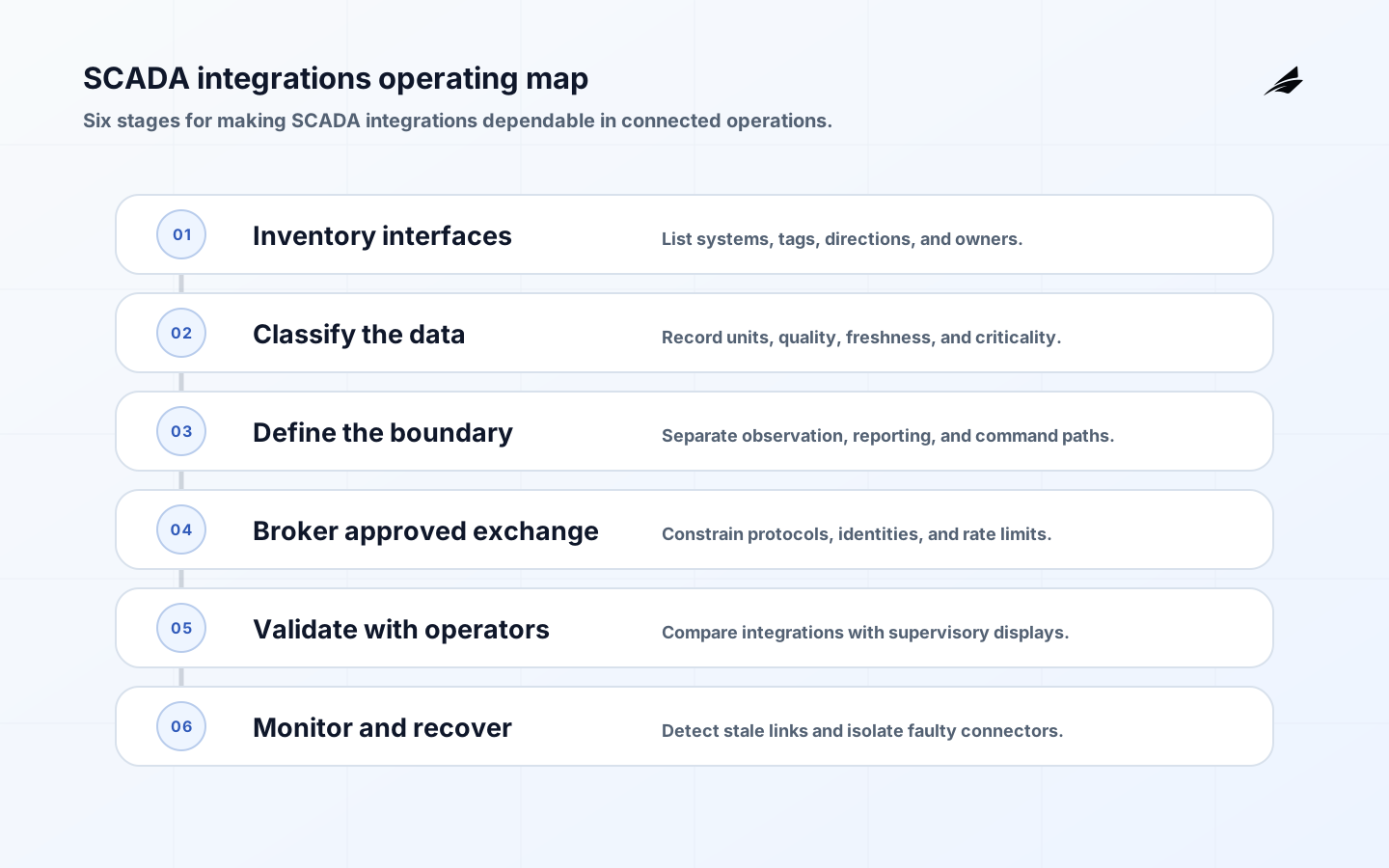
SCADA Integrations Checklist for Reliable Digital Operations is a practical planning guide for founders. SCADA integrations is valuable only when it supports a real operational decision: exchange operational information between supervisory systems and other business or analytical services without weakening control boundaries or misrepresenting process state. Treat it as an operating design problem, not a product category. The team needs to know the protected or controlled asset, the people who may act, the evidence that makes an outcome credible, and the condition that requires a different response. That framing makes early trade-offs visible. It also prevents a polished implementation from becoming an opaque dependency that nobody can safely change during an incident.
Define The Decision
Begin SCADA integrations work by writing down the decision in a form an operator can challenge. For this topic, the core asset is an interface register containing controller or SCADA source, tag meaning, engineering units, quality state, sampling rule, permitted direction, owner, and approved consumer. The boundary matters because a read path for reporting is not permission to command equipment; command workflows require explicit authority, confirmation, interlocks, and a clear record in the system that owns control. Ask what must still be true when an integration is delayed, a credential fails, a device is replaced, or an engineer is unavailable. A good answer names the system of record, the accountable owner, the required evidence, and the default safe behavior. It does not claim that a network, dashboard, gateway, or service is inherently trustworthy simply because it is familiar.
| Decision area | Question to settle | Evidence before release |
|---|---|---|
| Purpose | Which repeated operation does SCADA integrations improve, and what is the cost of a wrong result? | A named user, decision, and acceptance scenario. |
| Authority | Who can change policy, data, or configuration, and who may approve an exception? | Role mapping, approval record, and audit event. |
| Time | Which timestamps describe observation, receipt, action, and review? | Examples showing time zone, clock source, and stale-state behavior. |
| Failure | How should the system behave when there is a tag mapped with the wrong unit, a stale value treated as current, a polling load that harms a control network, or an integration that bypasses the operator’s established alarm workflow? | A tested fallback, notification owner, and recovery decision. |
Design The Operating Boundary
The architecture should make normal work and exceptional work equally legible. With SCADA integrations, that means separating the authoritative record from derived views, and separating a request for action from evidence that the action occurred. Avoid an all-or-nothing trust model. Constrain identities and connections to the least access that supports the workflow; keep policy, configuration, and operational records versioned; and retain the context needed to interpret older data. This is how a team can investigate an outcome without reconstructing intent from chat messages or a vendor console after the fact.

- Model the smallest SCADA integrations workflow that changes an important operational decision, including its unhappy path.
- Name the owner of the source record, the integration, the control rule, and the first-line support response.
- Make freshness, quality, identity, and authorization visible wherever a user is asked to rely on a signal.
- Use stable identifiers and change records so retries, replacements, and corrections can be explained rather than guessed.
- Set explicit limits for access, retention, rate, and scope before a convenient temporary exception becomes permanent.
- Test a tag mapped with the wrong unit, a stale value treated as current, a polling load that harms a control network, or an integration that bypasses the operator’s established alarm workflow with the people who would actually diagnose and recover it.
Stage The Rollout
A controlled rollout is evidence gathering, not merely a smaller deployment. For SCADA integrations, first integrate a small read-only set of noncritical, well-understood values, validate them alongside operator displays across shifts, then add consumers before considering control actions. Select a cohort that exposes meaningful variation but has clear operational cover. Decide in advance what result pauses expansion: a security control that cannot be verified, a mismatch between displayed and source state, a performance threshold, or a failed recovery test. Review both successes and near misses with the operating team. The aim is to make adoption repeatable, so the next site, device group, or workflow is added through a known decision rather than improvisation.
| Rollout gate | What to observe | Decision when it fails |
|---|---|---|
| Readiness | Inventory completeness, named owners, and documented preconditions. | Hold the cohort until the missing condition is resolved. |
| Behavior | Normal and adverse SCADA integrations scenarios under representative load and connectivity. | Correct the design or reduce the scope before expanding. |
| Control | Authentication, authorization, logging, and exception approval in the live path. | Remove the uncontrolled path and retest. |
| Recovery | Whether the team can execute isolate the connector, preserve a last-known-value marker and timestamps, and let the supervisory system remain authoritative when a downstream service is unavailable. | Keep rollout paused until recovery evidence is repeatable. |
Make Controls Operable
Controls only help when people can operate them under pressure. Design SCADA integrations so an on-call engineer or supervisor can see what changed, why the system took its current state, and what they are permitted to do next. Temporary access needs expiry and ownership. Changes need a version and a traceable approver. Sensitive actions need both a technical check and a humanly understandable confirmation. These habits reduce the chance that a local fix silently shifts risk elsewhere. They also give leadership a usable account of how the service is governed rather than a collection of screenshots.
Measure And Review
Choose measures that reveal whether SCADA integrations is reducing uncertainty in daily work. Track tag quality, interface latency, stale-value display, mapping changes, rejected writes, connection availability, and discrepancies found during operator reconciliation. Pair each indicator with a review question: is the number telling us about the controlled system, or only about the collector? Is a lower count a genuine improvement, or has visibility been lost? Can the owner explain a material change in the measure? This prevents dashboards and reports from becoming decorative. Review thresholds after incidents, staffing changes, and architecture changes, because the operating context can change faster than the metric definition.
| Signal | Why it matters | Review cadence |
|---|---|---|
| Coverage | Shows whether important assets and paths are represented, not just easy ones. | Weekly during rollout; monthly once stable. |
| Freshness | Distinguishes delayed evidence from a current operating state. | Continuously, with a visible stale threshold. |
| Exceptions | Shows where policy or workflow does not fit real work. | Each exception and a monthly trend review. |
| Recovery evidence | Proves the team can restore a known-safe state. | After change and through scheduled exercises. |
Use Authoritative References
This guide draws on Guide to Operational Technology Security, MITRE ATT&CK for ICS, Zero Trust Architecture, RFC 8446: TLS 1.3. These references do different jobs: they define security principles, protocol behavior, lifecycle expectations, or monitoring practices. They do not replace site-specific engineering review. Use them to test assumptions, especially where SCADA integrations crosses a trust boundary or affects a safety-relevant workflow. For related implementation context, read SCADA Integrations: Implementation Checklist, IoT Telemetry Explained: From Device Signal to Decision, and Network Observability: Mistakes and Fixes. Those pieces help turn the checklist into a connected operations plan rather than a stand-alone technical artifact.
Takeaways
- SCADA integrations should begin with a named operational decision and accountable owner.
- Keep the authoritative record, derived view, and action request distinguishable.
- Prove the unhappy path and recovery path before widening a rollout.
- Measure uncertainty reduction with freshness, exceptions, coverage, and recovery evidence.
- Review temporary access, policy changes, and operating thresholds as first-class work.
Faq
When is SCADA integrations worth doing? It is worth doing when the current workflow has a consequential decision that depends on fragmented, late, insecure, or difficult-to-explain information. Start where better evidence or a safer action would change an outcome, rather than where a new platform is easiest to buy. What is the smallest credible first release? Build one observable path with a real owner, one system of record, one exception route, and a tested recovery action. A narrow release that survives an outage teaches more than a broad launch that relies on manual workarounds. How should a team handle uncertainty? State it in the workflow. Mark data as stale or estimated, preserve the original evidence, and route ambiguous cases to a named reviewer. Hiding uncertainty creates faster-looking but less reliable operations.
Conclusion
Reliable SCADA integrations is less about adopting a fashionable architecture than about keeping promises through normal work, change, and failure. Establish the decision, identify the authoritative evidence, constrain access, stage the rollout, and rehearse recovery. Then use operational signals to revise the design. That sequence creates a system the team can run and explain, even when connectivity, staffing, or upstream services are not behaving politely.