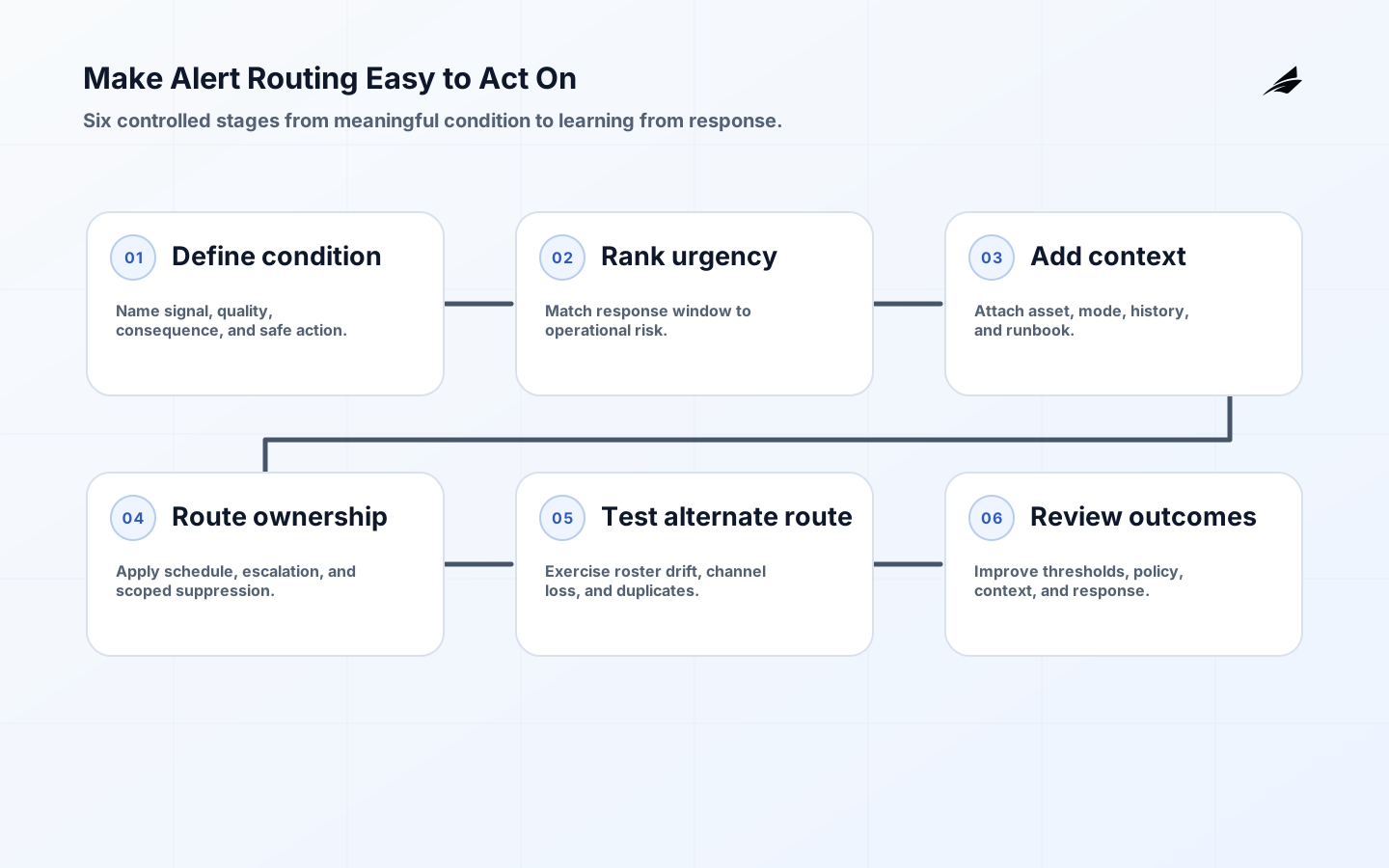
Alert routing is the operating path that turns a detected condition into an owned response. Detection alone does not protect a service. Someone must know what happened, why it matters, what evidence supports it, what action is safe, and what to do if the first notification path fails. A plain-language alert routing design makes those choices visible to the people who receive alerts and to the leaders accountable for the outcome.
What alert routing means
Separate signal, condition, alert, notification, acknowledgement, action, and resolution. A sensor value may be a signal; a sustained threshold breach may be a condition; an owned work item may be the alert; a page or message is only one notification channel. The alert routing architecture guide connects these terms to the service boundary. Clear language prevents a successful message delivery from being mistaken for a successful response. Cross-system response examples appear in SCADA integration checklist and Alert routing for growing teams.
| Stage | Question | Evidence |
|---|---|---|
| Detect | What changed and how certain is it? | Signal, threshold, quality, time |
| Classify | How urgent and consequential is it? | Severity rule and context |
| Route | Who can act and through which channel? | Owner, schedule, policy |
| Acknowledge | Has a person or system accepted it? | Actor, time, status |
| Resolve | Did the underlying condition end? | Outcome and follow-up |
Design the alert routing boundary
Keep detection logic separate from delivery policy where possible. The detector should preserve source, asset, observed time, quality, and condition details. The routing layer should apply severity, ownership, schedules, suppression, escalation, and channel choice. A notification provider is a dependency, not the source of truth. OpenTelemetry's observability primer supports a correlated view of signals; use a stable incident or event identifier so a message, acknowledgement, and resolution can be connected.
Set scope and urgency
Define the operational consequence before assigning a severity label. An advisory may belong in a daily queue; an urgent condition may need a staffed channel; a safety-relevant state may require local action independent of a cloud notification. Include freshness and quality context so a stale reading does not produce a confident page. NIST SP 800-82 Rev. 3 is relevant where availability and safe operation intersect. Severity should change the expected action, not merely the colour of a card.
- Name the owner and backup for every actionable alert.
- Attach the asset, current mode, recent history, and safe next step.
- Group repeated symptoms around one probable cause.
- Keep suppression narrow, time-bounded, and visible.
- Define what happens when the roster, channel, or escalation service is unavailable.

Apply routing controls
Use explicit policy for schedules, escalation windows, acknowledgement, deduplication, and suppression. An alert may be routed to an on-call engineer first and a service owner later, but the policy should say when escalation occurs and what evidence travels with it. Protect the routing configuration with role-based access and change history. NIST SP 800-207 reinforces the value of explicit access decisions; alert policies deserve the same care because a silent change can remove a response path.
| Control | Practical rule | Failure to expose |
|---|---|---|
| Deduplication | Group repeated observations with a stable key | One fault becomes a notification storm |
| Escalation | Set a timed next owner and channel | No action after a missed acknowledgement |
| Suppression | Record reason, scope, owner, and expiry | A hidden maintenance window masks a real issue |
| alternate route | Use an independent path for critical conditions | Provider outage looks like system recovery |
| Audit | Keep policy and delivery history | No explanation for a missed response |
Measure the response, not the message count
Measure actionable rate, acknowledgement time, escalation rate, resolution time, duplicate ratio, stale context, missed delivery, and false urgency. Review whether recipients had enough information to act without searching five systems. A high delivery rate can coexist with poor outcomes if alerts arrive late or lack ownership. NISTIR 8259A helps frame device state and lifecycle considerations; use those states to avoid routing a maintenance message as though it were a current failure.
Exercise failure and recovery
Test a failed notification provider, stale on-call roster, duplicate signal, flapping condition, unavailable runbook, and an alert that resolves before acknowledgement. Confirm that the system records the condition even when delivery fails and that a later operator can see what was attempted. A critical alert should have an alternate route and a local or manual contingency route when the connected path cannot be trusted. The exercise is successful only when the recipient knows what to do next.
Make related decisions explicit
Alert routing depends on telemetry quality, identity, access, runbooks, and ownership. The network observability mistakes guide surfaces missing context, while device provisioning security review matters when alerts depend on device trust. Do not fix a weak signal by adding more recipients. Improve the condition, context, and response contract first.
Match channels to actions
A channel is part of the alert contract only when it preserves the information and timing needed for the action. A page may need a concise condition, asset, urgency, and runbook step; a queue may hold richer context for later review; a local indicator may be the safest contingency route when a site is disconnected. Test the same alert through each route and verify that acknowledgement and escalation remain visible. Channel choice should follow response need, not a general preference for one tool.
Avoid routing every recipient the same payload. The first responder may need a safe immediate action, while the service owner needs scope, history, and customer impact. Preserve the full condition centrally and provide role-appropriate views. This reduces message overload without hiding evidence. It also makes it easier to audit whether an escalation added useful context or merely copied the original notification.
Define an end-to-end timeout. It should include detection delay, routing delay, delivery delay, acknowledgement window, escalation, and resolution confirmation. If the system measures only provider delivery, leaders cannot tell whether the intended operational response happened. Review the tail of the distribution and the missed cases, because a calm average can hide the one alert that arrived after the safe response window.
Treat an alert route as a product surface for the operator. The wording, context, acknowledgement control, escalation timer, and resolution state should help a person make a safe decision under pressure. Test the route with someone who did not design it and ask what they believe has happened. If their interpretation differs from the system’s evidence, change the route before adding more automation or recipients.
Review policy with real incidents
Alert policy should be reviewed from actual response records, not only from configuration screens. Select a few alerts that were useful, noisy, delayed, suppressed, or missed. Trace the condition, context, route, delivery, acknowledgement, action, and resolution. Look for a mismatch between severity and consequence, a roster that did not reflect the current team, or a runbook that assumed a dependency was available. Each finding should produce a named change or a reason to keep the policy as it is.
Use maintenance windows carefully. Suppression can protect a team from known noise during planned work, but it should not erase evidence or hide an unrelated condition. Scope it to an asset, condition, or service; record the owner and expiry; and show the suppressed state in the operational view. If the work runs longer than planned, require an explicit renewal rather than letting a broad window continue by default.
Make notification channels reflect the action. A chat message may be useful for awareness, while a staffed paging route may be needed for an urgent response. Email can preserve a record but may not meet a short response window. Do not choose channels by popularity alone. Test the channel with the context, acknowledgement, escalation, and contingency route that the architecture promises. A channel that truncates the safe action is not an adequate route for that alert class.
Set a review rhythm that matches consequence. High-consequence routes deserve exercises and policy review after every relevant incident; lower-consequence queues may be reviewed weekly or monthly. Include roster changes, asset changes, device lifecycle, and runbook updates. NIST SP 800-213A is a helpful reference when alerts depend on device requirements or state, because a route built on an unknown device condition should not claim certainty.
| Review finding | Likely change | Proof after change |
|---|---|---|
| Useful but late | Tune threshold or route earlier | Latency and acknowledgement improve |
| Correct but ignored | Add action and context or downgrade | Operator outcome recorded |
| Suppressed unexpectedly | Narrow scope and add expiry | Window visible and closed |
| Escalation missed | Repair roster or alternate route | Exercise reaches next owner |
Keep an alert class small enough that its owner can explain every field and every escalation. If the class mixes unrelated conditions, split it. If a route depends on a hidden assumption such as a staffed channel or current device clock, make that dependency part of the condition. Good alert policy is selective: it gives operators fewer, clearer decisions and gives leaders evidence when the route fails.
Alert response takeaways
- An alert is an owned response contract, not a delivered message.
- Separate detection, classification, routing, acknowledgement, action, and resolution.
- Attach time, quality, asset state, owner, and safe next step.
- Test duplicates, suppression, roster drift, provider failure, and escalation.
- Review outcomes and remove alerts that repeatedly produce no useful action.
Alert routing questions
What makes an alert urgent?
Urgency comes from the consequence and time available for safe action, not from how unusual a value looks. A rare but harmless condition may be informational; a familiar condition with a short response window may be urgent.
How should teams reduce alert noise?
Start by removing alerts without an action, group symptoms, add context, tune thresholds from incident evidence, and make suppression explicit. Fewer messages help only when the remaining alerts are more actionable.
Conclusion: owned response
Plain-language alert routing gives connected systems a dependable response path. Define what matters, attach evidence and ownership, route according to consequence, rehearse failure, and learn from the actual response. The result is a calmer operating environment in which an alert earns attention because its next step is clear.