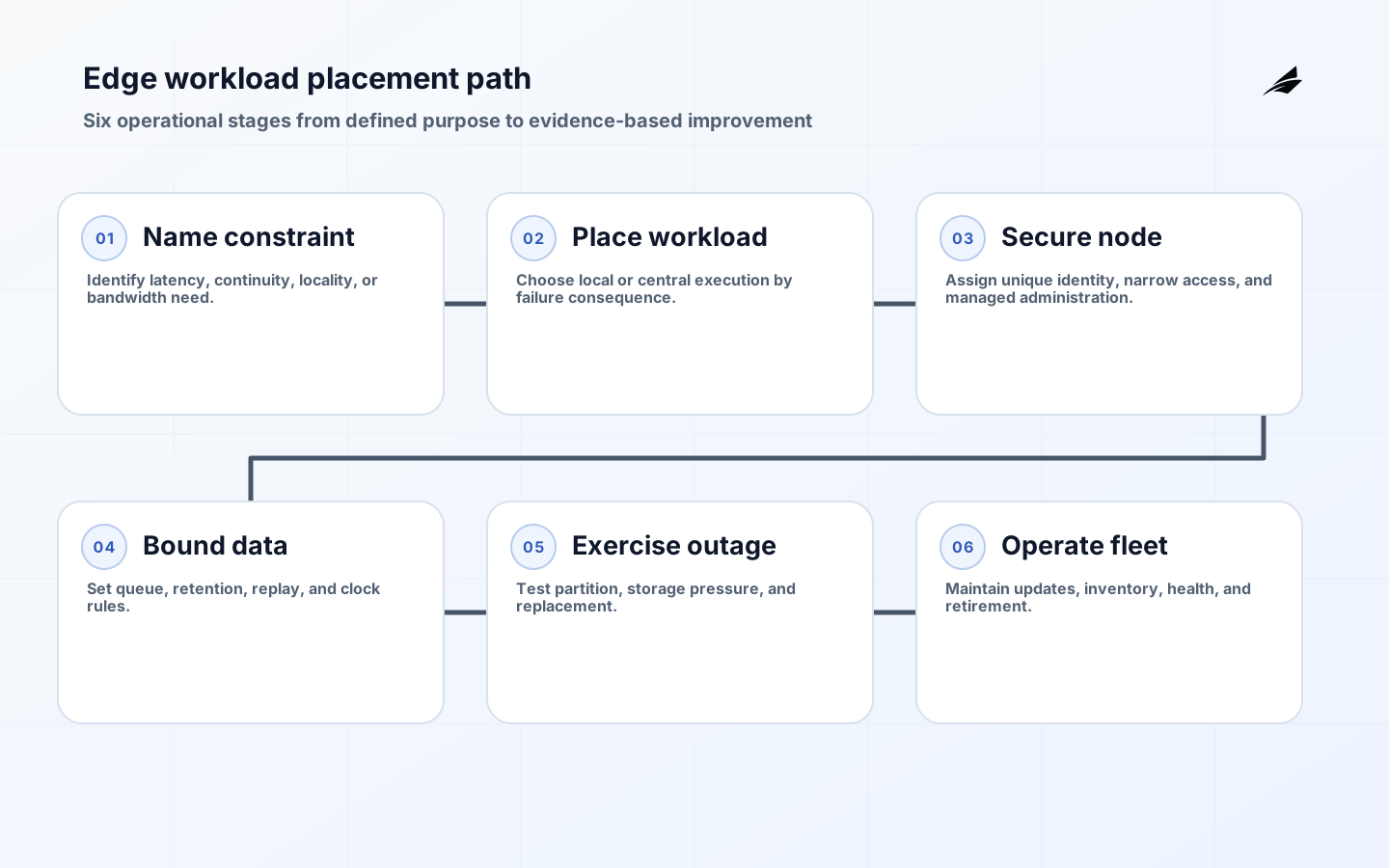
Edge computing should communicate an operational decision, not merely expose data or capability. Edge computing places selected processing, storage, or control-adjacent services near the source when continuity, latency, locality, or bandwidth has a concrete operational consequence. Begin with the person who will act, the authority they have, the time available, and the evidence needed to make a safe choice. The sensor data pipeline guide is relevant because a polished interface or distributed workload cannot repair ambiguous measurement, stale records, or missing provenance. For this part of the system, name the accountable owner, supporting evidence, exception route, and next measurable check.
Define the edge computing outcome and boundary
List each workload and decide what it must do when the WAN is lost, what latency it can tolerate, which data it needs locally, and whether it influences a physical process. Local buffering, filtering, protocol conversion, and inference may belong at the edge; fleet analytics, long-term history, and cross-site planning often belong centrally. Describe the smallest useful journey from source to decision, including normal conditions and planned maintenance. Name the authoritative system for each input, its time basis, owner, quality or confidence condition, and the consequence of acting on an incorrect value. Define what is merely informative, what requires acknowledgement, and what can change an operating state. That scope prevents a convenient screen or edge service from acquiring control authority it was not designed to carry. Within this decision boundary, name the accountable owner, supporting evidence, exception route, and next measurable check.
Make edge computing architecture decisions explicit
For CTOs and engineering leaders working on edge computing, this operating decision should connect search intent, canonical URLs, rendered content, structured metadata, crawl paths, and measurable search outcomes to evidence an accountable owner can inspect. Partition collection, transformation, authorization, storage, display, and control so a fault or permission in one layer does not silently become authority in another. Give each interface a versioned contract, authenticated caller, bounded data shape, timeout, retry behavior, and retained audit evidence. Use unique identities and least-privilege access for users, services, and devices. Document the dependencies that must remain available and the declared degraded behavior when they do not. The network segmentation guide helps keep those paths constrained as the system grows. In this operating review, move beyond the operating decision only after the owner can show the accepted result, the exception path, and the signal for another review.
| Decision | Useful design choice | Failure to avoid |
|---|---|---|
| Protocol conversion | Local gateway adapter | Exposing field devices directly |
| Event filtering | Bounded local queue | Uncontrolled raw-data backlog |
| Decision support | Defined offline mode | Assuming cloud is always reachable |
Make edge computing data and trust visible
In edge computing, CTOs and engineering leaders should make the relationship between search intent, canonical URLs, rendered content, structured metadata, crawl paths, and measurable search outcomes explicit and reviewable. Preserve source time and receipt time where delay is possible. Mark missing, stale, estimated, manually entered, and substituted values rather than displaying a confident but misleading result. Store source identity, configuration or model version, and the transformation that produced a derived value. Restrict administrative actions separately from ordinary viewing or processing. When a user or workload asks for more access, require a recorded business purpose and an expiration or review point. These details make investigation faster and keep exceptional access from becoming invisible permanent design. This operating review should close the information boundary only when the result, unresolved exception, and next review condition are recorded.
Design edge computing for failures and recovery
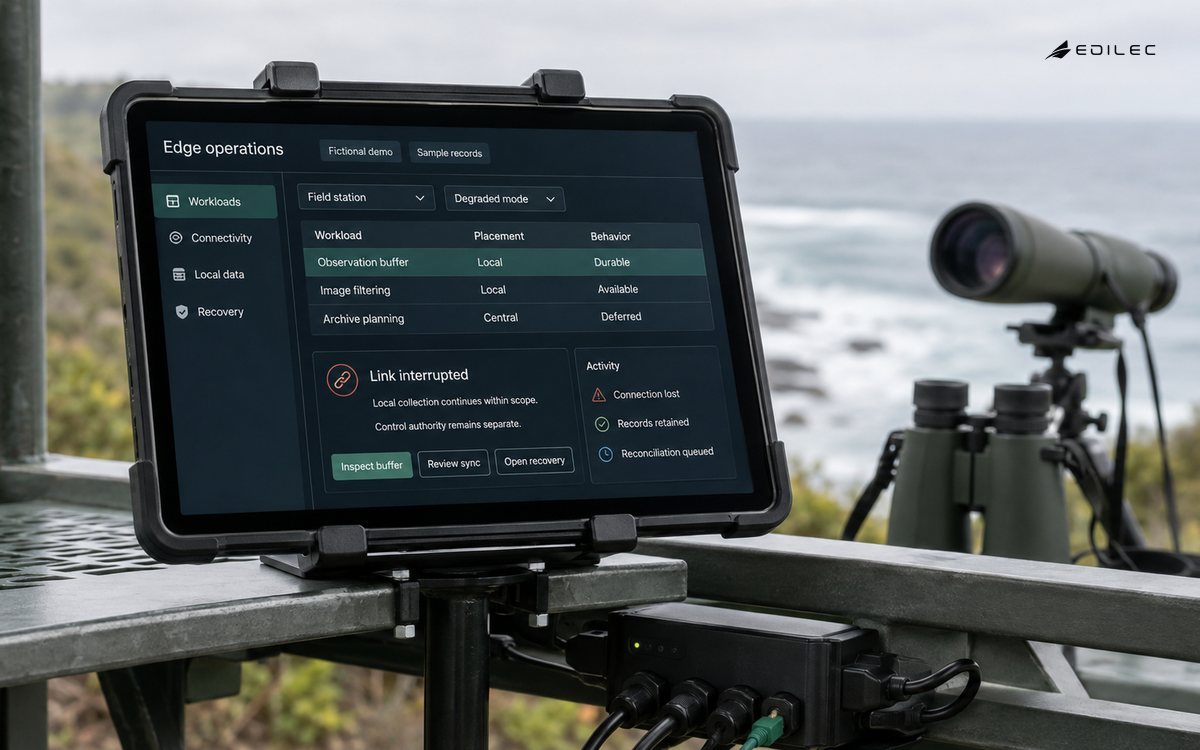
A dependable edge computing design makes search intent, canonical URLs, rendered content, structured metadata, crawl paths, and measurable search outcomes visible to the owner responsible for this recovery path. Exercise loss of connectivity, a partial transaction, duplicate input, unavailable dependency, full local storage, invalid credentials, clock correction, and replacement hardware or display. Specify who decides whether to continue in a degraded mode, what evidence proves the state, and how the authoritative record is reconciled afterwards. Bound retries and queues; an unbounded retry can convert a temporary fault into noise, overload, or repeated action. Support staff need a documented fallback and a way to distinguish a healthy quiet condition from a silent collector or stale data feed. The next step in this operating review is justified when the team can trace the accepted outcome, the fallback route, and the owner of follow-up.
| Failure | Expected behavior | Unsafe shortcut |
|---|---|---|
| WAN outage | Declared degraded operation | Unbounded retries |
| Storage full | Deterministic retention or pause | Silent data loss |
| Node replacement | Restore approved configuration | Rebuild from private notes |
Operate edge computing with accountable evidence
This information boundary for edge computing is strongest when search intent, canonical URLs, rendered content, structured metadata, crawl paths, and measurable search outcomes can be reviewed as one operating record. Measure the health of sources, integrations, identities, latency, backlog, freshness, and configuration changes, not just the final output. Route actionable conditions to a named responder using the alert routing architecture guide, including acknowledgement and escalation rules. Retain enough event context to reconstruct a material decision while protecting sensitive operational and customer data. Review a sample of real cases with users and operators: recurring workaround, ignored alert, or confusing drilldown is evidence that a contract or workflow needs correction. Acceptance in this operating review requires a visible outcome, a bounded exception path, and a measurable reason to revisit the decision.
Roll out edge computing in controlled increments
CTOs and engineering leaders can keep edge computing accountable by recording how search intent, canonical URLs, rendered content, structured metadata, crawl paths, and measurable search outcomes shape this operating decision. Pilot at a representative site or user group with explicit acceptance criteria. Test normal, denied, stale, unavailable, and recovery paths before expansion. Capture deployed version, configuration, affected identities, validation result, and decision maker. Use compatibility windows for data and interface changes, and rehearse rollback or alternative operation before a broad release. The pilot should reveal whether staff can run and support the system during pressure, not simply whether a demonstration can show a healthy result. For this operating review, the responsible owner should be able to explain what passed, what remains exceptional, and which signal reopens review.
Build acceptance evidence for edge computing
For edge computing, test the site as a distributed operational unit. Disconnect its upstream network, fill the local queue, expire a credential, deploy an incompatible workload, and replace a node with approved spare hardware. Verify how operators learn about each condition, what local work continues, what data is retained or dropped, and how the node reconciles on return. Capture installed software, configuration, device identity, and backup state before and after the exercise. These tests measure the ownership burden that a happy-path edge demonstration carefully avoids. To validate this evaluation, name the accountable owner, supporting evidence, exception route, and next measurable check.
Control change in edge computing
Every change to edge computing needs a bounded request, an accountable owner, a versioned configuration or artifact, and a validation result that can be reviewed later. Classify changes by consequence and decide which require peer review, maintenance coordination, staged deployment, or explicit approval. Keep the prior approved state and an operational reversal or containment route. Temporary exceptions should include reason, compensating control, expiry, and removal evidence. This prevents an urgent workaround from becoming an undocumented operating standard. It also gives support and incident responders a shared reference when the system behaves differently after a release. To govern this control, name the accountable owner, supporting evidence, exception route, and next measurable check.
Assign lifecycle ownership for edge computing
For edge computing, the evidence behind this ownership decision should cover search intent, canonical URLs, rendered content, structured metadata, crawl paths, and measurable search outcomes. Name owners for product behavior, operations, security, source data, integrations, and vendor dependencies. The same person need not own every layer, but handoffs must be explicit: who approves access, who watches health, who updates documentation, who handles an expired credential or failed rollout, and who decides retirement. Maintain an inventory that connects the deployed component, its configuration, identity, version, support status, and location or business role. Review this inventory after replacement, change, or incident. Clear lifecycle ownership makes a distributed technical choice supportable after the original project team has moved on. Do not widen the scope from this operating review until the evidence supports the result, the recovery route, and the next operating check.
Learn from edge computing operations
Use a short recurring review of real cases rather than an abstract maturity score. Look at denied requests, stale data, retries, failures, operator overrides, exceptions, and recovery time. Select one case and compare expected contract with observed behavior: what was known, who acted, what evidence was missing, and which control or instruction should change. Track the correction through implementation and retest it. This feedback loop keeps edge computing aligned with changing devices, workloads, people, and suppliers while avoiding a cycle of broad redesigns that never reaches the operating teams. For this part of the system, test one expected case, one ambiguous case, and one failure with a documented recovery action.
Measure edge computing without distorting it
Choose a small set of operational measures for edge computing that link technical behavior to the stated outcome. Measure completion or availability alongside quality: freshness, reconciliation success, denied access, recovery time, failed change, and unresolved exception can be more informative than raw volume. Define numerator, denominator, time window, exclusions, owner, and source for each measure. Avoid a target that encourages unsafe behavior, such as closing alerts quickly without confirming recovery or maximizing throughput by discarding difficult records. Review trends with the people doing the work and investigate meaningful variation using retained event and configuration evidence. Within this evaluation, test one expected case, one ambiguous case, and one failure with a documented recovery action.
Apply edge computing to one real operating case
Take one recurring case for Edge Computing: Buyer and CTO Guide and write the exact path from trigger to completion. Include the human role, device or service identity, message or data contract, policy decision, authoritative record, visibility to the user, and failure fallback. Then run the case with an expected input and a deliberately awkward one: delay, duplicate, loss of connectivity, permission denial, or stale configuration. Record what the system reports, what the operator sees, and what proves the final state. This compact exercise turns broad guidance into a reviewable implementation plan and catches assumptions before they become production incidents. When implementing this part of the system, test one expected case, one ambiguous case, and one failure with a documented recovery action.
Key takeaways
- Design edge computing around a specific decision and accountable owner.
- Show data quality, freshness, authority, and operating context with important output.
- Separate observation from privileged configuration or control actions.
- Test degraded behavior and preserve evidence that proves recovery.
- Review edge computing against a real exception each cycle, then document and retest the correction before relying on it at broader scale.
Frequently asked questions
Is an edge gateway the same as edge computing? A gateway can be one component; edge computing may also include local applications, storage, and fleet management. Can edge run without cloud? It can operate locally by design, but lifecycle governance still needs supporting services. Should ML run at edge? Only when local inference has a clear benefit and model version, resources, rollback, and output quality can be managed. Before releasing this part of the system, test one expected case, one ambiguous case, and one failure with a documented recovery action.
Conclusion
Edge computing is dependable when its evidence, trust boundaries, and failure behavior are visible to the people who rely on it. Keep the first scope narrow, validate real operating cases, and use those cases to improve the contract before scaling. While operating this part of the system, test one expected case, one ambiguous case, and one failure with a documented recovery action.