Field Service Portals: A Founder’s Guide to Reliable Workflows
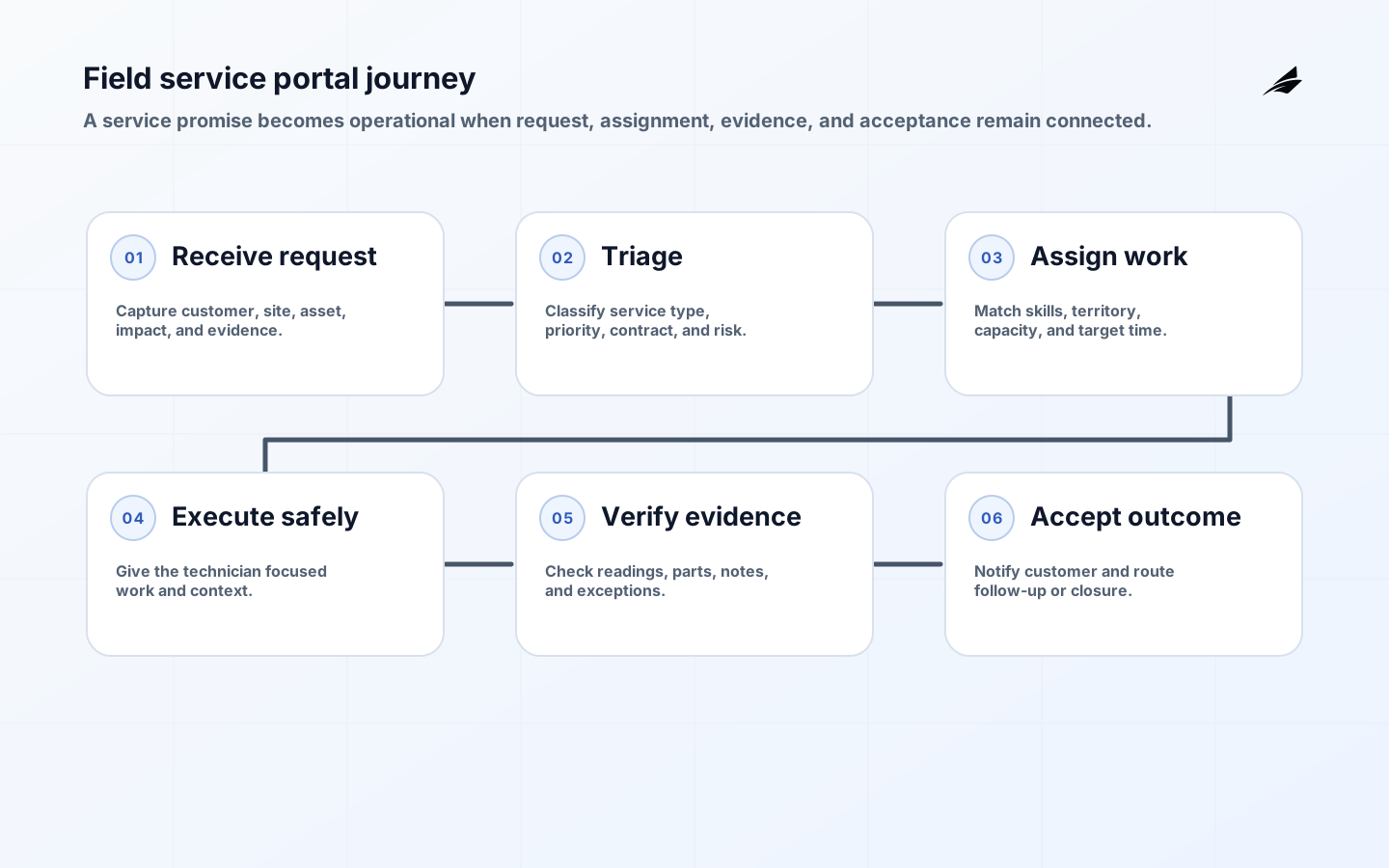
Field service portals are shared work surfaces between the people who request service, the people who dispatch and supervise it, and the technicians who complete it. Founders should not define them as a collection of forms. Their value comes from preserving one accountable path from a reported problem to a verified outcome. The portal must answer what asset is affected, what service level applies, who owns the next action, what evidence is required, and whether the customer can trust the status. The OpenAPI Specification is a useful anchor for keeping request, work-order, and status contracts explicit as those handoffs cross system boundaries.
Start with the service promise
Write the promise in operational terms: a customer can report an issue, see its acknowledgement, understand the next step, and receive evidence when work is complete. Then choose one service class where the promise can be measured. A portal for scheduled maintenance has different state and evidence needs from emergency repair. The first release should not combine every customer, asset class, contract rule, and dispatch exception. It should make one service journey legible to the people who run it. WCAG 2.2 is a practical reminder that status, error, and next-step communication must work for the technician and customer who are not sitting in the same place.
Name the actors and handoffs
A requestor wants acknowledgement and a realistic expectation. A dispatcher needs capacity, geography, skills, priority, and contract rules. A technician needs a focused job packet, safe access to the asset record, and a way to capture evidence without duplicating work. A supervisor needs exceptions and quality checks. Finance may need the approved work, parts, and billable basis. These are not interchangeable views of the same table. They have different permissions and different definitions of done. Model the handoffs explicitly so a status change is not mistaken for completed service.
| Portal concern | Decision to make | Failure if vague |
|---|---|---|
| Request intake | Which fields and evidence are required by service type? | Dispatchers spend time asking for basics. |
| Priority | Who can change urgency and what evidence is required? | Every customer claims emergency treatment. |
| Assignment | What skills, territory, capacity, and contract rules apply? | Work is routed to the wrong person or missed. |
| Completion | What proves the promised outcome occurred? | A closed ticket does not mean a repaired asset. |
| Customer visibility | Which internal notes and states are safe to expose? | Trust falls when status is inaccurate or too opaque. |
Build around an asset and service history
The portal needs a stable identity model for customers, sites, assets, contracts, work orders, people, parts, and evidence. Avoid treating the customer's description as the asset identity. A serial number, installed location, or registered equipment identifier should connect the work to a durable record. Keep observed facts separate from planned actions and from the final service outcome. A technician may report a symptom, a dispatcher may assign a diagnostic visit, and a supervisor may approve a replacement. If those are collapsed into one editable description, later users cannot tell who knew what and when.
- A request has a requestor, service type, location, asset reference, impact, and received time.
- An assignment has an owner, skill or territory reason, target time, and current state.
- A work order has planned steps, safety notes, dependencies, and a change history.
- Evidence has an actor, timestamp, relationship to the asset or step, and retention policy.
- A completion has an acceptance rule, unresolved exception, customer notice, and follow-up owner.
- Every external integration has a source of truth and a rule for delayed or contradictory data.
Choose a small, observable architecture
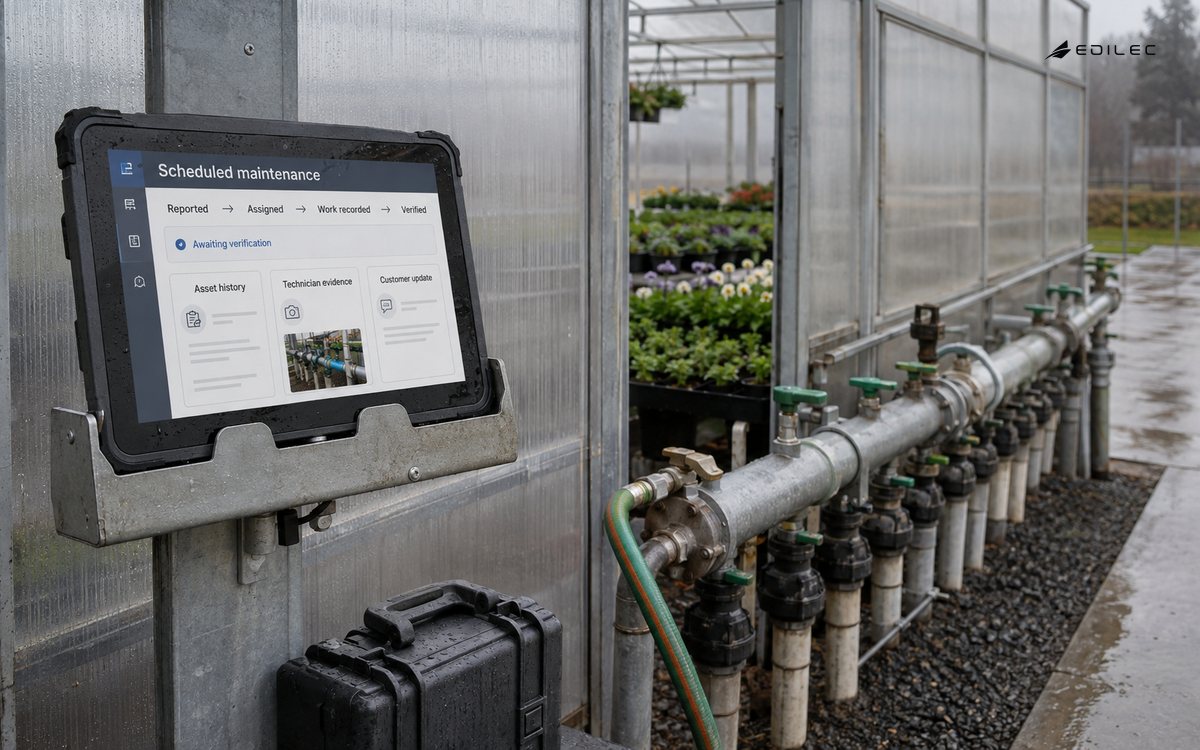
Founders often overbuild a field service portal because the domain contains many exceptions. Start with a modular workflow service, a searchable asset and customer model, a notification path, and an evidence store with explicit access rules. Keep device telemetry, scheduling, inventory, and billing integrations behind contracts rather than scattering vendor-specific assumptions through the interface. The portal should remain useful when a telemetry message is late or a billing system is unavailable. RFC 9110 helps separate safe retries from completed business work; the portal still has to define which state transition proves that a service promise was met.
| Layer | Responsibility | Operational test |
|---|---|---|
| Experience | Role-specific request, dispatch, technician, and customer views. | A user sees the next action and its owner. |
| Workflow | State transitions, approvals, SLA timers, and exception paths. | Invalid transitions are rejected with a useful reason. |
| Domain records | Customers, sites, assets, contracts, jobs, and evidence. | A work order resolves to one current asset and history. |
| Integration | Telemetry, scheduling, identity, inventory, and billing adapters. | A dependency outage is visible and recoverable. |
| Operations | Logs, metrics, audit events, support tools, and access reviews. | The team can investigate a disputed completion. |
Make permissions match real authority
Portal roles should express what a person may see, propose, approve, execute, or certify. A customer may see their own requests and approved evidence. A technician may see assigned work and the minimum asset detail needed for safe service. A dispatcher may assign work but not certify a repair they did not review. A supervisor may reopen a job with a reason. Apply tenant, site, asset, and state checks at the service boundary, not only in the front end. Record material actions with actor, time, old state, new state, and reason. This protects customers and gives founders a basis for support and compliance conversations as the product grows.
Roll out by service journey
Pilot one customer segment and one service journey with enough volume to expose real variation. Map the current process before launch and record how long intake, triage, assignment, travel, completion, and customer communication take. In the pilot, keep a manual fallback visible rather than hiding it. Review every request that required a bypass: a missing asset, an unavailable technician, a part not in inventory, or a customer dispute. Those cases are product evidence. NIST SP 800-207 is relevant here because each portal handoff should verify the actor, requested action, and resource rather than trusting the screen that initiated it.
Example: scheduled equipment maintenance
Suppose a facilities company maintains refrigeration units across several retail locations. The portal receives a due-maintenance schedule, groups work by site, assigns technicians with the right certification, and gives each job a checklist. A technician records readings and photographs, but the job remains pending until required readings fall within the service rule or a supervisor reviews the exception. The customer sees scheduled, en route, on site, completed, or follow-up required. The product is valuable because each state is tied to evidence and a next action. A dashboard that says “100 jobs closed” without those distinctions is not operational visibility.
Design for failure and dispute
Common failures include duplicate requests, stale schedules, missing asset identity, technician work captured outside the system, overexposed customer notes, and completion recorded before the promised outcome is verified. Plan for a mobile connection to disappear, a customer to reject a result, a part to become unavailable, and a contract to change while work is open. Store the original request and the final decision. A portal should support correction without rewriting history. If a technician must use a phone call or spreadsheet, let the support owner record the bypass and its reason; invisible work cannot be improved.
- A request can be found by customer, site, asset, job, and external reference.
- Every important status has an owner, entry rule, exit rule, and customer-facing meaning.
- A technician can complete the common path with minimal duplicate entry.
- An unavailable integration produces a visible queue or manual task instead of silent loss.
- Sensitive notes and evidence are scoped by customer, site, role, and purpose.
- A disputed completion can be reopened, investigated, and resolved without deleting the original record.
Measure service outcomes
Track acknowledgement time, time to assignment, arrival reliability, first-visit completion, repeat visits, work-order ageing, evidence completeness, customer reopen rate, and manual bypasses. Break down metrics by service type and customer segment; an average can hide an SLA failure for the most important contract. Measure portal adoption through completed work and evidence quality, not login counts. Also monitor integration freshness, notification delivery, access changes, and search failures. If the portal reduces dispatch calls but increases unresolved exceptions, founders should treat that as a product warning rather than a success story.
Field service portal takeaways
- Define the service promise and the evidence that proves it before adding features.
- Separate request, assignment, work, evidence, approval, and customer communication states.
- Build a durable asset and customer identity model rather than relying on free text.
- Enforce authority at the workflow boundary and audit material state changes.
- Pilot one service journey, preserve manual fallbacks, and learn from every bypass.
- Measure time, quality, rework, disputes, and evidence—not just portal activity.
Field service portal FAQ
What belongs in the first release?
Include one request-to-completion journey, asset and customer identity, assignment ownership, technician evidence, customer status, notifications, and an exception path. Defer broad inventory, billing automation, and every scheduling optimization until the core record is trusted.
Should the portal start with live telemetry?
Only when telemetry changes a service decision and its identity, freshness, and alert behavior are understood. A reliable work-order flow with a clear manual observation can be more valuable than a live feed that creates unowned alerts.
Do field technicians need offline support?
If technicians work in areas with poor coverage, usually yes. Start with offline drafts and evidence, explicit sync states, and online gates for high-consequence actions. Test recovery before promising full offline operation.
Conclusion: make the service promise observable
For a founder, the portal boundary is the promise from intake to accepted service, not the number of screens in the release. Define the asset, owner, evidence, permission, and exception at each handoff; then learn from the requests that still require a phone call or spreadsheet. Related patterns appear in the connected operations guide, network segmentation guide, and sensor calibration guide. The portal is doing its job when a customer, dispatcher, technician, and supervisor can each see the next accountable action.