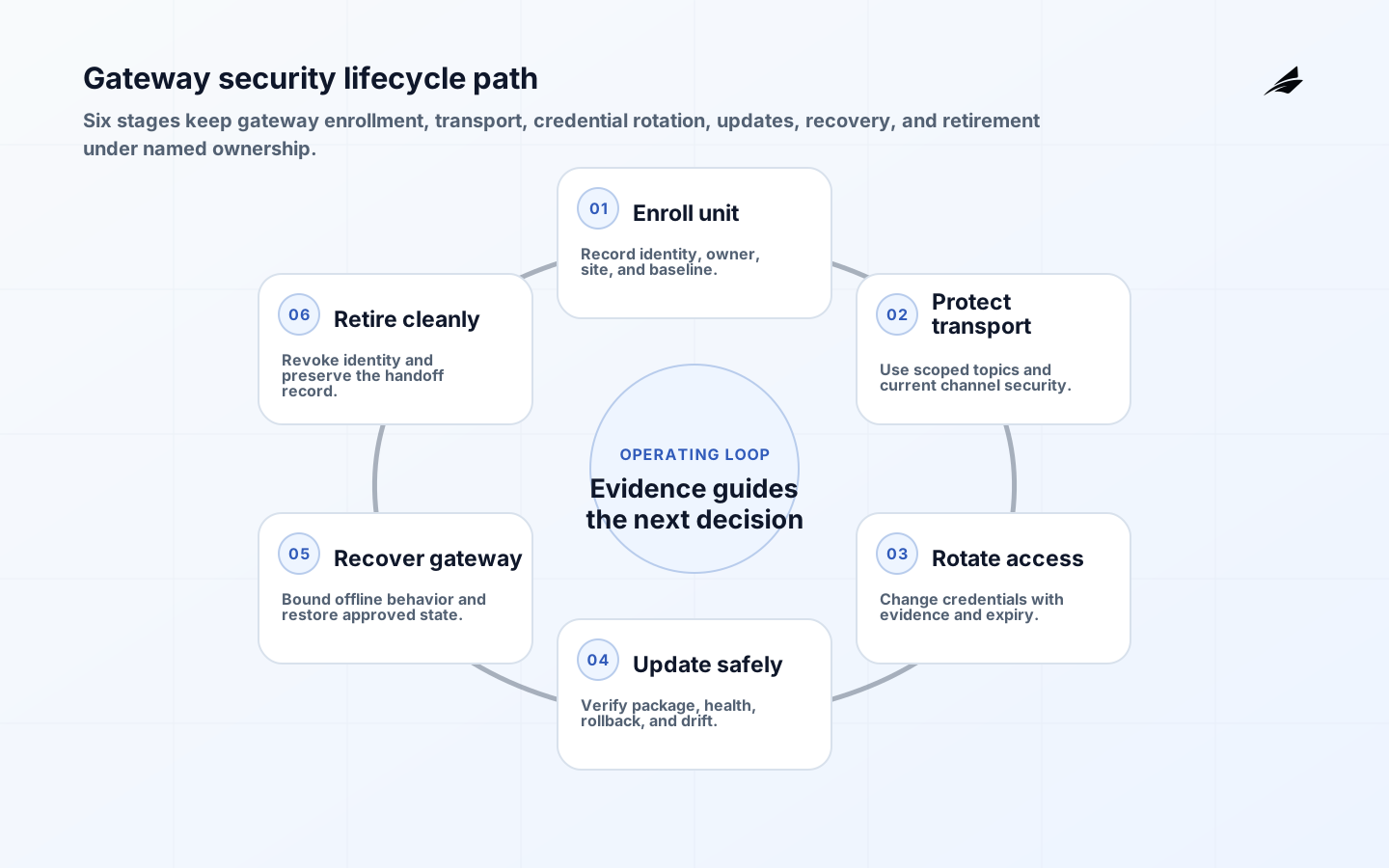
Gateway security becomes a team capability when enrollment, transport, access, updates, offline behavior, and retirement follow the same understandable lifecycle. The goal is not to add ceremony; it is to make a gateway’s authority and state explainable during a normal shift and an incident.
Define the gateway security decision
Map the trust boundary before choosing controls. Inventory every physical port, wireless interface, management service, local protocol, outbound destination, credential, and person who can change the gateway. Then identify which path could affect a safety, service, privacy, or availability outcome. NIST's IoT Device Cybersecurity Capability Core Baseline is useful for framing device identification, configuration, data protection, and update capabilities. The inventory turns those capabilities into decisions for an actual deployment.
| Control area | What to specify | Evidence to review |
|---|---|---|
| Purpose | State the operational decision, user, completion evidence, and cost of a wrong result for gateway lifecycle. Tie the boundary to a named rule and an observable test. | A named owner, an example record, and a repeatable test that shows the purpose rule works in production conditions for gateway lifecycle. |
| Authority | Name the system, role, or device that may create or correct this record for gateway lifecycle. Record the permitted transition and its approver. | A named owner, an example record, and a repeatable test that shows the authority rule works in production conditions for gateway lifecycle. |
| Time | Keep observation time, processing time, and review deadline distinct and visible for gateway lifecycle. Test the timing rule with a delayed record. | A named owner, an example record, and a repeatable test that shows the time rule works in production conditions for gateway lifecycle. |
| Change | Version the contract or rule and publish a migration and rollback decision for gateway lifecycle. Link the change to its compatibility evidence. | A named owner, an example record, and a repeatable test that shows the change rule works in production conditions for gateway lifecycle. |
Design the record and boundary — gateway lifecycle controls
Use distinct identities and network paths for the gateway, local devices, operators, and cloud services. A single shared password or broad network route makes later investigation almost impossible. Prefer outbound, authenticated connections where they meet the operational need; restrict inbound administration to a managed path with strong authentication and logging. The TLS specification describes the transport protections, but certificate lifecycle and authorization policy remain local responsibilities. Edge gateways adds deployment concerns that security design must accommodate.
Make controls testable — gateway lifecycle controls
Harden the management plane separately from the application workload. Remove unused services, lock configuration changes to accountable roles, protect secrets at rest, and use signed software updates with a documented rollback decision. Segment networks so a compromised sensor cannot automatically reach administration or business systems. Alerting should include failed management logins, unexpected configuration changes, certificate expiry, update failures, and new outbound destinations. A control is weak if the team cannot later show whether it was active on a specific gateway.
| Control area | What to specify | Evidence to review |
|---|---|---|
| Failure | Describe the safe response to loss, delay, duplication, malformed input, and access denial for gateway lifecycle. Assign each state to a recovery owner. | A named owner, an example record, and a repeatable test that shows the failure rule works in production conditions for gateway lifecycle. |
| Evidence | Retain identity, correlation, configuration, result, and accountable owner for investigation for gateway lifecycle. Make the evidence retrievable by incident. | A named owner, an example record, and a repeatable test that shows the evidence rule works in production conditions for gateway lifecycle. |
| Release | Test representative field conditions, permissions, degraded connectivity, and recovery before scale for gateway lifecycle. Include replacement and revocation cases. | A named owner, an example record, and a repeatable test that shows the release rule works in production conditions for gateway lifecycle. |
| Review | Measure decision impact, exception burden, and unresolved work; assign the next improvement for gateway lifecycle. Review the measure with the operating owner. | A named owner, an example record, and a repeatable test that shows the review rule works in production conditions for gateway lifecycle. |
Operate from evidence — gateway lifecycle controls
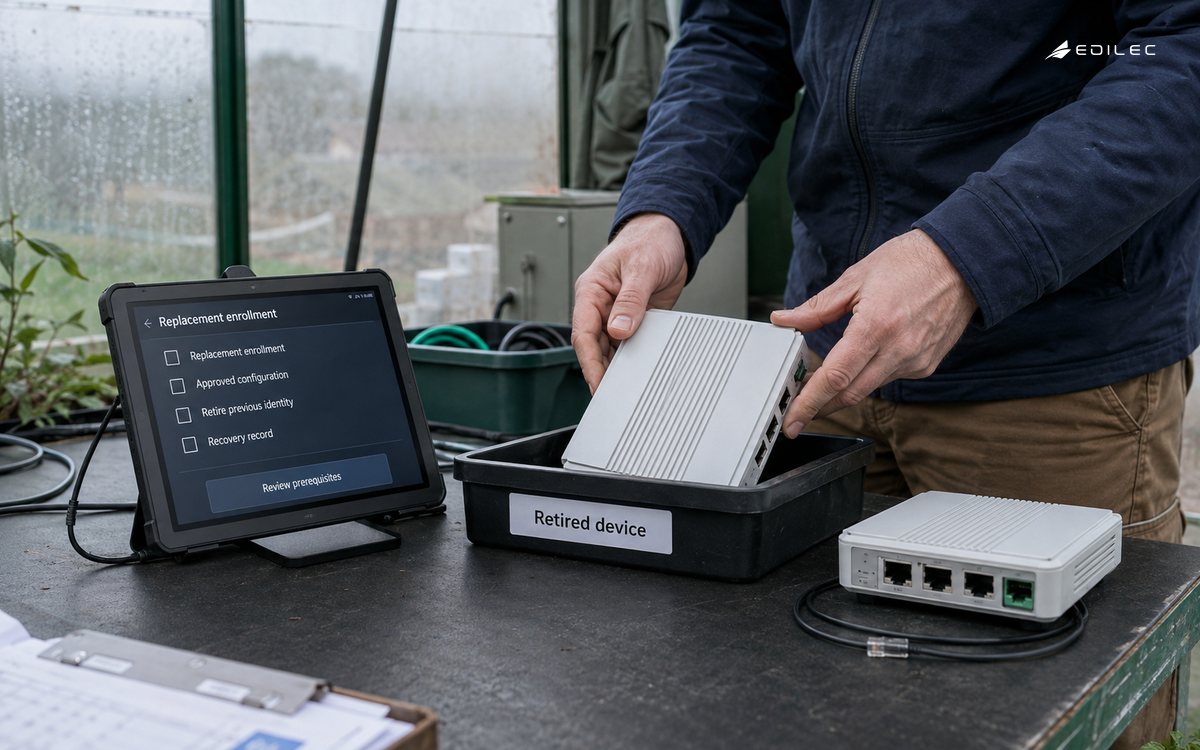
Security operations need an asset-level record. Keep the hardware identity, installed software version, configuration baseline, assigned site, credential status, and support owner together. Test revocation and replacement with a real disconnected gateway, because recovery procedures that assume healthy connectivity tend to fail when they are most needed. Review exceptions such as temporary remote access and local technician accounts; each should have an expiry, approving owner, and audit trail. Use incident findings to remove unnecessary paths rather than simply adding another alert.
Roll out and review deliberately — gateway lifecycle controls
Use a limited rollout that includes representative assets, roles, connectivity, and exception cases for gateway lifecycle. For gateway security, publish the success measure, a containment trigger, and the person allowed to pause the change. Review observed behavior with the people who perform the work, then update the operating record, test fixtures, and recovery guidance for gateway lifecycle. A feature is not mature because it is deployed; it is mature when a new operator can understand the boundary and a support owner can resolve a failure without guessing for gateway lifecycle.
A deeper gateway security review should connect site access, configuration drift, and credential recovery. Take one deployed gateway through an administrator login, a local protocol request, an outbound service connection, and a software update. Confirm that each action is separately authorized and leaves evidence that is useful to someone who was not present. Review the path a technician follows when the gateway cannot reach the management service; it often exposes an undocumented shared credential or an overly broad emergency exception. Keep the review concrete by naming the records, people, assets, and time windows involved for gateway lifecycle. It is tempting to call an architecture sound because its normal path is tidy, but operational confidence comes from explaining an incomplete path: a message that arrived after a decision, a device that was replaced, a technician who worked offline, or a credential that should no longer work for gateway lifecycle. For gateway security, record the observed result, the expected result, the owner who decides the difference, and the smallest corrective action. That creates a reusable acceptance test for the next release and prevents a local workaround from quietly becoming a permanent rule for gateway lifecycle. Review this evidence with engineering and the people who carry the operational consequence for gateway lifecycle. When their accounts disagree, preserve both facts and resolve the authority rather than smoothing the difference in a dashboard or export for gateway lifecycle. The goal is not perfect data. It is a system that tells people when its evidence is incomplete, states which record remains authoritative, and gives them a safe accountable way to respond for gateway lifecycle.
Run gateway security as a repeatable lifecycle
Growing teams need gateway security to remain understandable after the original installer leaves. Build a lifecycle record for every unit: enrollment, configuration baseline, certificate or key rotation, software update, connectivity changes, incident isolation, replacement, and retirement. At each step, identify the person or service allowed to act and the evidence that closes the step. MQTT supports publish and subscribe patterns suited to constrained environments, but a topic permission is not a complete authorization model. Scope identities to the smallest useful topics, deny administrative access from ordinary telemetry paths, and make broker-side changes reviewable. TLS protects a channel in transit; it does not decide whether a gateway should publish a particular asset’s data or receive a management command.
For gateway lifecycle planning, compare Edge Gateways: An Implementation Checklist That Holds Up, Device Provisioning: A Security Review for IoT Teams, Gateway Security: Engineering Notes for Field Operations; together they frame gateway lifecycle, ownership, and recovery without asking the reader to infer the operating boundary.
- Keep a lifecycle record from enrollment through retirement.
- Separate topic permissions, transport security, and management authority.
- Rehearse credential rotation, update failure, offline buffering, and recovery.
- Retain the operator decision and approved state after an incident.
Gateway security for growing teams takeaways for operators
- Treat each gateway as a managed identity with a known site, owner, and software state.
- Map interfaces and administration paths before selecting protective controls.
- Separate field traffic, management access, and cloud permissions into narrow routes.
- Make updates signed, observable, reversible, and tied to an approved baseline.
- Practice credential revocation and replacement under realistic connectivity loss.
Gateway-lifecycle questions for a growing fleet
What must be recorded at gateway enrollment?
Capture the unique identity, owner, site, software baseline, connected interfaces, approved routes, support contact, and the date the baseline became effective.
How should gateway credentials be rotated?
Use distinct identities, a planned overlap or cutover rule, an expiry record, and a test that confirms telemetry and management permissions after rotation.
Revoke credentials, remove routes, confirm downstream ownership, preserve the handoff record, and verify that no service still depends on the retired identity.
Primary references for A Field Guide to Gateway Security for Growing Teams
The primary references for this operating decision are MQTT Version 5.0 OASIS Standard, RFC 8446: TLS 1.3, RFC 3339: Date and Time on the Internet, NIST SP 800-193. Apply them with site procedures and sector requirements when checking the implementation for gateway lifecycle.
Conclusion: keep gateway lifecycle explainable
Gateway security is strongest when it is part of the operational design, not a device image checked once at shipment. Make every trust boundary visible, constrain privileges, and keep a recovery route that works when the site is impaired. Those habits scale better than a growing collection of exceptional remote-access rules.