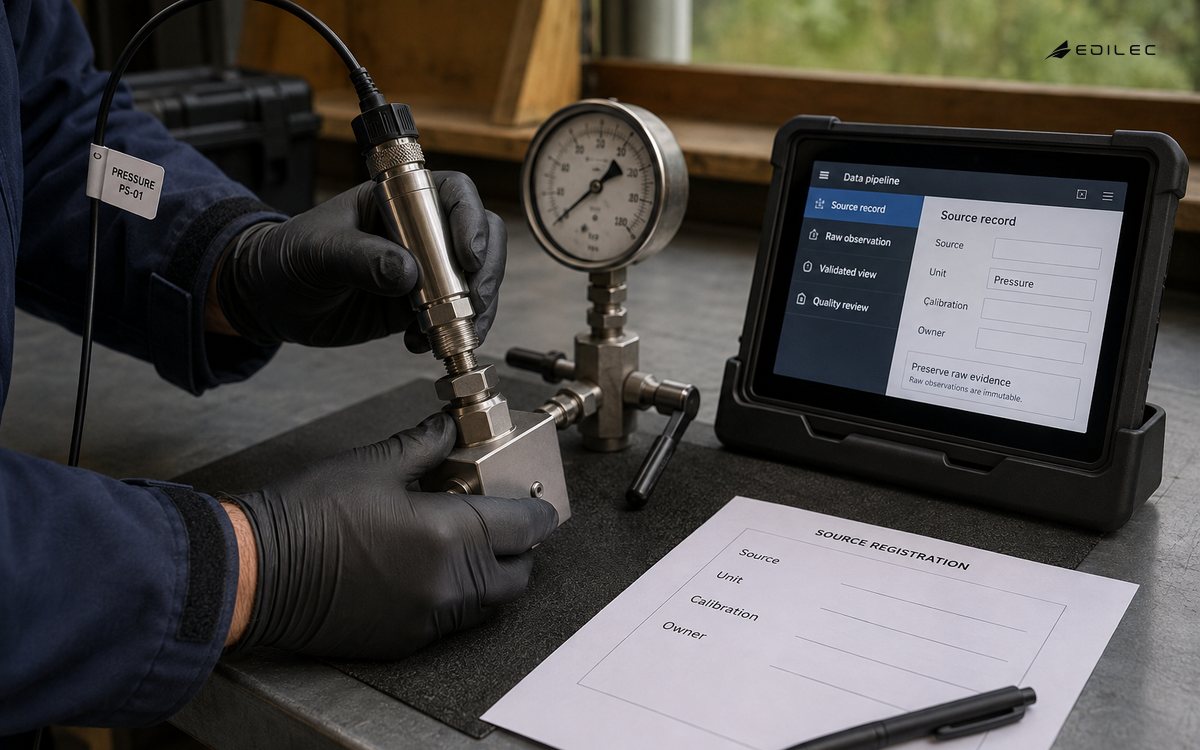
Sensor data pipelines move readings from an asset or gateway to storage, alerts, applications, and reports. Their core responsibility is preserving meaning across those transitions. A number without its source, unit, quality, timestamp, and handling history can be fast to query yet dangerous to use. Operations leaders should ask whether the pipeline lets a person trace a displayed result back to the observation and understand which validations, conversions, aggregations, and late-arrival decisions affected it.
Pipeline release readiness — Define the sensor data pipelines decision
Register the source before accepting its data. Record the asset, device, channel, physical quantity, unit, expected cadence, owner, location or scope, firmware, and purpose. Decide which systems may publish, which transformations are approved, and how a retired or replaced device is represented. SI units guidance from NIST is a useful reference for unit discipline; it does not eliminate the need to model a domain-specific quantity and tolerance.
| Control area | What to specify | Evidence to review |
|---|---|---|
| Purpose | State the operational decision, user, completion evidence, and cost of a wrong result — in sensor pipeline release review. | A named owner, an example record, and a repeatable test that shows the purpose rule works in production conditions — in sensor pipeline release review. |
| Authority | Name the system, role, or device that may create or correct this record — in sensor pipeline release review. | A named owner, an example record, and a repeatable test that shows the authority rule works in production conditions — in sensor pipeline release review. |
| Time | Keep observation time, processing time, and review deadline distinct and visible. | A named owner, an example record, and a repeatable test that shows the time rule works in production conditions — in sensor pipeline release review. |
| Change | Version the contract or rule and publish a migration and rollback decision — in sensor pipeline release review. | A named owner, an example record, and a repeatable test that shows the change rule works in production conditions — in sensor pipeline release review. |
Pipeline release readiness — Design the record and boundary
Retain an immutable or protected raw layer with the original payload, source and receipt times, gateway context, and ingestion result. Build normalized and derived layers for explicit uses, such as a dashboard, maintenance model, or customer report. Each transformation should state its input version, conversion, aggregation window, missing-data rule, and output owner. Sensor calibration data should join the lineage where it qualifies a measurement.
Pipeline release readiness — Make controls testable
Authenticate sources, validate schemas, deduplicate with source-aware identities, and impose limits on payload size and ingestion rate. Mark values that fail range, unit, or calibration-state checks instead of erasing the original evidence. Apply access control and retention by data sensitivity and purpose, because operational data can reveal customer activity, locations, or production patterns. Protect pipeline changes with review and test fixtures that include late, duplicate, malformed, and out-of-order input.
| Control area | What to specify | Evidence to review |
|---|---|---|
| Failure | Describe the safe response to loss, delay, duplication, malformed input, and access denial — in sensor pipeline release review. | A named owner, an example record, and a repeatable test that shows the failure rule works in production conditions — in sensor pipeline release review. |
| Evidence | Retain identity, correlation, configuration, result, and accountable owner for investigation. | A named owner, an example record, and a repeatable test that shows the evidence rule works in production conditions — in sensor pipeline release review. |
| Release | Test representative field conditions, permissions, degraded connectivity, and recovery before scale. | A named owner, an example record, and a repeatable test that shows the release rule works in production conditions — in sensor pipeline release review. |
| Review | Measure decision impact, exception burden, and unresolved work; assign the next improvement — in sensor pipeline release review. | A named owner, an example record, and a repeatable test that shows the review rule works in production conditions — in sensor pipeline release review. |
Pipeline release readiness — Operate from evidence
Measure the pipeline as a chain. Track source coverage, accepted and quarantined messages, arrival delay, transformation failures, schema-version distribution, freshness of published views, and the number of manual corrections. Sample a reported value and trace it backward during routine review; this approach is often the fastest way to find a silent lineage break. When a site reconnects after an outage, validate reconciliation volume and ordering rather than assuming an eventual upload restored the full operational story.
Pipeline release readiness — Roll out and review deliberately
Use a limited rollout that includes representative assets, roles, connectivity, and exception cases. For sensor data pipelines, publish the success measure, a containment trigger, and the person allowed to pause the change. Review observed behavior with the people who perform the work, then update the operating record, test fixtures, and recovery guidance. A feature is not mature because it is deployed; it is mature when a new operator can understand the boundary and a support owner can resolve a failure without guessing.
A deeper sensor data pipelines review should connect lineage, late arrivals, and published-view freshness. Pick a displayed KPI or alert and follow it back through every transformation to the device channel. Include a raw message that arrives late, another with a changed unit, and one that must be quarantined. The review should show which representation changes, which remains immutable, and who decides whether a corrected value is republished. A pipeline is trustworthy when this explanation does not depend on a single developer's memory. Keep the review concrete by naming the records, people, assets, and time windows involved. It is tempting to call an architecture sound because its normal path is tidy, but operational confidence comes from explaining an incomplete path: a message that arrived after a decision, a device that was replaced, a technician who worked offline, or a credential that should no longer work. For sensor data pipelines, record the observed result, the expected result, the owner who decides the difference, and the smallest corrective action. That creates a reusable acceptance test for the next release and prevents a local workaround from quietly becoming a permanent rule. Review this evidence with engineering and the people who carry the operational consequence. When their accounts disagree, preserve both facts and resolve the authority rather than smoothing the difference in a dashboard or export. The goal is not perfect data. It is a system that tells people when its evidence is incomplete, states which record remains authoritative, and gives them a safe accountable way to respond.
Pipeline release readiness — Key takeaways
- Register the asset, channel, unit, owner, and purpose before data enters the pipeline.
- Keep raw evidence separate from normalized and derived representations.
- Document each transformation's inputs, rules, timing, and accountable owner.
- Quarantine quality failures with context instead of silently discarding them.
- Test and monitor late, duplicate, out-of-order, and reconnect data as normal operational cases.
Pipeline release readiness — Frequently asked questions
Pipeline release readiness — Should raw sensor payloads be kept forever?
Not necessarily. Retention should reflect investigation, audit, safety, privacy, and cost needs. Keep raw evidence long enough to explain material derived results, then enforce a documented deletion or aggregation policy.
Pipeline release readiness — How can a team detect a broken transformation?
Use versioned fixtures and monitor both technical failures and data distributions. A successful job can still be wrong if a unit, channel mapping, or aggregation rule changes unexpectedly; lineage checks make that visible.
Keep a compact decision record for changes to sensor data pipelines. It should capture source channel, raw payload reference, transformation version, published view, and reconciliation outcome. This record is not bureaucracy for its own sake: it lets the next engineer, operator, or support owner understand what changed, what evidence was reviewed, and which question remains open. During an incident, it also prevents the team from relying on a screenshot or an unverified recollection when deciding whether to contain, correct, or continue the service.
Pipeline release readiness — Conclusion
Sensor data pipelines deserve the same care as the decisions they influence. Register sources, preserve raw evidence, make transformations explicit, and rehearse the awkward timing conditions of real operations. That turns a stream of readings into information people can rely on and investigate.
Pipeline release readiness — Turn the Checklist into a Release Gate
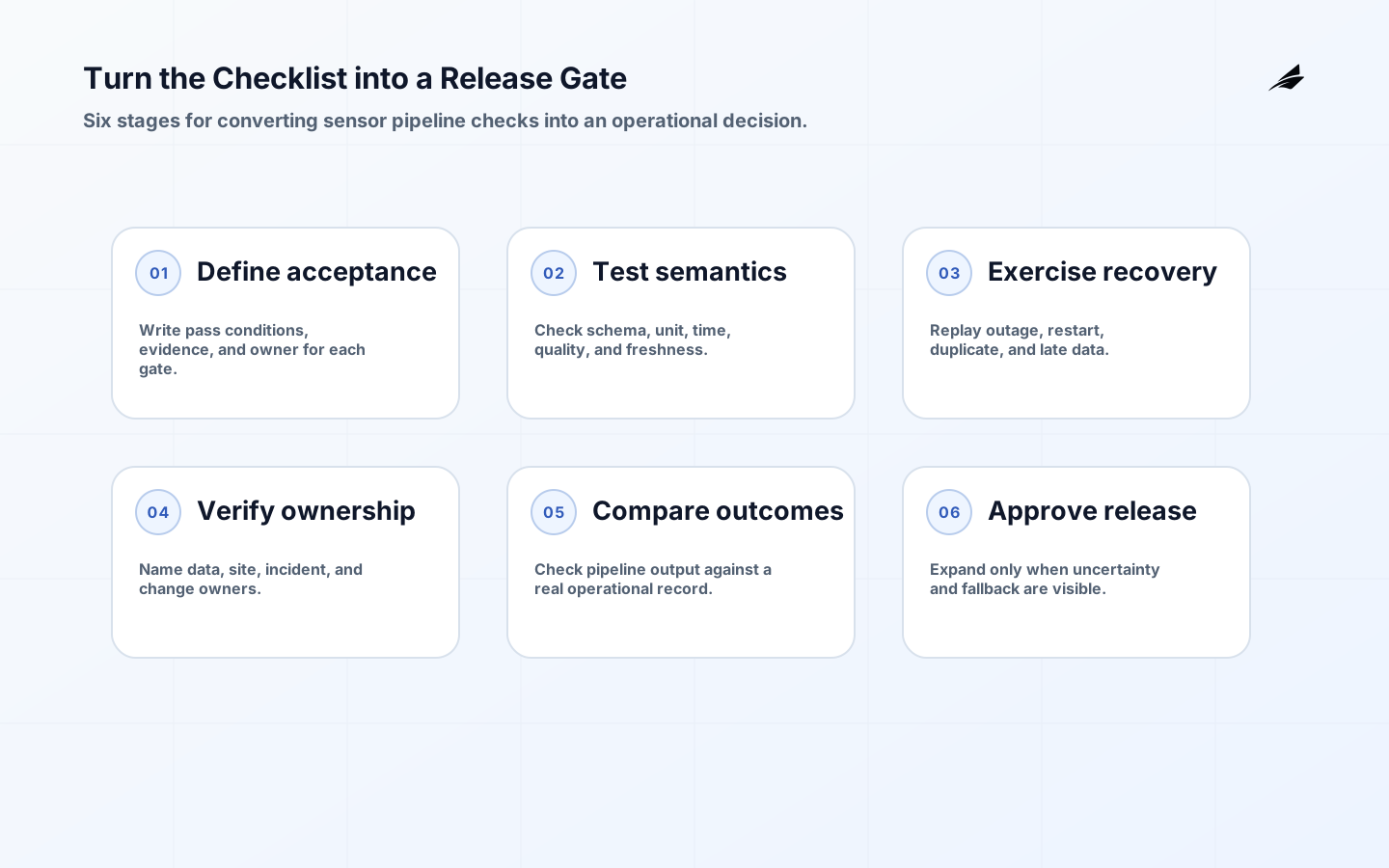
A checklist for sensor data pipelines is useful when each item has a pass condition, evidence, and owner. “Validate data quality” is too broad to release a system. A stronger item says that every accepted record has a stable source identity, observed time, unit, quality state, and schema version; invalid records are quarantined with a reason; and a representative replay produces the expected operational result. The checklist should be short enough to use during a site change and specific enough to expose a missing contract.
| Checklist gate | Evidence | Decision |
|---|---|---|
| Schema and units | Versioned contract plus accepted and rejected examples. | Release or correct the producer. |
| Time and quality | Clock, observed time, freshness, and quality tests. | Accept only if uncertainty is visible. |
| Recovery | Replay after outage, restart, and duplicate delivery. | Expand only after reconciliation works. |
| Ownership | Named data, site, and incident owners. | Do not release an orphaned path. |
Run the checklist against one real workflow before adding more sensors. For example, choose a pump health view and verify that a restart, clock drift, duplicate packet, and late reading produce understandable states. Compare the pipeline output with a maintenance log or direct instrument reading. MQTT v5 provides delivery and session semantics that should be chosen by consequence, while RFC 3339 gives a precise basis for timestamp representation. The checklist is complete only when a person can decide whether to trust the output and knows what to do when the answer is no.
Selected references for this topic include MQTT Version 5.0, Transport Layer Security (TLS) Protocol Version 1.3, Date and Time on the Internet: Timestamps, IoT Device Cybersecurity Capability Core Baseline. The selected publications anchor pipeline release readiness; apply them with site procedures and deployment obligations.
For adjacent operating patterns, compare Sensor Data Pipelines: Common Mistakes and Practical Fixes, IoT Telemetry Explained: From Device Signal to Decision, Network Observability: Mistakes and Fixes. The neighboring references connect sensor data pipelines checklist for reliable digital operations to its wider operating context.