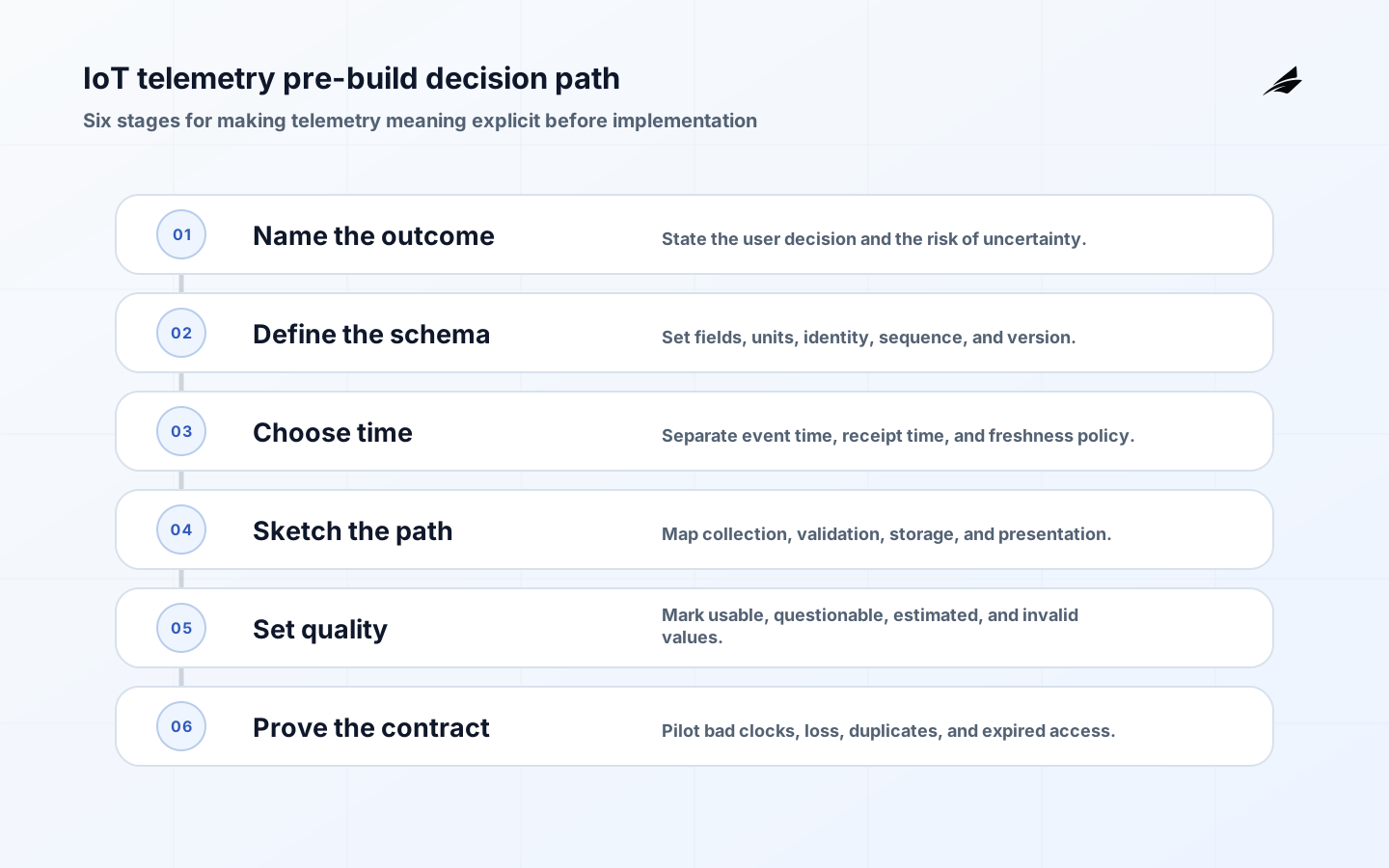
The most expensive IoT telemetry mistakes are often made before the first sensor is connected. Teams choose a payload format without deciding what a missing value means, select a database without defining retention, or build a dashboard before agreeing on freshness. A useful first build begins with the decision the data will support. For example, a maintenance planner may need to know whether a motor deserves inspection today, not merely whether a sensor published a number. OpenTelemetry signals helps separate metrics, logs, and traces; apply the same discipline to device observations, health signals, and derived operational state. These choices become a design conversation that can be tested.
Name the Outcome Before the Data
Write the decision with an actor, time window, action, and risk. “Show all readings” is not an outcome. “Allow a site supervisor to pause a production line when vibration remains above a validated limit for five minutes” is specific enough to design around. It exposes whether the data must be continuous, whether a delayed signal is unsafe, and who is allowed to act. Link to IoT telemetry explained from first principles for the difference between a raw observation and an interpretation. Keep the decision narrow at first; a telemetry platform that promises every future use case usually leaves today’s critical path under-specified.
| Decision | Data requirement | Acceptance test |
|---|---|---|
| Detect a sustained condition | Windowed values with trusted event time | The system identifies five consecutive valid readings. |
| Compare sites | Comparable units and calibration metadata | Two sites report the same physical basis. |
| Explain a past action | Retained provenance and calculation version | An operator can reproduce the displayed result. |
| Trigger a command | Fresh state, authorization, and acknowledgement | The command expires safely if evidence is stale. |
Define the Smallest Useful Schema
A good schema carries measurement name, value, unit, event time, device identifier, sequence or sample identifier, quality, firmware or schema version, and the location or asset context needed for the decision. Do not add fields simply because they might be useful; each field creates validation, storage, privacy, and compatibility work. Conversely, do not omit the metadata that makes a value trustworthy. Decide whether calibration status is a separate signal or part of the reading, and decide how a device reset affects sequence numbers. With MQTT, document topic ownership and delivery expectations against the MQTT 5.0 specification rather than assuming a client library’s defaults are the product contract.
Choose a Time and Freshness Policy
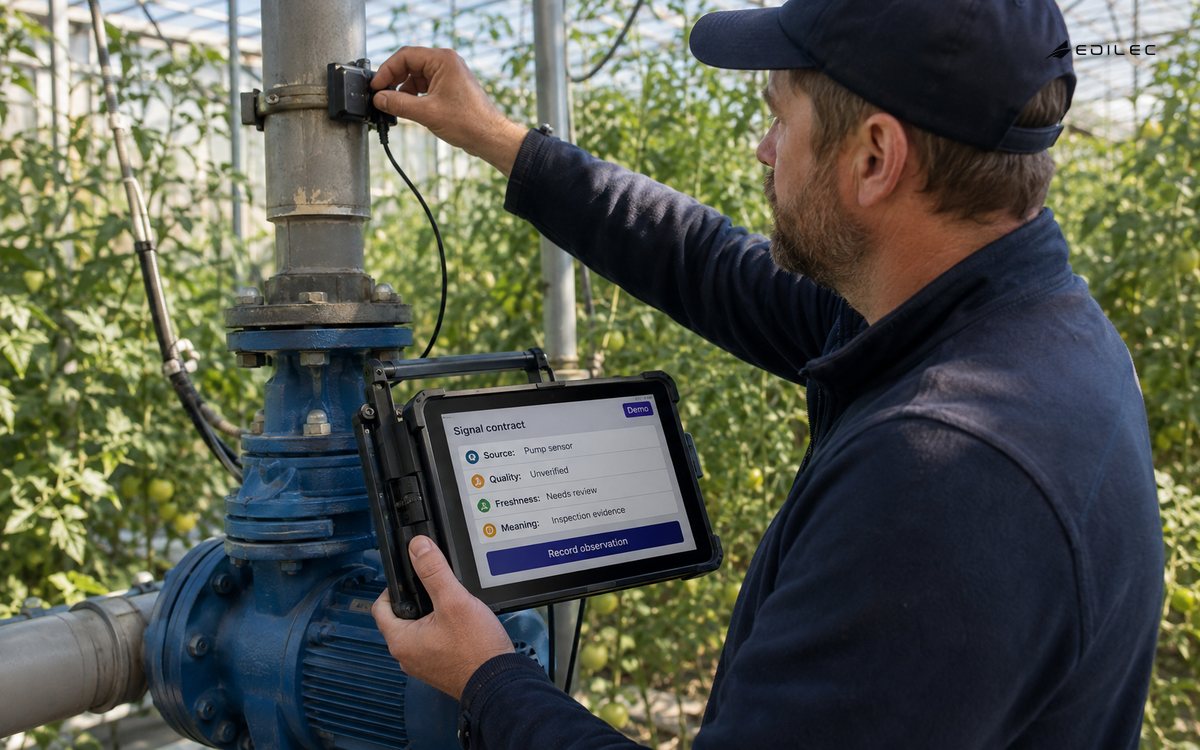
Before coding, answer how the system determines that a reading is late. Event time is what the device observed; receipt time is when a gateway or service saw it. Keep both. Define allowable clock skew, late-arrival handling, replay order, and the display label for stale evidence. If a device cannot maintain a trustworthy clock, use receipt time for freshness but expose that limitation. A timestamp without a confidence rule creates false precision. Test a device that reports old data after reconnecting, a gateway with a bad clock, and a daylight-saving transition. The goal is not perfect time; it is honest time.
| Situation | Safe interpretation | System behavior |
|---|---|---|
| No message in window | Unknown, not zero | Show stale and route a health signal. |
| Late but valid message | Historical evidence | Store with both event and receipt time. |
| Out-of-range value | Potential fault or real event | Quarantine or flag before alerting. |
| Repeated device identifier | Possible retry or replay | Deduplicate and preserve the audit trail. |
Sketch the Evidence Path
Draw the path from device to decision: sampling, local queue, gateway, broker or endpoint, validation, enrichment, storage, calculation, alert, and user interface. For each hop, name the owner, retry policy, maximum queue, and evidence emitted on failure. The OpenTelemetry Collector model of receivers, processors, and exporters is a helpful mental model for making those stages visible. Avoid a single opaque ingestion service that both accepts bad data and silently rewrites it. Keep raw or normalized records available according to the retention decision so an incident can distinguish a sensor fault from a parser change.
Keep Reported and Desired State Separate
A common first-build mistake is using one field for what a device reports and what a user wants. AWS IoT’s Device Shadow documentation shows a useful pattern: reported state and desired state can be represented separately while the device is offline. Apply the principle even without that service. A command should include issuer, scope, expiry, version, and acknowledgement. A reading should include observation and quality. The UI should make a pending command visibly different from a confirmed device state. This prevents a disconnected device from appearing compliant simply because a control request was saved.
Make Quality a First-Class Field
Quality is not an afterthought attached only when something goes wrong. Decide which conditions make a reading usable, questionable, estimated, or invalid. Range checks catch obvious failures, but cross-sensor consistency, calibration age, battery state, and firmware version may matter too. Let consumers choose whether to exclude questionable values, show them with a warning, or use them for a low-risk trend. Record the rule version that produced the quality state so a later change does not rewrite history without explanation. A product that labels every value valid teaches operators to ignore the label when the first bad decision arrives.
Set the Trust and Access Boundary
The data path should answer who may publish, read, transform, export, and delete telemetry. Use per-device or per-tenant authorization where the risk warrants it, minimize retained identifiers, and protect credentials through the lifecycle. Separate operational visibility from unrestricted raw-data access. If a gateway aggregates many devices, ensure a compromised gateway cannot impersonate every device without detection. The companion device provisioning security review helps with onboarding; this initial design should also define revocation, audit, and response once telemetry is flowing.
Build a Pilot That Can Fail Usefully
Choose a representative device, a representative network, and one decision. Inject loss, delay, duplicates, clock drift, invalid units, expired credentials, gateway restart, and consumer backpressure. The pilot succeeds when the team can identify the failure, explain its effect on the decision, and use a rehearsed correction. Capture device battery or CPU only alongside business and operational evidence such as time to detect stale data and time to restore trustworthy flow. Read Sensor Data Pipelines for Connected Systems: Operating Guide before expanding the design. A small pilot that reveals an unresolved contract is progress, not failure.
Assign Ownership Before Scale
Someone must own schema compatibility, device coverage, pipeline health, storage cost, access policy, and incident response. Put those responsibilities in a runbook with escalation boundaries. Measure expected-versus-received messages, stale duration, invalid rate, sequence gaps, duplicate rate, processing latency, queue depth, and operator response. Tie each signal to an action: a sequence gap may trigger investigation, while a stale safety signal may require a human decision. Product teams should review these measures with operators because a technically healthy pipeline can still fail to support the intended work.
A pre-build review is strongest when it uses a real sample rather than a diagram alone. Bring one expected reading, one stale reading, one invalid reading, one duplicate, and one reading from a restarted device. Walk each through the proposed schema and state transitions. This reveals whether fields are missing, whether the team agrees on units, and whether a downstream consumer can make a safe distinction between unavailable and zero.
Keep the first implementation deliberately small. One device family, one transport, one storage path, and one decision are enough to prove time, quality, provenance, and recovery. Add a second device family only after the contract survives different sampling rates, firmware versions, and network conditions. A smaller foundation is easier to migrate than a large ambiguous pipeline that has already accumulated business dependencies.
The strongest first-build decision is often a deliberate exclusion. Defer dashboards, long-term analytics, or remote control until the core observation contract is proven. A narrow implementation can still leave extension points for later schemas and consumers, while avoiding early commitments that make correction expensive.
Document the first consumer contract alongside the schema. State which values it accepts, which quality states it ignores, how it handles duplicates, and what it does when evidence is late. This keeps the pipeline useful as more consumers arrive with different tolerance for uncertainty.
Version the contract with the decision, not only with the payload. A field change can be harmless for storage and still alter an alert or maintenance choice.
Practical Takeaways
- Start with one operational decision and make its time and risk boundaries explicit.
- Keep measurement, state, health, quality, and command acknowledgement separate.
- Preserve provenance, units, event time, receipt time, sequence, and schema version.
- Model the full evidence path, including buffers, retries, validation, storage, and presentation.
- Test bad clocks, disconnects, duplicates, invalid values, and expired access before scale.
- Assign owners for contracts, cost, access, coverage, and correction.
FAQ: Telemetry Before the First Build
Should a dashboard be the first telemetry deliverable?
Usually not. First define the decision, evidence contract, freshness rule, and failure behavior. A small operational view can then prove whether the data supports the work. Starting with charts often hides missing provenance and encourages teams to optimize appearance instead of trustworthiness.
Do we need to keep raw readings?
Keep them when they are necessary to investigate faults, validate transformations, meet an obligation, or reproduce an important decision. If raw retention is too costly or sensitive, define a documented aggregation and deletion policy that preserves enough evidence for the use case.
Conclusion
The first telemetry build should settle meaning before machinery. Define the outcome, schema, time policy, quality states, trust boundary, failure path, and ownership, then build only enough pipeline to prove those choices. That discipline gives later devices and use cases a stable foundation instead of a larger collection of ambiguous readings.