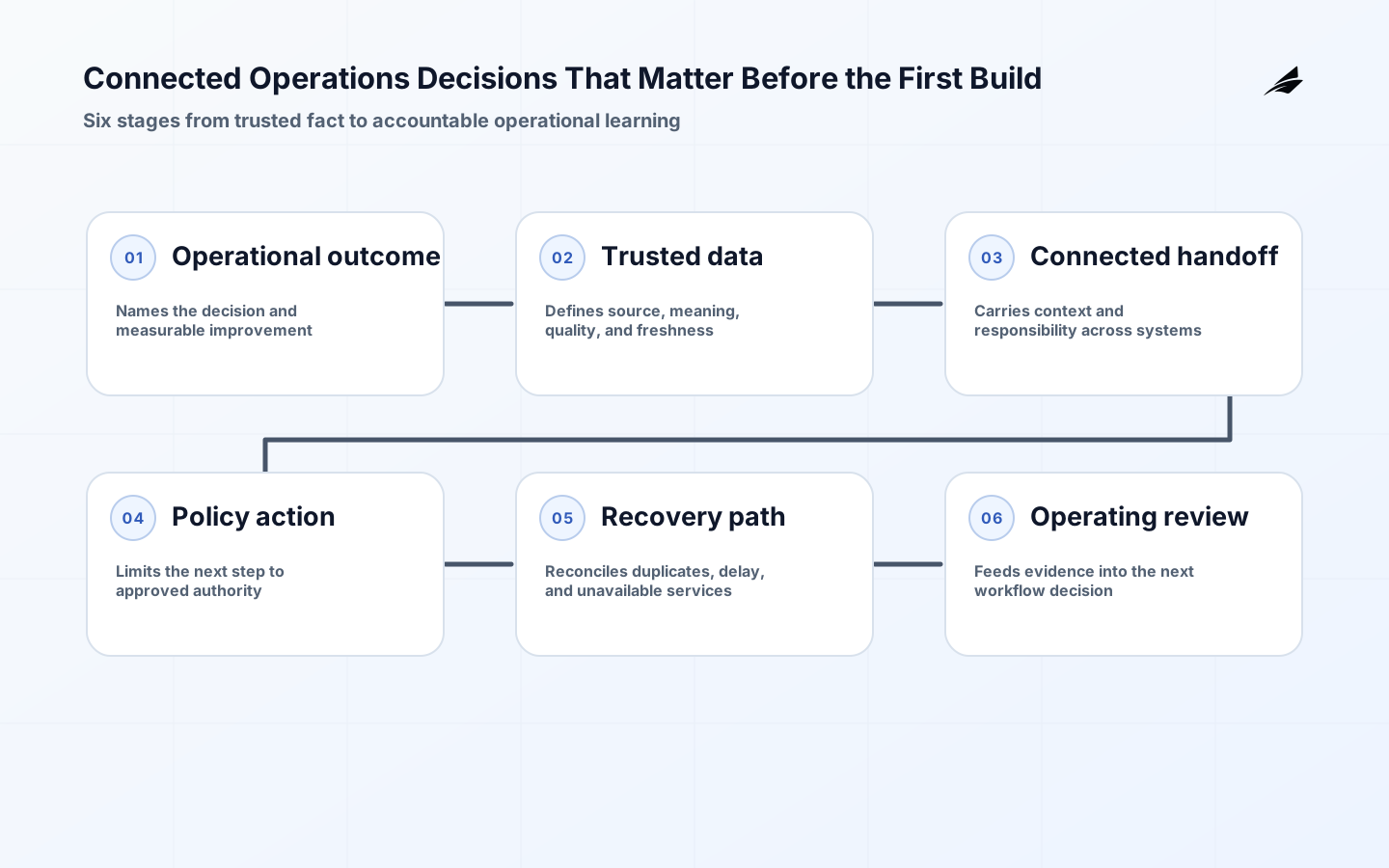
A connected-operations practice is not the accumulation of sensors, dashboards, and integrations. It is the ability to move a trusted fact to the person or system that can make a bounded decision, then preserve the outcome and recover when the path breaks. Start with a business or operating moment: a condition needs investigation, a line needs scheduling, a technician needs context, or a customer needs a reliable status. NIST SP 800-82 Rev. 3 helps keep the ambition grounded because operational systems must account for safety, availability, and reliability alongside data sharing. The first build should improve one decision end to end, not promise a unified platform before ownership is known.
Choose an operational outcome
Describe the current workflow with its actors, source facts, handoffs, latency, exception routes, and consequence of delay. Then choose an outcome that can be observed: fewer unowned alerts, faster verification of a condition, fewer duplicate site visits, or a more complete handover. Avoid a generic objective such as “single pane of glass.” It does not reveal what must change for an operator. A useful outcome has a named owner and a decision boundary. It also states what the new path will not automate until evidence supports it, especially where people, equipment, or regulated obligations are affected.
| Workflow element | Question to settle | Owner |
|---|---|---|
| Triggering fact | Which source is authoritative and how fresh must it be | Data or asset owner |
| Decision | Who may assess, approve, or act | Operations owner |
| Action | What changes in a downstream system or field process | Process owner |
| Evidence | What proves completion or safe exception handling | Service owner |
Make data meaning explicit across teams
Systems can exchange values while people still disagree about their meaning. Give each shared operational fact an identity, source, observation time, receipt time, units, quality state, ownership, and retention rule. Make a distinction between a measured fact, a calculated estimate, a work status, and a forecast. An asset identifier needs a documented cross-reference if different systems use different names. This small contract work prevents a dashboard, work order, and data pipeline from each presenting a plausible but incompatible version of current state. It also makes it possible to investigate a disputed outcome without relying on screenshots or memory.
- Start with one measurable decision and one accountable operational owner.
- Map where a fact originates, changes meaning, and is considered complete.
- Carry time, unit, quality, source, and identity with shared data.
- Keep human approval distinct from automatic observation or notification.
- Define exception states and their escalation owner before launch.
- Record how a manual correction is made, approved, and later reconciled.
Build the first connected workflow
Choose a representative path that crosses the real boundaries: an asset signal, a gateway or ingestion service, a decision service, a work system, and a person who closes the loop. Instrument every handoff before expanding volume. Design delayed, duplicated, missing, and low-quality facts as first-class cases. Where a workflow affects equipment, default to informing or requesting confirmation rather than issuing a broad control action. The device configuration, logical-access, data-protection, update, and state-awareness capabilities in NISTIR 8259A provide a practical checklist when the workflow depends on connected devices.
Design for interruption and recovery
Every connected workflow will encounter outages, stale inputs, conflicting updates, and unavailable people. State the safe degraded behavior for each: preserve last-known values with age, stop automatic actions that need fresh authority, queue only idempotent work, and make pending status visible. Recovery needs a comparison source, a time window, and an owner empowered to decide a mismatch. Do not let an integration retry indefinitely without recording whether its intended action already occurred. A recovery exercise should show that the team can return to a coherent state after a partial failure, not merely that a connector reconnects.
Govern access and change at the handoffs
Connected operations often creates new paths between field assets, enterprise applications, and support tools. Apply the identity-and-policy approach in NIST SP 800-207 to those handoffs: authorize a specific request in context, use least privilege, and make administrative changes reviewable. Maintain an asset and service inventory, a named owner, and a tested removal process. Change reviews should ask whether a new interface changes data authority, action authority, or recovery scope. This is more useful than a blanket approval because it links controls to the actual operational consequence.
| Operating signal | What it reveals | Action when it worsens |
|---|---|---|
| Decision latency | Whether facts reach the responsible owner in time | Inspect slow handoff and capacity or queue cause |
| Unowned exception age | Whether failures have an accountable route | Escalate and repair ownership or runbook |
| Reconciliation mismatch | Whether systems diverged after interruption | Pause expansion and compare evidence |
| Manual correction rate | Whether the modeled workflow fits reality | Investigate source quality or rule design |
Run a connected-workflow acceptance exercise
Select one operating condition that should produce a human or system response and trace it across every owner. Create the source fact, delay it, duplicate it, make its quality uncertain, and temporarily remove the downstream work system. Ask participants to identify the authoritative status at each point: the asset or source, gateway or ingestion service, decision logic, work queue, operator, and closure record. The test is not about forcing a failure for its own sake. It reveals whether the organization can see a fact changing hands and still know who is responsible when the normal handoff is interrupted.
After restoration, reconcile the facts and decisions. Confirm that duplicate work is not created, late data does not overwrite a justified later decision, and a manual correction is attributable. Review who can alter a rule, route a task, or issue a command, and whether those permissions are narrower than ordinary observation. Finally, measure the time to restore a coherent operational picture, not just the time to reconnect an API. A connected workflow is ready to grow when its people can explain the exception route as confidently as the happy path and can use the evidence to improve the next release.
Rehearse one connected decision
A connected-operations practice becomes useful when a named person can make a better decision with less searching and fewer handoffs. Consider a maintenance coordinator deciding whether to dispatch a technician after a vibration alert. The workflow needs an asset identity, a trustworthy signal, a threshold or policy, a work-order destination, and a way to explain why the decision was made. A dashboard alone may display facts but still leave the coordinator to reconcile systems manually.
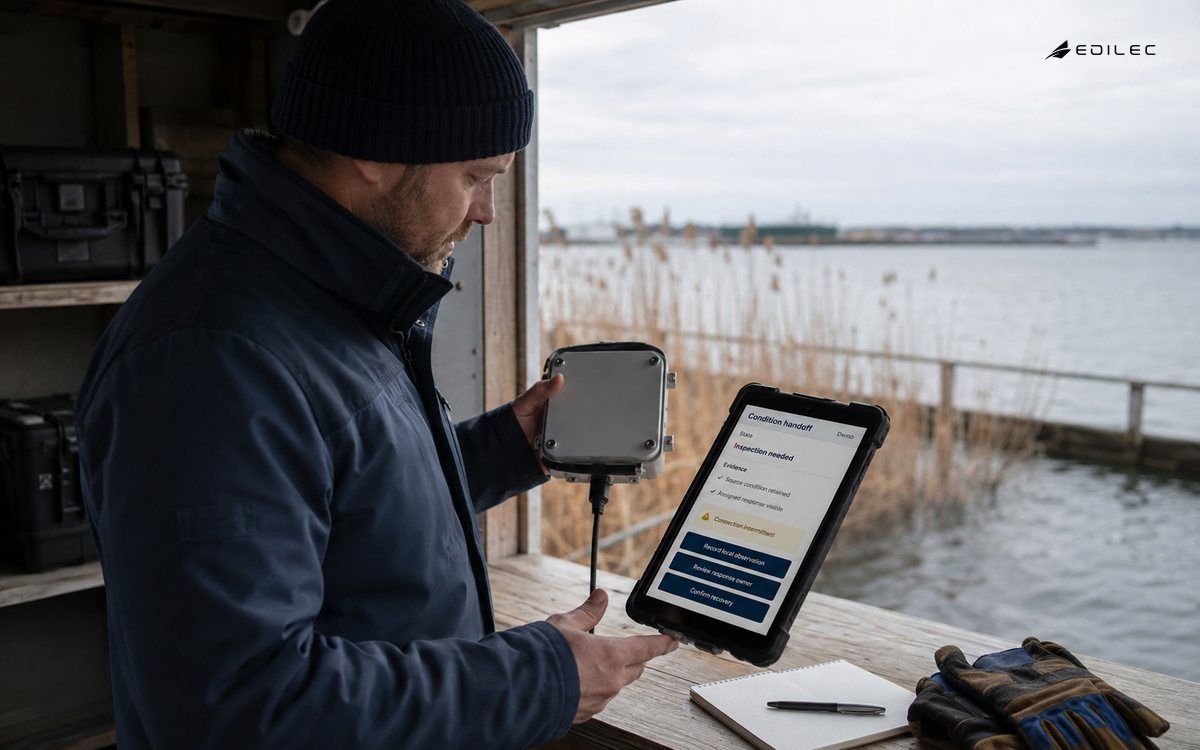
Start with one decision and map every handoff that can change its meaning. Mark which system owns the asset, measurement, assignment, and final outcome. Define freshness, quality, units, and exception states. Then test the complete path when telemetry is late, a queue is duplicated, a work order is cancelled, or the downstream system is unavailable. The first connected workflow should make recovery explicit; otherwise it only moves ambiguity faster.
| Decision layer | Concrete question | Evidence |
|---|---|---|
| Signal | Is the measurement current and meaningful? | Timestamp, quality and source |
| Policy | What condition permits the next action? | Versioned rule and owner |
| Handoff | Which system accepts responsibility? | Correlation ID and state |
| Recovery | How is a mismatch corrected? | Reconciliation result and exception owner |
Standards for trustworthy handoffs
Use NIST Cybersecurity Framework 2.0 for governance and recovery, NIST SP 800-82 Rev. 3 for physical and operational context, NIST SP 800-207 for explicit trust decisions, and NISTIR 8259A for device capability expectations. Treat each reference as input to a local workflow and risk review.
For related context, compare connected operations playbook, connected operations for CTOs, and connected operations for connected systems. Use those perspectives to test the boundary described here while keeping the operating decision and owner in view for connected operations.
Key takeaways for connected workflow design
- A connected operation starts with one accountable decision, not a technology inventory.
- Shared data needs identity, time, units, quality, ownership, and a clear authority.
- Instrument the handoffs where a fact changes system or human responsibility.
- Use safe degraded states and explicit reconciliation rather than blind retries.
- Evaluate access and change at each new operational boundary.
- Measure decision delay, unowned exceptions, and repair work to guide expansion.
Questions about connected operating decisions
- What makes a connected-operations pilot credible? It proves one full workflow with named owners, normal and degraded behavior, a usable decision signal, and a way to reconcile after failure.
- Should connected operations automate actions immediately? Only where authority, current data, safety controls, and recovery have been demonstrated. Notification and human confirmation are valuable early stages, not signs of failure.
Create an operating charter for each connected workflow. It should name the decision, intended outcome, participating systems, source-of-truth facts, handoff owners, access boundaries, safe degraded behavior, reconciliation route, service indicators, and review cadence. Keep it short enough to use during a change or incident, but concrete enough that a newly involved team can see where authority resides. The charter is not a substitute for detailed design; it is the shared map that exposes when a proposed integration bypasses an owner, creates an unreviewed action path, or assumes a recovery process that does not exist.
Expand a connected workflow in bounded rings. Start with a site, asset class, or work type where owners can observe the result closely. Compare the new decision path with the existing process, including exceptions and customer communication. Add the next ring only after evidence shows the system is understood, support capacity exists, and recovery does not rely on one expert. This rollout rhythm makes the architecture accountable to operating reality and prevents a promising integration from becoming a fragile mandatory dependency overnight.
Keep a visible decision log for changes to authority, data meaning, and exception handling. It should capture the reason, owners, affected workflow, validation evidence, rollback point, and date for review. This helps future operators distinguish an intentional operating policy from an accidental integration behavior that has survived unnoticed.
Communicate workflow changes to the people who receive the new alerts, tasks, or escalation duties. Explain the trigger, evidence, authority, and recovery route in their ordinary operating language. Adoption fails when a technically correct integration surprises a shift team with a new responsibility it did not accept or cannot fulfill.
Conclusion: connect facts to accountable action
The worthwhile form of connected operations shortens the distance between a reliable fact and an accountable response. See Connected Operations: Operations Playbook, How CTOs Should Think About Connected Operations, and Connected Operations for Connected Systems to extend that discipline into delivery and production.