Offline Sync for Engineering Teams: A Practical Design Guide
Offline sync is the agreement that lets a device or browser keep useful local state when a network disappears, then reconcile that state with a shared service later. Engineering teams should treat it as a user-visible data contract. A field technician may need to complete an inspection in a basement, a vehicle may cross a dead zone, or a handheld device may be suspended for hours. The right question is not whether the client can cache a screen; it is which actions remain safe, which records are authoritative, and how a person will understand a conflict. MQTT guidance on sessions and delivery is a useful protocol reference, but transport behavior does not decide business meaning. Your product must do that explicitly.
Define the offline sync boundary
Start by naming the smallest workflow that must continue without connectivity. Do not begin with a generic offline mode. List the records a user reads, creates, edits, or deletes; the moment each change becomes consequential; and the fallback when the client cannot prove current state. A draft inspection note can usually be stored locally. A payment, safety override, or irreversible equipment command may require an online check. The AWS IoT Device Shadow reference is a concrete example of separating desired, reported, and divergent state; use that distinction to define what the product can safely promise while disconnected.
Make the user contract explicit
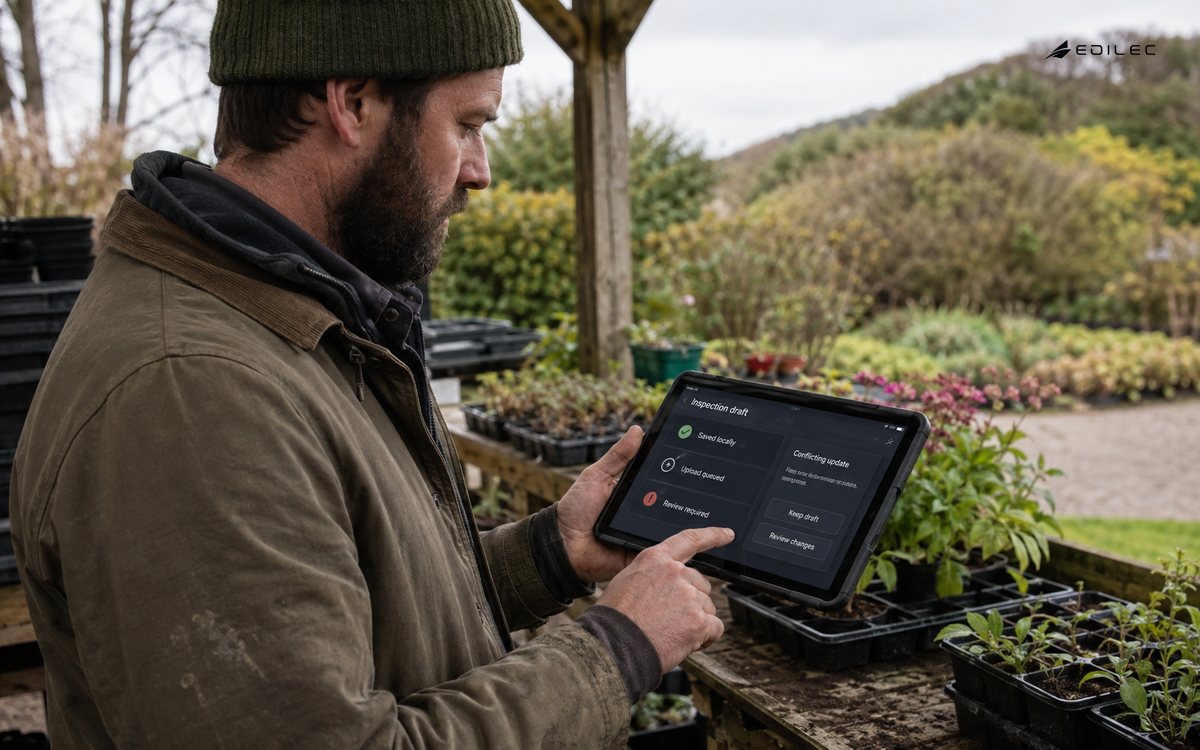
Users need to know whether a change is saved on the device, queued for upload, accepted by the service, or rejected during reconciliation. Those states should have plain-language labels, timestamps, and a next action. A small icon without an explanation is not enough when a technician must leave the site. Tell the user which fields can be edited offline, how long local data is retained, and what happens if the same record changes elsewhere. The WebSocket protocol specification is a useful reminder that a live connection is only a transport; it does not turn a client-side write into an accepted business fact.
| Decision | Recommended starting rule | Evidence the team should keep |
|---|---|---|
| Offline scope | Allow drafts and bounded updates; keep high-consequence actions online. | Workflow map with action risk and fallback. |
| Local state | Store the minimum fields needed to resume work and show sync status. | Retention, encryption, purge, and schema notes. |
| Authority | Name the service record that wins when facts conflict. | Field-level authority and version policy. |
| User message | Separate saved locally, queued, accepted, and needs review. | Copy, state transitions, and support examples. |
Choose conflict rules before implementation
Conflict resolution is a business decision disguised as a technical one. A last-write-wins rule is simple, but it can erase a careful correction made by another operator. Merging every field can preserve incompatible facts, such as two different completion times or two owners. A useful design classifies fields by meaning. Notes may merge as append-only entries, status may require a transition rule, and a measured value may need a review queue when the difference exceeds a tolerance. Version numbers and timestamps help detect divergence; they do not, by themselves, tell the system which value is correct.
- Which fields are append-only, and which represent a single current fact?
- Can two users make valid changes at the same time, or must one review the other?
- What is the acceptable tolerance for a numeric or time difference?
- Does a conflict need to block the workflow or can it be resolved after submission?
- How will support staff see the original values, actors, versions, and final decision?
- Which changes must be replayable when the client reconnects after a partial upload?
Design the data model for replay
A robust offline sync model usually has an entity record, a client change or operation, a server version, and an outcome. Give each operation a stable idempotency key so a retry cannot create a duplicate task or inspection. Preserve the client timestamp for user context, but use a server-side ordering or version for authority. The local queue should record dependencies: an attachment may depend on a parent record, and a status transition may depend on a prior update. If the queue is merely a list of HTTP requests, it becomes difficult to explain why one item failed or to resume safely after the fourth request succeeds and the fifth times out.
Build a failure-aware sync path
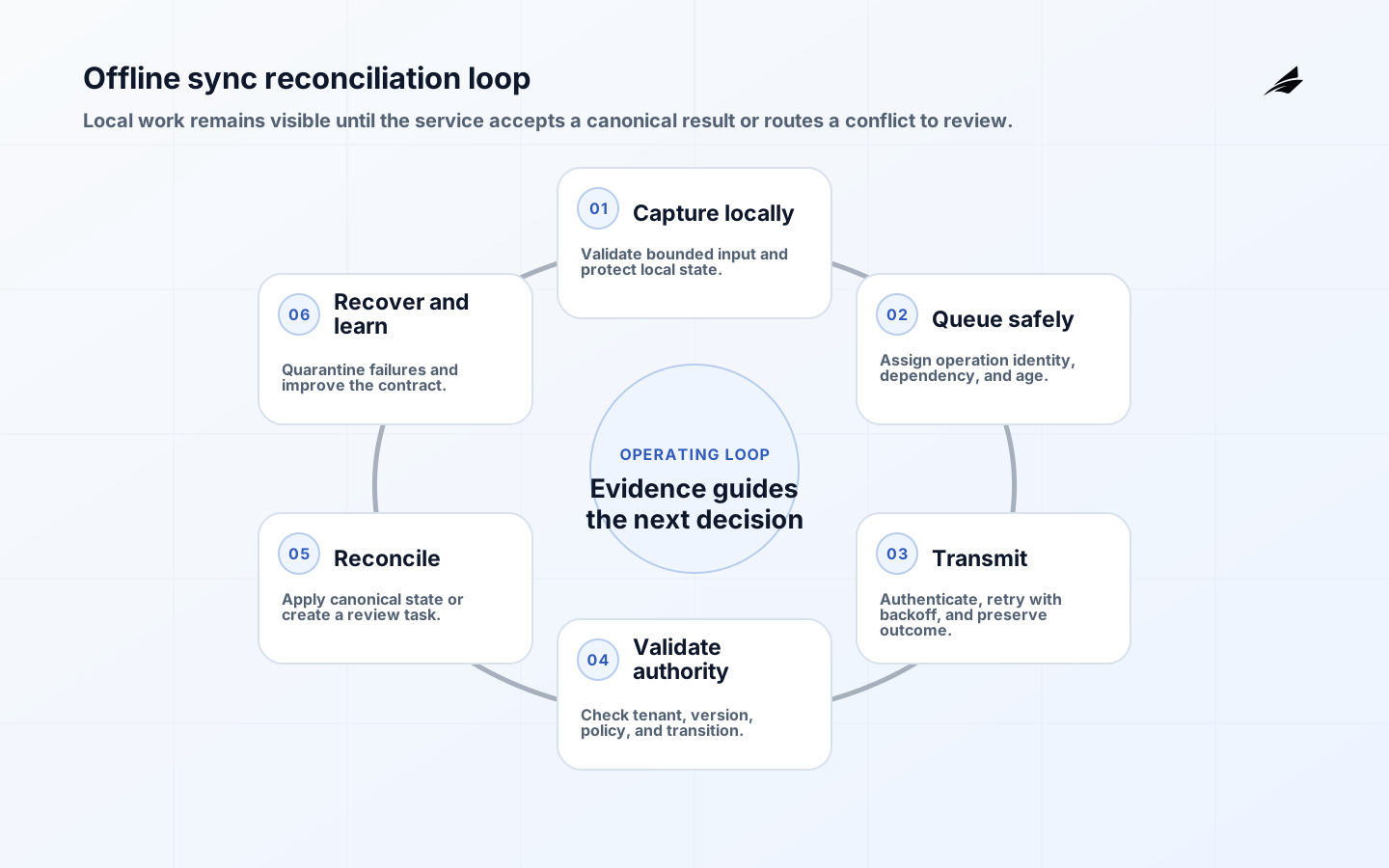
The path should make progress visible from capture to reconciliation. A client writes a bounded local transaction, validates what it can, and appends an operation. A synchronizer selects eligible operations, sends them with identity and version context, and records the response. The server validates authorization and current state before applying a change. Accepted operations return a canonical representation; rejected ones return a reason the user or support owner can act on. The HTTP Semantics specification helps distinguish transport success from application success, so the sync contract can name both without confusing a response code with a completed workflow.
Turn the architecture into operating controls
| Stage | Control | Useful signal |
|---|---|---|
| Capture | Validate required fields and local schema version. | Rejected local writes and schema migrations. |
| Queue | Assign an idempotency key and dependency state. | Queue age, size, and blocked operations. |
| Transmit | Use authenticated sessions, bounded retries, and backoff. | Attempts, latency, disconnects, and retry class. |
| Apply | Check actor, tenant, version, and transition policy. | Accepted, rejected, and conflict outcomes. |
| Reconcile | Replace local state with a canonical result or review task. | Unresolved conflicts and time to resolution. |
Do not hide a permanently failing operation behind automatic retries. A retry policy should distinguish temporary transport failure, authentication expiry, invalid data, authorization change, and a genuine conflict. Each class deserves a different response. A device with a clock that is years out of date can create confusing ordering; a client with an old schema may need migration; a revoked user may need the local queue quarantined. RFC 9293 helps keep transport assumptions grounded, while the product contract still owns authentication, authorization, and business reconciliation.
Roll out offline sync in a narrow slice
Choose one workflow with real connectivity gaps and a forgiving recovery path. Instrument a connected baseline first: completion time, abandonment, duplicate records, correction rate, and support contacts. Then enable local capture for a small cohort and deliberately test airplane mode, process termination, clock drift, storage pressure, duplicate taps, token expiry, and reconnect during upload. A pilot is successful when the team can explain both normal operation and the worst recent conflict. It is not successful merely because queued writes eventually appear in a dashboard.
Example: a field inspection workflow
Imagine an inspection app that records equipment condition, photos, notes, and a recommended follow-up. Offline, the technician can create a draft, attach evidence, and mark observations. The app cannot close a safety-critical finding until it has checked the current asset state online. If a dispatcher changes the assignment while the technician is offline, the technician's observations remain valid, but the assignment conflict goes to review. The final record shows the observation author, capture time, upload time, asset version, and the person who resolved the assignment. That division protects useful field work without pretending every action is equally safe offline.
Review the failure modes that matter
The most damaging mistakes are silent success claims, accidental overwrite, duplicate side effects, and unrecoverable local data. A green sync badge that means only “the request left the device” creates false confidence. A local purge triggered by a failed migration can erase evidence the support team needs. A retry around a non-idempotent command can create two shipments or two work orders. Treat these as design-review questions, not post-launch bugs. The MQTT Version 5.0 specification can inform protocol delivery choices, but application-level idempotency and auditability remain your responsibility.
- Prove that local data is protected at rest and removed according to a stated retention rule.
- Show that every side-effecting operation has an idempotency strategy.
- Exercise partial failure between parent and child records.
- Verify that an expired identity cannot silently upload queued sensitive data.
- Give support a replay or quarantine view without granting unnecessary business authority.
- Test migration from at least two previous local schemas before broad rollout.
Measure trust, not just throughput
Track the age of the oldest queued operation, the percentage of work completed offline, conflict rate by field, duplicate side effects prevented, time to resolve a conflict, and the number of users who abandon a queued workflow. Segment by device model, software version, geography, and connectivity pattern when that data is appropriate. A low average queue time can conceal a small group of devices that never reconnect. Pair technical signals with user outcomes such as rework, missed inspections, or corrections after submission. If the team cannot connect a sync metric to a decision, it is probably telemetry without an owner.
Offline sync decisions worth preserving
- Define which work can safely continue offline before selecting a storage or sync library.
- Use explicit states for local save, queued upload, accepted result, and review required.
- Make authority and conflict behavior field-specific where the business meaning differs.
- Give every side-effecting operation a stable idempotency key and a recovery path.
- Instrument queue age, conflict resolution, duplicate prevention, and user rework together.
- Launch with one workflow, one accountable owner, and a tested manual fallback.
Offline sync FAQ
Is offline sync the same as caching?
No. Caching makes previously fetched data available locally. Offline sync also accepts local changes, tracks their authority, retries delivery, detects divergence, and reconciles a canonical result. A read-only cache may be enough for a reference catalogue; it is not enough for an inspection or work-order workflow.
Should every conflict block the user?
No. Block only when the conflicting fact changes safety, authorization, financial meaning, or the next valid transition. Append-only notes can often be retained automatically. The rule should be visible to the user and support owner, with a review path for the cases that cannot be merged safely.
When should a team buy a sync service?
Consider a managed service when the team needs durable multi-device conflict handling, has a clear data model, and can evaluate its retention, security, and operational fit. A vendor does not remove the need to define authority, user messaging, idempotency, or high-consequence online gates. Prove those contracts with a narrow workflow first.
Conclusion: make disconnection a designed state
Offline sync should expose four different truths: what the technician saved, what the service received, which version became authoritative, and what still needs a human decision. Make those distinctions visible in the workflow and in support evidence, then pilot them against real dead zones and interrupted uploads. The event streaming guide, edge computing guide, and sensor data pipelines guide cover adjacent concerns. A good offline feature does not pretend the network is reliable; it tells people exactly what the system knows and what action closes the gap.