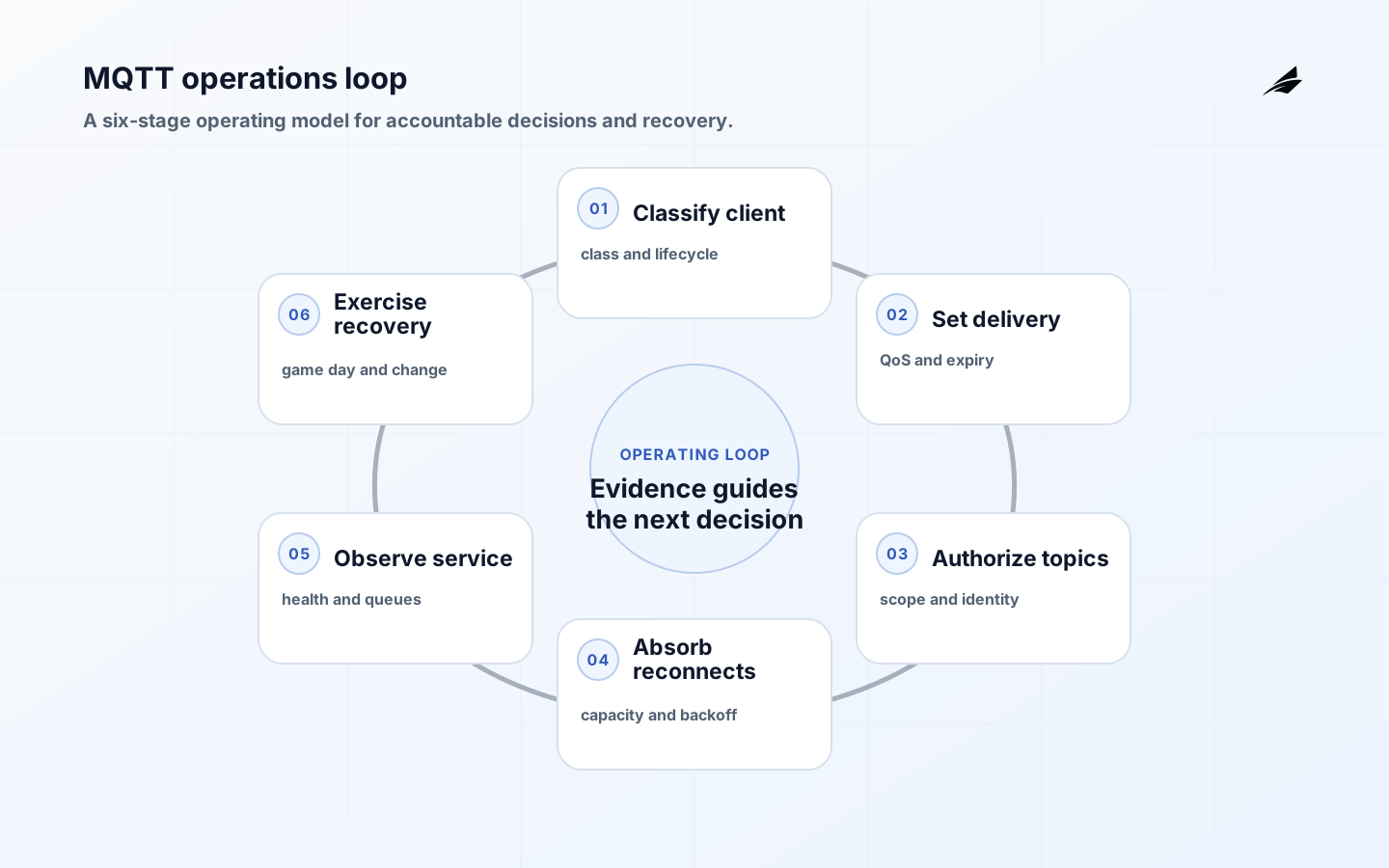
An MQTT broker accepts publications from clients and routes them to subscribers based on topics. For operations leaders, it is not simply a lightweight connectivity feature. It is a shared service that shapes which device data arrives, who can see or issue messages, how reconnecting clients behave, and how an outage reaches downstream work. MQTT's simple publish-subscribe model is useful for intermittent devices, but its operational qualities come from topic governance, session settings, authentication, authorization, capacity, and the way applications handle delivery. The MQTT architecture guide provides protocol detail; this article focuses on operating choices.
Define the broker service promise
Before selecting a product or topology, list client classes and what each needs: expected connections, message rate and size, latency, offline behavior, retention, ordering scope, and consequence of loss or delay. A sensor reporting hourly health is not equivalent to a command acknowledgement or alarm transition. Make the service promise precise enough to test, including planned maintenance and regional failure. MQTT quality of service levels describe protocol delivery interactions; they do not eliminate the need for idempotent application handling or guarantee that a downstream system performed a business action. Set an availability and recovery objective per use case, then ensure contracts and runbooks can meet it. MQTT Version 5.0 defines the protocol behavior that client and broker contracts must interpret.
Choose delivery and session behavior deliberately
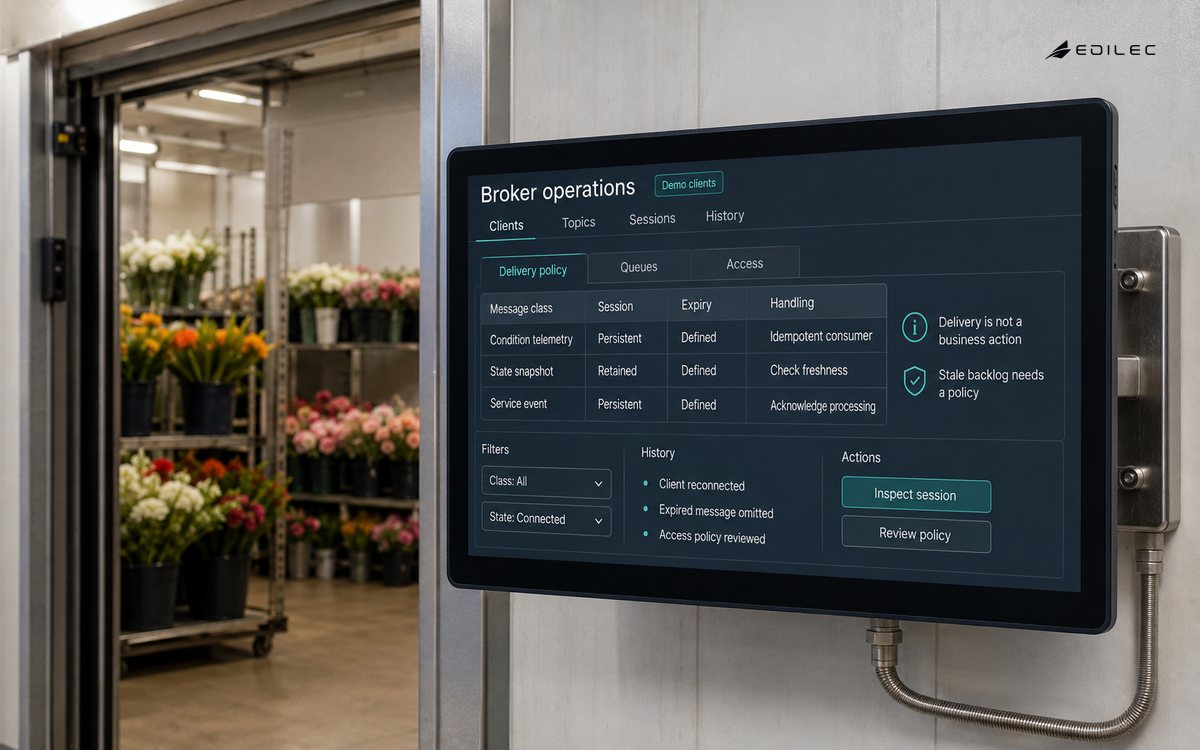
MQTT offers QoS 0, 1, and 2 with distinct delivery trade-offs. The correct choice depends on whether a receiver can tolerate loss, duplicate messages, latency, and connection overhead. Persistent sessions and queued messages can help intermittently connected clients, but they consume storage and can release a stale backlog at a surprising moment. Retained messages are useful for a latest known state when their meaning and expiry are clear; they are dangerous when clients mistake a historical state for a live command. Define session expiry, message expiry, maximum queue, and overflow behavior per client class. Test reconnects after a long outage, not just a clean disconnect. NIST SP 800-213 frames device cybersecurity expectations that affect client onboarding and lifecycle control.
| MQTT feature | Good use | Operational caution |
|---|---|---|
| QoS 0 | Frequent, lossy telemetry | Do not use where a missing transition is material |
| QoS 1 | Important events with idempotent consumers | Duplicates are expected and must be handled |
| Persistent session | Known intermittent client | Bound queued work and define stale-message behavior |
| Retained message | Current configuration or state | Use expiry and clear ownership of publisher |
| Shared subscription | Distributed consumer work | Monitor uneven load and consumer failure |
Govern topic names and authorization
A topic hierarchy should communicate scope without leaking customer or sensitive details. Define segments for tenant or organization, site, asset class, identity, message type, and direction only where they improve authorization and operations. Avoid a casual wild-card subscription that gives a diagnostic tool access to all production traffic. Grant clients the smallest publish and subscribe patterns needed, use unique credentials, encrypt connections, and disable anonymous or default administrative access. Record topic ownership, payload contract, retention behavior, and data classification in a catalog. Topic names become a public interface inside the estate; changing them without migration planning can be as disruptive as changing an API.
Capacity-plan for reconnect storms
Broker capacity is driven by concurrent connections, connection churn, TLS handshakes, subscriptions, payload rate, retained messages, queued sessions, persistence, replication, and network placement. The biggest operational spike often occurs when power or cellular service returns to many clients at once. Use randomized reconnect backoff, connection rate limits, bounded queues, and a test environment that can mimic the recovery profile. Decide whether to deploy local brokers, a clustered central service, or a hybrid model based on latency, isolation, maintenance skill, and failure consequence. A high availability feature does not replace client behavior; clients still need to reconnect safely and applications need to understand delayed data.
| Operating signal | What it can indicate | First response |
|---|---|---|
| Connection surge | Power or network recovery | Check rate limits and client backoff |
| Queued session growth | Offline clients or stuck subscriber | Identify class, age, and expiry behavior |
| Authorization denials | Misconfiguration or attempted misuse | Correlate identity, topic, and change history |
| Publish latency rise | Resource saturation or persistence problem | Protect critical traffic and inspect bottleneck |
Operate, monitor, and change the broker safely
Name owners for broker platform, client onboarding, topic contracts, certificates, and incident response. Monitor availability, connection success, authentication failures, queue age, dropped or expired messages, capacity, replication health, and administrative changes. Keep a tested procedure for certificate rotation, client credential revocation, broker upgrade, and controlled draining of a node. During an incident, responders should be able to determine whether a missing value was never published, rejected, queued, delivered, or ignored by a consumer. That requires logs and metrics that retain relevant identifiers without exposing raw payloads broadly. Review unused subscriptions and stale credentials regularly; shared infrastructure accretes risk quietly. NIST SP 800-82 Rev. 3 provides operational technology guidance relevant to broker availability and incident response.
Select and roll out by operational fit
Compare managed and self-operated brokers by the responsibilities your team can actually sustain: upgrades, security patches, tenant separation, data residency, networking, support access, observability, export, and disaster recovery. Use a representative proof with real certificates, offline clients, denied permissions, a slow consumer, and a broker restart. Define the exit path and topic migration approach before broad adoption. The cheapest connection price can be misleading if it creates manual credential work or hides queue behavior. A good selection leaves the operations team able to state what happens to each important message when the client, network, broker, or consumer fails.
Key takeaways for MQTT brokers
- Set delivery, session, expiry, and recovery expectations per message class.
- Treat QoS as a protocol mechanism, not proof of a completed business action.
- Design topics and least-privilege authorization as stable internal interfaces.
- Test reconnect storms, queue limits, and stale retained state before scale.
- Operate the broker with named owners, evidence, and change controls.
Frequently asked questions about MQTT brokers
Does MQTT guarantee exactly-once business processing? No. Consumers must make their own side effects idempotent. Are retained messages a cache? They can serve a latest-state purpose, but must have a defined owner and expiry. Should every client use persistent sessions? No; choose them where offline delivery is worth the storage and stale-backlog risk. What should be load tested first? Connection recovery and TLS setup at the scale expected after a shared outage.
Conclusion: run the broker as shared operations infrastructure
MQTT brokers are powerful because they decouple devices and applications, but that decoupling transfers responsibility into contracts and operations. Make delivery and access behavior visible, rehearse the difficult recovery paths, and choose a service model the team can genuinely maintain. That is how lightweight messaging remains dependable at fleet scale.
Run a broker game day with operations, application, and security owners together. Simulate a regional network return, one broker node draining for maintenance, a revoked client credential, a subscriber that stops processing, and an attempted publication to a forbidden command topic. Observe client behavior and communication as well as broker metrics. The exercise should produce concrete limits: how quickly clients reconnect, when queues expire, which services lose freshness, and who has authority to alter access. Those facts are far more useful than a generic high-availability diagram when leaders decide where resilience spending belongs. NIST Cybersecurity Framework 2.0 gives operations leaders a structure for reviewing broker risk and recovery.
Maintain a topic and client inventory that can answer operational questions quickly: who publishes this message, which subscribers depend on it, what service level applies, what sensitive fields may appear, and when the owner last reviewed access. Pair it with a deprecation process that gives consumers a migration deadline, observes remaining traffic, and removes permission only after evidence confirms the old path is unused. Topic sprawl is not merely untidy; it makes authorization review and incident scoping unreliable. By treating topics as owned interfaces, an operations leader can scale new clients without turning the broker into a shared network where nobody knows which messages still matter.
MQTT broker acceptance checks
- Each client uses a unique credential with narrow publish and subscribe permissions.
- Topic owners document payload meaning, expiry, classification, and supported consumers.
- Reconnect behavior is rate limited and tested after a shared outage.
- Queued persistent sessions have a documented size, age, and overflow policy.
- Retained state has a named publisher, expiry, and consumer interpretation.
- Consumer side effects are idempotent under QoS redelivery or replay.
- Broker maintenance drains work with observable client and subscriber impact.
- Revoking a credential removes its broker access within the stated window.
- Capacity evidence includes peak reconnect behavior, not only daily average throughput.
How Operations Leaders Should Think About MQTT Brokers operating checklist
A dependable MQTT broker design makes the decision boundary visible. Define the user, the unit of work, the allowed action, the evidence required, the time boundary, and the owner who can correct a result; MQTT operations record the boundary. Apply the official controls already named in this article: provenance should connect entities, activities, and responsible agents; security controls should protect the action that matters; observability should describe a customer-relevant outcome rather than only a technical event; MQTT operations record the boundary. In practice, this means a late source, rejected request, disputed invoice, blocked service, or reconnecting device becomes an owned state with a next review, not an unexplained red badge; MQTT operations record the boundary. Use one representative path as the release test. For a data path, reconcile a sample against the source. For a portal, prove tenant isolation and safe correction. For a workflow, replay a duplicate and a dependency failure. For billing, reproduce the same charge from retained inputs. For MQTT, exercise expiry, reconnect, authorization, and downstream acknowledgement. The test should produce evidence that an operator can inspect without asking the original implementer; MQTT operations record the boundary. Read the related Edilec guides related guide, workflow exceptions, and production operations; MQTT operations record the boundary. | Review question | Evidence to retain | Decision when absent | |---|---|---| | What was requested? | scope, actor, time | clarify or reject | | What changed? | event, version, owner | investigate or replay | | What is trusted? | client policy, topic scope, broker health | publish with caveat or hold | | How is it corrected? | before, after, reason | approve, reverse, escalate | | What improves next? | cause, trend, owner | schedule a bounded change | ### FAQ What belongs in the first release? One complete path with its highest-cost exception. Who owns the result? The person accountable for the business meaning, supported by a technical owner; MQTT operations record the boundary. When should scope expand? After normal work, failure recovery, access review, and correction are all measurable; MQTT operations record the boundary. ### Conclusion The durable form of MQTT brokers is an operating capability: explicit promise, controlled action, inspectable evidence, and a review loop. Start narrow, test the uncomfortable cases, and scale only when the evidence remains understandable; MQTT operations record the boundary.