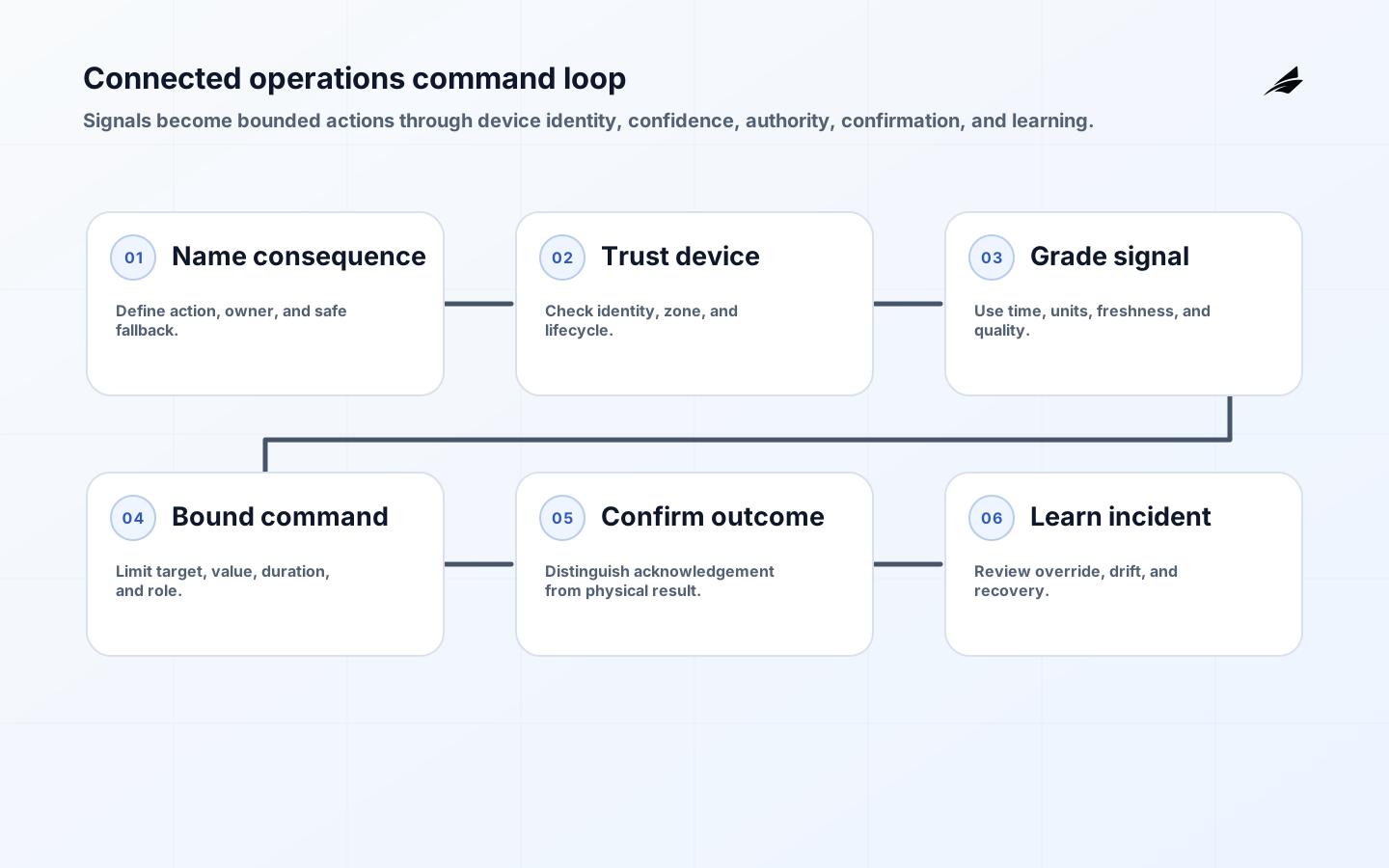
Connected Operations: A Control Playbook
Connected operations controls should earn authority from device identity, signal quality, and a safe recovery path. Connected operations join physical conditions to digital decisions. A signal may be late, noisy, duplicated, or produced by a device whose configuration changed; a command may be authorized in software but unsafe at the equipment boundary. A dependable design therefore treats identity, signal confidence, command scope, confirmation, and recovery as one operating loop. This playbook is for teams connecting equipment, field systems, and operational software. Compare the firmware updates guide, the inventory guide, and the semantic layers guide.
Define the physical consequence
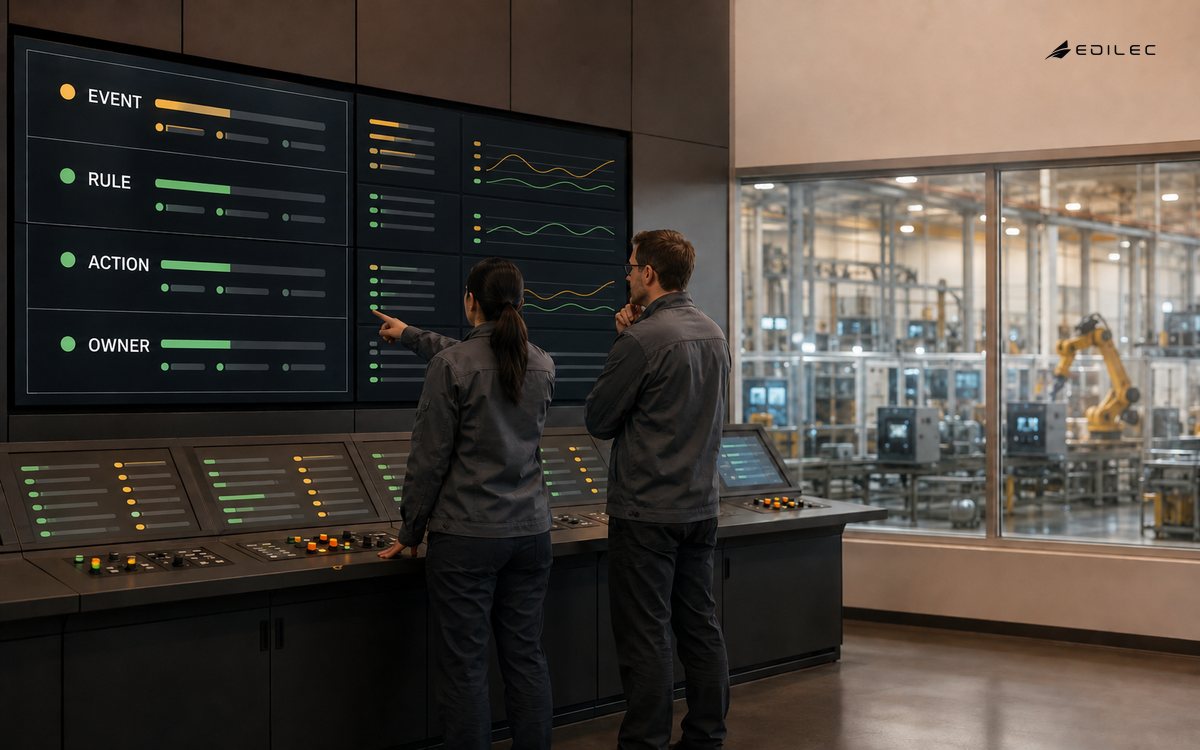
Start with the action the system might enable: change a set point, dispatch a technician, reserve equipment, isolate a segment, or report a safety condition. State what is allowed automatically, what needs confirmation, and what must never be inferred from a weak signal. Name the site, equipment owner, operator, and safe degraded state.
The NIST SP 800-82 Rev. 3 guidance is useful because operational technology combines availability, safety, and security concerns. Use it as context rather than a universal recipe. A connected feature is incomplete if it cannot say what happens when the signal disappears or the operator is unavailable.
Register devices and trust zones
Give every device, gateway, controller, and service a durable identity, owner, location, lifecycle state, and configuration reference. Keep test, maintenance, and production identities separate. Record which trust zone may publish telemetry or receive a command.
Do not treat network reachability as identity. A device that moves sites, loses a certificate, or returns from maintenance needs a controlled state change. The NIST IoT Device Cybersecurity Capability Core Baseline provides useful capability questions for identification, configuration, data protection, and lifecycle support.
Grade signal quality before action
A signal needs context: source, timestamp, calibration or firmware state, units, sequence, freshness, and confidence. Define how stale or contradictory observations affect the decision. A dashboard may show the last value for awareness while an automated command requires a fresh, corroborated state.
Keep observed time separate from received time, especially over intermittent networks. Detect duplicates and impossible jumps, but route them to a reviewer when the consequence is material. Avoid turning every anomaly into an alarm; classify whether it needs a safe hold, a maintenance task, or a human assessment.
Bound command authority
Map command permissions to site, equipment, mode, and consequence. A service that can read every signal should not automatically write every actuator. Require an explicit reason, target, requested value, duration, and expiry. Put a human confirmation in the path when the command can affect safety, production continuity, or regulated conditions.
At the equipment boundary, verify that the command is still valid. The OPC UA Security material provides a useful reference for communication security concepts, but application policy must still decide whether a specific action is permitted. Record rejection and expiry as first-class outcomes.
Plan for loss and disagreement
Connected paths fail in several ways: network loss, power interruption, sensor drift, gateway restart, stale credentials, and conflicting local control. Define the safe state, local fallback, reconnection behavior, and reconciliation rule before adding remote control.
Do not replay a queued command blindly after a long outage. Re-check state, authority, target, and expiry. An operator needs to see the last trusted state, pending actions, and the reason automation paused. A “connected” badge is not evidence that the physical action occurred.
Integrate telemetry with meaning
Use a stable event envelope with device, site, signal, unit, observed time, received time, quality, and correlation reference. Keep raw evidence separate from derived state so a correction can be understood. Retain enough context to investigate without collecting more site or personnel data than the purpose requires.
Connect incidents to the commands and signals that preceded them. The NIST Cybersecurity Framework 2.0 PDF can help structure detection and recovery discussions, while the local runbook should state who may isolate equipment, who may resume it, and what evidence they must record.
Pilot one bounded loop
Choose one equipment class, one site, and one consequence-limited action. Run telemetry in observe-only mode before enabling control. Ask operators to handle stale data, contradictory signals, a rejected command, and an outage. Compare response time, false alarms, manual interventions, and safe holds.
Acceptance requires an operator to understand the command reason and cancel or escalate it. It also requires an engineer to trace the path from device to service and a site owner to approve the degraded state. Expand only when the loop behaves predictably under imperfect conditions.
Operate with human recovery
Review signal quality, command rejection, stale state age, device configuration drift, credential failures, and incident recovery time. Segment by site, device family, network path, and firmware version. A low average alarm rate can hide a site that has stopped reporting.
Treat human intervention as part of the system, not as a failure to automate. Capture why automation paused, what the operator did, and whether the rule or equipment needs correction. Improve the loop by changing a boundary, test, configuration, or runbook rather than merely silencing the alert.
Choose autonomy by evidence
Compare options by local control, identity, command scope, offline behavior, audit depth, update path, and recovery staffing. A hosted platform may simplify operations while increasing dependency on connectivity; a local controller may preserve continuity while increasing patching and support work.
Write the autonomy decision as a set of conditions that can be rechecked. If a site, equipment class, or firmware state changes, the allowed action may need to narrow. The right architecture is the one whose authority and fallback remain visible when the network or people are under stress.
| Element | Record | Guardrail |
|---|---|---|
| Device identity | Device, site, owner, configuration | No anonymous write path |
| Signal state | Value, unit, time, freshness, quality | Stale data cannot trigger unsafe action |
| Command | Target, value, reason, authority, expiry | Scope and duration are bounded |
| Outcome | Acknowledgement, physical result, recovery | Software acceptance is not completion |
Key takeaways
- Define the physical consequence and safe degraded state before enabling control.
- Separate device identity, signal quality, command authority, and software reachability.
- Re-check state and expiry after outages; never replay blindly.
- Run observe-only pilots with operators and imperfect conditions.
- Treat human recovery and configuration drift as operating evidence.
| Signal | Risk question | Response |
|---|---|---|
| Stale telemetry | What state is still trusted? | Hold command and notify owner |
| Command rejection | Is authority or equipment state wrong? | Escalate with context |
| Configuration drift | Does the device still fit policy? | Quarantine or requalify |
| Manual override | Why did automation stop? | Review rule, site, or training |
Frequently asked questions
When should connected operations use human approval? When the action has material safety, continuity, financial, or regulatory consequence, or when the signal quality and context are not strong enough for bounded autonomy.
How can a team trust a device signal? Combine durable device identity with source, time, units, configuration, freshness, quality checks, and a defined response to contradictory or stale observations.
What does a safe degraded state mean? It is the explicit local or manual behavior used when communication, identity, signal confidence, or command authority is unavailable.
Connected operations also create privacy and security questions. Telemetry can reveal occupancy, production rhythm, worker presence, or customer activity. Minimize collection, restrict views by role and site, and set retention for raw and derived observations. Review whether incident logs repeat sensitive values. A technically correct monitoring design can still be inappropriate if it exposes more operational detail than the purpose requires.
Field support should have an evidence-first workflow. Give the technician device identity, last trusted signal, configuration version, recent commands, local mode, and safe next steps. Avoid asking for a screenshot when structured evidence exists. If a site must remain in manual mode, record the owner and review time so a temporary fallback does not become invisible permanent behavior.
Cyber-physical boundaries deserve a review of local behavior. Record what the controller does when remote authority disappears, what a technician sees during maintenance, and how a device rejoins after isolation. A central service should not assume that a queued command remains appropriate after the site has changed state. Revalidate target, value, time, and role before resuming.
Connected operations need a shared vocabulary between site staff and software teams. Define signal, state, command, acknowledgement, physical result, override, and safe hold. A service may know that a command was accepted while the operator knows that equipment did not move. Preserve both facts and make the difference visible. This prevents a green dashboard from hiding a physical failure.
Use maintenance mode as an explicit state with its own authority. During inspection or repair, automated commands may need to stop even though telemetry continues. Record who entered the mode, which actions are blocked, how the device returns to service, and what evidence proves that local work is complete.
A connected workflow should distinguish a command that was accepted by a gateway from a command that produced the intended physical state. Store the gateway response, device acknowledgement, observed state, and operator confirmation separately. If they disagree, route the case to a safe hold with the last trusted evidence. This vocabulary improves incident response and prevents premature closure.
Before enabling remote action, ask the site operator to describe the same event in local terms. Their account may reveal a maintenance mode, physical interlock, or timing dependency that the central system cannot infer. Add that constraint to the contract and test it at the equipment boundary. Connected operations are strongest when software evidence and field knowledge agree.
Conclusion
Connected operations should earn autonomy through evidence. Make the physical consequence, device identity, signal quality, command scope, human recovery, and degraded state explicit before expanding from observation to control.