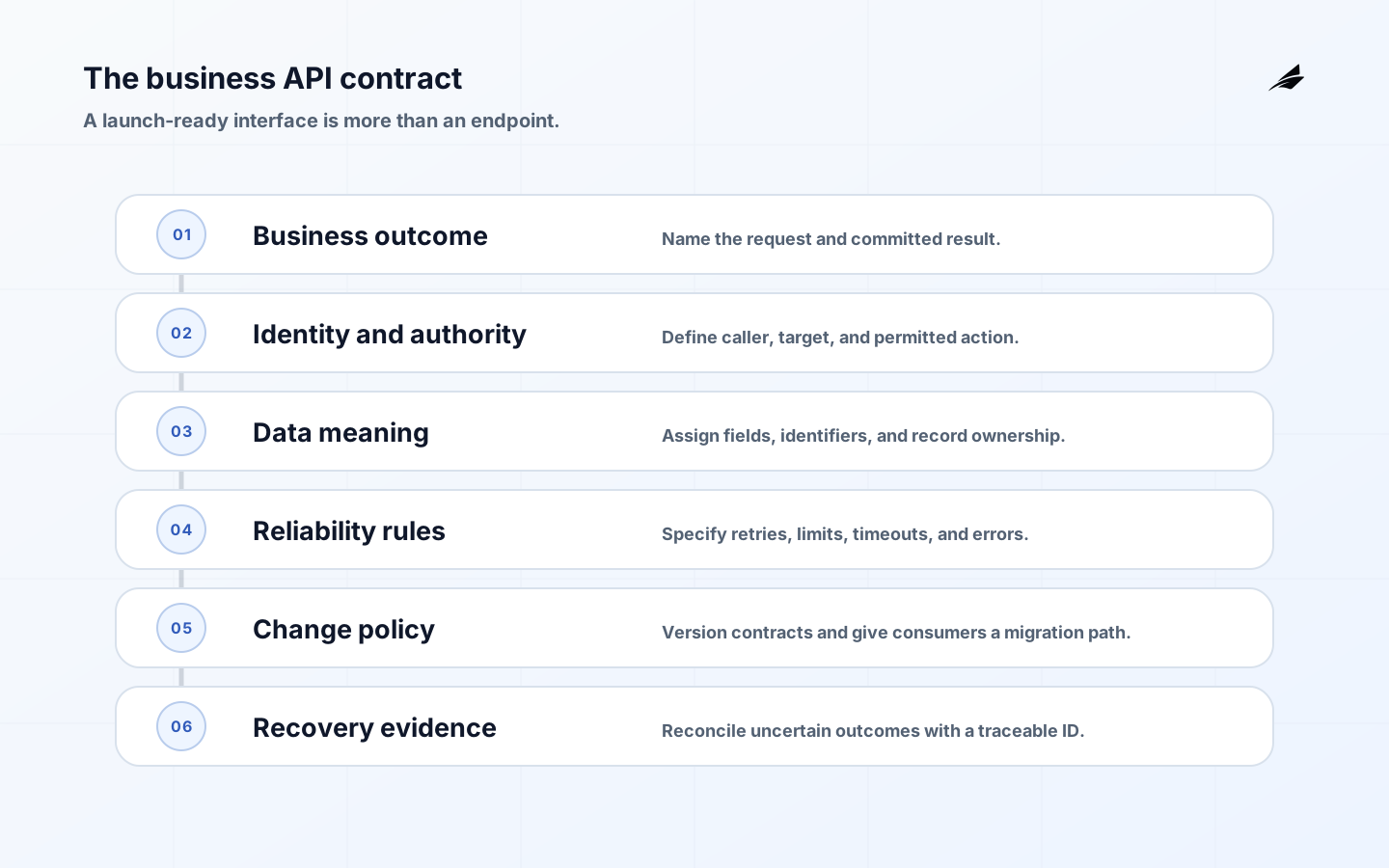
For a business team, an application programming interface is a governed agreement that lets one software system request data or an action from another. The visible endpoint is only one part of that agreement. A launch-ready API also defines who may call it, what each field means, which system owns the record, how duplicate requests are handled, what the caller should do after failure, and how changes will be introduced without surprising consumers. Thinking in contracts keeps a product launch focused on dependable business outcomes instead of treating “the API” as an invisible engineering task.
What API meaning for business teams means in practice
In practical terms, API meaning for business teams connects a known input to a bounded operational result. A clear definition includes the scope of the work, the accountable owner, the information that is authoritative, and the limits of automated or delegated action. It also states what the capability does not decide. That negative boundary matters because it prevents adjacent systems and informal workarounds from taking on authority by accident. Write the definition so that an operator can test it against a real case and a technical team can derive interfaces, controls, and support measures from it.
Turn the term into a decision model
Begin planning with an ordinary case and then add cases that reveal risk: incomplete information, a sensitive request, a changed rule, duplicated input, an unavailable dependency, and a demand for historical evidence. For each case, agree what must be true before the capability proceeds, which person may resolve uncertainty, and what result counts as safe. This approach turns a vague request into a decision contract. It also keeps delivery honest: a successful happy path is not enough when an API caller may read or change a resource without appropriate authority.
Set the authority and data boundary
Assign an explicit owner to the API contract. Identify the authoritative system, durable identifier, lifecycle states, change process, and retention rules. Copies, notifications, reports, and caches can be useful, but they should not become accidental places to correct the underlying fact. When information crosses a boundary, describe whether the receiving system has a read-only projection, a working copy, or separate authority. This distinction lets teams reconcile differences, investigate a dispute, and alter the design without silently changing the meaning of a record.
Match controls to the consequence
Controls should be chosen for the consequence of the action, not added as a final checklist. Verify client identity, authorize the precise resource and function, validate inputs, and apply limits where repetition could cause harm. Test denied requests and malformed input as deliberately as the expected route. When the result is difficult to reverse, require confirmation, approval, or an explicit exception path. A good control explains a safe reason for refusal and gives legitimate users a way to correct the request rather than forcing them into an unofficial channel.
Make evidence and recovery part of the service
Build operational evidence into the first release. Capture a correlation identifier, source, relevant rule or policy version, result, time, and accountable actor or service. Protect sensitive values and retain only what the purpose justifies, but keep enough context for a support team to reconstruct what happened. Decide how a partial failure is detected, whether the request and response can be retried safely, and how state is reconciled after recovery. This evidence is not decorative compliance work. It is what makes an incident explainable and what gives leaders a factual basis for improvement.
Design the exception path
Common failure modes deserve a visible operating route. A stale configuration, changed source meaning, duplicate message, revoked permission, slow dependency, or unexpected exception should enter a named queue with priority, owner, and service target. Avoid automatic retries that amplify a bad instruction. Where certainty is weak, choose a bounded fallback such as holding for review, abstaining, or showing a last confirmed state with a warning. The objective is not to promise that nothing fails; it is to make failures safe, understandable, and recoverable. Topic-specific implication: An API contract should say more than field names.
Decision criteria at a glance
| Question | Decision | Evidence |
|---|---|---|
| What is protected? | Define the intended operational outcome. | A real case with expected result. |
| Who may act? | Apply a bounded role and client identity. | Positive and negative access tests. |
| What changes? | Record a controlled request and response. | Trace, status, and reconciliation path. |
| How is harm contained? | Route uncertain or failed work for review. | Named owner and recovery rehearsal. |

Use this table as an interview guide, not a scorecard that replaces judgement. Strong answers are backed by a working example, a named owner, or a test. Weak answers rely on an assurance that another team will resolve the issue later. Resolve the weak answers before broad rollout. In a product launch, ambiguity around authority or recovery is expensive because it surfaces exactly when a client, operator, or reviewer needs an immediate answer.
A six-stage implementation sequence
| Stage | Outcome | Review question |
|---|---|---|
| Define outcome | Name the decision and protected result. | What is the useful business boundary? |
| Assign authority | Confirm owner and authoritative information. | Who may change the rule or record? |
| Build narrow path | Implement one end-to-end case. | What is deliberately out of scope? |
| Verify controls | Exercise positive and negative paths. | Can the system refuse safely? |
| Operate and recover | Observe outcomes and rehearse correction. | Can support explain a failure? |
| Review and improve | Use evidence to change the design. | What should be retained or retired? |
Release with an acceptance threshold
Implement the smallest end-to-end version that can demonstrate the outcome. Establish the authoritative input, one valued use case, access controls, an operational trace, and a correction route. Connect a real user or downstream service, observe the work, and measure both successful and exception cases before expansion. Maintain a decision log that records why a rule exists, who approved it, and what evidence supports it. That log prevents future maintainers from treating deliberate constraints as accidental defects and makes changes easier to review. For this guide, the implementation focus is launch governance also needs an inventory.
Implementation notes for API meaning for business teams
An API contract should say more than field names. Specify the resource state a caller may observe, the preconditions for mutation, the meaning of an absent value, pagination and filtering behaviour, error format, and whether repeated requests are safe. Use example requests and responses drawn from the business cases, including a denied request and a stale update. IETF HTTP guidance is valuable because it reminds teams that clients and servers evolve at different paces. A contract must therefore support change without asking every consumer to deploy in lockstep.
Launch governance also needs an inventory. List the endpoint, owner, environment, client, data classification, authentication method, rate expectation, and retirement date. Review that inventory when a client leaves, a scope changes, or an incident occurs. For partner APIs, test the offboarding path as carefully as onboarding: remove credentials, revoke access, retain the required evidence, and confirm that delayed jobs cannot continue using a former entitlement. This is how an integration stays a managed business relationship rather than an anonymous technical dependency.
Work through a launch-order example
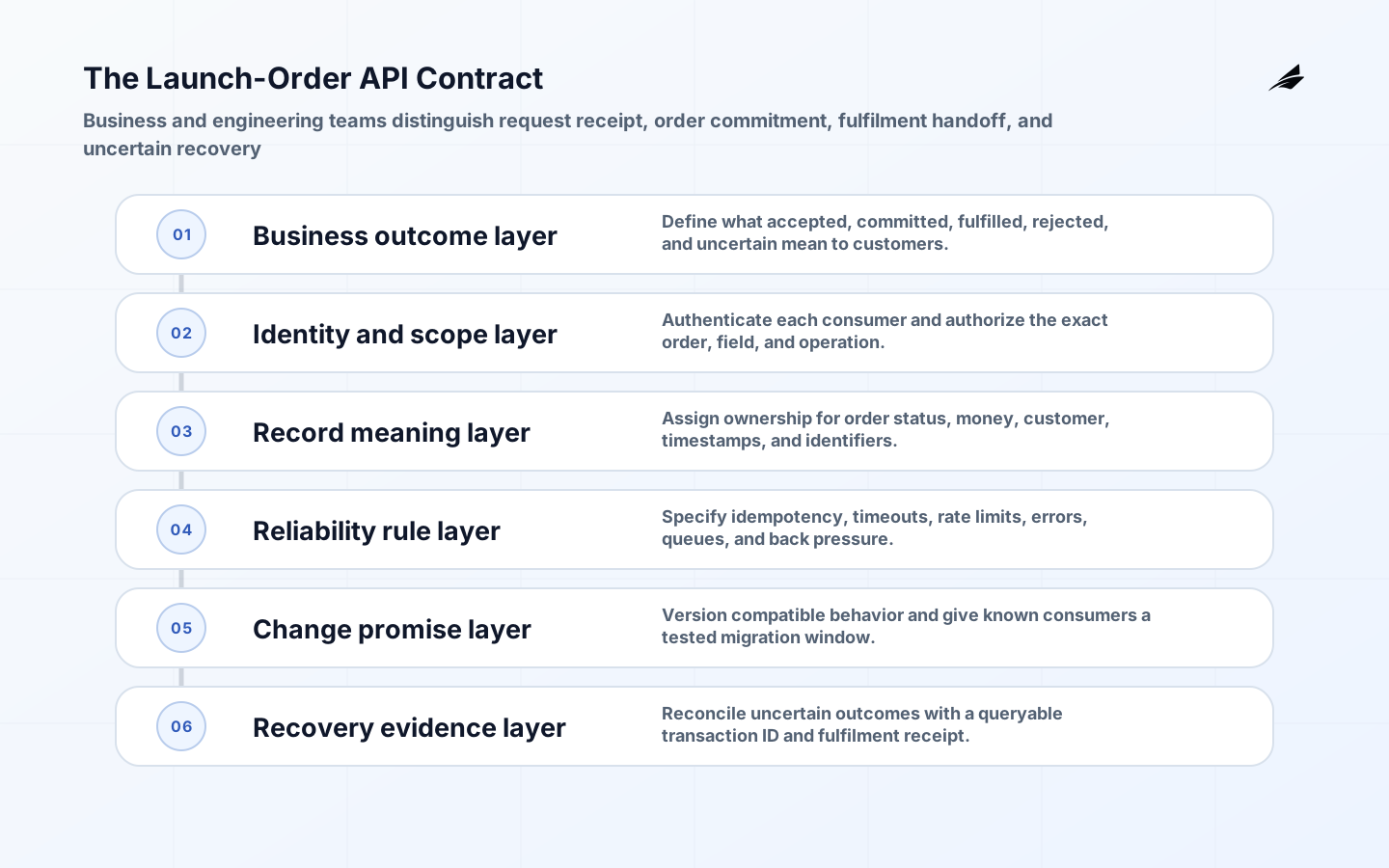
Imagine a new commerce product sending an accepted order to fulfilment. The API contract must distinguish “request received” from “order committed,” carry a stable order identifier, and return errors a caller can act on. The OpenAPI Specification gives humans and tools a standard way to describe HTTP operations and schemas. HTTP Semantics, RFC 9110 defines method and response semantics, but the business still has to state whether a retry creates a second shipment, whether cancellation is permitted after allocation, and which timestamps are authoritative.
Security and ownership belong in the same contract. The OWASP API Security Top 10 highlights broken object authorization, unrestricted resource consumption, inventory gaps, and unsafe consumption of upstream APIs. Translate those risks into product decisions: authorize against the requested order, set quotas by consumer and business flow, maintain an owner and retirement date for every version, and validate supplier responses before they enter the system of record. Edilec’s API integration delivery plan helps scope implementation, while the API integration checklist turns the contract into release evidence. The ERP, CRM and workflow integration guide shows how to assign record authority across systems. For event-driven exchanges, the AsyncAPI specification provides a corresponding machine-readable contract.
| Contract element | Business question | Launch evidence |
|---|---|---|
| Identity and authority | Which consumer may read or change which record? | Object-level authorization tests for allowed and denied cases |
| Meaning and ownership | Which system owns status, money, customer, and timestamps? | Field dictionary and reconciliation owner |
| Retry behavior | Can the same request safely be repeated? | Duplicate and timeout tests using a stable idempotency key |
| Capacity | What happens during launch traffic or a supplier slowdown? | Rate limits, queue policy, load result, and back-pressure response |
| Change policy | How will consumers learn and migrate? | Version compatibility test, deprecation window, and contact owner |
| Recovery | How are uncertain outcomes reconciled? | Operational runbook and a queryable transaction identifier |
Key takeaways
- Define API meaning for business teams through the decision and consequence it supports.
- Assign clear authority to records, rules, and exceptions.
- Test denied, incomplete, duplicated, and failed cases before scale.
- Treat evidence, accessibility, and recovery as release requirements.
Frequently asked questions
- Is API meaning for business teams mainly a technology choice? No. Technology supports the design, but ownership and controlled operation determine whether it works.
- Who owns it? A business owner is accountable for the outcome and policy; technical owners are accountable for secure, reliable implementation.
- What belongs in a first release? One valuable end-to-end case, a meaningful exception route, access controls, useful evidence, and a review measure.
Operating review considerations
Business teams should insist on a plain-language API catalogue alongside technical documentation. Each entry should name the capability, owning team, permitted consumers, data classification, service expectation, and contact route for change or incident work. Pair this catalogue with a sandbox or contract test suite so prospective consumers can prove their use without touching production data. The combination makes integration planning more honest: a partner can see what is offered, what is intentionally excluded, and how responsibility is shared when an interface evolves.
Conclusion
A credible API meaning for business teams implementation makes responsibility clearer for everyone involved. Readers should be able to identify the protected outcome, authoritative information, rule that governed the action, and route for correction. That is a better standard than a vendor-specific feature list. Build a narrow, evidence-backed capability, review it with the people who operate it, and extend it only when normal work and meaningful exceptions remain understandable.