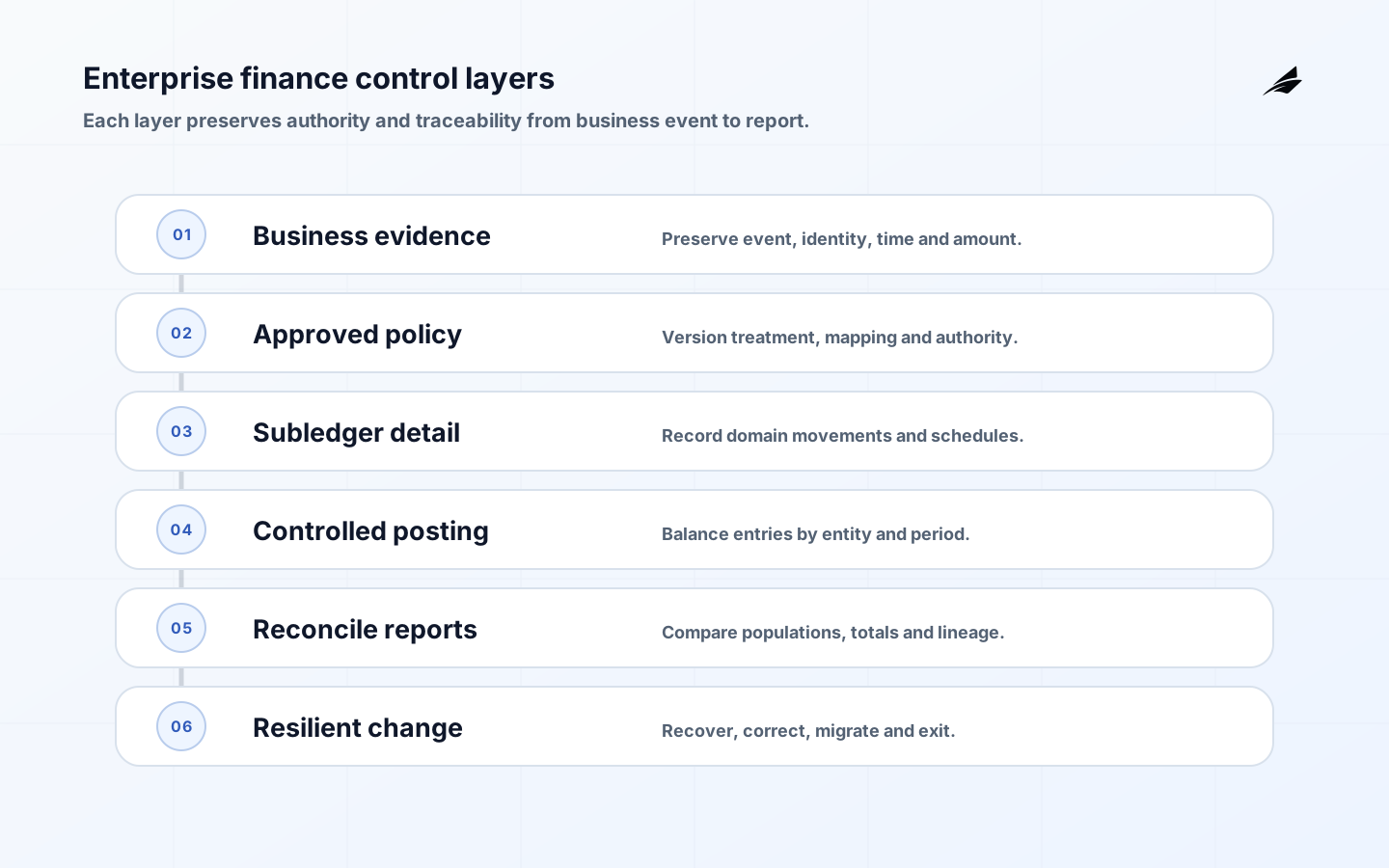
Enterprise finance systems are not one ERP screen. They are a controlled network that turns operational events into receivables, payables, cash, assets, payroll, tax evidence, subledger movements, journals, consolidation, and reports. Architecture matters because financial truth is assembled across boundaries. If identifiers, state, timing, currency, approval, and correction semantics are weak, the general ledger receives unexplained totals and the close becomes a recurring investigation.
This guide focuses on the architecture and control model. Edilec's ERP integration guide covers dependable interfaces, the enterprise approvals guide addresses decision authority, and the founder billing guide connects product commerce to finance. Accounting, tax, and statutory decisions require qualified owners; software should preserve and execute approved policy rather than improvise it.
Key takeaways
- Model the business event, accounting interpretation, posting, settlement, and reporting result as linked records rather than one mutable status.
- Assign record authority and effective-time rules at each boundary; the ledger is authoritative for postings, not necessarily for every operational fact.
- Use subledgers and controlled interfaces to preserve transaction detail while posting balanced, traceable summaries.
- Design idempotency, period control, reversals, reconciliation, and reruns before automating journals.
- Protect privileged finance actions and sensitive data with least privilege, separation of duties, monitoring, and tested recovery.
Map records and authority before products
Select one material flow, such as order to cash, procure to pay, or usage to revenue. Trace its business event, contractual context, operational state, accounting event, subledger transaction, payment or settlement, journal, and report. Record the source identifier, legal entity, account or counterparty, event time, effective date, currency, amount precision, policy version, approval, and correction relationship. A shared transaction ID across the chain turns reconciliation from fuzzy matching into a controlled comparison.
| Record | Authority | Must preserve | May not decide alone |
|---|---|---|---|
| Order or service event | Operational product | What occurred, for whom, when, quantity, and source ID | Accounting treatment |
| Contract and price | Approved commercial system | Terms, effective dates, obligations, and amendments | Whether service was delivered |
| Accounting event | Finance policy service or subledger | Rule version, dimensions, debit and credit intent | Operational truth without source evidence |
| Journal | General ledger | Balanced posting, period, entity, account, and source reference | Customer entitlement |
| Settlement | Bank or payment evidence plus treasury process | Gross, fees, currency, date, and external reference | Revenue recognition |
| Report | Controlled reporting layer | Definition, lineage, period, adjustments, and approval | Silent correction of source records |
Keep valid-time and system-time where timing matters. A contract amendment can be recorded today but apply next month; a late operational event can arrive after a period closes; a journal can post now with an accounting date in the prior open period. Make cutoff policy explicit. Do not let interface arrival time quietly determine financial period. For revenue, IFRS 15 provides principles around contracts, performance obligations, transaction price, allocation, and satisfaction; system design should retain evidence for the organization's approved interpretation.
Separate operational, subledger, and ledger concerns
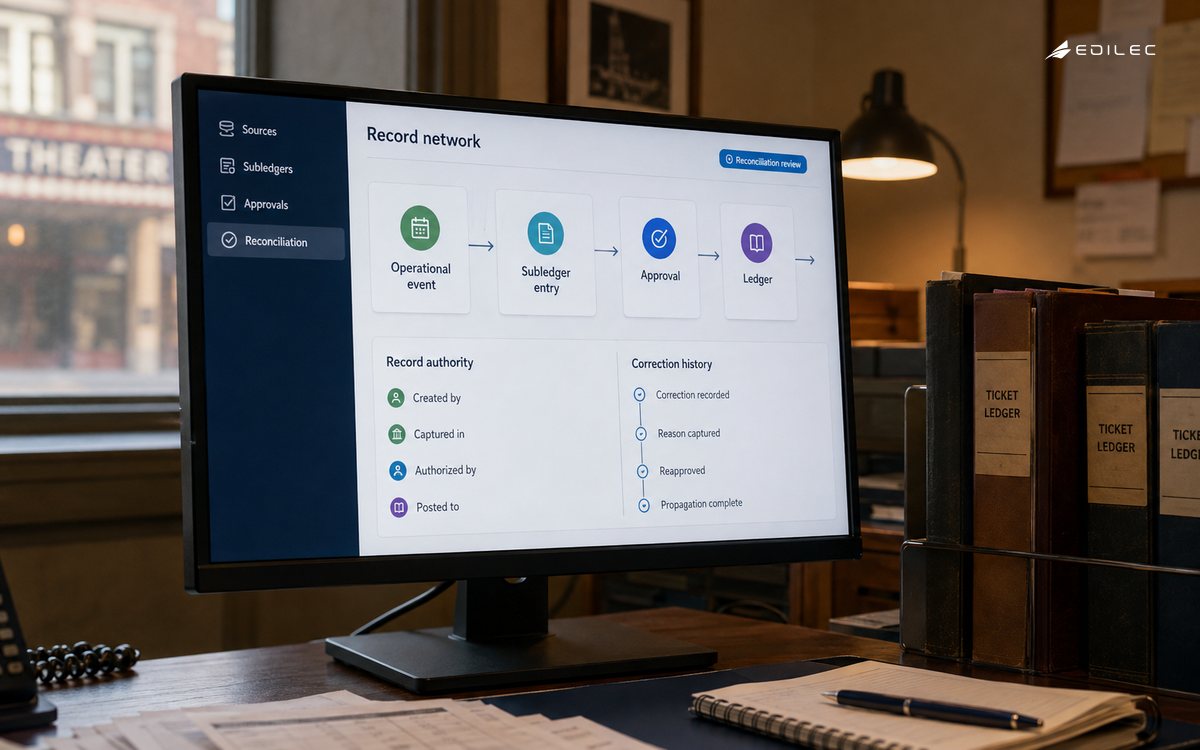
Operational systems optimize fulfilment, customer service, procurement, or workforce processes. Subledgers organize detailed financial movements for a domain and support schedules, ageing, matching, and reconciliation. The general ledger records approved postings by entity, account, period, and dimensions. A finance architecture may combine these capabilities in one suite, but the logical responsibilities remain useful. Avoid pushing every operational field into the ledger or reducing rich transactions to an untraceable monthly total.
| Interface contract | Required behavior | Financial reason |
|---|---|---|
| Identity | Stable transaction, counterparty, entity, and source references | Enables exact trace and duplicate detection |
| Amount | Currency, precision, sign, unit, tax components, and rounding boundary | Prevents drift and ambiguous totals |
| Time | Event, effective, received, posting, and settlement dates where relevant | Supports cutoff and late-data policy |
| State | Versioned lifecycle with allowed transitions | Prevents an invalid status from triggering posting |
| Delivery | Idempotency, ordering assumptions, rejection queue, and replay | Allows recovery without duplicate journals |
| Correction | Reversal or linked adjustment with reason and approval | Preserves the original trail |
| Reconciliation | Expected population and control totals | Detects silent loss and transformation errors |
Use an outbox or another reliable publication pattern when an operational transaction and its integration event must agree. Consumers should reject invalid contracts visibly, deduplicate by stable key, and expose processing state. A retry after timeout must not create a second invoice, payment, or journal. For compound operations, use explicit pending and compensating states rather than pretending distributed systems provide one universal transaction. Reconcile source and destination populations even when delivery technology claims exactly-once behavior.
Embed financial and security controls
Controls should exist at the action point. Examples include approved vendor creation before payment, maker-checker review for bank detail changes, journal approval by type and amount, period locks, permitted account mappings, balanced-entry validation, duplicate invoice detection, and restricted emergency access. Separate request, approval, execution, and review for material actions. Bind approval to the transaction version and show the approver the consequence; approving a label while hidden lines can change is not a control.
Use the NIST Cybersecurity Framework to structure governance, protection, detection, response, and recovery. Apply the NIST Privacy Framework to payroll, customer, supplier, and payment-related personal data. The OWASP ASVS can guide verification of authentication, session management, access control, validation, logging, data protection, and other application controls. Map these references to the actual finance roles and interfaces instead of treating framework adoption as evidence by itself.
Make reconciliation an architectural capability
Every material handoff needs an expected population, accepted population, rejected population, amount or quantity totals, and aged difference queue. Reconcile operational events to subledger entries, subledger to ledger, payments to bank settlement, and ledger to controlled reports. Segment by legal entity, period, currency, source, and transaction type. Offsetting errors can make a grand total balance while individual customers or accounts remain wrong. Assign each exception a reason, owner, materiality, next action, and deadline.
| Signal | Decision supported | Response threshold example |
|---|---|---|
| Unprocessed source events | Whether close population is complete | Stop dependent posting when material events exceed cutoff |
| Interface rejection age | Whether contract or master data blocks finance | Escalate high-value records before period deadline |
| Out-of-balance or duplicate attempt | Whether posting integrity is at risk | Block the journal and investigate |
| Manual journal volume | Whether interfaces or policy create uncontrolled work | Sample high-risk classes and fix recurrent sources |
| Reconciliation difference | Whether systems agree by defined population | Hold sign-off or document approved immaterial timing item |
| Privileged action anomaly | Whether access is misused or compromised | Suspend access and invoke investigation path |
Monitoring should connect technical symptoms to financial consequences. The Google SRE monitoring guidance emphasizes signals that lead to action. For a finance interface, queue depth matters because it represents unposted business events; latency matters relative to cutoff; availability matters at the transaction path; and errors must be classified by recoverability. Give each alert an owner, runbook, and decision threshold. Avoid paging on every transient retry while material silent gaps wait for month-end.
Deliver change without breaking the close
- Baseline the current population, manual adjustments, close duration, differences, failure routes, and control evidence.
- Version mappings, chart-of-accounts rules, tax and accounting policy configuration, interfaces, and report definitions.
- Test normal, duplicate, late, rejected, amended, reversed, foreign-currency, period-closed, and partial-settlement cases.
- Run a parallel reconciliation at transaction and control-total level before switching the authoritative path.
- Plan migration with opening balances, historical detail, in-flight items, lineage, sign-off, and a read-only archive.
- Rehearse rollback and roll-forward; reconcile every transaction processed during a failed cutover.
- Schedule around business capacity and close risk, but avoid indefinite freezes that create one dangerous annual release.
For a cloud finance platform, understand data residency, tenant isolation, encryption, key options, identity federation, audit export, integration limits, backup, recovery objectives, support access, release cadence, and exit. Test vendor and internal recovery together. A successful database restore is not sufficient if bank files, workflow state, subledger detail, and external references cannot be brought to a consistent point. Record which manual operations are permitted during outage and how they will be entered and reconciled afterward.
Create an architecture decision record for each material boundary: why a capability remains in an operational system, moves to a subledger, or belongs in the ledger; which team owns the contract; what volume and period-close assumptions apply; and how the boundary can be replaced. Review decisions when entities, currencies, business models, acquisition systems, or reporting obligations change. This record keeps platform consolidation from becoming an end in itself and gives future teams the context needed to simplify safely.
Frequently asked questions
Should the general ledger be the source of every finance report?
It should be authoritative for posted accounting balances, but operational and subledger reports often need detail the ledger should not hold. Build controlled reporting that reconciles to ledger totals while retaining governed lineage to the appropriate detailed source.
Does finance need real-time integration?
Use latency required by the decision. Fraud controls or credit availability may need seconds; statutory consolidation may not. Real-time delivery adds operational complexity and does not eliminate reconciliation, cutoff, or approval. Define timeliness per flow rather than making it a platform slogan.
Why prefer reversals over editing posted records?
A linked reversal and corrected posting preserve what was decided, how the error was found, who approved the correction, and how balances changed. Silent mutation damages auditability and can leave downstream systems inconsistent. The exact mechanism should follow accounting and statutory policy.
Conclusion
Enterprise finance architecture is trustworthy when every material number can be traced to an authorized business event and policy, every handoff can be reconciled, and every correction preserves the story. Separating operational, subledger, ledger, and reporting responsibilities makes that path clearer. Strong interfaces, embedded controls, actionable monitoring, and rehearsed recovery let finance systems evolve without turning each close into forensic work.