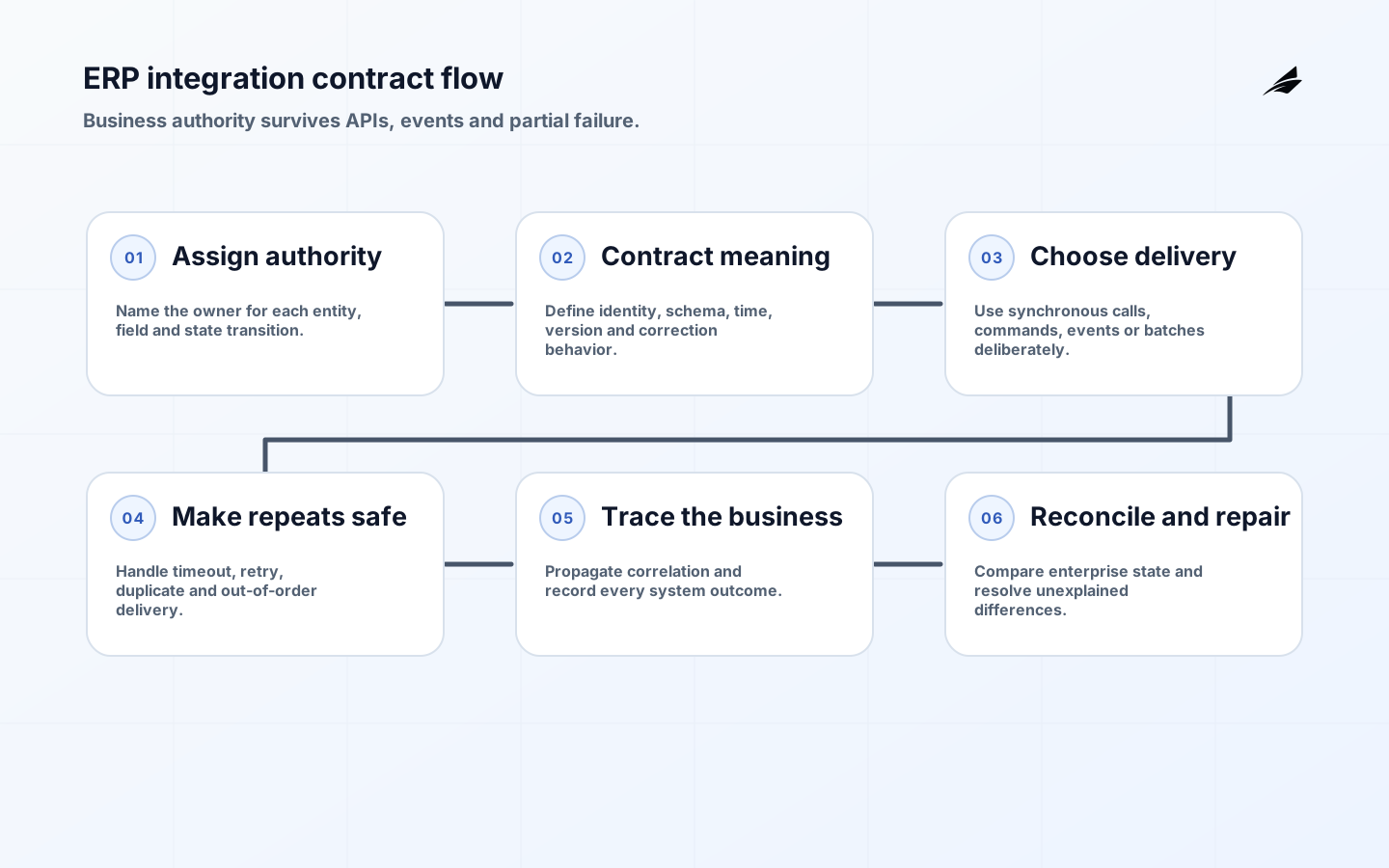
ERP integration connects orders, suppliers, products, inventory, invoices, payments, employees and financial postings across systems with different models and release cycles. A successful interface does not merely move fields. It preserves business identity, authority, state transitions, effective time and evidence so the enterprise can explain what happened and recover from partial failure.
The engineering goal is controlled convergence, not perfect simultaneity. Some transactions require a synchronous acceptance before work can continue; others are safer as durable events or scheduled batches. Every design should declare freshness, consistency, failure ownership and reconciliation. Without those contracts, a technically healthy pipeline can leave an order shipped but unbilled or an employee active in one system and terminated in another.
Edilec's system of record guide helps establish authority, while master data engineering notes, finance systems integration guidance, and inventory systems guidance deepen important ERP domains.
Key takeaways
- Assign field- and transition-level authority before choosing middleware.
- Use explicit schemas, versions and business identifiers for every interface.
- Design retries, deduplication and out-of-order handling as normal behavior.
- Trace business transactions across queues and systems, then reconcile outcomes.
- Migrate in vertical slices with controlled dual-running and retirement criteria.
Map record and transition authority
A system of record label is often too broad. CRM may own a prospect's sales relationship, ERP may own the accepted customer account and a billing platform may own payment-method tokens. Define authority by entity, field and lifecycle transition. State who may create, update, approve, cancel and correct each record. Include derived fields and reference data such as tax codes, units and legal entities.
Use stable enterprise identifiers plus source identifiers. Never use a mutable email, supplier name or display code as the only join key. Maintain cross-reference mappings with provenance and status. Resolve duplicate and merge behavior explicitly: when two customer records merge in CRM, does ERP re-key history, preserve aliases or reject the event? Deletion, anonymization and legal holds also require cross-system semantics rather than a generic delete call.
| Contract element | Required detail | Example failure | Design response |
|---|---|---|---|
| Business identity | Stable key and source references | Two suppliers share a normalized name | Use governed IDs and match review |
| Authority | Owner by field and transition | CRM overwrites ERP credit status | Reject unauthorized update |
| Time | Occurred, effective and processed timestamps | Backdated price changes current invoices | Apply temporal policy and version |
| State | Allowed transitions and terminal states | Cancelled order becomes shipped | Validate transition preconditions |
| Delivery | Acknowledgement, retry and expiry | Timeout creates duplicate invoice | Idempotency key and outcome lookup |
| Correction | Reverse, supersede or compensate | Edited posting loses audit history | Append controlled correction |
Choose the interaction pattern per business need
Use synchronous APIs when the caller needs immediate validation or a reference before continuing, such as creating an approved sales order. Use durable events to announce completed business facts to multiple consumers, such as CustomerActivated. Use commands or queues for asynchronous work with one responsible handler. Use batch for high-volume, period-bound exchange where latency permits and operational restartability is strong.
Avoid pretending that one pattern fits every leg. A web checkout might call an availability service synchronously, then publish an order-accepted event and later receive asynchronous fulfillment updates. The OpenAPI Specification supports machine-readable HTTP API contracts; CloudEvents provides a standard event envelope. Neither defines your business meaning, idempotency or ownership, which must remain explicit.
Version schemas and behavior together
Define required and optional fields, types, units, enumerations, constraints, null meaning and examples. JSON Schema can validate JSON structure, but valid syntax can still carry an impossible tax jurisdiction or unknown cost center. Add business-rule validation with precise error codes. Contract tests should run against provider and consumer implementations, not only example payloads.
Prefer additive changes, tolerant readers and explicit deprecation. An optional field is not automatically compatible if a consumer's default changes business behavior. Publish version support windows and consumer inventory. For events, never mutate historical meaning under the same type name. For APIs, distinguish resource version used for concurrency from interface version. Preserve unknown fields when intermediaries do not own them.
Engineer for retries and partial completion
Networks time out after either failure or success, so a caller may not know whether the ERP committed. Accept an idempotency key tied to the business command and return the original result for retries. Consumers should deduplicate messages by durable event identity while keeping handlers safe to repeat. Do not mark a message complete before the business transaction commits; use an outbox or equivalent atomic handoff where appropriate.

Set bounded retries with backoff for transient faults and route non-retryable cases to an owned exception process. A dead-letter queue is evidence, not resolution. Store the reason, payload reference, correlation ID and next action. Handle out-of-order events with entity versions or transition checks. A shipment event arriving before order creation should wait or reconcile, not create an invented partial order.
| Scenario | Expected system behavior | Evidence retained | Operator action |
|---|---|---|---|
| Caller timeout after commit | Return prior result for same key | Command key and ERP reference | None unless results differ |
| Duplicate event | Acknowledge without duplicate effect | Event ID and prior processing | Investigate producer if rate rises |
| Schema violation | Reject before business mutation | Validation path and version | Correct producer or map data |
| Business-rule rejection | Keep source state and explain reason | Rule, values and owner | Resolve master data or policy |
| Consumer outage | Retain ordered durable backlog | Lag and oldest event | Restore capacity and monitor replay |
| Partial downstream success | Reconcile and compensate deliberately | Per-system outcome | Complete, reverse or approve exception |
Observe business flow, not only middleware
Assign a correlation ID at the originating business transaction and propagate it through API calls, events and jobs. Distributed traces help relate operations across services, but add business identifiers and privacy controls so support can locate a transaction without logging full sensitive payloads. Capture contract version, retry count, state transition and final reference.
Technical dashboards should show availability, latency, error codes, queue lag and throughput. Business reconciliation should show accepted orders not created in ERP, shipments not billed, invoices not posted, employee changes not acknowledged and totals that disagree across a period. Define tolerances and owners. A green integration runtime cannot overrule a red business reconciliation.
Protect every integration identity
Give each workload a distinct identity and least-privilege access to specific operations and entities. Rotate credentials through a managed secret system, authenticate messages and encrypt transport. Validate authorization inside the receiving service; a trusted network path is not authority. NIST's Zero Trust Architecture centers protection on resources and explicit authentication and authorization rather than implicit network trust.
Minimize replicated sensitive fields and classify integration logs. Protect administrative replays, mapping changes and exception edits as privileged actions. Separate the ability to alter a supplier's bank details from the ability to release payment. Alert on volume anomalies, new destinations and repeated authorization failure. Supplier-hosted connectors need the same ownership, evidence access and offboarding plan as custom services.
Migrate through a controlled vertical slice
Choose one end-to-end business flow and cohort, such as domestic purchase orders for one business unit. Clean identifiers, establish baseline counts and freeze uncontrolled mapping changes. Backfill master data with versioned scripts and reconciliation. Run the new interface in shadow where possible, compare decisions, then make one authority switch at a defined time. Avoid indefinite bidirectional synchronization between old and new sources.
For cutover, define transaction freeze or capture, backlog drain, sequence checkpoints, acceptance queries and rollback boundaries. Prove that rollback will not duplicate records or reverse valid work. Retirement criteria should cover consumers, credentials, schedules, queues, monitoring and retained evidence. An old interface that is merely undocumented remains a production dependency.
Example: order to cash
CRM submits an approved quote using a command key. The integration validates customer and product references, then ERP creates a sales order and returns its durable ID. ERP publishes OrderAccepted through an outbox. Fulfillment consumes it idempotently and later publishes ShipmentDispatched. ERP validates the shipment transition, posts delivery and creates billing work. Finance reconciliation compares shipped quantities, invoices and ledger postings.
If the initial API times out after ERP commit, the retry returns the same sales-order ID. If shipment arrives twice, the second event produces no duplicate billing. If a product mapping is missing, the order is rejected before mutation with an owned correction. Those behaviors matter more than whether the middleware diagram looks elegant.
ERP integration implementation checklist
- Assign authority by entity, field and state transition.
- Create stable identifiers and controlled cross-reference mappings.
- Document schema, semantics, versioning, time and correction behavior.
- Implement idempotency, deduplication, ordering and durable handoff.
- Propagate correlation while minimizing sensitive logs.
- Define technical service levels and business reconciliation controls.
- Test timeout-after-commit, duplicates, backlog replay and partial success.
- Retire old jobs, credentials and authority after verified cutover.
Maintain an integration test portfolio
Keep contract fixtures for valid, boundary and rejected payloads, plus end-to-end journeys for the most valuable business flows. Add production failures after sanitization and review. Run provider contract tests before ERP, SaaS or middleware upgrades, and verify behavior in a representative environment with realistic rate limits. A test suite should prove duplicate safety, version compatibility and reconciliation, not merely that an endpoint returned a success code.
ERP integration FAQ
Do we need an enterprise service bus?
Not necessarily. Choose infrastructure from routing, transformation, governance and operating needs. A platform cannot replace clear ownership and contracts; excessive central transformation can hide domain meaning.
Should every ERP change become an event?
No. Publish business facts that consumers need and the producer can support. Raw change-data capture can aid replication but may expose storage details and ambiguous intermediate state.
Can we guarantee exactly-once processing?
End-to-end business effects usually require idempotent design and reconciliation even when a transport offers strong delivery guarantees. Timeouts and external systems still create ambiguity.
Conclusion
ERP integration architecture succeeds when business authority survives technical distribution. Define identities and state, choose interaction patterns deliberately, make repetition safe, trace outcomes and reconcile the enterprise record. With those foundations, APIs, events and middleware become useful implementation tools instead of sources of hidden operational debt.