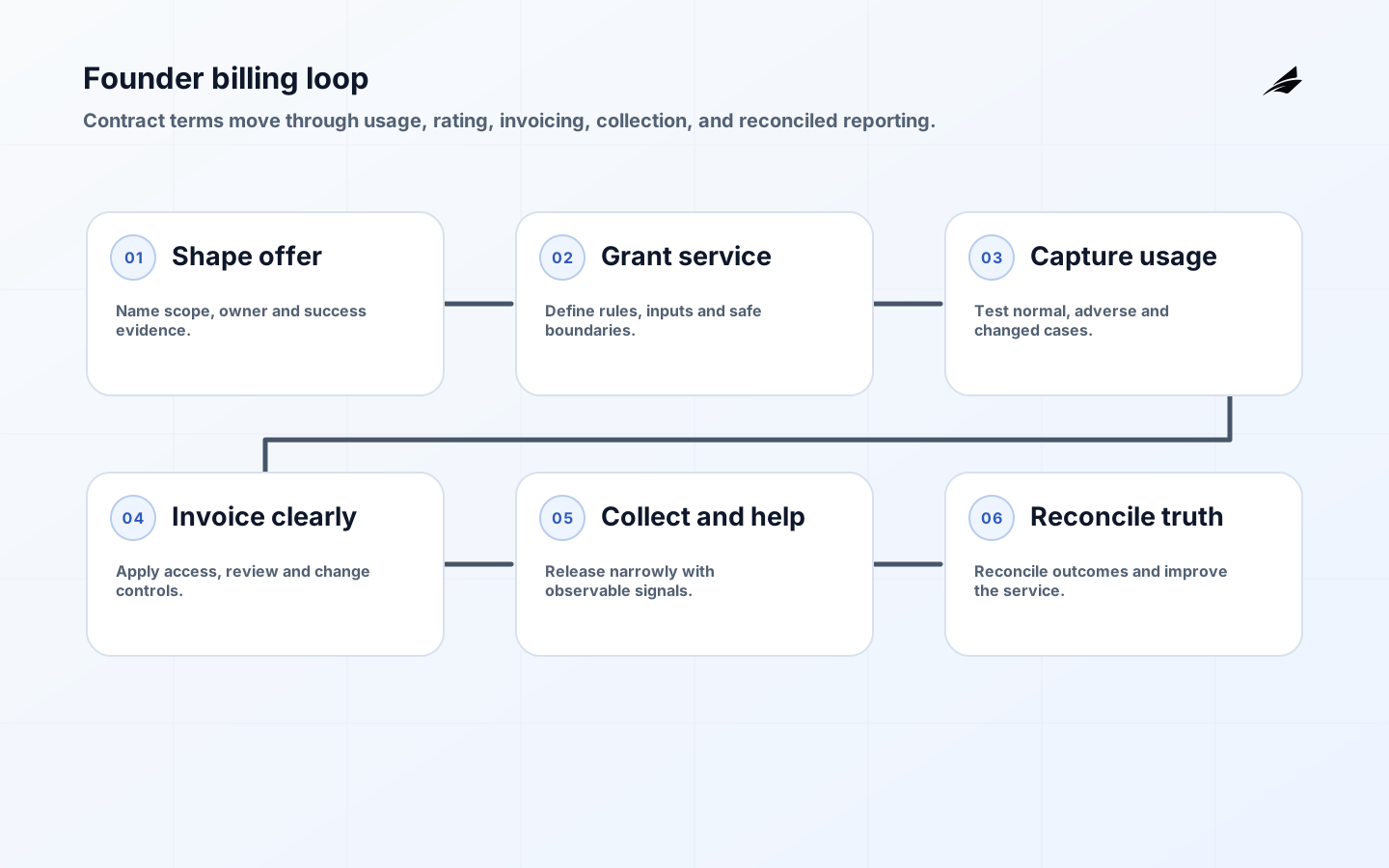
A charge begins with a commercial event, not an invoice screen. Founders should define the customer account, contract, service period, price version, quantity evidence, tax context, and cancellation rule that make an event billable. For founders, the first useful scope is one valuable path with an explicit correction boundary, not a broad platform replacement. The finance systems guide explains downstream accounting evidence, the ERP integration guide covers interface contracts, and the enterprise reporting guide shows how reconciled records reach decision-makers.
Map the billable event before the invoice
Founders should start with one billable event and follow it to collected cash. Choose a real subscription renewal, usage charge, or implementation milestone; identify the contract clause that authorizes it, the pricing version that calculates it, and the customer and legal entity that receive the invoice. Record event time separately from processing and invoicing time. Name who may correct quantity, apply a credit, void an invoice, write off a balance, or reopen a disputed item. The resulting map exposes whether commercial commitments can be reproduced without asking the salesperson or consulting a private worksheet. It also defines the identifiers and evidence a growing billing team must preserve before adding another product, currency, or collection route.
| Founder billing decision | Operating rule | Contract-to-cash proof |
|---|---|---|
| Billable event | Define which delivered event creates a charge and which events are excluded. | Contract clause, source event, occurrence time, and customer. |
| Price and credit authority | Separate approved rate maintenance from discretionary credit and write-off decisions. | Effective price, approver limits, credit reason, and actor. |
| Invoice identity | Carry stable event, rating, line, receivable, and settlement references. | Linked identifiers, service period, invoice date, and currency. |
| Customer correction | Use a linked credit, corrected invoice, or payment reallocation instead of hidden edits. | Original charge, remedy, approval, communication, and final balance. |
Separate pricing, entitlement, and collection states
Keep entitlement, invoice, payment, and accounting-posting states separate. Stable identifiers must connect usage or delivery to rating, invoice lines, payment attempts, credits, and financial records so a correction preserves the original story.
Walk a downgrade that occurs mid-period, a metered event that arrives late, a payment failure, and a goodwill credit. Decide the proration, approval, customer explanation, ledger effect, and the exact event to reconcile.
| Billing failure | Controlled treatment | Founder-level indicator |
|---|---|---|
| Usage lacks a valid price | Hold the event outside invoicing and route it to contract or pricing ownership. | Unrated value and oldest-event age. |
| Payment notification repeats | Deduplicate by provider event and verify one application to the receivable. | Repeated callbacks and payment-to-balance differences. |
| Invoice is disputed | Pause unsuitable collection activity and assemble the contract and event explanation. | Open dispute value, age, and cause. |
| Contract changes after issue | Determine the effective date and create an approved prospective or corrective treatment. | Credits by amendment cause and affected periods. |
Use evidence and controls deliberately
Use public control guidance to interrogate specific billing risks. The NIST Cybersecurity Framework helps assign responsibility for protecting and recovering invoicing and payment services. The NIST Privacy Framework prompts decisions about why customer, payer, and contact data is collected and where it appears in exports or support tools. OWASP ASVS supplies concrete verification ideas for authentication, authorization, input handling, logging, and sensitive operations such as credits or bank-detail changes. Google's monitoring guidance helps distinguish an actionable signal—an unbilled-event backlog threatening invoice day—from the detailed records used to diagnose it. Translate these references into the company's contract terms, approval thresholds, retention rules, and named response owners rather than treating framework alignment as proof that a charge is correct.
- Choose one contract pattern and prove how its billable events become customer invoice lines.
- Separate event occurrence, processing, invoice, due, settlement, and correction times.
- Constrain price changes, credits, write-offs, bank details, and payment actions by role and value.
- Exercise late usage, duplicate provider messages, disputed charges, failed delivery, and partial payment.
- Reconcile expected events to invoices and open balances before adding products or billing regions.
Reconcile revenue events and customer corrections
Reconcile billing in three directions: expected billable events to rated charges, charges to issued invoice lines, and payments or credits to the open customer balance. Give every gap an ageing clock, reason, and owner. A service can be technically available while usage waits unrated, invoices fail delivery, or settlements remain unapplied, so founders need these populations alongside uptime. Test delayed metering, a pricing-service outage, duplicated payment notification, disputed invoice, and post-invoice contract correction before scaling. Sample the evidence behind both clean and corrected accounts, and confirm that recovery does not rely on broad database edits. The related enterprise systems guide helps connect billing records to finance-system ownership and close controls as transaction volume and organizational specialization grow.
Build the operator view around the customer balance and the next permitted action. A billing specialist should see the governing contract version, source events, rating rule, invoice history, payments, credits, dispute status, and any reconciliation gap without assembling several exports. The screen should distinguish correcting an unbilled event, issuing a credit note, retrying delivery, and changing collection treatment because those actions carry different authority and accounting effects. Customer support may need an explanation and escalation button but no ability to edit price or payment credentials. Finance may need posting and settlement evidence without access to unnecessary customer content. When a price or exception policy changes, version the rule and update operator guidance, validation, and queued work together. Test that staff can resolve a representative case using constrained roles; a workflow that still requires shared admin access, private messages, or an offline tracker has not actually operationalized its controls.
Measure control before chasing collection speed
A founder dashboard should show unbilled value and age, events rejected by rating, invoices not delivered, overdue balances by reason, payments awaiting application, credits and voids by cause, dispute age, and revenue reconciliations not cleared. Segment by product, price version, customer cohort, currency, and source integration. Pair collection speed with invoice-correction and dispute rates so aggressive dunning cannot look successful while customers challenge inaccurate charges. Review a few underlying accounts with sales, billing, support, and finance; the useful response may be repairing contract capture or metering rather than adding collectors.
| Contract-to-cash signal | Business question | Corrective decision |
|---|---|---|
| Unbilled event value | How much delivered activity has not reached an invoice and why? | Fix price or source gaps and pause unsafe bulk replay. |
| Credits and voids by cause | Are commercial promises, usage, pricing, or invoice delivery producing avoidable corrections? | Inspect representative accounts and assign the shared upstream fix. |
| Unapplied settlement balance | Has collected cash reached the correct customer receivable? | Improve remittance matching and resolve material aged items. |
Build a controlled first release
Choose one product, contract pattern, currency, and invoice cadence for the first controlled release. Include real customers only after commercial, billing, engineering, support, and finance owners agree how a valid charge is derived, approved exceptions are represented, and payment is reconciled. Keep the population small enough to compare every invoice line with its contract and billable event. It must still traverse actual identity, tax, payment, notification, and ledger integrations; a toy path will not reveal ownership gaps. Define pause criteria before the first invoice run and give customers a clear route to question a charge.
Acceptance tests should prove contract-to-cash lineage. Given a signed contract and a precisely identified usage or milestone event, the system should select the effective price, calculate quantity and currency with defined rounding, create one invoice line, deliver it to the intended billing contact, post the expected accounting reference, and apply the eventual settlement to the same customer balance. Retain contract, event, rating, invoice, payment, and journal identifiers in the test evidence. Add amendments effective mid-cycle, missing tax data, a repeated event, a failed delivery, and a payment received without a usable remittance reference. Operators should be able to explain each outcome and recover it through supported actions. This verifies the operating chain founders depend on, not merely the correctness of an isolated formula.
Rehearse exceptions that affect money or customer trust. A transient invoice-delivery failure may retry idempotently, while a missing contract term should pause rating for owner review. A duplicated usage event must be quarantined before invoicing; an erroneous issued charge normally needs a linked credit or corrected invoice rather than history edited in place. Decide who can approve each remedy and how finance and the customer are notified. Verify the resulting balance and ledger effect after recovery. Record-specific correction tools are safer than replaying an entire billing period, which can multiply side effects and obscure which accounts were actually repaired.
Each month, review three accounts end to end: one that billed and collected normally, one with an aged exception, and one that required a credit, dispute, or correction. Reconstruct the commercial promise, billable events, rating decision, invoice, delivery, settlement, and finance reconciliation. Ask whether every handoff preserved a stable reference, whether the assigned operator had enough context and authority, and whether the customer received an explanation consistent with the records. Compare this evidence with backlog and correction metrics. A repeated manual price override may indicate poor contract structure; unmatched payments may expose weak remittance capture; slow disputes may reflect an interface that hides source usage. Assign one change to a policy, source, integration, operator tool, or support instruction, with an owner and completion date. At the next review, verify that the change altered the relevant population. The purpose is to turn account evidence into system improvement, not to celebrate a meeting that repeatedly rediscovers the same exceptions.
Expand billing only after the current product and cohort can account for expected events, reproduce invoice calculations, reconcile settlements, and close exceptions within an agreed time. Version pricing and contract interpretations with effective dates, test old and new populations in parallel, and notify support and finance before activation. Keep a way to stop new rating or issuance and apply bounded credits when reversal is impossible. New volume amplifies unclear commercial rules; controlled expansion should multiply a proven operating pattern.
Run a founder-level billing review

Review one customer from signed order through cash and support history. Compare the commercial promise with product, price, quantity, billing anchor, tax inputs, payment terms, entitlement, invoice lines, payment result, credit, and accounting export. Ask whether customer, support, finance, and engineering describe the same obligation. A mismatch may be an offer, contract, catalogue, usage, integration, or ownership defect. Assign each boundary before adding more pricing variants.
Use this review with the article tables and linked Edilec guides. Sample completed records as well as exceptions, retain the rule and source versions that produced each outcome, and assign every corrective action to a policy, data, interface, integration, security, or operating owner. Metrics indicate where to investigate; representative cases reveal what must change. Before scope expands, repeat the exercise with an unavailable dependency, a delayed message, an unauthorized user, and a correction after the nominal process has finished. This review is specific to founder billing and customer trust.
- Name catalogue contract usage and finance owners.
- Trace events to invoices cash and credits.
- Preview upgrades downgrades and late usage.
- Help support explain charges safely.
- Review unbilled usage disputes and overrides.
- Delay complexity until reconciliation works.
Key takeaways
- Trace a real invoice line from contract and delivered event through price, issue, settlement, and ledger reference.
- Give founders visibility into unbilled value, invoice corrections, disputes, overdue causes, and unapplied cash.
- Use idempotent event and payment processing so retries cannot create a second customer effect.
- Provide authorized, linked credits and reallocations instead of deleting financial history.
- Scale billing when current accounts reconcile and operators can explain exceptions without private spreadsheets.
Frequently asked questions
What is the first practical step for billing operations?
Should billing logic live in the product? Keep business-event and entitlement meaning near the product; select a billing platform for the policy execution capabilities required.
How should teams handle exceptions?
Can issued invoices be edited? Prefer traceable adjustments or credits that preserve the event and explain the customer-facing correction.
Conclusion
Billing operations for founders becomes dependable when the commercial promise is clearer than the implementation. Define authority and evidence, keep customer-facing exceptions visible, reconcile the final result, and use corrections to simplify the next offer and operating cycle. That is how billing becomes part of responsible growth rather than another destination for data.