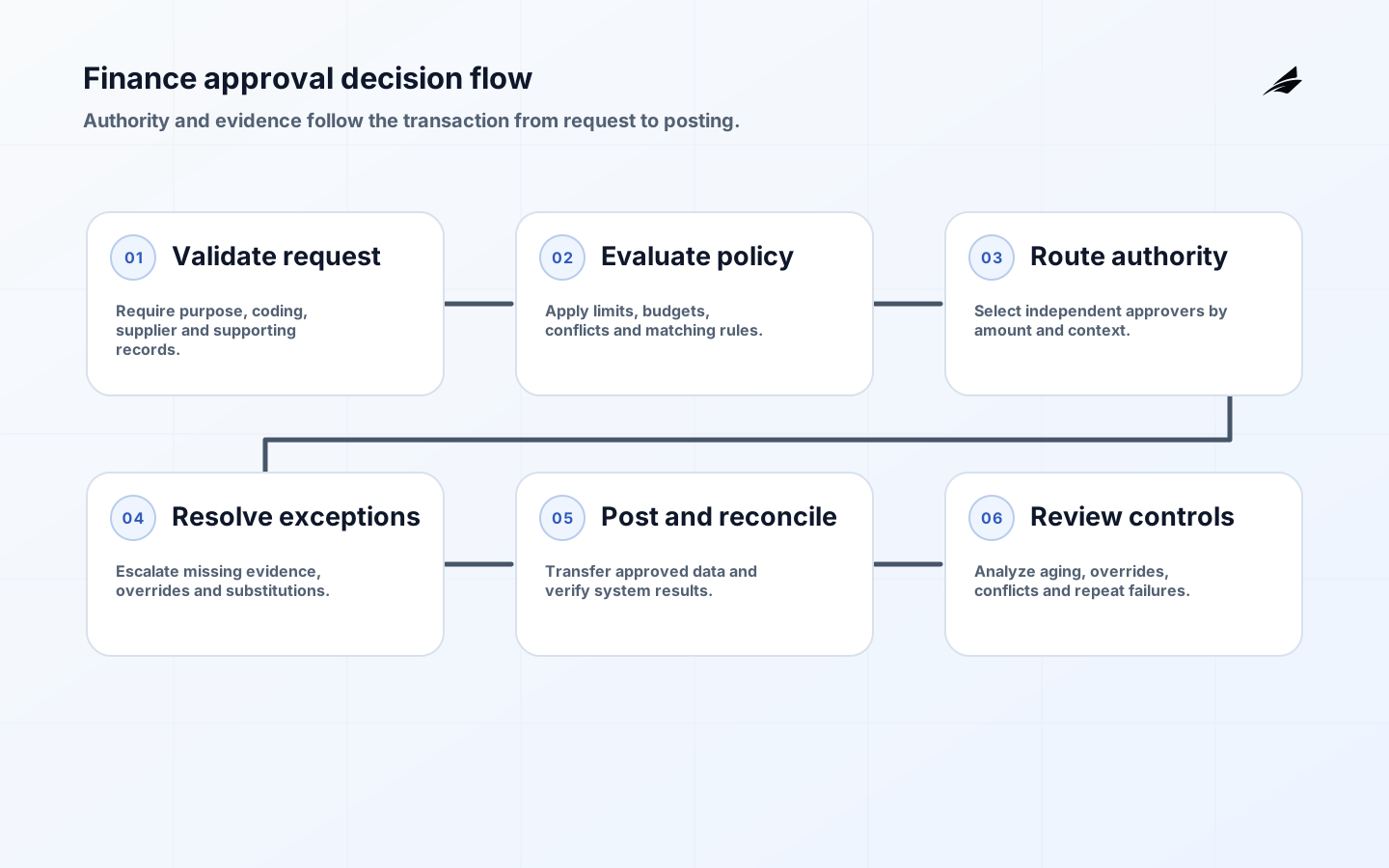
Approval workflow systems for finance teams convert policy, delegated authority and supporting evidence into controlled transaction decisions. They can shorten cycle time and improve auditability, but automation also scales weak master data, conflicting roles and poorly defined exceptions. A sound finance workflow records what was requested, which policy applied, who had authority, what evidence they reviewed, how the transaction posted and whether later changes invalidated the approval.
Connect approval design to master data ownership, because vendor, cost-center and chart-of-account quality determine routing. The client portal architecture guide helps when suppliers or customers submit records, while enterprise reporting architecture explains how operational evidence becomes trusted reporting. Finance, procurement, operations, security, audit and engineering should approve the control model together before a platform team encodes it.
Start with transactions, risks and authority
Inventory transaction families such as purchase requisitions, purchase orders, supplier onboarding, invoices, expense claims, journals, credit notes, customer refunds, capital requests and master-data changes. For each, document financial statement and operational risk, value tiers, legal entity, currency, budget, tax, related-party or conflict conditions, required supporting records and posting system. Map normal, urgent, retrospective, rejected, returned, cancelled and amended cases. Approval should respond to transaction risk rather than one universal hierarchy.
The U.S. GAO’s current 2025 Green Book frames internal control around operations, reporting and compliance objectives and five integrated components. Although its mandatory audience is federal agencies, its control design language is useful more broadly. Define the objective for each finance approval and the risk it treats. Avoid adding reviewers only to demonstrate control: an approval is useful when the approver has authority, evidence, competence and a clear decision criterion.
| Transaction | Risk-based input | Representative decision |
|---|---|---|
| Supplier setup | Identity, tax, bank, ownership and duplicate checks | Approve supplier and independent bank verification |
| Purchase | Need, budget, category, supplier and contract | Authorize commitment within delegated limit |
| Invoice | Purchase order, receipt, price, tax and duplicate status | Approve exception or release matched liability |
| Journal | Purpose, accounts, period, support and preparer | Independent approval before posting |
| Expense | Policy, receipt, business purpose and attendee | Approve reimbursement or documented exception |
| Refund | Original transaction, reason, amount and destination | Authorize payment to verified recipient |
Model the finance approval record
Assign one immutable request identifier and version the financial facts under review. Store transaction type, legal entity, amount and currency, accounting and tax dimensions, supplier or payee, supporting-document references, policy and authority-rule versions, conflict results, approver identity, decision, reason and timestamps. If a material field changes after approval, define which approvals are invalidated and restart from a controlled state. Never overwrite approval history to make the current screen look simple.

Use an ordered decision table for routing. Resolve currency conversion date, amount boundaries, budget ownership, category specialists, legal-entity officers and risk flags explicitly. Define sequential versus parallel behavior, quorum, rejection, return, delegation, substitution, escalation and timeout. SAP’s current Flexible Workflow documentation describes start and step conditions, recipients, deadlines, notifications, exception handling, simulation and approval history. Validate the chosen platform’s exact behavior with boundary tests.
Enforce segregation of duties and delegated authority
Separate request, approval, vendor or account maintenance, receipt, posting, payment release and reconciliation where risk requires it. The 2025 Green Book publication includes control-activity guidance covering segregation of duties, configuration management and contingency. Build preventive conflicts into role assignment and transaction-time checks. Where staffing makes full separation impractical, document compensating review, scope, approver and expiry rather than silently allowing self-approval or uncontrolled administrators.
Maintain delegated authority as governed master data with owner, source approval, effective dates, legal entity, transaction class, amount and substitution rules. Review it after organizational change and expire temporary delegation automatically. Resolve authority at task creation and retain the rule result. Workflow administrators may configure policy but should not complete business approval through elevated access. Emergency overrides need a reason, limited scope, independent retrospective review and prominent reporting.
Integrate ERP, procurement, banking and identity systems
Name the source of truth for employee, organizational, supplier, bank, chart, budget, receipt and transaction data. Use stable identifiers and effective dates. At submission, validate required dimensions against authoritative records. At approval, preserve the version reviewed. At posting, send an idempotency key and reconcile the returned document number, status and amount. Handle timeouts by querying destination state before retrying. Put irrecoverable cases in an owned queue with repair and replay controls.
Automated matching should expose why records matched or differed. Define quantity and price tolerances, partial receipt, freight, tax, currency, duplicate and credit-note behavior. Keep payment execution distinct from approval and verify destination bank data through an independent process. Identity events should promptly remove approval roles. Microsoft’s Power Automate approvals documentation shows approvals through email, an approvals center and mobile; if using channel notifications, minimize sensitive content and require authenticated access to full evidence.
| Control test | Scenario | Expected evidence |
|---|---|---|
| Authority boundary | Amounts immediately below, at and above every limit | Correct rule and approver resolved |
| Conflict | Requester is approver, vendor maintainer or payment releaser | Action denied or compensating control invoked |
| Amendment | Amount, supplier, bank or account changes after approval | Affected approval invalidated and version retained |
| Integration | Duplicate, timeout, partial posting and destination rejection | No duplicate effect; case reconciled |
| Absence | Delegation starts, expires and conflicts | Authorized substitute only for effective period |
| Continuity | Identity, ERP or notification channel unavailable | Controlled queue, recovery and no lost request |
Pilot, reconcile and train for judgment
Pilot one transaction class and legal entity through a representative financial cycle. Load real authority, policy and master data under appropriate protection. Test routine and exceptional cases, period close, absence, high value, foreign currency and system failure. Reconcile workflow states to ERP documents and general-ledger or subledger totals. Define rollback for new submissions and in-flight cases. Keep the previous route available only under a controlled fallback with duplicate-prevention and later reconciliation.
Train approvers on evidence and policy, not only interface actions. A useful approval screen highlights amount, supplier or payee, budget impact, coding, matching exceptions, prior related activity and conflicts. Require reasons for rejection and override from a controlled vocabulary plus comment where needed. Show deadline and escalation without encouraging reflex approval. COSO notes that effective internal controls support reliable information and sustained operations on its Internal Control page; preserve that operational purpose instead of designing only for audit retrieval.
Monitor control operation and process health
Track submission completeness, first-pass match, cycle time by stage, queue age, return, rejection, delegation, override, self-approval prevention, failed posting, duplicate prevention and reconciliation breaks. Use medians and upper percentiles, and segment by transaction and risk tier. Monitor approvals completed unusually quickly, repeated just-below-threshold amounts, excessive delegation, split purchases, new-bank changes and administrator intervention. Treat indicators as review leads, not automatic allegations.
Sample completed cases against source documents, authority and downstream posting. Review rule changes and access periodically. Maintain evidence retention aligned with financial, tax, contractual, privacy and litigation requirements. Restrict audit exports and ensure their integrity. Feed repeated exceptions into policy, master-data, training or integration improvement. A faster approval system is successful only when it preserves valid authorization and reduces rework, improper transactions and unexplained manual correction.
Design evidence for privacy and usability. Store document references rather than uncontrolled copies where possible, classify attachments and restrict them by transaction and role. Scan uploads, enforce file limits and preserve integrity. Approval notifications should show enough context to act without disclosing bank, tax, payroll or personal data on a lock screen. Define who may export approval populations and mask fields not needed for review. Retention should apply consistently across workflow, ERP, email notifications, integration logs and audit extracts, with legal holds where required.
Manage policy and workflow change together. A new limit, tax rule, entity, account, acquisition or organization structure can alter routing and control. Require an effective date, owner, test cases, approval and communication for configuration changes. Simulate representative transactions before activation and compare the resolved route with policy. Keep prior versions available to explain historical approvals. After release, monitor no-match, unexpected auto-approval and queue shifts. A technically successful deployment may still encode an outdated authority document or send work to an unstaffed role.
Include continuity for period-end and payment deadlines. Define controlled offline intake or queued submission when workflow or ERP services are unavailable, with duplicate prevention and later entry. Keep emergency contacts and delegated authority current. Test recovery of in-flight state and reconciliation, not only application restart. When deadlines justify an override, record the business reason and require prompt independent review. Continuity must preserve control intent; a fallback spreadsheet with unrestricted editing and no transaction identifiers can create a larger reporting problem than the outage.
Key takeaways
- Model finance workflows by transaction risk, authority and required evidence.
- Version the facts, policy and approver resolution behind every material decision.
- Enforce segregation across request, master data, posting, payment and reconciliation.
- Design ERP integrations for idempotency, repair, replay and financial reconciliation.
- Measure control outcomes and exception patterns alongside approval speed.
Frequently asked questions
Should finance approvals happen from email?
Email can notify and offer a convenient authenticated action, but the approver should have access to current evidence and policy context. Avoid sensitive details in messages, protect against forwarded links, and record the authoritative decision in the workflow system.
Can low-value transactions be auto-approved?
Yes when policy explicitly permits it and preventive checks cover supplier, budget, duplication, matching and conflicts. Record the rule version and monitor aggregate or split behavior. Low amount does not always mean low risk, especially for new payees or bank changes.
What does an auditor need from the system?
Traceable population, configuration and access evidence; the request and versions; authority and conflict results; approver decisions; exceptions; downstream posting; and change history. Agree retention and sampling access while protecting personal and confidential data.
Conclusion
Approval workflow systems help finance when they connect policy, authority, evidence and accounting results. Design the durable record, enforce independence, integrate authoritative data and test exceptions through reconciliation. The result can speed routine work while making material judgment and control more visible.