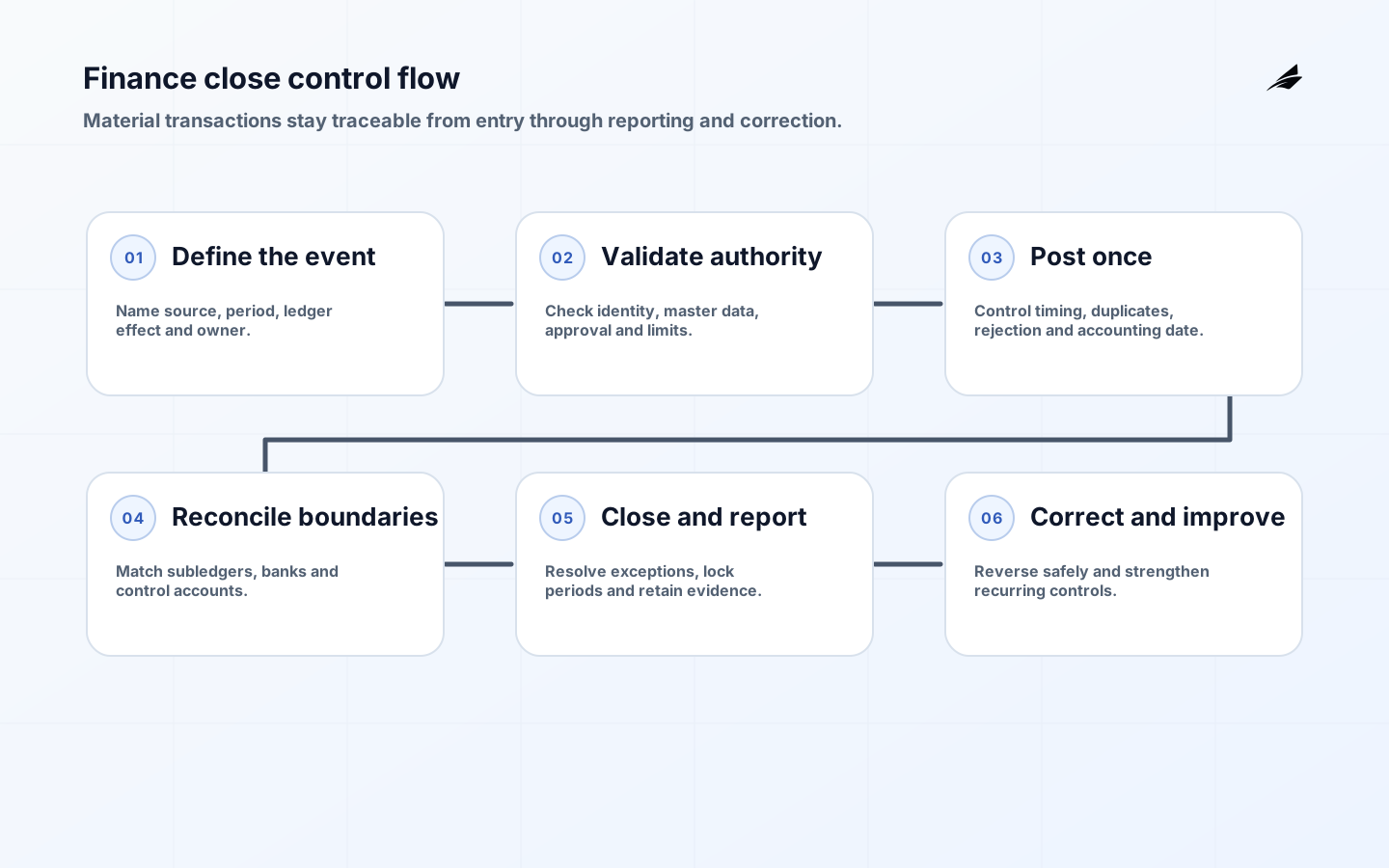
Finance systems becomes difficult at the point where a growing company can no longer rely on the same people remembering how accounts, journal entries, payment approvals, close evidence, and reporting dimensions should behave. The practical question is not which platform has the longest feature list. It is how operations leaders and finance partners will turn an operational or financial event into a controlled accounting record and still have a reconciled close with traceable evidence for material balances when volume, staff changes, integrations, and exceptions arrive together. Start with the event that has real operational consequence, the named finance systems owner, and the evidence that proves the result. That approach turns finance systems from a software selection exercise into an operating capability. The standards and guidance behind this article are linked throughout and collected in the source credits; they are useful for framing governance, privacy, security, and response obligations without pretending that any one framework supplies a complete implementation.
Edilec’s finance systems mistakes and fixes identifies common control failures, finance systems for IT managers connects technology to ownership, and finance systems in production covers support and recovery.
Frame the finance systems decision
Anchor the checklist in one accounting promise: a source event must become a complete, authorized, correctly dated, and explainable financial record. Identify the operational owner, accounting owner, source application, subledger or ledger destination, posting deadline, and evidence needed at close. Define which system owns commercial facts and which owns accounting treatment; a convenient reporting copy should not silently become authoritative. NIST's data-governance definition helps frame these decision rights when teams disagree over who may correct a consequential record. Document who can approve a temporary treatment and how it will be cleared. The finance system engineering notes cover common implementation failures around that boundary.
Define records, states, and boundaries
Describe the financial record chain explicitly: source event, accounting classification, journal or subledger entry, approval, posting, settlement, reconciliation, and correction. Each stage needs business and effective dates, legal entity, currency, account dimensions, actor, and a stable reference back to origin. Corrections should use reversals or adjusting entries rather than overwrite history. Finance must be able to explain why a balance exists and which evidence supports it, not simply reproduce the number. The NIST Data Governance and Management Profile connects formal authority with privacy and cybersecurity risk. Apply that principle to master-data and mapping changes: integrations can carry an account or supplier value, but only the designated owner can define or amend its financial meaning.
| Design question | Good operational answer | Evidence to retain |
|---|---|---|
| Which event enters accounting? | A documented commercial occurrence at the correct transaction grain | Originating record, event timestamp, and unique business key |
| Who assigns financial treatment? | The finance role authorized for the entity, account, and value threshold | Approval identity, policy basis, and delegation evidence |
| Where can posting stop? | Validation, approval, period, balancing, or downstream acceptance | Specific status, diagnostic code, queue owner, and age |
| How is an error repaired? | A linked reversal or adjustment made under documented authority | Original entry, correcting entry, rationale, approver, and posting date |
Design the exchange and exception path
Write an interface contract for every posting path. It should declare transaction grain, required identifiers, entity, currency, accounting and event dates, dimensions, duplicate key, balancing rule, acknowledgement, and correction method. Separate acceptance by the integration from successful subledger or general-ledger posting. Failed records need reason codes, retry safety, aging, and a queue owner; suspense without ownership only postpones the close problem. Carry one correlation reference from operational event through posting and settlement so reconciliation can match complete populations instead of approximate totals. Use the system-of-record design guidance to decide whether each fact belongs to commerce, billing, procurement, payroll, treasury, or the ledger before mapping fields.
Control access and change
Design access around incompatible duties: creating or changing a supplier, entering a journal, approving it, releasing payment, and reconciling the account should not collapse into one unchecked role where the risk is material. Restrict open periods, master-data changes, manual entries, and interface mappings, and retain before-and-after values with approval evidence. The NIST Cybersecurity Framework supports connecting governance, protection, detection, response, and recovery. For finance, that means monitoring sensitive changes and rehearsing correction, not merely requiring login. Keep cardholder, bank, payroll, and personal data out of broad logs and support exports. Every rule or mapping release should record scope, affected accounts, test and reconciliation evidence, approver, rollout, and rollback.
| Signal | Likely interpretation | First accountable response |
|---|---|---|
| Unposted value grows near close | A feed, approval queue, or accounting rule is preventing recognition | Reconcile value and count by cause, then give each material group a clearance owner |
| Journal adjustments cluster in one account | Mapping or source classification may no longer reflect actual transactions | Trace a sample to origin and correct the governing rule rather than repeating journals |
| Duplicate postings appear after recovery | Replay is not anchored to a durable event identifier and accepted state | Stop the affected feed, identify the complete population, and reverse only proven duplicates |
| Close evidence lives in private spreadsheets | The controlled path does not explain balances or accommodate a known exception | Observe the reconciliation task and add the missing evidence or disposition route |
Control Finance System Changes
Rehearse one material transaction from origin through period close. Inject a duplicate, invalid dimension, missing approval, late arrival, failed posting, reversal, and absent settlement confirmation. Confirm how totals are reconciled before and after replay and which owner clears each difference. Include accounting, treasury or process operations, the interface engineer, and the control owner. They should agree when processing stops, when retry is safe, and who decides a temporary manual treatment. CISA's incident response planning guidance is aimed at security events, but prepared roles and communication also improve recovery from finance-system failures. The exercise should prove a controlled accounting outcome, not relabel every defect as an incident.
Release in small, observable slices
Pilot a defined transaction population across at least one meaningful close checkpoint. Baseline manual journals, reconciliation effort, late adjustments, spreadsheet dependencies, and exception age. Run old and new paths in parallel where balances can be compared, and reconcile opening population, accepted events, rejected events, postings, and closing totals. Watch for default accounts that conceal mapping defects, backdated entries, shared credentials during close, unsupported journals, and excess access to payment or bank data. Publish cutover and support ownership plus thresholds for pause or rollback. A staged release gives finance a chance to identify timing and authority semantics before a broad migration makes old and new records difficult to compare.
Measure useful operation
Monitor financial completeness and explainability as well as availability. Useful measures include missing or duplicate source sequences, rejected postings, aged suspense, unreconciled differences, manual journals, late entries, correction reversals, interface lag, access exceptions, close duration, and material balances without retained support. Segment by entity, source, and account class, then inspect representative exceptions with finance. Google's monitoring guidance distinguishes detection signals from diagnostic detail; each finance alert should likewise name an owner and the records needed for investigation. Review recurring exceptions and upcoming interface changes on a close-aware cadence. The production operations guide adds practical service-management context.
Prove the close with one transaction family
Example: procure-to-pay at month end

Take a supplier invoice received one day before period end. The system should preserve supplier identity, purchase order, receipt evidence, invoice and accounting dates, tax treatment, currency, approval state, posting reference, payment status, and every correction. Test a matched invoice, price variance, missing receipt, duplicate, backdated approval, credit note, and an item held across the close. Finance should be able to explain which period recognizes the obligation and why without reconstructing the story from email.
Use the case to test the whole control chain. Confirm that bank-detail changes receive independent authorization, interfaces reject malformed and duplicate events, suspense items have owners and aging rules, and subledgers reconcile to the general ledger. Run a failed integration and an isolated restore so the team can prove completeness after recovery. Track close time alongside unresolved exceptions, late adjustments, manual journals, and reconciliation differences. Speed gained by pushing investigation into the next period is not an improvement.
Key takeaways
- Start from a material transaction family and assign both its operational and accounting owners.
- Write down posting grain, period logic, approval authority, and reversal treatment before connecting applications.
- Carry one durable business key from source event through subledger, ledger, settlement, and reconciliation.
- Separate sensitive duties and retain evidence for master-data, mapping, journal, and payment changes.
- Prove completeness with population reconciliation and period-end failure cases before widening the release.
Frequently asked questions
Can finance controls be fully automated?
Validation and reconciliation can be automated, but people still set policy, investigate exceptions, approve sensitive changes, and accept residual risk.
Which close metrics matter most?
Track elapsed time, late events, unreconciled balances, aged suspense, manual journals, post-close adjustments, failed interfaces, and control exceptions.
What is the first practical step for finance systems?
Select one recurring transaction whose accounting treatment or reconciliation creates visible rework. Map its source evidence, posting grain, accounting rule, approvals, ledger destination, period deadline, settlement, and correction route. That trace creates a bounded finance-system test without requiring every process to migrate at once.
When is automation ready?
Finance automation is ready when the team can prove completeness, duplicate handling, balanced posting, rejection ownership, period treatment, reversal, reconciliation, and rule-change authority. Test each case with representative transactions and reconcile populations before treating throughput or close speed as release evidence.
Conclusion
Reliable finance systems make every material transaction explainable from origin to financial statement. Define the event model, protect master data and access, reconcile every boundary, and test period-end exceptions before depending on automation. Retain population totals and exception ownership through each interface so recovery can prove completeness instead of merely restarting processing. Designing close speed, control evidence, and recovery together gives finance confidence without unnecessary delay.