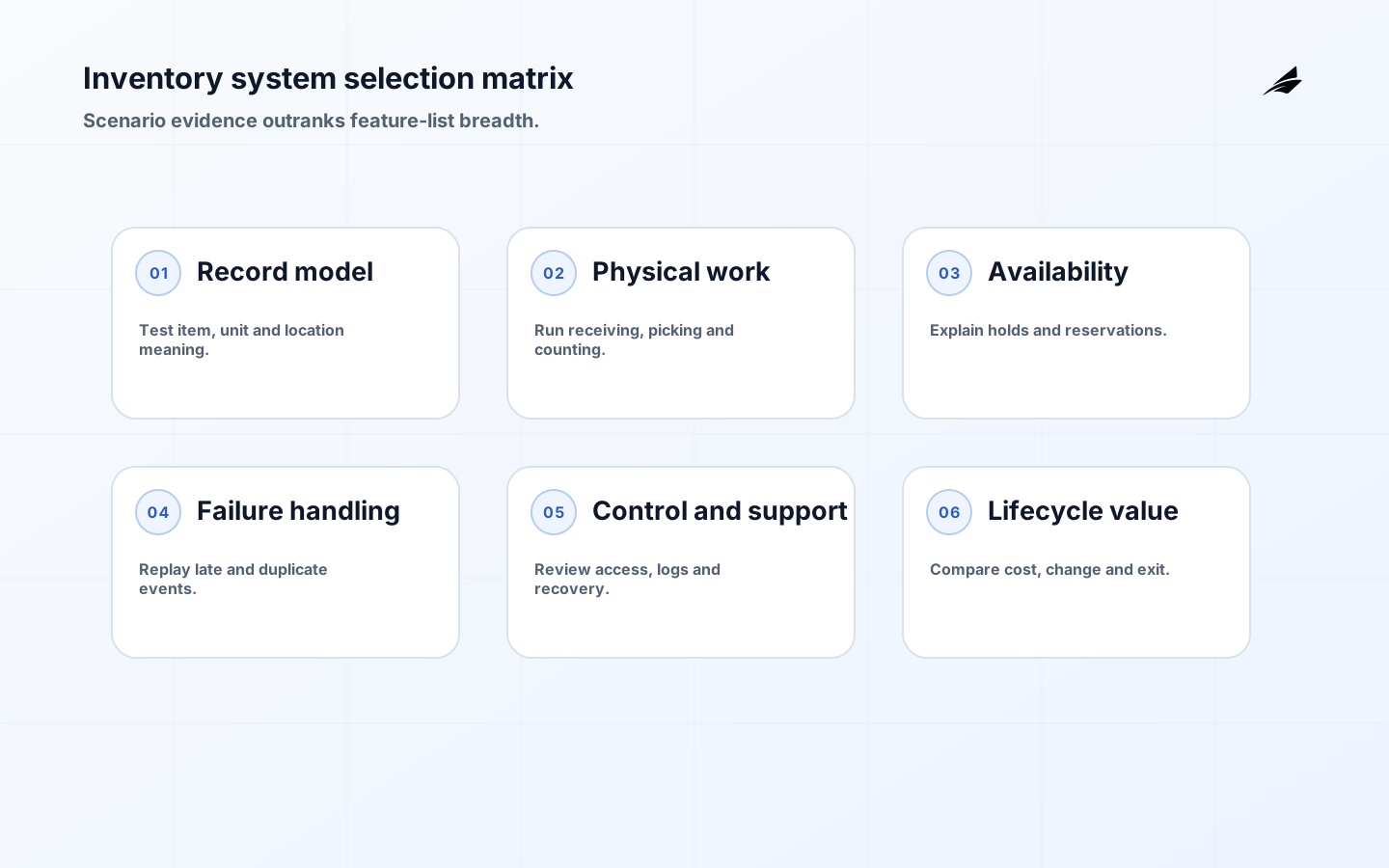
Inventory systems for IT managers should be compared through real operating scenarios, not a checklist of screens. The winning product must preserve item and location identity, calculate availability consistently, support physical work, survive integration failures, expose an auditable adjustment path and remain supportable during peak demand. Begin with the business model: distribution, manufacturing, retail, service parts and regulated goods need different depth. Then decide whether the inventory application, ERP, warehouse system or commerce platform owns each fact. GS1’s EPCIS overview is a useful reference for event-based visibility across trading partners. It does not choose a product, but it helps evaluators ask whether movements retain enough context to be shared and reconciled.
Define the inventory promise before selecting software
Begin with a named business outcome and trace its life from proposal to final result. Write the states in plain language, including who may create, approve, change, cancel, or investigate each one. Capture stable references, effective time, source authority, and the reason for a material change. Then test awkward conditions such as double scans, cancelled orders, transfers, physical variance, offline devices, and destination outages. Those cases reveal whether a rule is truly understood or merely implicit in one person’s spreadsheet or memory. A well-designed inventory systems workflow leaves enough evidence for a newcomer to answer what happened without gaining unrestricted production access.

| Decision | Working rule | Evidence to retain |
|---|---|---|
| Boundary | State the inventory systems outcome and exclusions. | Definition, examples, and lifecycle states. |
| Authority | Name the accountable business and technical owners. | Authority record and escalation route. |
| Identity and time | Keep durable references and effective time. | Source reference and change history. |
| Exception | Route ambiguous or failed work visibly. | Queue, reason, and disposition. |
Capture movements as durable, attributable events
For inventory systems, authority must follow the consequence of the decision. Assign a business owner for meaning and exceptions, a technical owner for behaviour and reliability, and a support path that can act within safe limits. Separate a proposed change from an approved result when the outcome affects customers, money, access, reporting, or compliance. Make the distinction visible in the data model and user interface. A broad administrator role is not a substitute for accountable design; it makes routine recovery depend on unsafe access and turns later review into reconstruction.
- State the inventory systems decision in terms a business owner can test.
- Retain source references, effective time, and change rationale.
- Give each consequential exception an accountable route.
- Limit service identities and recovery permissions to the action required.
- Test the normal path alongside correction, retry, and unavailable-dependency cases.
Calculate availability without confusing it with stock on hand
The most consequential control is the link between the intended decision and the resulting effect. Make the relevant identifiers, policy or rule version, input state, actor, and outcome available together. A person investigating a failure should not need to join unrelated exports by hand. Preserve an explicit reason for an override, replay, correction, or reversal. This supports controlled recovery and also prevents a temporary workaround from silently becoming permanent process. Inventory systems benefits when automation is traceable enough to be challenged, paused, and improved.
| Failure pattern | Control | Signal to review |
|---|---|---|
| Duplicate or repeated action | Use stable references and defined retry behaviour. | Duplicate detection and corrective actions. |
| Wrong or stale input | Validate source authority, version, and timing. | Corrections after completion. |
| Unclear responsibility | Assign a queue, owner, and escalation decision. | Unacknowledged or aged exceptions. |
| Silent downstream fault | Separate receipt from final business outcome. | Accepted work without confirmed result. |
Control allocation, adjustments, and physical counts
For inventory systems, build the first release around a small but complete path. Use representative records and exercise normal progress, rejection, duplicate delivery, late arrival, corrected input, and an unavailable dependency. Agree in advance what every party should see, which action is allowed, and what final evidence proves the business result. Release to a bounded population where possible, reconcile results before expansion, and keep a rollback or compensating action available. This approach finds assumptions in mappings, permissions, and timing before they become broad operational incidents.
Scale locations and channels from reconciliation evidence
Operate inventory systems as a feedback loop. Review movement delay, impossible balances, reservation expiry, allocation overrides, count variance, transfer ageing, and channel differences with the owners who can interpret and change the underlying work. A number is useful only when it distinguishes normal variation from a condition that requires action. Look for concentration by source, rule version, customer or employee group, location, product, and time period where relevant. Repeated manual work is evidence: it may expose missing policy, unclear ownership, a poor upstream interface, or a legitimate scenario that needs a supported path rather than another workaround.
Review the operating design before expansion
Use a concrete scenario set before scaling inventory systems. Include a transfer between locations, a reservation for a priority order, and a count that finds a variance. Walk each scenario with the people who create the input, approve an exception, operate the system, support users, and consume the result. Ask what each person can see, which condition changes their next action, and where the workflow can stop safely. A scenario is not a demo script: it is a test of whether the operational model survives ordinary ambiguity. Record disagreements as decisions to resolve, because they often reveal an unstated ownership or timing rule.
The record for this workflow should make its important context durable: item identity, unit, location, state, movement reference, reservation, count evidence, and adjustment. Avoid treating a dashboard or export as the only explanation of state. It may be useful for review, but the operational system needs the references that let a case be traced back to a source and forward to its effect. Define retention and access boundaries for that evidence. The objective is not to store every possible detail; it is to preserve the minimum context needed to make a correction, satisfy a legitimate review, and understand a result.
Design for the moment when a scanner repeats a movement or a channel publishes availability before a transfer is received. Decide whether automation may retry, whether a person must review, which service can be paused, and how the final result is confirmed. A safe recovery path prevents urgency from becoming a reason to bypass controls. It also limits the cost of a defect: staff can act on an identified item or request rather than rerunning a broad job. Where a compensating action is needed, link it to the original event and retain a reason so the history remains intelligible.
The human interface matters as much as the integration contract. For this workflow, warehouse and support staff need to see why a quantity is unavailable without editing the balance directly. Give them language that explains the state and a route to ask for help without exposing records beyond their role. Training should be based on real scenarios and supported by a current runbook, not only a launch presentation. When the process changes, update the policy, interface, and support instructions together; otherwise users will continue following an obsolete but locally sensible practice.
For inventory systems, choose rollout gates tied to observed control performance. Before adding another team, region, channel, or source, review whether the current scope can reconcile its expected work to its final result and whether exceptions have an owner. Sample completed cases for evidence quality, not just throughput. Set a clear threshold for pausing expansion if error, override, or access signals rise. This gives leadership a practical basis for deciding whether more scale will compound a weakness or extend a workflow that is already dependable.
Use evidence and controls deliberately
The controls around inventory systems should be grounded in durable public guidance. The NIST Cybersecurity Framework helps set governance and risk-management responsibilities. The NIST Privacy Framework is useful when the workflow handles personal or sensitive information and needs a clear purpose. Google SRE monitoring guidance helps separate action signals from diagnostic detail. The OWASP Application Security Verification Standard provides practical checks for sensitive actions, service identities, and exposed interfaces. These sources are decision aids, not substitutes for a team’s own policy and evidence.
Run scenario-based selection, including failure
Give shortlisted vendors the same representative data and scripted cases: partial receipt with damaged stock, unit conversion, lot expiry, split fulfillment, reservation expiry, transfer with a missing destination scan, cycle-count variance, return disposition and duplicated integration message. Ask operators to perform the work while IT observes state changes, audit history and error handling. The system-of-record guide helps allocate authority, the finance-systems guide frames valuation handoffs, and the ERP perspective for founders helps connect selection to growth constraints.
Score the product and the implementation partner separately. A capable platform can still fail through weak master data, unclear roles or brittle customization. Request evidence for API limits, versioning, export, background-job monitoring, role granularity, restore testing, mobile offline behavior and support escalation. Use the OWASP ASVS to make application-security expectations testable. Total cost should include devices, labels, integrations, environments, migration, training, count operations, vendor support, peak capacity and exit. A fixed license price is not a useful comparison when one option shifts substantial effort into manual reconciliation.
| Selection dimension | Demonstration question | Evidence to score |
|---|---|---|
| Record model | Can item, lot, unit, owner and location be unambiguous? | Configured sample records |
| Availability | How are holds, reservations and transfers treated? | Explainable quantity calculation |
| Failure recovery | What happens after duplicate or late events? | Replay and reconciliation result |
| Operations | Can support trace one transaction end to end? | Job history, logs and runbook |
| Security | Can sensitive actions be separated and reviewed? | Role matrix and audit export |
| Exit | Can data and event history be extracted usefully? | Test export and field documentation |
Key takeaways
- Start inventory systems with one consequential decision and its owner.
- Make source, state, timing, and exception evidence visible.
- Treat retries, corrections, and access boundaries as product behaviour.
- Reconcile intended work to the final operational result.
- Use recurring exceptions to improve policy and upstream quality.
Frequently asked questions
Is stock on hand the same as available inventory?
No. Available inventory applies policy for states, reservations, buffers, ownership, and channel commitments; stock on hand is only a recorded quantity.
Why retain movement history?
It explains balance changes, supports reconciliation, identifies missing or duplicate events, and provides evidence for corrections and financial review.
Conclusion
The best inventory system is the one that fits the operating model and remains understandable when reality diverges from the plan. Compare products with difficult scenarios, score implementation and support evidence, and insist on explainable availability and correction. IT managers should leave selection with a record-authority map, integration contract, migration proof and lifecycle cost model, not merely a preferred interface. That foundation makes later warehouse and channel growth much less expensive.