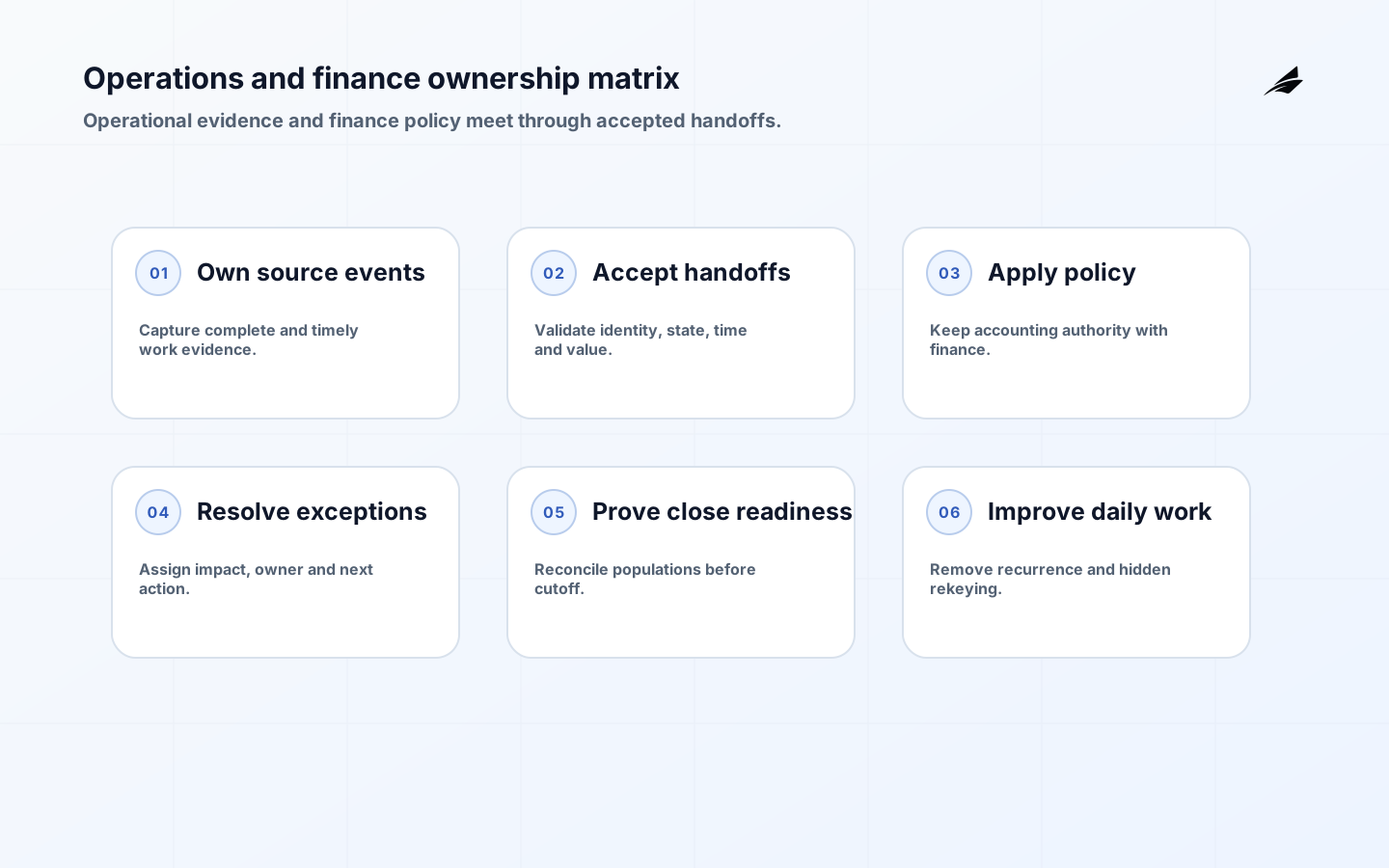
Finance systems for operations leaders matter because the financial record begins in operations. A shipment confirms fulfilment, a goods receipt creates liability evidence, a return changes inventory and revenue, a time record supports payroll or project cost, and a contract amendment changes what can be billed. Finance defines accounting policy and controls; operations owns the timeliness, completeness, and meaning of many source facts. Reliable systems make that shared responsibility visible.
This guide is about daily ownership and close readiness rather than finance platform architecture. Use it with Edilec's billing operations plan, ERP integration guide for founders, and system of record design explainer. The target is a close that confirms controlled daily work, not a monthly campaign to reconstruct missing evidence.
Key takeaways
- Operations should own the quality and timing of operational facts; finance should own accounting interpretation, posting policy, and financial sign-off.
- Define handoffs with identifiers, states, cutoff, evidence, rejection feedback, and correction rules.
- Manage exceptions in a shared queue with materiality, owner, age, and next action rather than private spreadsheets.
- Use daily control totals and close-readiness signals to find gaps while the work is still understandable.
- Measure process outcomes and control health together; speed without completeness simply moves work to finance.
Draw the operations-finance operating model
Choose one flow and place the operational owner, finance owner, system owner, control owner, and exception owner around it. Write the event that starts the handoff, required fields and documents, acceptance rule, deadline, acknowledgement, rejection route, and correction mechanism. For order to cash, operations may own proof of delivery and customer acceptance while finance owns invoice policy, receivables, and revenue treatment. For procure to pay, the split may run across request, purchase order, receipt, invoice match, approval, and payment.
| Flow | Operations owns | Finance owns | Shared evidence |
|---|---|---|---|
| Order to cash | Order, entitlement, fulfilment, return, and service evidence | Billing policy, receivables, revenue treatment, and posting | Customer, contract, delivery, invoice, and adjustment IDs |
| Procure to pay | Need, purchase order, receipt, service confirmation, and dispute | Supplier controls, match policy, liability, payment, and posting | Supplier, PO, receipt, invoice, approval, and payment references |
| Inventory | Movement, count, condition, location, and adjustment request | Valuation policy, reserves, financial adjustment, and sign-off | Item, lot, location, event, count, and reason |
| Workforce or project | Approved time, assignment, milestone, and delivery | Payroll or cost policy, capitalization, allocation, and posting | Worker, project, period, approval, and source record |
| Cash operations | Customer or operational remittance context | Bank reconciliation, allocation, treasury, and ledger | Bank reference, payer, currency, amount, and date |
Responsibility is not the same as system access. An operations leader can own source-data quality without the right to alter posted journals. A finance owner can reject an incomplete receipt without owning warehouse execution. Define decision rights for create, approve, post, reverse, reopen, and override. Review conflicts such as creating a supplier and approving its payment. Protect emergency access with expiry, reason, logging, and independent review.
Make handoffs explicit and recoverable
A finance handoff is complete only when the receiver accepts it. The sender should publish a stable event or record with business identifier, legal entity, counterparty, amount or quantity, currency and precision, event and effective time, state, source evidence, and version. The receiver validates policy and master data, acknowledges acceptance, or rejects with a reason that the source owner can act on. Silent drops and generic errors create close surprises.

| Failure pattern | What operations sees | What finance sees | Joint fix |
|---|---|---|---|
| Missing identifier | Work completed in local workflow | Unmatched invoice, payment, or journal | Generate stable ID at source and require it downstream |
| Late event | Normal correction after cutoff | Unexpected prior-period or accrual difference | Define cutoff, late-data route, and materiality |
| Mutable history | Record simply shows current state | No evidence for original posting or reversal | Use versioned events and linked correction |
| Master-data conflict | Supplier or customer appears valid locally | Entity, tax, bank, or account control fails | Assign authority and return an actionable rejection |
| Spreadsheet override | Team keeps service moving | Uncontrolled journal or unexplained total | Create governed exception workflow and migrate recurring logic |
| Duplicate retry | User repeats after timeout | Double invoice, payment, or receipt | Idempotency key and visible processing state |
Corrections should preserve the original state and explain the change. Operations proposes a return, receipt correction, quantity adjustment, or reclassification with evidence and reason. Finance applies the approved accounting effect, often through a reversal or linked adjustment rather than editing posted history. This protects both teams: operations can correct reality, and finance can retain a traceable financial story. Reopen rules should state period, materiality, approval, and downstream impact.
Run the close as a daily readiness process
Create a close calendar backward from reporting deadlines, but monitor readiness every day. Track unconfirmed deliveries, unmatched receipts, unbilled usage, pending returns, failed integrations, unapproved time, unreconciled cash, inventory count differences, and aged exceptions. Show the amount or operational quantity at risk, not only item count. Owners should know the cutoff and the consequence of missing it. Finance decides accrual, estimate, or hold policy; operations provides the best available evidence and resolution date.
| Readiness signal | Owner | Decision before cutoff | Proof of completion |
|---|---|---|---|
| Delivered but not billable | Fulfilment or service operations | Complete evidence, correct source, or flag exception | Accepted billing population |
| Receipt without matched invoice | Procurement operations | Resolve quantity, price, supplier, or timing difference | Matched, approved exception, or accrual input |
| Inventory adjustment pending | Warehouse or inventory owner | Approve count evidence and reason | Posted operational adjustment linked to financial effect |
| Failed interface records | System and process owners | Correct, replay, or document controlled exclusion | Source and destination control totals agree |
| Unallocated cash | Receivables and operations contact | Identify payer and invoice or classify exception | Bank, subledger, and ledger reconcile |
| Manual journal request | Requesting operations owner and finance | Supply evidence, dimensions, and approval | Posted journal with source reference and review |
Accounting treatment remains a finance judgment. For example, the IFRS 15 standard page describes principles for recognizing revenue from customer contracts. Operations leaders do not need to become accounting policy authors, but they should understand which fulfilment, acceptance, modification, or return evidence finance relies on. Design the operational workflow so that evidence is captured as work occurs, not recreated from email at quarter end.
Manage exceptions as operational work
Use one shared view for exceptions, even if work remains in specialized systems. Each item needs category, source and destination IDs, legal entity, period, amount or quantity, materiality, customer or supplier impact, owner, age, next action, deadline, evidence, and resolution. Distinguish a timing difference from a data defect, policy question, system failure, and suspected control breach. Those classes need different people and response times. Track recurrence by source and root condition.
Secure the queue and connected actions. Finance and workforce records can contain personal, commercial, banking, or tax data. The NIST Privacy Framework helps connect processing to privacy risk. The OWASP ASVS offers application verification guidance, and the NIST Cybersecurity Framework structures governance through recovery. Apply role, entity, amount, and purpose restrictions; redact broad exports; and log consequential changes without exposing sensitive values unnecessarily.
Measure flow, quality, and control health
Pair speed with completeness and correction. Useful signals include handoff acceptance rate, cutoff attainment, rejection reasons, exception age and value, duplicate attempts, manual journal volume, reconciliation difference, post-close adjustments, and time spent reconstructing evidence. Segment by process, location, product, entity, and source system. Google's monitoring guidance emphasizes actionable signals; an operations-finance dashboard should likewise tell an owner whether to correct a source, add capacity, change a rule, or stop a flow.
- Review one ordinary item, one aged exception, and one correction from each material flow every month.
- Trace each from source evidence to financial result and identify waiting, rekeying, missing context, and uncontrolled override.
- Fix recurring causes in source workflow, master data, policy, interface, or training; do not normalize permanent cleanup.
- Recheck the same metric and case type after the change to confirm it reduced work without creating a new control gap.
- Retire reports and spreadsheets whose purpose has moved into a controlled workflow, preserving required records.
Operations leader checklist
- Each material operational event has an owner, stable identifier, defined state, effective time, and required evidence.
- Finance policy and operational truth have separate owners and an explicit handoff.
- Cutoff, late data, correction, reopening, and emergency override rules are documented and tested.
- Receivers acknowledge accepted records or return actionable reasons; rejected populations remain visible.
- Daily control totals and close-readiness signals expose item count, value, age, and accountable next action.
- Sensitive access and conflicting duties are restricted; privileged and manual changes receive independent review.
- Recovery tests include replay, duplicate prevention, reversal, backlog reconciliation, and close impact.
Frequently asked questions
What should operations leaders own in finance systems?
Own the completeness, timing, meaning, and correction of operational facts and their exception path. Finance owns accounting interpretation, policy, posting controls, and sign-off. Both share the handoff, reconciliation, and improvement of recurring failures.
How can teams shorten month-end close?
Move evidence capture, validation, control totals, and exception resolution into daily work. Shorter close comes from fewer unknowns and cleaner handoffs, not simply asking finance to work faster during the last days of the period.
Are spreadsheets always a control problem?
No. They can support bounded analysis and review. Risk rises when a spreadsheet becomes the only source, contains uncontrolled formulas or sensitive exports, drives recurring postings, lacks review, or cannot reproduce its input population. Move stable recurring logic into governed systems.
Conclusion
Operations leaders improve finance systems by making operational facts complete, timely, and correctable before they become financial exceptions. Explicit ownership, accepted handoffs, daily reconciliation, shared exception work, and close-readiness signals replace last-minute reconstruction with controlled flow. The best result is not merely a faster close; it is an organization that can explain its numbers and improve the work that produces them.