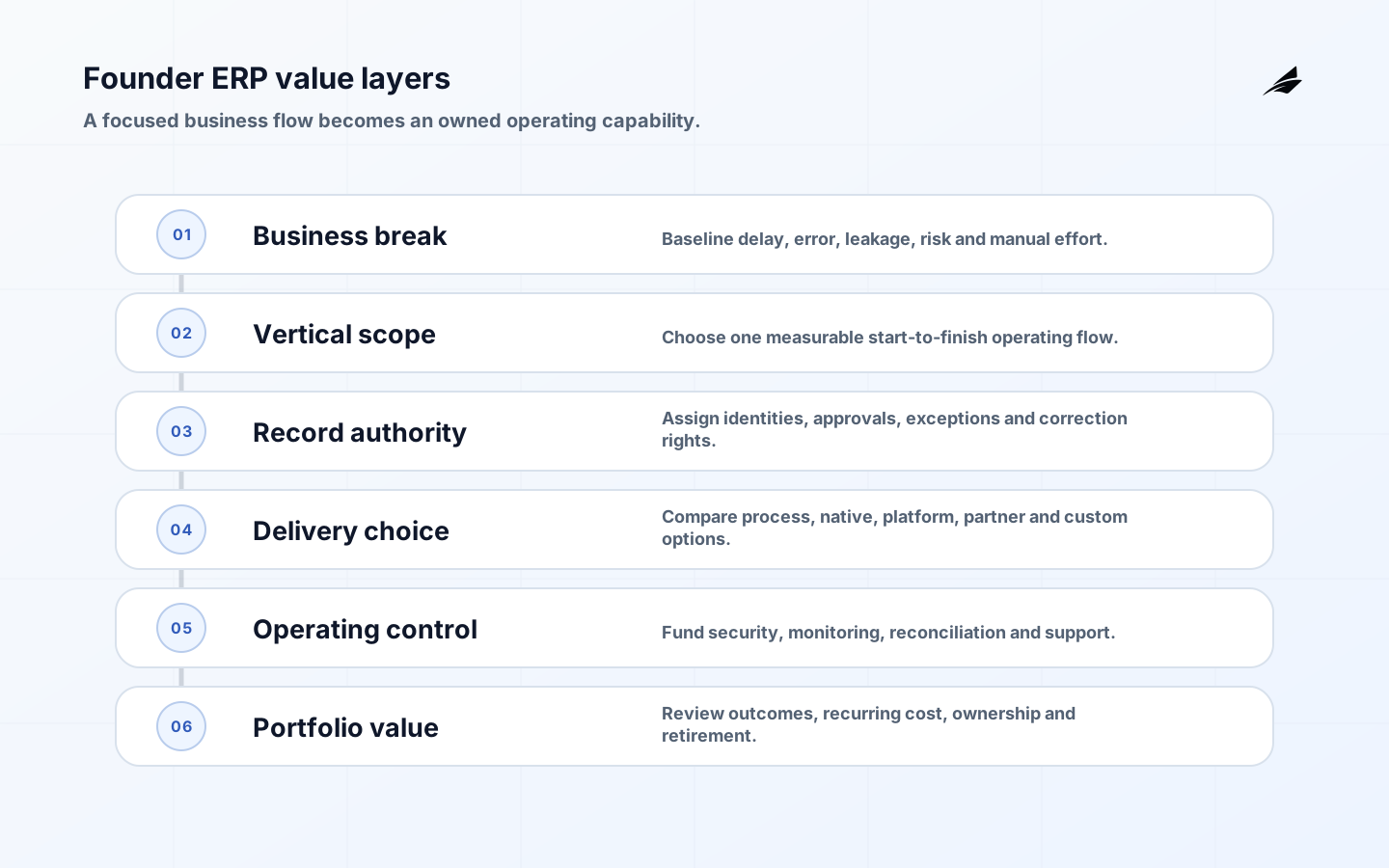
ERP integration becomes a founder problem when revenue, cash, inventory or service work depends on people re-entering data between systems. The tempting response is to connect everything. A better response is to identify the few business transitions where delay or inconsistency creates material cost, then build an owned, measurable path from one authoritative record to the next.
The investment is not just an API project. It exposes ambiguous customer identities, informal approval rules, inconsistent product codes and exceptions known only to experienced staff. Founders should judge the program by operating control and business outcomes: fewer unbilled shipments, faster close, reliable availability, lower correction effort and clearer accountability when something fails.
Use Edilec's system of record design guide to clarify authority, master data engineering notes for shared identities, and finance systems guide for the operational-financial boundary.
Key takeaways
- Integrate a business outcome, not a collection of applications.
- Name the authoritative owner for customers, products, orders and postings.
- Budget data cleanup, exception handling, controls and support alongside connectors.
- Avoid broad two-way sync unless both directions have explicit authority.
- Prove value and recovery on one vertical slice before scaling the program.
Know when integration is worth doing
Good triggers are concrete: orders exceed manual-entry capacity, inventory promises are wrong, close depends on spreadsheet reconciliation, acquisitions create duplicate masters or regulated evidence cannot be reconstructed. Estimate current volume, delay, error rate, staff time and financial exposure. A connector that saves minutes but adds a critical unsupported dependency may not be the best next investment.
Do not automate a process whose decision rights are still disputed. If sales can change payment terms after finance approval, integration will either reproduce the conflict faster or hide it. First document the desired transition and exception owner. Sometimes a workflow change, product configuration or removal of duplicate tools creates more value than custom integration.
| Signal | Likely need | Founder question | Evidence before funding |
|---|---|---|---|
| Orders re-keyed into ERP | Order capture integration | Which accepted order becomes binding? | Volume, errors and delay by channel |
| Available stock disagrees | Inventory authority and event integration | Where does custody change? | Oversells, adjustments and stale feeds |
| Invoices lag shipments | Fulfillment-to-billing control | What proves billable delivery? | Unbilled value and aging |
| Close requires manual joins | Master data and posting integration | Which dimensions are authoritative? | Reconciliation hours and late entries |
| Employee exits leave access | HR-to-identity lifecycle | What event requires revocation? | Open accounts after termination |
Scope one vertical business flow
Choose a start-to-finish slice with visible value, such as accepted web order to ERP sales order to shipment to invoice. Define included channels, entities, locations and exceptions. Set a baseline for cycle time, rework and leakage. A vertical slice reveals identity, authority, data, controls and support together; a horizontal promise to integrate all customer data often produces infrastructure without a completed outcome.
Write acceptance in business terms. Every eligible accepted order appears once in ERP within five minutes; rejected orders display an owned reason; shipment cannot be billed twice; daily totals reconcile to source. Include a recovery objective and manual fallback. The scope should state what remains manual so teams do not mistake partial automation for end-to-end control.
Set ownership before selecting a platform
Assign a business owner for the process and a technical owner for the service. Then map record authority. CRM might own lead activity, but ERP may own legal customer, credit status and accepted order. Product information may originate in a product system while ERP owns purchasable and financial attributes. Authority can change at a lifecycle transition; write that transition down.
Require stable IDs and a managed mapping process. Names, email addresses and SKU descriptions are not reliable enterprise keys. Decide who resolves duplicates and how merged or closed records propagate. A system-of-record discussion is not bureaucracy; it prevents a later two-way sync from creating an endless argument between applications.
Choose implementation and partner model
Native connectors can be economical when the workflow and supported objects match. Integration platforms can speed mapping, orchestration and operations across many interfaces. Custom services are justified when business rules, scale or product experience are differentiating. Ask for supported versions, rate limits, data residency, observability, retry behavior, export, termination support and total run cost, not only a demo.

Open standards reduce some lock-in but do not remove operating work. The OpenAPI Specification can describe HTTP interfaces and CloudEvents standardizes event envelopes. Your company still owns business semantics, mappings and exceptions. Contract for source code or configuration access, environments, tests, runbooks, accounts and knowledge transfer. Avoid a partner-held production dependency that the internal team cannot inspect.
| Cost area | Often omitted | Budget question | Exit evidence |
|---|---|---|---|
| Data | Cleanup, deduplication and mapping | Who resolves historical conflicts? | Governed IDs and migration report |
| Delivery | Test environments and realistic fixtures | Can end-to-end failures be reproduced? | Automated contract and journey tests |
| Operations | Monitoring, on-call and exception staff | Who responds after launch? | Dashboards, queues and runbooks |
| Change | ERP and SaaS release compatibility | How are breaking changes detected? | Version inventory and upgrade tests |
| Security | Service identities and privileged replay | Who can move or correct sensitive data? | Access review and audit trail |
| Exit | Connector replacement and data export | Can the company change suppliers? | Documented ownership and decommission plan |
Protect cash, data and authority
Integration accounts should have only the operations they need. Separate supplier-bank maintenance from payment release and order creation from credit override. NIST's Zero Trust Architecture emphasizes explicit resource access rather than trust based on network location. Apply that principle to service identities, administrators and partner access, with managed secrets and auditable changes.
Decide which errors block the flow. A missing optional sales note may be logged; an unknown currency, bank-account change or invalid tax code may require a hold. Protect correction and replay as privileged operations because they can duplicate or alter financial effects. Minimize sensitive fields copied into middleware logs and non-production environments. Ask the security and finance owners to approve control design before volume makes shortcuts permanent.
Demand business-level observability
Technical uptime is not enough. The operating dashboard should show orders accepted but absent from ERP, shipments not invoiced, events waiting beyond service level, rejected master data and totals that do not reconcile. OpenTelemetry tracing can connect service operations, but each transaction also needs a searchable business reference and privacy-aware evidence.
Give every exception a queue, owner, reason, age and resolution. Track recurrence by root cause. If staff repeatedly correct the same product mapping, fix master data or the upstream process rather than celebrating quick ticket closure. Set a monthly service review across operations, finance and engineering. Integration quality is shared operating work, not a handoff to IT after project completion.
Example: integrating a new sales channel
A growing distributor adds a marketplace. The first scope covers domestic stocked items and prepaid orders. The marketplace order ID maps to one enterprise order; ERP validates customer, SKU, price and tax data; warehouse release happens only after ERP acceptance. Shipment confirmation returns through the same reference, and daily controls compare orders, shipped quantities, refunds and ERP postings.
International orders and bundles remain manual until product and tax rules are ready. During a two-week pilot, the team shadows results and investigates every difference. Launch proceeds only when duplicate creation, exception age and reconciliation meet targets. This bounded design produces usable evidence and avoids turning edge cases into hidden production policy.
A founder's six-week decision checklist
- Week 1: baseline one painful flow and name its business owner.
- Week 2: map record authority, identifiers, approvals and exceptions.
- Week 3: compare process change, native connector, platform and custom options.
- Week 4: prototype one vertical slice with realistic data and failure cases.
- Week 5: price operations, security, reconciliation, partner terms and exit.
- Week 6: approve a staged pilot with outcome, stop and retirement criteria.
Govern the integration portfolio as the company grows
Maintain a simple register of every production interface: business purpose, owner, systems, data classes, technology, provider, service level, monthly cost, credentials, last test and retirement state. This reveals duplicate feeds and ownerless jobs before an acquisition or ERP upgrade does. Tier interfaces by business impact so the company spends resilience and on-call effort where a failure affects cash, customers, rights or operations.
Review the portfolio quarterly with finance, operations and technology. Compare recurring cost, incidents, exception effort and actual usage. Consolidate transformations that express the same governed rule, but avoid a central platform team becoming the owner of every business meaning. Fund planned compatibility work for ERP and SaaS releases. Retirement is a project outcome: remove schedules, queues, credentials, firewall rules and vendor access after consumers and records are verified.
ERP integration FAQ for founders
What should we integrate first?
Choose a high-friction, measurable flow with stable enough rules and bounded risk. Order-to-cash, inventory availability or HR-to-access are common candidates, but the baseline should drive priority.
Will an integration platform eliminate custom work?
No. It may accelerate connectors, transformations and operations, but your team still owns business semantics, data cleanup, controls, testing and exceptions.
How should ERP integration ROI be measured?
Combine labor and cycle-time savings with reduced leakage, fewer errors, better service and risk reduction. Include recurring licenses, support, exception staffing, upgrades and change management in cost.
Conclusion
Founders should treat ERP integration as an operating-model investment. Start with a costly business break, clarify authority, fund the hidden data and support work, and prove one recoverable flow. A smaller integration that the company can explain and operate is more valuable than a broad network of connectors with no accountable owner.