Workflow exceptions are the cases that do not safely fit the happy path: a missing approval, duplicate record, unavailable dependency, disputed outcome, policy conflict, or time-critical override. They are not proof that a workflow has failed. They are proof that the workflow is meeting real operating conditions. The failure is treating them as invisible manual work, because then nobody can see their customer impact, risk, or recurring cause.
Classify exceptions by decision, not by annoyance
A useful exception record says what expected state was violated, what action is paused or allowed, who can decide, and what evidence is needed. Avoid a single catch-all other queue. A payment mismatch, customer identity dispute, and failed integration need different skills, response windows, and permissions. Classification should be just detailed enough to route a case and later reveal a pattern; it should not turn frontline reporting into taxonomy work.
Distinguish a recoverable operational exception from a security or compliance incident. The former may permit controlled continuation, while the latter may require containment and investigation. State that decision rule in the workflow rather than relying on the person who happens to see the alert. A clear rule protects staff from improvising beyond their authority under pressure.
| Exception | Default action | Accountable decision |
|---|---|---|
| Required source data missing | Pause dependent action and request correction | Data steward or originating team |
| External service unavailable | Retry within limit, then expose pending state | Service owner |
| Approval threshold crossed after change | Invalidate prior approval and resubmit | Budget or policy owner |
| Potential fraud or access issue | Contain action and preserve evidence | Security or risk function |
Workflow exception architecture
Represent the exception as a first-class object linked to the affected work, rather than as a free-text note. It needs a stable ID, category, severity, detected time, correlation ID, evidence references, current owner, and explicit state. Keep the normal workflow's state separate: an order might be awaiting approval while its supplier-data exception is being resolved. That separation prevents a simple status field from carrying contradictory meanings.

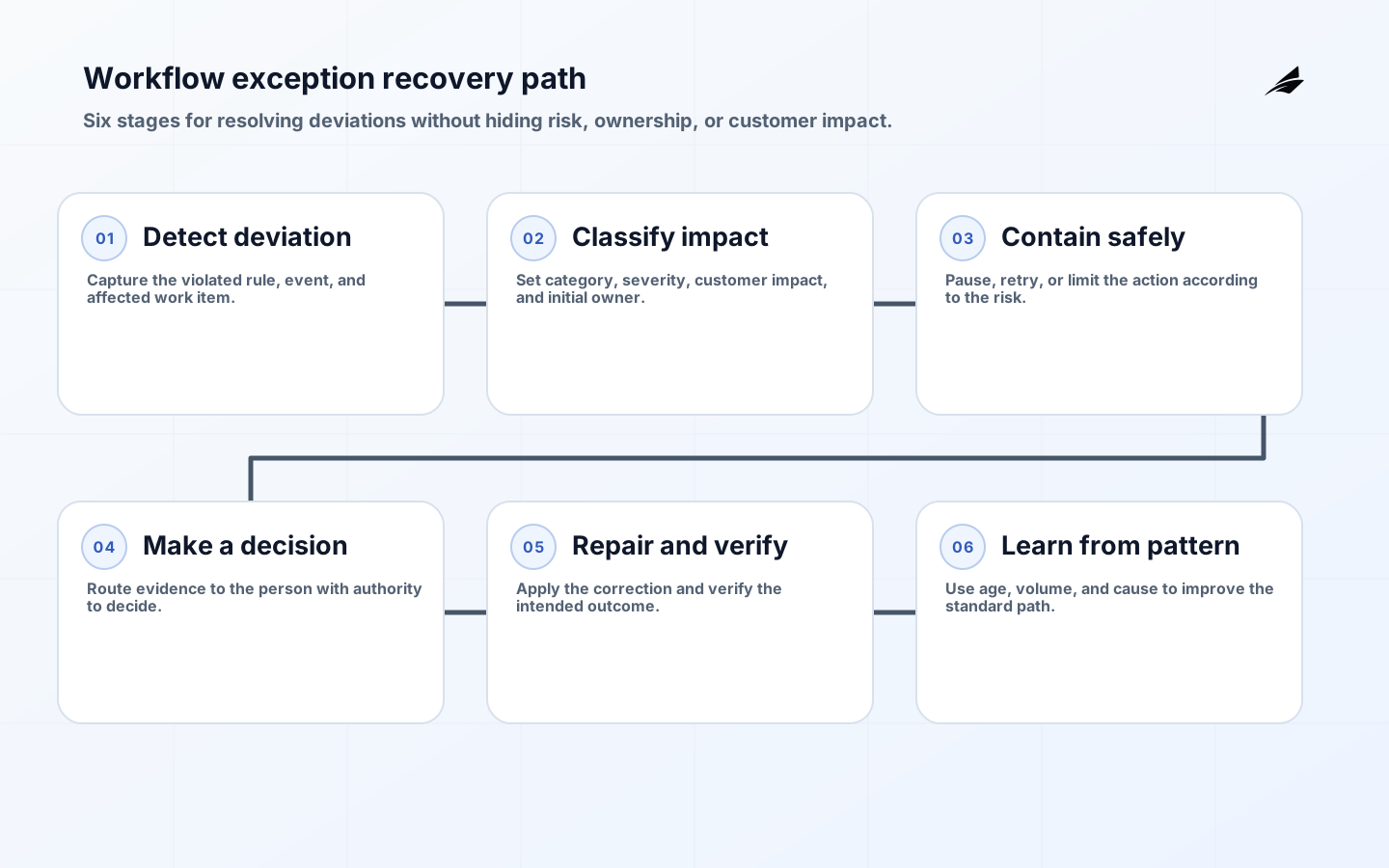
Use idempotent event handling and a bounded retry policy for technical failures. A transient timeout can be retried automatically; a schema mismatch or repeated authorization denial should create a reviewable exception with the failed input safely referenced. Record attempts without logging secrets or sensitive payloads. This gives business process automation a safe boundary between automation and human judgment.
Route by authority and urgency
Assign a named primary owner at creation, even when a specialist group will handle the case. The owner is responsible for customer communication and next action; the specialist is responsible for the decision or repair. Escalation timers should use an operational clock appropriate to the service, not a generic reminder that fires after the customer has already been harmed. Let teams reassign with a reason so handoff patterns can be examined.
Design the user experience around uncertainty. Show whether the underlying action is safely paused, provisionally completed, or denied; show the next review time; and avoid false completion messages. A requester who sees processing for three days cannot make a sensible business decision. A truthful pending state is often more valuable than an optimistic one.
| State | Meaning | Required transition evidence |
|---|---|---|
| Detected | Rule or person found a deviation | Rule, reporter, and affected object |
| Triaged | Severity and owner selected | Classification and decision rationale |
| Waiting | External or internal dependency unresolved | Named blocker and review time |
| Resolved | Repair or authorized decision applied | Outcome, actor, and verification |
Turn recurring exceptions into design work
Review exception volume alongside its age and impact. A large number of quick, harmless corrections may point to an interface defect; a small number of old exceptions may reveal a serious ownership gap. Group by originating system, policy rule, and work type. For related guidance on keeping shared records authoritative, see master data management for enterprise systems. Then choose one remedy: improve validation, change the standard path, clarify policy, train an owner, or accept the cost as a deliberate service level.
Do not automate a decision merely because it appears frequently. First determine whether outcomes are consistent and whether the evidence can be evaluated safely by a rule. If they are, automate the detection or routing before automating the resolution. That sequence preserves a human review sample and reduces the chance that a flawed rule scales a flawed decision.
Introduce exceptions without disrupting live work
Begin with two or three high-impact exception types and backfill only the facts people need to act. Train owners with real examples, including a case they must escalate. Set a short review rhythm during the first month to adjust categories and service levels. The goal is not a perfectly complete exception model; it is a system that makes uncertain work accountable quickly.
- Publish clear thresholds for automatic retry, pause, escalation, and manual override.
- Preserve event time and correlation IDs across systems.
- Sample resolved cases to ensure the evidence supports the closure.
- Feed recurrent data problems into system of record design.
Workflow exception takeaways
- Exceptions are part of a mature workflow, not an embarrassment to hide.
- Model them with owners, evidence, states, and customer impact.
- Separate technical retry from human decision and policy override.
- Use recurring cases to improve the standard flow.
The BPMN 2.0.2 specification gives exception paths a shared process vocabulary. NIST SP 800-53 Rev. 5 supports accountable controls and evidence. The OWASP Logging Cheat Sheet covers useful event records without unsafe payloads, while the OWASP Transaction Authorization Cheat Sheet keeps authorization tied to the action and its context.
Workflow exception FAQ
Should every error create a case? No. Expected, safe retries can remain technical events. Create a case when a person must decide, the customer needs a truthful update, a risk threshold is crossed, or repeated attempts require investigation.
Who can close an exception? The person with authority to attest that the required repair or decision occurred. The requester can contribute evidence, but closure should not be a way to clear an inconvenient queue.
How long should exceptions be retained? Retention depends on the business record, regulation, contract, and security need. Decide it with records and risk owners; preserve enough evidence to explain material decisions without retaining sensitive data indefinitely.
Assurance review for recovery evidence
For workflow exceptions, read a small set of cases from detection through closure with the operational owner. Check whether the category predicted the right authority, whether the customer was told the truth, and whether the resolution actually removed the condition that caused the deviation. A queue can look healthy while cases are being closed without repair. Sampling keeps the exception model connected to real decisions rather than only to status metrics.
The assurance review should produce a small, owned change rather than a broad redesign. For workflow exceptions, write down the observed condition, the decision it affected, the owner who will correct it, and the signal that will show whether the correction worked. Revisit the same class of work after the change. This closes the loop between policy, system behavior, and the people who depend on the outcome.
Exception governance should include a regular decision about which rules still deserve enforcement. A control that generates many harmless pauses may be poorly calibrated, while a rare exception with severe consequences may need faster escalation and stronger evidence. Review the rule owner, not only the queue owner, and record why a threshold changes. This matters when workflows are connected: an upstream validation change can turn a downstream exception into a flood. A controlled release, a monitoring window, and a rollback condition let teams improve rules without making live customers the test environment.
Finally, make the review of workflow exceptions a normal operating meeting rather than an annual clean-up. Bring a sample of recent work, one aged item, one recovery case, and one decision that depended on a shared record. Ask whether the current owner, evidence, and system state would let a new colleague understand what happened and act safely. Record only the changes that have a named owner and a testable signal. This small cadence is how an enterprise system stays aligned with changing customers, policies, and teams without relying on heroic knowledge held by a few people.
Keep this review evidence with the workflow exceptions record: the observed case, the owner, the chosen correction, and the date it will be checked again. That modest history prevents the same issue from being rediscovered when staff or systems change.
Conclusion: govern workflow exceptions
A dependable enterprise workflow tells the truth about work that cannot proceed normally. By giving exceptions their own identity, authority, and recovery path, a team protects customers while learning where the standard process needs to change. That is much stronger than a hidden spreadsheet full of urgent requests.
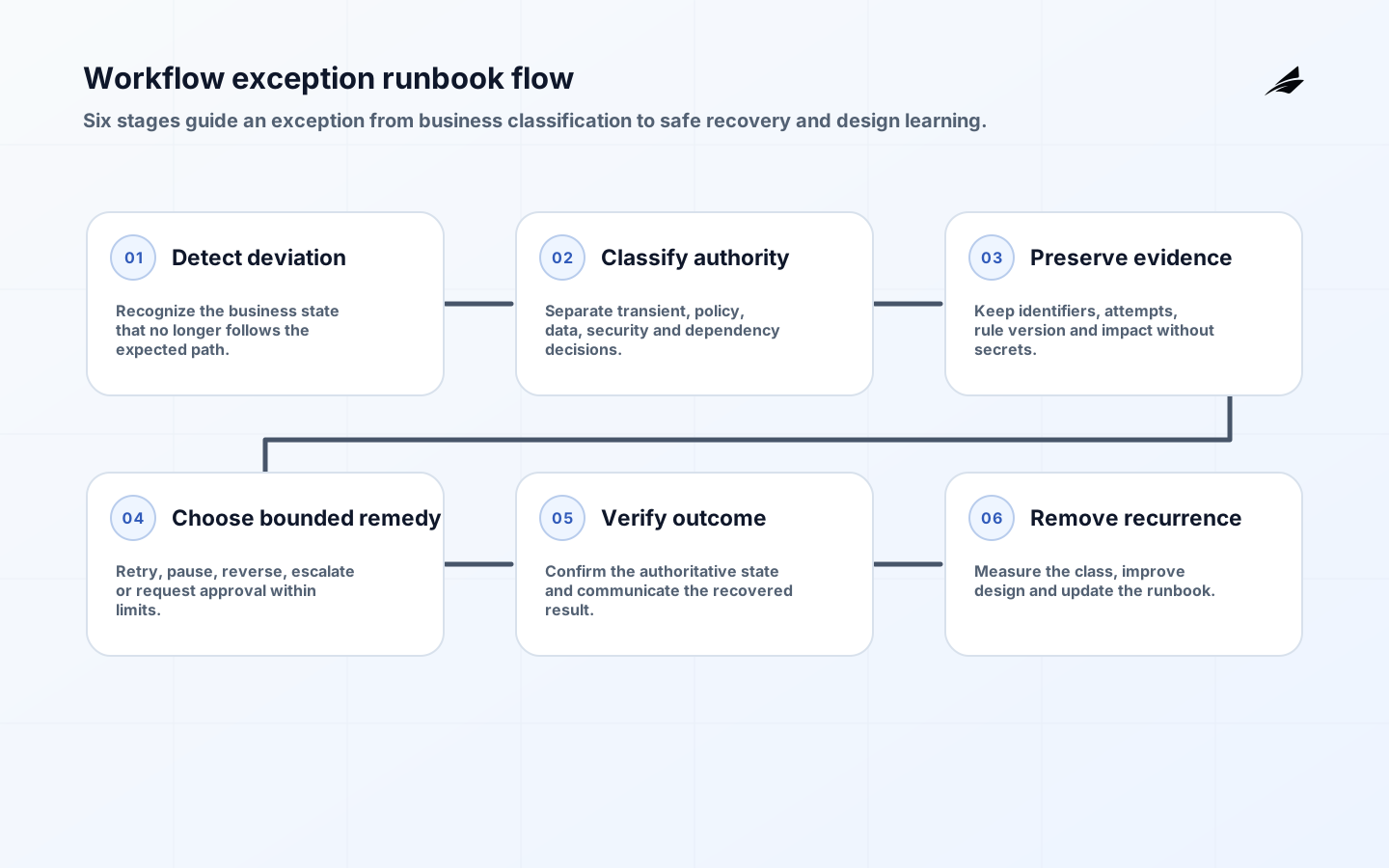
Write the exception runbook around decisions
An exception runbook should help a person decide safely at 02:00, not describe every internal class or screen. Start with the trigger, affected business state, evidence that must be checked, actions the operator may take, actions requiring approval, and the proof of recovery. BPMN can clarify the intended path, but the runbook must also describe what happens when a message is duplicated, a dependency is unavailable, or a policy decision is ambiguous. Keep a redacted example beside the rule so a new operator can recognize the case without copying sensitive data.
| Exception signal | First decision | Safe next move |
|---|---|---|
| Transient timeout | Could the action have completed? | Check idempotency and receiving state before retry |
| Rule conflict | Which authority owns the policy? | Pause, preserve evidence and request a decision |
| Missing data | Can the outcome be computed safely? | Quarantine the case and request the smallest correction |
| Repeated failure | Is the design or dependency broken? | Escalate with correlation, attempts and impact |
A payment approval that times out illustrates why this matters. Retrying blindly can create a duplicate authorization; refusing every retry can strand a legitimate order. The operator should first query the authoritative transaction state, compare the correlation identifier, and only then use a documented reversal or retry route. OWASP's transaction authorization and logging guidance supports separating the authorization decision from the user interface and recording enough event context to investigate without exposing secrets.
Review exception samples with the people who receive the work, not only the workflow designer. Look for labels that describe technical symptoms instead of business meaning, approvals that no longer have an accountable owner, and logs that show a failure but not the attempted remedy. Promote a recurring exception into product or process work only when the evidence shows its frequency, impact, and a safe change. The goal is fewer ambiguous decisions, not a queue with an impressive closure rate.
Workflow exception decisions
Make the queue legible to the person who owns the outcome. A useful exception record shows the affected business object, current state, reason for diversion, permitted next actions, required authority and time of next review. Avoid forcing operators to translate an internal error code into a customer or finance consequence. If the same code can mean several business situations, split the classification or expose the missing context before routing.
At release, run a permissions test as well as a failure test. Confirm that an operator can see the evidence needed to decide, cannot approve their own restricted action, and cannot retrieve unrelated sensitive cases. Then verify that the audit record survives a retry and links the recovery to the original attempt. These small tests turn the exception path into a governed operating capability rather than a privileged back door.