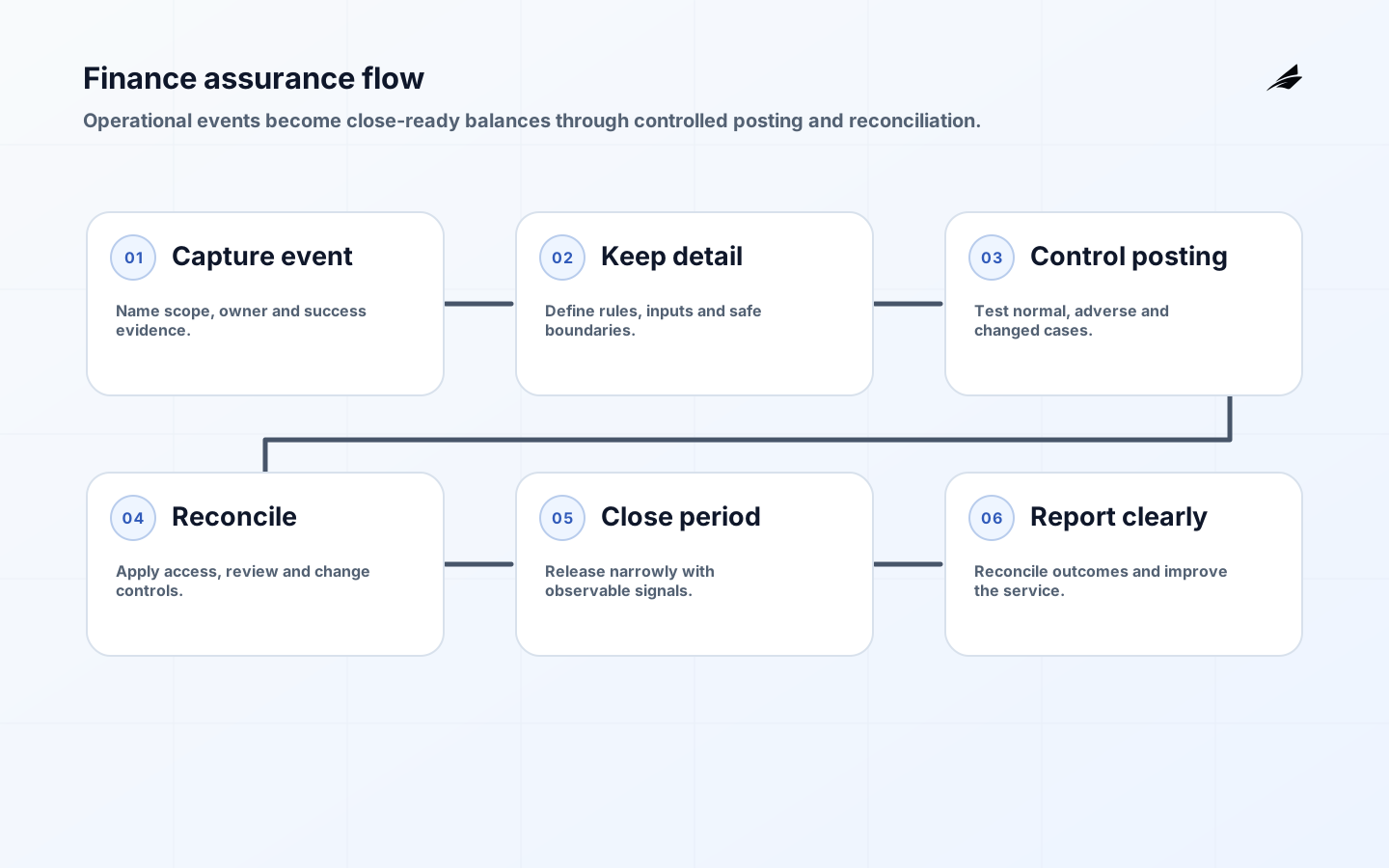
Finance systems translate commercial activity into controlled accounting records and decision-ready reporting. Their reliability depends on more than a chart of accounts: teams need disciplined period boundaries, role-aware access, traceable adjustments, reconciliations, and evidence that survives review. This guide helps IT managers treat finance workflows as an operational system, keeping interfaces with billing, procurement, payroll, and the ERP clear enough to diagnose rather than conceal disagreement.
Frame the finance systems decision
Begin a finance-system design with an accounting proposition, not a feature inventory. For example: when a shipment is accepted, create a receivable and revenue entry for the correct legal entity, currency, account, tax treatment, and period. Name the operational event that supports the proposition, the subledger or ledger that owns each accounting fact, the controller who accepts the treatment, and the close deadline that determines materiality. This framing reveals disagreements while they are still inexpensive. Sales may treat an amended order as current truth, while accounting needs both the original and effective amendment. Treasury may care about settlement date when revenue operations cares about invoice date. Document those distinctions and specify which application may originate, adjust, post, or merely display each value. Use finance system engineering notes to examine recurring design failures, then resolve authority in policy and data contracts before configuring a workflow around an accidental source of truth.
Define records, states, and boundaries
Model financial records as linked histories. A journal should retain its source transaction, posting status, accounting date, preparer, approver, reversal relationship, and supporting evidence; an account or reporting dimension needs an effective date and stewardship trail. Avoid overwriting a posted fact merely to make today's balance look right. Use an adjusting or reversing entry that preserves both the original assertion and the authorized correction. The same principle applies to master data: a renamed cost center should not silently recast a closed-period report unless the organization has approved a restatement. Define which facts remain in the billing, payroll, procurement, or banking system and which identifiers travel into the ledger. A reviewer should be able to move from a financial statement total to a journal population and then to representative source events. The NIST Data Governance and Management Profile provides a useful risk lens for governing shared data. In a finance architecture, that lens translates into named stewardship, controlled replication, documented retention, and an explicit decision about which system may correct each record.
| Finance record question | Accounting design rule | Evidence for close |
|---|---|---|
| What supports the entry? | Start from an authorized operational event at a declared accounting grain | Source transaction, legal entity, amount, currency, and event date |
| Who accepts the treatment? | Assign preparation, approval, posting, and reconciliation duties separately where material | Named actors, approval limits, and posting identity |
| How is a posting exception exposed? | Hold invalid dimensions, closed periods, and unbalanced journals outside the ledger | Rejected batch, validation reason, owner, and ageing |
| How is history corrected? | Post an authorized adjustment or reversal linked to the original journal | Original and corrective entries, rationale, period, and approver |
Design the exchange and exception path
Design each financial interface around a balanced, traceable batch or event population. State the unit being transferred, the expected debit and credit behavior, mandatory dimensions, currency precision, accounting-date rule, and acknowledgement that means the destination actually posted the entry. Idempotency keys must prevent a timeout retry from creating a second journal. Rejected entries belong in an owned exception queue with a reason code, materiality, ageing clock, and safe disposition: correct at source, enrich, resubmit, park for close review, or reverse after posting. Preserve a correlation identifier across order, invoice, settlement, subledger, and general-ledger records so reconciliation does not depend on similar amounts and timestamps. If an interface aggregates detail, retain a manifest that can reproduce the summarized journal. If it converts currency, keep the rate source and rate date. The system-of-record design guidance is particularly relevant when several applications can display the same amount but only one is authorized to amend the underlying financial fact.
Control access and change
Place controls where a financial assertion can be created, altered, released, or concealed. Separate journal preparation from approval for material entries, restrict who may reopen a period, and require independent reconciliation of bank, subledger, and intercompany balances. Role design should reflect legal entity and account sensitivity rather than broad job titles. Emergency access needs a short lifetime and after-the-fact review. Changes to posting mappings, exchange-rate sources, tax rules, or approval thresholds deserve test evidence and an effective date because they can change reported results without changing application availability. The NIST Cybersecurity Framework helps connect governance, protection, detection, response, and recovery; finance teams can apply that sequence to both malicious activity and control breakdowns. Keep payment data out of comments, tickets, and general logs, and mask production data used for testing. Finally, review evidence quality: an approval click proves little if the reviewer could not see the journal, source support, or exception that made the entry unusual.
| Close indicator | Financial risk suggested | Immediate investigation |
|---|---|---|
| Unposted batches approach cutoff | An interface, account mapping, approval, or source population is incomplete | Compare control totals and assign the oldest material batches |
| Manual journal value increases | Automated accounting or source classification may no longer cover real activity | Review support and causes for the largest entries |
| Subledger and ledger totals diverge | Posting completeness, aggregation, reversal, or duplicate control has failed | Freeze unsafe replay and reconcile by batch and account |
| Closed periods receive new activity | Period controls or late-event policy may be bypassed | Identify the posting authority and assess restatement impact |
Control Finance System Changes
Exercise the close with controlled defects before relying on a new finance system. Select one material transaction stream and seed a repeated source event, an invalid account combination, a posting after period lock, an unmatched settlement, and a reversal that arrives in the following period. Confirm that totals expose each defect, the exception reaches a named queue, and the operator can find source evidence without privileged database access. Finance should decide which condition blocks close, which permits an accrual or documented estimate, and who can authorize that treatment. Engineering should demonstrate replay, recovery, and reconciliation after the dependency returns. CISA's incident response planning guidance offers transferable practices for role assignment and communication. Applied here, the lesson is to rehearse material finance failures with the controller, system owner, integration maintainer, and support lead, then record escalation thresholds and stakeholder messages before a close-night outage forces the team to improvise.
Release in small, observable slices
Release finance changes by transaction stream, entity, or reporting period so the team can reconcile a defined population. Capture the existing close effort first: manual uploads, spreadsheet mappings, email approvals, suspense-account clearing, and follow-up performed after the reported close date. During a parallel run, compare record counts, control totals, account balances, ageing, and representative journal lineage between the incumbent and replacement paths. Differences need an accounting explanation, not a tolerance chosen merely to pass cutover. Block expansion when unsupported manual journals appear, defaults send activity to the wrong entity or account, users combine incompatible duties, bank files receive broader access, or a destination reports success before posting. Define who may pause the feed, how unposted work is preserved, and whether rollback means replaying events or continuing the old route. A limited run across a real period-end is valuable because it reveals late adjustments, period boundaries, rate changes, and approval conflicts that a synthetic test rarely reproduces.
Measure useful operation
Finance-system monitoring should connect technical behavior to close risk. Watch unposted event age, interface control-total differences, suspense balances, failed or repeated journals, reconciliations past due, privileged-access use, manual-entry volume, and postings into prior periods. Segment the signals by entity and transaction class; one global success rate can hide a stopped subsidiary or a small population with material value. Google SRE's monitoring guidance usefully separates immediate detection signals from diagnostic detail. A page might fire when a posting queue threatens the close timetable, while the linked investigation provides batch IDs, source counts, account distribution, recent mapping changes, and the responsible service and finance owners. Review trends alongside actual exceptions and the time required to clear them. The production operations guide adds operating context. Together, these practices make monitoring a way to protect completeness and accuracy, not merely prove that servers responded during the month.
Trace one financial event through the close

Follow one annual customer contract through billing, cash, revenue scheduling, journals, foreign-exchange treatment, reporting, and a later credit. The subledger should retain operational detail; the general ledger should receive controlled, balanced postings with durable references. Reconciliation proves that the expected population moved completely and once. Review proves that an authorized person considered exceptions. Neither is replaced by a successful interface job, and closed-period corrections should remain explicit rather than rewriting posted history.
Use this review with the article tables and linked Edilec guides. Sample completed records as well as exceptions, retain the rule and source versions that produced each outcome, and assign every corrective action to a policy, data, interface, integration, security, or operating owner. Metrics indicate where to investigate; representative cases reveal what must change. Before scope expands, repeat the exercise with an unavailable dependency, a delayed message, an unauthorized user, and a correction after the nominal process has finished. This review is specific to finance postings and close evidence.
- Name every authoritative master record.
- Separate entry approval posting and review.
- Carry stable references through corrections.
- Test cut-off duplicates and reversals.
- Retain exception dispositions and sign-off.
- Version reports and close evidence.
Key takeaways
- Design finance systems from an accounting assertion and the operational evidence that supports it.
- Keep source event, journal, period, entity, currency, approval, and correction references connected.
- Separate duties around preparation, posting, master-data change, payment release, and reconciliation according to risk.
- Reconcile populations and control totals across interfaces instead of inferring completeness from job success.
- Prove period lock, late adjustment, reversal, and recovery behavior during a realistic close exercise.
Frequently asked questions
What is the first practical step for finance systems?
Choose one recurring finance system event that currently causes rework or uncertainty, name its accountable owner, and map its source, states, consumers, deadline, and correction route. That produces a testable boundary for finance systems without requiring an enterprise-wide redesign.
When is automation ready?
Automation in finance systems are ready when the team can explain the normal result, duplicate behavior, rejection route, correction method, and who is allowed to change the rule. Test those cases with representative finance system records before relying on volume or a dashboard as evidence of readiness.
Conclusion
A dependable finance system preserves the path from commercial event to accounting assertion and from reported balance back to evidence. Define ownership at every handoff, retain adjustments instead of erasing history, and reconcile populations before close pressure arrives. With those disciplines, faster processing and automation strengthen financial control instead of making errors travel faster.