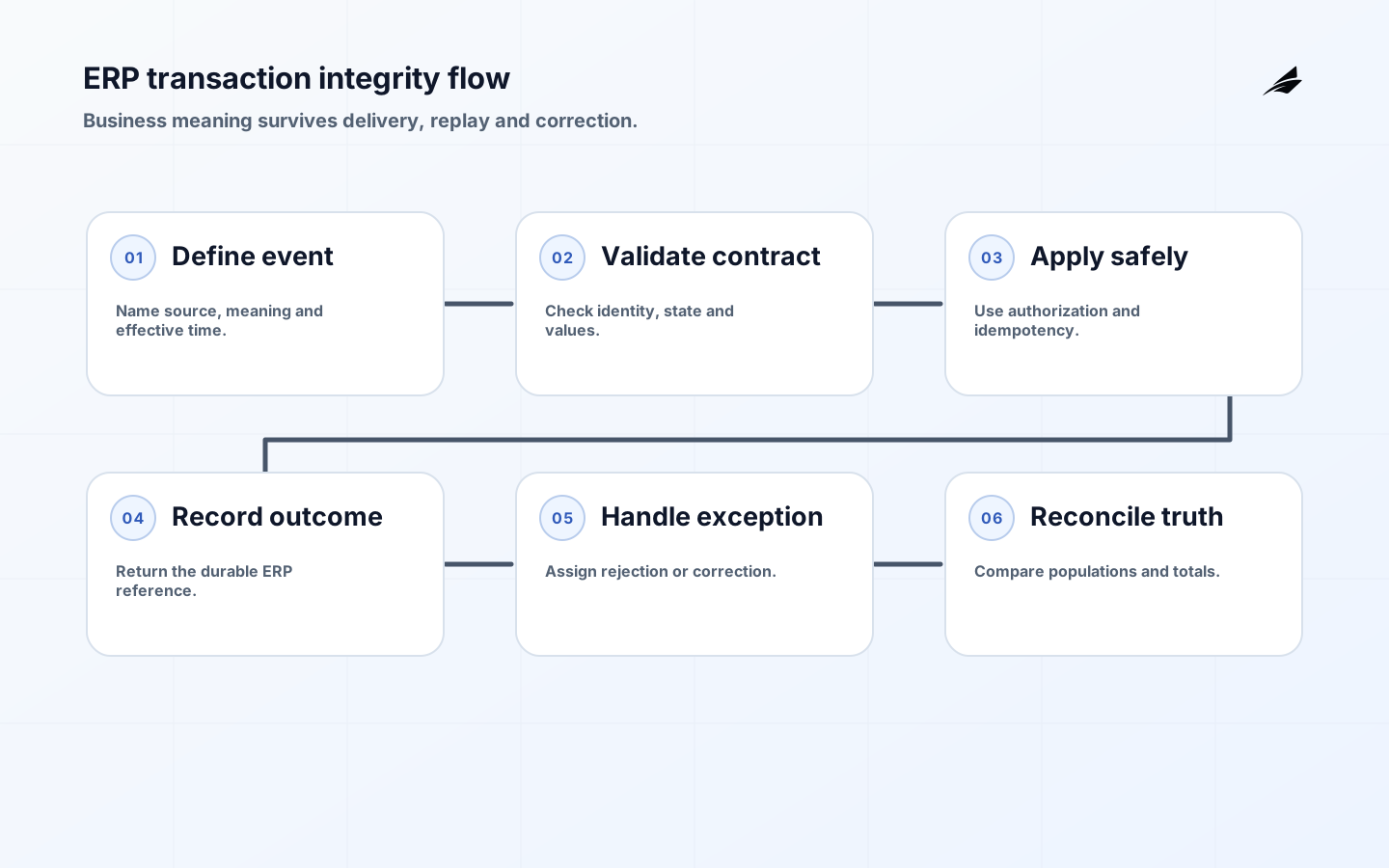
ERP integration is the controlled movement of business facts between the enterprise resource planning system and the applications that create or consume them. The hard part is rarely sending JSON or a file. It is agreeing what an order, invoice, receipt, customer or posting means; which system may change it; how duplicates behave; and how the books are reconciled after a partial failure. A useful ERP integration design therefore starts with accounting and operational authority, not middleware. NIST’s data governance definition is a concise reminder that enterprise data requires formal decision rights. For engineering teams, those rights become schemas, state transitions, validation rules, access policies and evidence that every accepted transaction reached its intended outcome.
Frame the ERP integration decision
Before mapping fields or configuring rules, write one sentence that states the decision or action at stake: move a business event between operational software and the enterprise resource planning system without corrupting meaning. Then identify the initiating event, the person who owns the decision, the systems that observe it, and the deadline at which a late answer causes harm. This narrows scope without hiding dependencies. NIST defines data governance as processes that formally manage enterprise data assets and establish authority for decisions; that is a helpful lens when teams disagree about who can change a consequential record. In ERP integration, a polished screen cannot compensate for authority that has not been decided. Document the system of record for the event, the consumer that relies on it, the failure mode, and the person allowed to accept a temporary workaround. ERP integration engineering notes helps extend that framing into implementation detail.
Define records, states, and boundaries
The durable design unit is a record with a lifecycle, not a loose collection of fields. For orders, customers, financial dimensions, fulfillment events, and accounting records, make the important states explicit: proposed, valid, changed, rejected, completed, and corrected where they apply. State transitions need a business meaning, an effective time, and an accountable actor. Also define what stays in the originating application and what is distributed as a reference or event. ERP integration carries business commitments, not just payloads. An order may need to become a receivable, a shipment may close a fulfillment obligation, and a customer change may affect tax or credit policy. The design must therefore identify the business event and the ledger or operational effect before selecting a connector. The NIST Data Governance and Management Profile emphasizes that governance helps organizations manage privacy and cybersecurity risk alongside data use. In practice, this means that a new integration should not become the accidental owner of a record simply because it is easiest to query.

| Design question | Good operational answer | Evidence to retain |
|---|---|---|
| What starts work? | A named business event with a source and effective time | Source reference and correlation ID |
| Who may decide? | A current role or assigned owner, not an assumed inbox | Authority or assignment record |
| What can fail? | A defined rejection, retry, and escalation path | Error reason and handoff history |
| How is it corrected? | A controlled reversal or amendment, not a silent overwrite | Old value, new value, reason, and actor |
Design the exchange and exception path
A reliable path makes normal processing boring and abnormal processing legible. Define required inputs, validation rules, identity matching, timing, duplicate handling, target acknowledgement, and who investigates a failure. Write an interface contract for each consequential event: source of truth, event identifier, schema, required fields, reference data, validation result, target response, retry policy, and reconciliation owner. Idempotency belongs in the business effect, not only in the message broker. Do not use an error queue as a place to hide uncertainty. Each rejected record should show what failed, whether the source must change, whether a retry is safe, and who owns the next action. Where a workflow crosses several systems, preserve one correlation reference from the initiating event through the operational effect. That is the difference between proving a result and guessing from timestamps. This work also benefits from system-of-record design guidance, especially when the team must decide which application owns a fact rather than merely carrying a copy.
Control access and change
Controls should protect the decision that matters without turning ordinary work into an approval ritual. Separate credentials and permissions by environment and integration purpose. Require review for mappings that change tax, legal entity, account, or posting logic. Capture correlation IDs across source, transport, and target so an operator can prove where a record stopped. The NIST Cybersecurity Framework is a useful reference for treating governance, protection, detection, response, and recovery as connected activities. Security is also operational: a mistaken role assignment, unreviewed mapping, or undocumented manual correction can be as damaging as a technical outage. Establish a short change record for rule and interface changes, including purpose, impacted records, test evidence, rollback approach, approver, and completion result. Keep production credentials and test data separate. When sensitive data is involved, minimize the fields in logs, exports, notifications, and support tickets before adding more monitoring.
| Signal | Likely interpretation | First accountable response |
|---|---|---|
| Records wait past their target | An owner, validation, or downstream dependency is blocked | Inspect the oldest items and assign a named resolver |
| Manual corrections rise | A rule, master record, or upstream process is drifting | Sample corrections and fix the shared cause |
| Duplicates or repeats appear | Retries lack a stable business key or matching rule | Pause unsafe replay and reconcile the affected population |
| Users work around the system | The path is slow, unclear, or missing an exception state | Observe the real task before adding another form |
Control Erp Integration Changes
Operating discipline keeps ERP integration useful after the first release. Run a bounded event class through a sandbox with normal, duplicate, late, malformed, and correction cases. Reconcile the target posting to the source population before enabling unattended production processing. Bring the integration owner, a frontline user, a technical maintainer, and a control or finance partner into the review. They should agree on which result is authoritative, which failures stop work, which failures can be retried, and how a customer or colleague is informed. CISA's incident response planning guidance is written for security incidents, but its emphasis on documented roles, communications, and preparation transfers well to important business-system failure paths. The goal is not to label every defect an incident; it is to ensure that a consequential failure has a practiced route to a decision.
Release in small, observable slices
Choose a bounded population, a reversible change, and a time-boxed observation period. Baseline the current process first, including hidden spreadsheet steps and side-channel conversations, so the team can tell whether ERP integration reduced work or simply moved it. A retry creating a duplicate posting, a mapping silently defaulting a financial dimension, timing ambiguity around cut-off, identity mismatches, and teams correcting target data without leaving a path back to the source event. A release plan should include reconciliation before and after cutover, a clear support contact, and criteria for expanding, pausing, or rolling back. Avoid a big-bang migration when old and new records cannot yet be compared. A small parallel run is often worth the effort because it reveals semantics that diagrams miss: a late edit, a user with two roles, a correction from a trusted source, or a downstream system that acknowledges work before it is actually complete.
Measure useful operation
Measure the health of the decision path, not only system uptime. For this ERP integration, useful signals include accepted and rejected event counts, end-to-end latency, duplicate prevention events, reconciliation differences, manual correction volume, and change failures by interface version. Review them with examples from real work rather than a single aggregate score. Google SRE's monitoring guidance distinguishes the fast signals used to detect a condition from the detailed evidence used to diagnose it; the same distinction helps business systems. An alert should name a service or process owner and indicate the next investigation step. A monthly review can retire noisy checks, address repeated exceptions, and make planned changes visible to the teams that will discover their effects first. production operations guide offers additional context for treating those reviews as an operating routine.
Write a transaction contract finance can challenge
For each exchange, write a one-page contract: business event, source of truth, required identifiers, amount and currency semantics, effective time, allowed states, duplicate key, rejection reasons, correction method and reconciliation owner. “Synchronize invoices” is not a contract. “Create one ERP receivable for each approved billing event, preserving source invoice ID and tax breakdown, then return the ERP document number” is testable. The first-principles ERP guide helps clarify record authority; engineering guidance for ERP integration covers implementation trade-offs; and the production ERP integration guide focuses on operational ownership.
Suppose a commerce platform emits an order twice because its first acknowledgement times out. The integration should derive a stable idempotency key from the source order and event type, recognize the replay, and return the existing ERP reference. If three of four order lines post, retrying the entire request may double the successful lines. The contract must say whether the ERP transaction is atomic, compensating entries are required, or a line-level reconciliation will repair the result. Apply testable controls from the OWASP ASVS to authentication, authorization, validation and logging, while keeping financial payloads and credentials out of diagnostic messages.
| Integration case | Required behavior | Proof |
|---|---|---|
| First delivery | Validate and create one authorized record | Source ID mapped to ERP ID |
| Exact replay | Return prior outcome without a second posting | Idempotency record |
| Business correction | Post an approved amendment or reversal | Linked correction and reason |
| Invalid master data | Reject without losing the source event | Owned exception with code |
| Downstream outage | Retry within policy, then escalate | Attempt history and reconciliation |
Key takeaways
- Begin ERP integration with one consequential decision and a named integration owner.
- Define lifecycle states, authority, effective time, and correction before automating handoffs.
- Use stable references and an explicit exception path across every consequential exchange.
- Protect sensitive data and high-impact changes with proportionate access, review, and audit records.
- Release with reconciliation and real failure cases, then use operating evidence to improve the path.
Frequently asked questions
What is the first practical step for ERP integration?
Choose one recurring ERP integration event that currently causes rework or uncertainty, name its accountable owner, and map its source, states, consumers, deadline, and correction route. That produces a testable boundary for ERP integration without requiring an enterprise-wide redesign.
When is automation ready?
Automation in ERP integration is ready when the team can explain the normal result, duplicate behavior, rejection route, correction method, and who is allowed to change the rule. Test those cases with representative ERP integration records before relying on volume or a dashboard as evidence of readiness.
Conclusion
Good ERP integration is an agreement about business truth expressed in reliable software. Define record authority and correction semantics before choosing transport, make every retry safe, and reconcile totals and populations rather than trusting a green job status. When finance can trace a posting to its source and engineering can reproduce every exception, the integration is doing more than moving data: it is preserving the integrity of the business process.