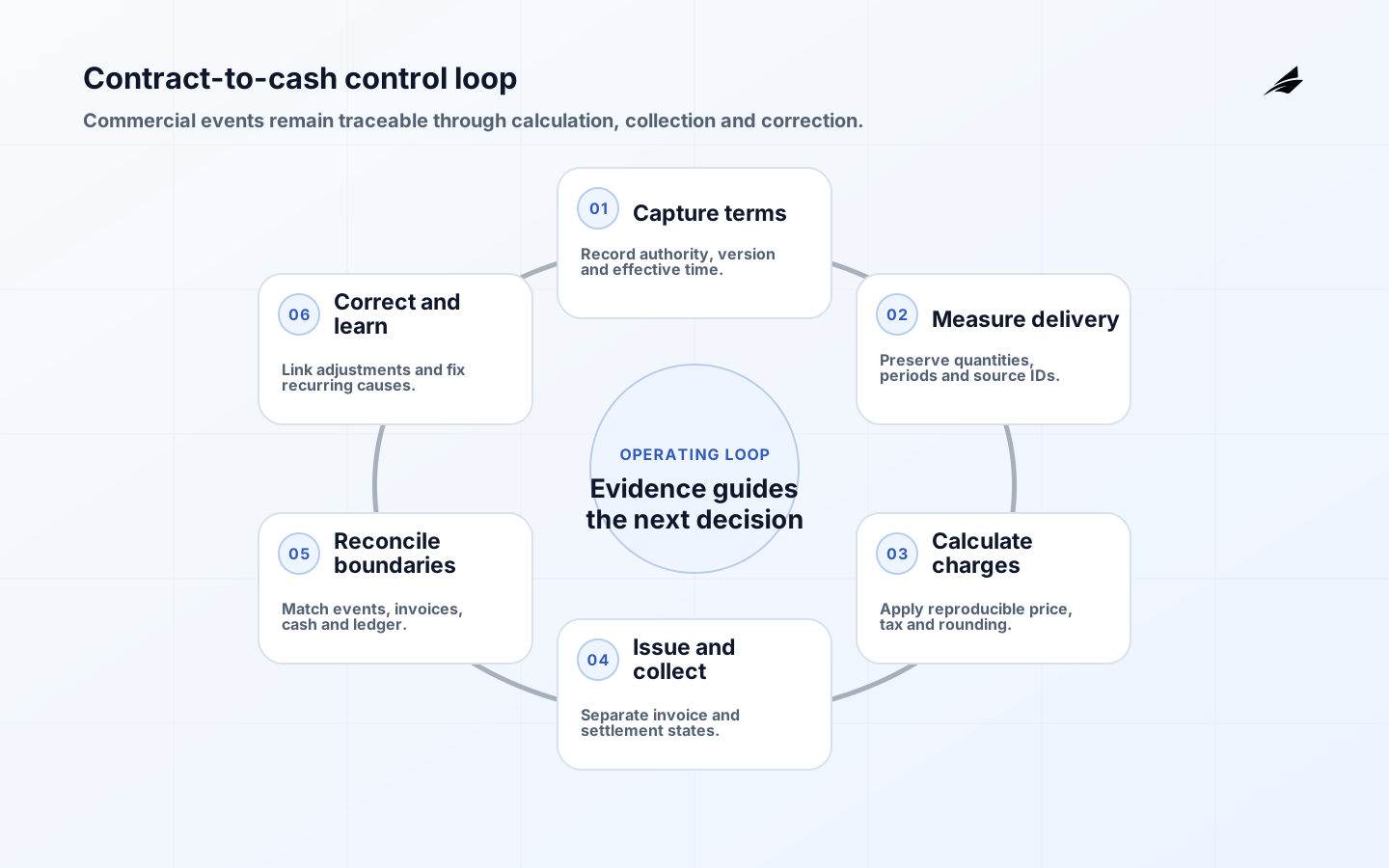
Billing operations is the operating system between a signed commercial promise and money that can be explained. It has to translate products, prices, quantities, service periods, usage, taxes, credits and payment events into an invoice the customer recognizes and finance can reconcile. Growth exposes every ambiguity: an upgrade arrives near period end, usage is corrected after a draft invoice, a payment succeeds while a webhook is delayed, or support grants a credit without the right authority. A dependable design makes those cases explicit before volume turns them into month-end archaeology.
The practical objective is not maximum automation. It is a contract-to-cash path in which each material amount has an origin, calculation, effective time, owner and correction method. The companion hands-on billing planning guide helps teams map current work, while the finance systems mistakes guide covers record-authority failures that often surface during billing projects.
Key takeaways
- Model commercial events before choosing billing rules or screens.
- Separate entitlement, invoice and settlement states so one failure does not corrupt another record.
- Make retries idempotent and make every rejected event visible to an accountable queue.
- Require evidence for credits, write-offs, backdating and manual price changes.
- Reconcile quantities and money across boundaries, then test restoration as part of normal operations.
Model the commercial events that create money
Begin with events, not fields. A new subscription, seat increase, consumption record, renewal, cancellation, refund and negotiated credit each has a business meaning and effective time. Record who or what authorized it, which contract or order it belongs to, and whether it replaces or supplements an earlier event. Store the calculation inputs needed to reproduce the result. A final invoice total without the applicable price version, quantity basis and service period is an outcome without evidence.
Keep the system of record explicit. The CRM may own an approved order, the product may own measured usage, the billing platform may own invoice state, the payment provider may own settlement events, and the ledger may own accounting entries. The system-of-record design guide shows why copying a field does not transfer authority. Define a stable customer and contract identifier across systems, plus a correlation identifier for each chargeable event.
| Commercial event | Minimum evidence | Failure to design for |
|---|---|---|
| New order | Approved terms, customer, currency and start date | Draft or unapproved terms become billable |
| Usage received | Meter, period, unit, quantity and source reference | Duplicate or late usage changes an invoice silently |
| Plan change | Old and new terms, effective time and proration rule | A mid-period change is charged twice |
| Credit or refund | Reason, authority, original charge and amount | Support corrections cannot be audited |
| Cancellation | Notice, service end and final billing treatment | Access and charging stop at different times |
Separate entitlement, invoice and payment state
A customer can be entitled to service while an invoice is still a draft, and an issued invoice can remain unpaid without changing what was delivered. Treat those as related lifecycles rather than one status. Stripe's invoicing overview distinguishes invoice creation, finalization and payment activity; the same conceptual separation is valuable even when another platform is used. Define which transition is reversible, which requires a new correcting document, and which can affect customer access.
Write state-transition rules in business language. For example: approved usage can enter a draft invoice until the cutoff; finalization freezes line-item calculations; a post-finalization dispute creates a credit note rather than overwriting history; and payment failure starts a collection workflow rather than deleting the invoice. Make effective dates and accounting dates separate where needed. This prevents a late operational correction from quietly rewriting a closed reporting period.
Engineer handoffs for duplicates, delay and rejection
Distributed billing is at-least-once reality. A sender can time out after the receiver committed, events can arrive out of order, and a consumer can be unavailable. Give each business operation an idempotency key and make the receiver return the stored outcome for a repeated request. Stripe documents idempotent requests for safely repeating API operations. The principle is broader: deduplication should use a stable business key and operation scope, not a fragile timestamp comparison.
A webhook acknowledgement proves receipt, not full downstream completion. Stripe's subscription webhook guidance also shows why invoice finalization failures require explicit handling. Persist incoming events before processing, verify signatures, separate retryable from permanent errors, and expose the oldest unresolved item. A dead-letter queue needs an owner, a diagnosis, a safe replay mechanism and a record of what happened after replay.
| Control point | Required behavior | Evidence to review |
|---|---|---|
| Event intake | Authenticate, validate and persist before acknowledgement | Signature result and receipt time |
| Duplicate handling | Return the original outcome for the same operation key | Key, payload hash and prior result |
| Ordering | Reject or defer an event whose prerequisite is absent | Dependency and retry reason |
| Replay | Limit scope and prevent a second financial effect | Population, approver and reconciliation |
| Exception queue | Assign one owner and an age target | Reason, attempts and next action |
Control sensitive billing work without slowing every case
Apply stronger controls where a user can create value, erase evidence or expose payment data. Separate the ability to configure prices from the ability to approve a backdated change. Put limits and reason codes around credits and write-offs. Review dormant access and emergency access. The current PCI DSS document library provides the authoritative PCI DSS 4.0.1 materials for environments that store, process, transmit or can affect payment account data; confirm scope with qualified specialists rather than assuming a hosted checkout removes every responsibility.
Minimize customer and payment data in logs, exports, tickets and analytics. The NIST Privacy Framework is useful for connecting collection, processing and retention choices to privacy risk. Operationally, a support analyst usually needs payment status, failure category and provider reference, not full payment credentials. Mask sensitive values by default and test that lower environments, observability tools and data warehouses do not become uncontrolled copies.
Rehearse a billing close with difficult examples
Build a golden set of contracts that includes a straightforward renewal, mid-cycle upgrade, downgrade, minimum commitment, late usage event, failed payment, partial refund, tax-location correction and cancellation. Finance should reproduce each expected amount independently; engineering should trace every source event; support should explain the result to a customer. Run the same cases after rule, provider and schema changes. A test that only checks whether an invoice exists cannot detect a commercially wrong invoice.
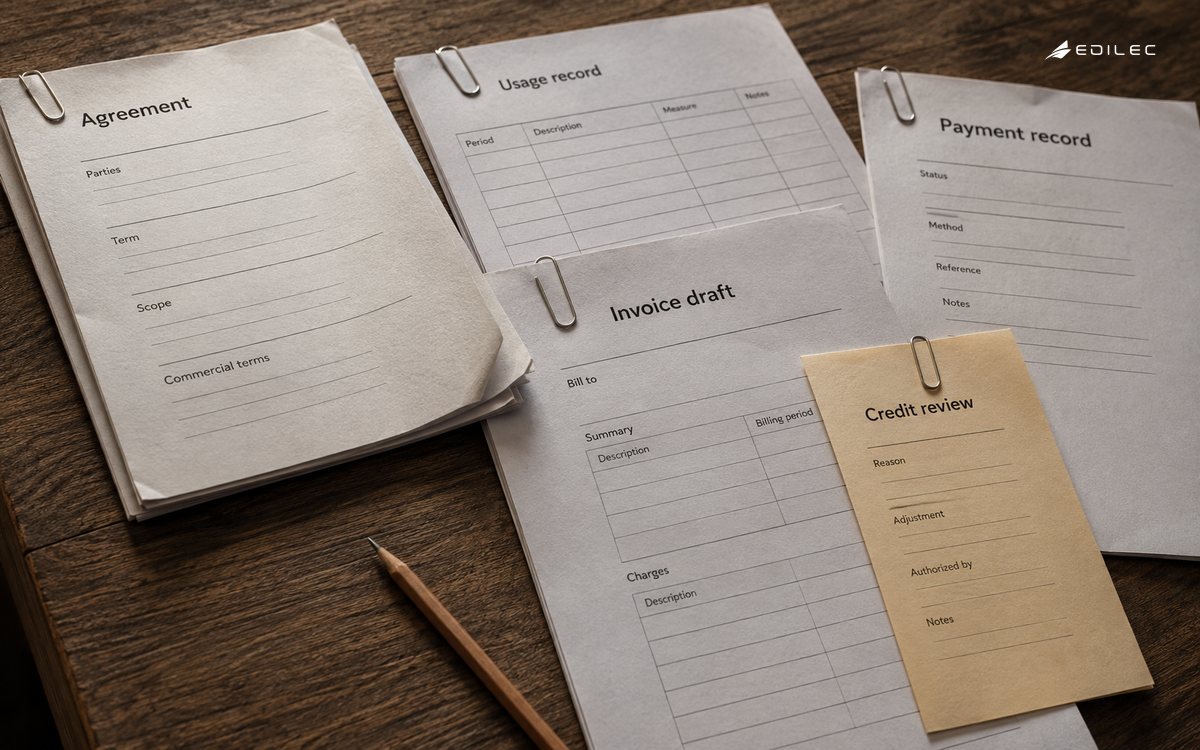
Before release, compare a bounded population in old and new paths. Reconcile invoice count, line count, taxable amount, discounts, credits, collected cash and ledger postings. Investigate differences by category rather than forcing totals to match. Define pause criteria, such as an unexplained value difference, missing source references or an exception queue older than the billing cutoff. The broader enterprise billing operations guide can help turn this rehearsal into a recurring control routine.
Treat pricing configuration as controlled product logic. Keep a catalog of active and retired price versions, supported currencies, rounding rules, discount precedence and tax inputs. A proposal should reference the exact version that billing will use. When commercial teams need an exception, capture it as explicit terms rather than a note that someone must interpret during close. Review configuration changes with representative contracts and calculate before-and-after results. Separate a future price release from a correction to an existing customer. This prevents an apparently harmless default change from altering open renewals or backdated adjustments.
Plan customer communication as part of correction. A technically accurate credit can still create confusion when invoice numbers, service periods or reasons are unclear. Give support a trace from disputed line to source event and calculation, plus authority limits for resolution. Track disputes by cause, value and age. Recurring disputes often identify a metering, sales-handoff or product-language defect earlier than financial reconciliation does. Close the loop by assigning the shared cause to a product, finance or engineering owner and verifying that later invoices no longer reproduce it.
Keep a billing defect ledger that connects each customer-visible correction to the broken control and its verified repair. For example, five credits caused by late seat-removal events should not appear as five unrelated support gestures. Record the affected population, financial value, discovery path, temporary containment and permanent owner. Re-run the original contracts after the fix and review the next billing cycle for recurrence. This turns adjustment data into an engineering and commercial quality signal while preserving the evidence finance needs for close.
Billing operations checklist
- Every billable event has a stable identifier, effective time, source and contract reference.
- Price, tax, proration and rounding rules are versioned and reproducible.
- Entitlement, invoice, collection and ledger states have separate owners and transitions.
- Retries, out-of-order events and permanent rejects have tested behavior.
- Credits, refunds, write-offs and backdating retain authority and reason evidence.
- Daily and close-period reconciliations produce owned exceptions, not unexplained balancing entries.
- A restoration exercise proves that records, keys, integrations and reconciliation evidence can be recovered together.
Frequently asked questions
Should the billing platform be the system of record?
Usually it should own invoice lifecycle and calculation artifacts, but not every commercial fact. Approved terms may belong to an order system, measured consumption to a product meter, settlement to a provider and accounting entries to the ledger. Document authority per record and transition instead of declaring one universal master.
How often should billing be reconciled?
Reconcile high-volume event counts and values daily, with more frequent alerting for material gaps. Perform fuller reconciliation at invoice finalization and financial close. The cadence should leave enough time to investigate before a customer notice, collection attempt or reporting deadline becomes difficult to reverse.
Are manual billing adjustments always a problem?
No. An authorized, reasoned and traceable adjustment is a legitimate exception mechanism. The warning sign is repeated manual work with vague reasons, missing links to original charges or no owner for the shared cause. Review adjustment patterns to decide whether policy, master data, product metering or workflow needs repair.
Conclusion
Reliable billing operations preserves the meaning of a commercial promise across systems. Model events and states, design for duplicate and delayed delivery, narrow sensitive access, and reconcile every material boundary. When correction is explicit and difficult cases are rehearsed, a growing team can change products and prices without losing control of customer trust or financial evidence.