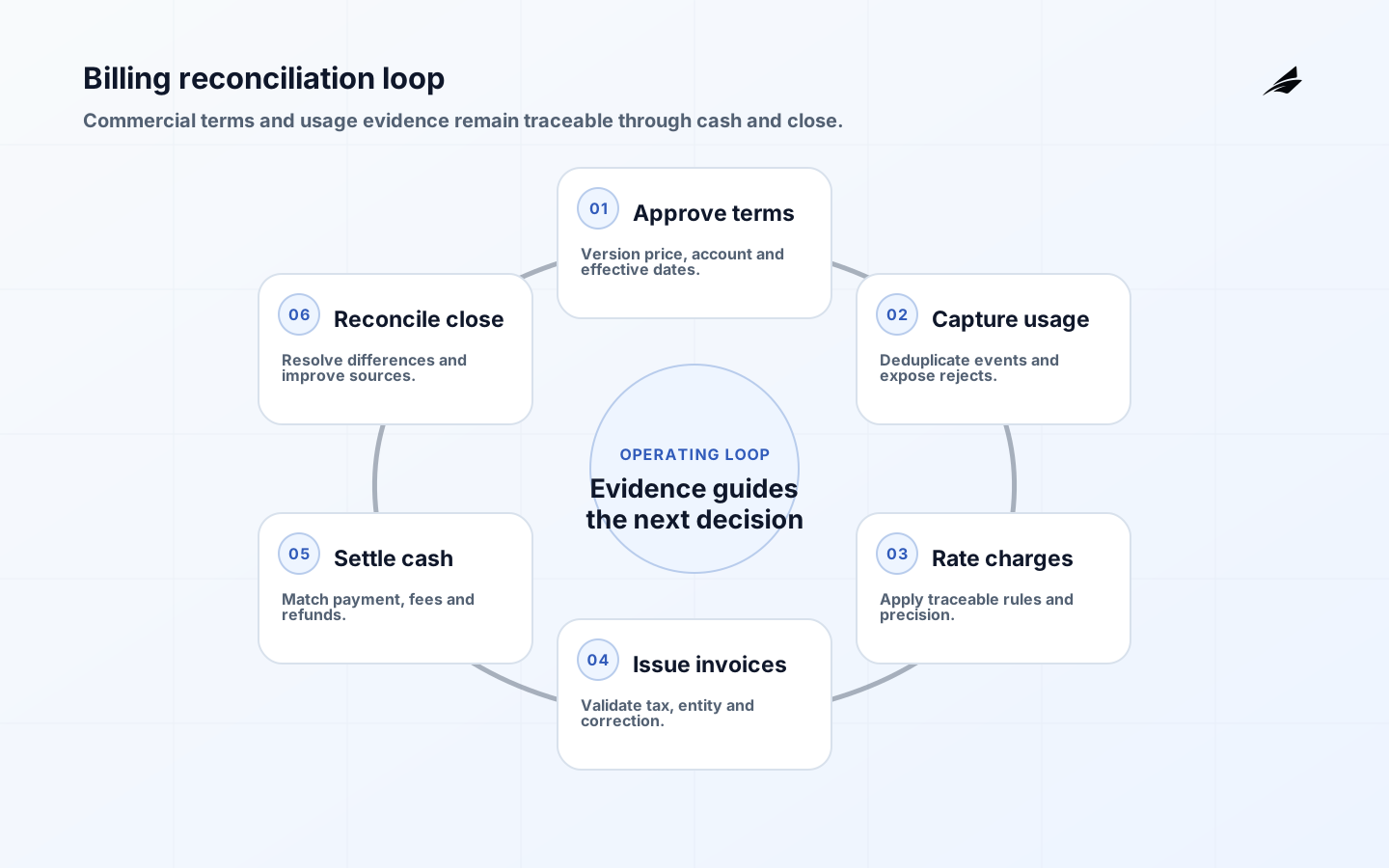
Billing operations is the controlled path from a customer's commercial agreement and actual consumption to an understandable invoice, a recorded payment, and finance evidence that reconciles. The hard part is rarely generating a PDF. It is preserving meaning across product events, pricing, tax, credits, payment providers, receivables, and the general ledger while giving customers and operators a reliable correction path.
This billing operations checklist is designed for digital products with subscriptions, usage, or mixed pricing. It complements Edilec's billing planning guide, finance systems mistakes and fixes, and enterprise billing operations guide. Accounting policy, tax treatment, and consumer obligations vary by jurisdiction, so product and engineering decisions should be reviewed by qualified finance and legal owners.
Key takeaways
- Keep contract terms, entitlements, usage events, rated charges, invoices, payments, and ledger entries as linked but distinct records.
- Make usage ingestion idempotent and reconcile expected populations before rating.
- Version price logic and preserve the rule used for every charge; never recalculate history silently.
- Use credits, adjustments, and reversals that retain the original invoice trail.
- Reconcile end to end by billing period, customer, currency, and legal entity, with owned exceptions.
Map the contract-to-cash evidence chain
Draw the billing chain for one offer. Identify the signed or accepted commercial terms, account and legal entity, product entitlement, meter definition, event source, rating rule, tax decision, invoice, payment attempt, settlement, refund, revenue schedule, and ledger posting. For each handoff, record the identifier, authority, effective time, immutable evidence, retry behavior, and owner. This prevents an invoice line from becoming an unexplained number detached from the customer action and rule that produced it.
| Billing object | System authority | Control question | Evidence retained |
|---|---|---|---|
| Commercial terms | Contract or approved order system | Who approved price, currency, term, and exception? | Version, approver, effective dates |
| Usage event | Product metering boundary | Can retries create duplicates or late events change a closed period? | Event ID, account, quantity, event time, received time |
| Rated charge | Billing engine | Which price and aggregation rule was applied? | Rule version, input population, calculation trace |
| Invoice | Receivables system | Is numbering, tax, legal entity, and correction behavior valid? | Issued document and status history |
| Settlement | Payment provider plus bank evidence | Did the processor result reach cash and receivables? | Provider reference, fees, currency, settlement batch |
| Ledger entry | General ledger | Does posting reconcile to the approved subledger population? | Journal reference, period, account mapping |
Do not make one status field carry the entire lifecycle. An invoice can be issued while payment is pending; a payment can settle while a dispute is open; revenue recognition can follow a different schedule from cash. IFRS 15 establishes principles around contracts, performance obligations, transaction price, allocation, and recognition. Engineering should encode the evidence and approved policy decisions finance needs, not invent accounting policy inside application code.
Control usage capture and rating
Define a meter in business language before implementation. State the event, unit, customer mapping, event-time rule, aggregation window, exclusions, corrections, and late-arrival policy. A request count, active seat, gigabyte-hour, and completed delivery have very different evidence. Generate a stable event ID at the authoritative boundary. Consumers should process idempotently and retain rejected events rather than dropping malformed records. Compare source totals with accepted, rejected, duplicated, and late populations every period.

Rating must be deterministic for the same event population, account state, and rule version. Version catalog prices, negotiated overrides, tiers, minimums, free allowances, rounding, and currency behavior with effective dates. Run a preview before issuing invoices and explain material changes against the prior period. Keep calculations at sufficient precision and round only at defined boundaries. A customer-facing line should map to a charge trace an operator can understand without reading source code.
| Test case | Expected behavior | Failure to prevent |
|---|---|---|
| Same event delivered twice | One billable contribution; duplicate is visible | Double charge |
| Event arrives after cutoff | Apply documented late-event policy and retain period link | Silent movement between periods |
| Plan changes mid-cycle | Use effective-time segmentation and approved proration | Whole-period recalculation at the new price |
| Tier boundary reached | Aggregate in the defined scope and round at the approved step | Per-event rounding drift |
| Account mapping missing | Hold in an exception queue; do not rate to a default customer | Cross-customer charge |
| Rule is corrected | Issue traceable adjustment or rerating decision | History overwritten without explanation |
Issue invoices and handle payments safely
Before invoice issuance, validate legal entity, customer identity, billing address, tax evidence, currency, due date, line descriptions, totals, and document numbering. Separate draft, approved, issued, voided, credited, and paid states. After issuance, prefer a credit note, debit adjustment, or linked replacement according to policy rather than editing the original record. Give support staff a plain-language trace and limit who can approve financial changes.
Minimize the payment-data boundary. The PCI DSS overview states that the standard applies to entities that store, process, transmit, or can affect the security of account data; the current PCI document library is the authoritative location for versions and supporting material. Hosted payment collection and tokenization can reduce exposure, but teams still need to confirm their actual scope. Never place full payment credentials in application logs, support tickets, analytics, or model prompts.
Reconcile before the close
Reconciliation is not a month-end rescue. Run daily or period-to-date controls that compare product events to accepted meter events, meter events to rated quantities, charges to invoices, invoices to receivables, processor activity to bank settlement, and billing subledger totals to the general ledger. Use control totals and explicit populations, not sampled spot checks alone. Segment by customer, product, currency, country, and legal entity so an aggregate balance cannot hide offsetting errors.
| Reconciliation | Control total | Typical exception | Owner |
|---|---|---|---|
| Product to meter | Count and quantity by event date | Missing source partition or rejected schema | Product and data engineering |
| Meter to charges | Rated quantity and amount by rule version | Unmapped account or late event | Billing operations |
| Charges to invoices | Draft, issued, held, and adjusted amount | Approval hold or tax failure | Billing and finance |
| Invoices to cash | Open, paid, failed, refunded, and disputed amount | Webhook gap or unmatched transfer | Receivables |
| Processor to bank | Gross, fees, refunds, and net settlement | Timing or currency difference | Treasury |
| Subledger to ledger | Amount by entity, period, currency, and account | Posting map or cutoff difference | Accounting |
Every difference needs a reason code, owner, age, financial impact, customer impact, and resolution. Reversals and reruns must be idempotent. Protect administrative actions using least privilege, strong authentication, separation of duties, and useful audit evidence. The NIST Cybersecurity Framework helps organize governance, protection, detection, response, and recovery, while the OWASP ASVS supplies application-security verification requirements that can be tailored to the billing surface.
Release and period-close checklist
- Commercial terms and catalog rules are versioned, approved, effective-dated, and testable with representative examples.
- Usage events carry stable IDs, event time, account context, unit, and source; accepted and rejected populations reconcile.
- Rating tests cover duplicates, late data, plan changes, tier boundaries, precision, tax handoff, and correction.
- Invoices have controlled states, understandable lines, legal-entity checks, and a traceable credit or adjustment path.
- Payment collection has a confirmed PCI scope; secrets and account data are excluded from logs and general support tooling.
- Processor activity reconciles to settlement, receivables, refunds, disputes, fees, and ledger postings.
- Operators can pause issuance, isolate a customer or rule, rerun safely, notify affected customers, and prove recovery.
- Close sign-off records unresolved differences, materiality, owner, expected correction, and approval.
Before each major pricing launch, run a billing acceptance review with product, engineering, billing operations, finance, support, tax, and security owners. Walk a routine customer, a negotiated contract, a mid-period change, a failed payment, a refund, a disputed invoice, and a late usage correction from source to ledger. Confirm which team answers the customer and which record is authoritative at every step. Record unresolved limitations with materiality and a date to revisit. This cross-functional walkthrough catches assumptions that isolated unit tests miss, such as a product plan name that does not map to an invoice description or a processor state that receivables cannot interpret.
After launch, compare the first two complete billing periods with the pre-release baseline. Review not only total billed amount but invoice changes, credits, failed collections, support contacts, event rejects, manual journals, close delay, and customer complaints. A new billing capability can improve revenue capture while making explanations and corrections worse. Keep expansion gated until the team can reconcile both the financial result and the operational burden.
Document customer-visible behavior as part of the control set: invoice timing, usage detail, dispute intake, payment retry communication, credit application, and final resolution. Clear communication reduces avoidable support work and gives operators another signal when system state and customer experience diverge.
Frequently asked questions
Should billing logic live in the product or a billing platform?
Keep the meaning of product events and entitlements close to the product boundary. Use a billing platform for catalog, rating, invoicing, payment, tax integrations, or receivables where its controls fit. The contract between them matters more than claiming that either side owns all billing logic.
Can an issued invoice be edited?
Generally, preserve the issued document and apply the approved correction mechanism for the jurisdiction and policy, such as a credit note or linked adjustment. Silent editing damages customer communication, reconciliation, and audit evidence. Finance and tax owners should define the allowed route.
What should be automated first?
Automate an end-to-end reconciliation for one material billing population before complex exception decisions. Visibility into missing, duplicate, rejected, and unmatched records create a safer base for later automation and often exposes more value than another invoice-generation feature.
Conclusion
Dependable billing operations makes every amount explainable from agreement and usage through invoice, cash, correction, and ledger. Teams reach that state by preserving identifiers and versions, testing awkward cases, limiting payment exposure, and reconciling continuously. The checklist is complete only when an operator can find a difference, stop further harm, correct it without erasing history, and show that every affected system agrees.