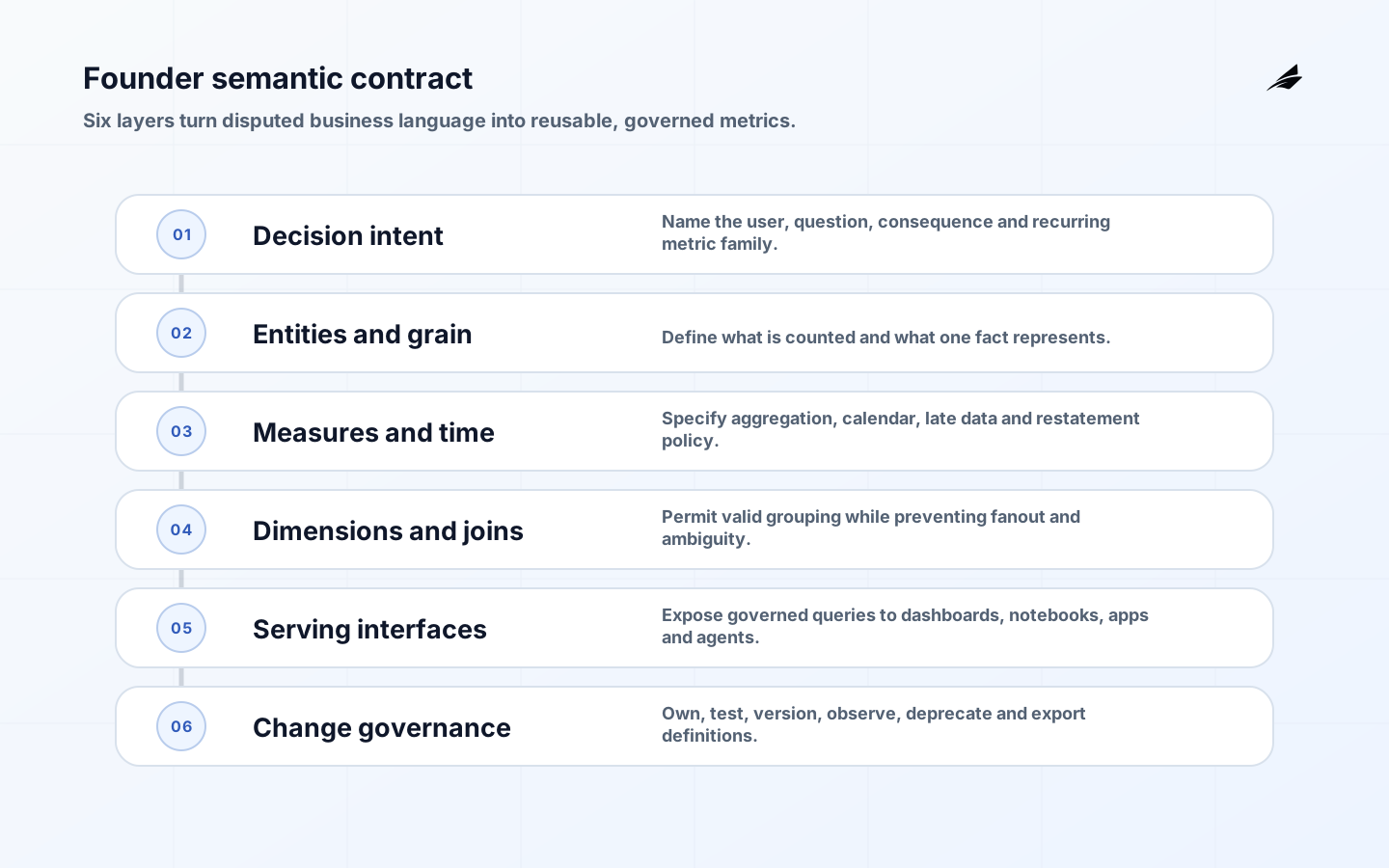
Founders should think about semantic layers as an operating contract for business meaning, not a fashionable box between a warehouse and a dashboard. The layer defines trusted entities, dimensions, measures, time behavior, joins and access so revenue, activation or retention means the same thing in dashboards, notebooks and applications. It becomes valuable when disagreement and repeated logic cost more than maintaining the contract. Before that point, a documented model and a small set of reviewed queries may be enough.
Compare the concept with the engineering guide to metric layers and the warehouse modeling guide for operations leaders. The analytics documentation guide for CTOs covers adjacent ownership. A semantic layer cannot repair unknown source events or unresolved business policy; it can make those disagreements explicit and testable.
Start with the decision problem
List the decisions harmed by inconsistent numbers: board reporting, sales compensation, product investment, customer health or financial planning. Collect current definitions and run them against the same period. Differences often come from entity grain, time zone, late events, refunds, internal users, status changes, joins and slowly changing attributes. Quantify hours spent reconciling and the consequence of a wrong decision. That evidence determines whether a shared layer is worth its setup and governance cost.
Choose one domain and three to five high-value metrics. For subscription revenue, specify contract or invoice basis, currency conversion, effective dates, credits, expansion, contraction, churn and restatement. For product activation, name the eligible account, qualifying events, time window and bot exclusion. A metric definition should be executable and accompanied by plain language. If executives cannot agree the business rule, a semantic tool will only encode one side of the disagreement.
| Contract element | Question | Example |
|---|---|---|
| Entity | What thing is counted? | Workspace, not user |
| Grain | What does one fact row represent? | One invoice line |
| Measure | What value can aggregate? | Net amount in reporting currency |
| Dimension | How may results be grouped? | Plan at transaction time |
| Time | Which timestamp and calendar apply? | Posted date in UTC |
| Policy | What is excluded or restated? | Internal workspaces excluded |
Know what a semantic layer must contain
A functioning layer needs physical source mappings, entities and join relationships, dimensions, measures, metrics, filters, time semantics, descriptions, ownership, access policy and query behavior. Dbt's open source MetricFlow project compiles metric definitions into reusable SQL, while dbt's semantic model documentation describes entities, measures and dimensions on top of models. Product syntax varies, but the design questions remain: which joins are valid, which aggregations are safe and which version is authoritative?

Keep business meaning close to tested data models. Microsoft's Power BI star-schema guidance distinguishes dimension tables used for filtering and grouping from fact tables used for summarization. That foundation reduces ambiguous joins and double counting. The semantic layer should not become a patch over arbitrary operational tables. Define conformed entities and dimensions upstream where several metrics need them, then expose a constrained analysis surface that matches the supported grain.
Choose the right ownership and serving model
A BI-native model is practical when one tool serves almost all analysis and the team values rich product integration. A warehouse- or transformation-adjacent layer suits teams that want metrics in code and several clients. A standalone semantic service may provide APIs, caching and cross-tool access but adds infrastructure and vendor dependence. A simple curated mart can remain the right answer for an early company. Evaluate actual consumers: dashboards, notebooks, spreadsheets, embedded analytics, reverse ETL and AI tools.
Looker illustrates a BI-centered approach: official LookML documentation describes dimensions, aggregates, calculations and relationships that generate SQL, with model projects commonly version-controlled. The advantage is one governed query surface; the trade-off is coupling definitions and access to that ecosystem. Test portability by implementing two representative metrics and calling them from the clients the company truly uses. Do not select from architecture diagrams alone.
| Approach | Strength | Trade-off | Good fit |
|---|---|---|---|
| Curated marts | Simple and transparent | Logic can repeat in clients | Early team, few metrics |
| BI-native model | Deep dashboard integration | Tool coupling | One dominant BI platform |
| Transformation-native | Metrics as reviewed code | Client compatibility varies | Strong analytics engineering |
| Standalone service | APIs, caching, many consumers | Another production service | Multi-tool or embedded use |
| Open vocabulary | Interchange and formal semantics | More modeling discipline | Cross-organization data |
Pilot one metric family end to end
Select a metric family with real disagreement and stable enough source data. Write a decision record for definitions, create fixtures for edge cases, implement entities and joins, and compare output with existing reports. Expose the metric to one dashboard and one non-BI consumer if multi-client value is part of the case. Measure query latency, development effort, discrepancy reduction and user comprehension. Run parallel for a complete business cycle before retiring the prior calculation.
Example: define active paid workspaces for a weekly operating review. Entity is workspace; eligibility requires a paid contract effective on the period end; activity requires one qualifying production event in the preceding 28 days; internal and suspended workspaces are excluded. Dimensions include plan, region and acquisition cohort as of period end. Tests cover trial conversion, cancellation, reactivation, late event arrival and workspace merge. Publish numerator, eligible denominator and freshness instead of only a percentage.
Govern definitions like product interfaces
Assign one business owner and one technical steward per metric. Propose changes through a short request with rationale, affected consumers, sample output, effective date, backfill decision and migration plan. Review code, tests and documentation together. Version breaking changes rather than silently rewriting history. Deprecate old fields with usage telemetry and a deadline. Keep a searchable changelog so a board number can be explained months later without reconstructing repository history.
Test uniqueness, accepted values, referential integrity, metric fixtures, join fanout and time boundaries. Compare published totals to authoritative operational or financial records where appropriate. Monitor freshness, query errors, latency and volume. The W3C RDF Data Cube Vocabulary is aimed at multidimensional statistical data rather than startup BI, but its explicit observations, dimensions, attributes and measures illustrate why semantics need structure and identifiers when data must travel between systems.
Keep access and privacy in the contract
Decide whether access is enforced in the warehouse, semantic service, BI tool or a combination. Prefer a small number of authoritative enforcement points and test them from every client. Row and column rules must survive generated joins, caches and exports. Do not expose sensitive dimensions merely because aggregate metrics use them. Record purpose, user identity and query where required, and apply suppression or minimum group rules when small segments could reveal individuals.
AI and natural-language interfaces make this more important. A semantic layer can constrain available measures and joins, but it does not guarantee that a generated query is appropriate or its explanation is true. Return metric definitions, filter context, freshness and lineage with results. Limit high-impact automated actions to approved metrics and thresholds. Evaluate questions with ambiguous terms, forbidden dimensions and prompt attempts to bypass access before connecting an agent to the layer.
Model cost, lock-in and exit
Include modeling labor, licenses, query compute, caching, reliability, client integration, governance and migration. Savings come from fewer duplicate calculations, faster analysis, safer self-service and reusable embedded metrics; validate those outcomes. A semantic service can also add latency and an on-call dependency to every dashboard. Set service objectives based on consumer needs and provide a documented degraded mode for critical reports.
Inspect how definitions are represented, exported and tested. Prefer source-controlled plain text or a documented API, stable identifiers and generated SQL visibility. Keep fixtures and expected results independent of the vendor so a replacement can be evaluated. Avoid using proprietary features in the first pilot unless they create clear value. The practical exit test is whether another engineer can reproduce the top metrics from retained definitions, mappings and tests.
Set an explicit service boundary for semantic queries. Name supported metrics, dimensions, grains, clients and latency classes; unsupported ad hoc joins should fail clearly rather than produce plausible double counts. Return a query identifier, generated plan or SQL where safe, definition version and freshness with each result. Provide an incident path for a wrong metric just as for a failed pipeline: contain affected reports, identify the first bad version, correct or restate results, notify users who acted on them and add a regression fixture. Shared meaning deserves production-grade correction because one defect can propagate to many decisions.
Key takeaways
- Invest when inconsistent meaning is causing material decision or delivery cost.
- Model entities, grain, joins, measures, dimensions, time and policy together.
- Pilot a small metric family across the clients that matter.
- Give definitions owners, tests, versions, lineage and deprecation paths.
- Evaluate access, reliability, operating cost and portability before scaling.
Frequently asked questions
Is a semantic layer the same as a data warehouse?
No. The warehouse stores and processes data; the semantic layer presents governed business meaning and query relationships over data. Some platforms combine both capabilities, but the responsibilities remain distinct. A weak warehouse model makes semantic work harder rather than unnecessary.
Is a business glossary enough?
A glossary is useful for agreed language, owners and policy, but it does not ensure queries implement those definitions. Connect important terms to executable metrics, source lineage and tests. Keep the human explanation and machine behavior synchronized through the same change process.
When is a startup too early?
It is too early when sources and core entities change weekly, only one analyst produces reports, or metric disagreement has little consequence. Document definitions and build clean marts first. Reconsider when several teams repeatedly implement the same logic or external products need consistent metrics.
Conclusion
A semantic layer is worthwhile when shared meaning becomes infrastructure for decisions and products. Founders should demand a clear problem, bounded pilot, executable contracts, ownership and an exit route. Built that way, the layer reduces argument without pretending business definitions stop evolving; it gives change a disciplined place to happen.