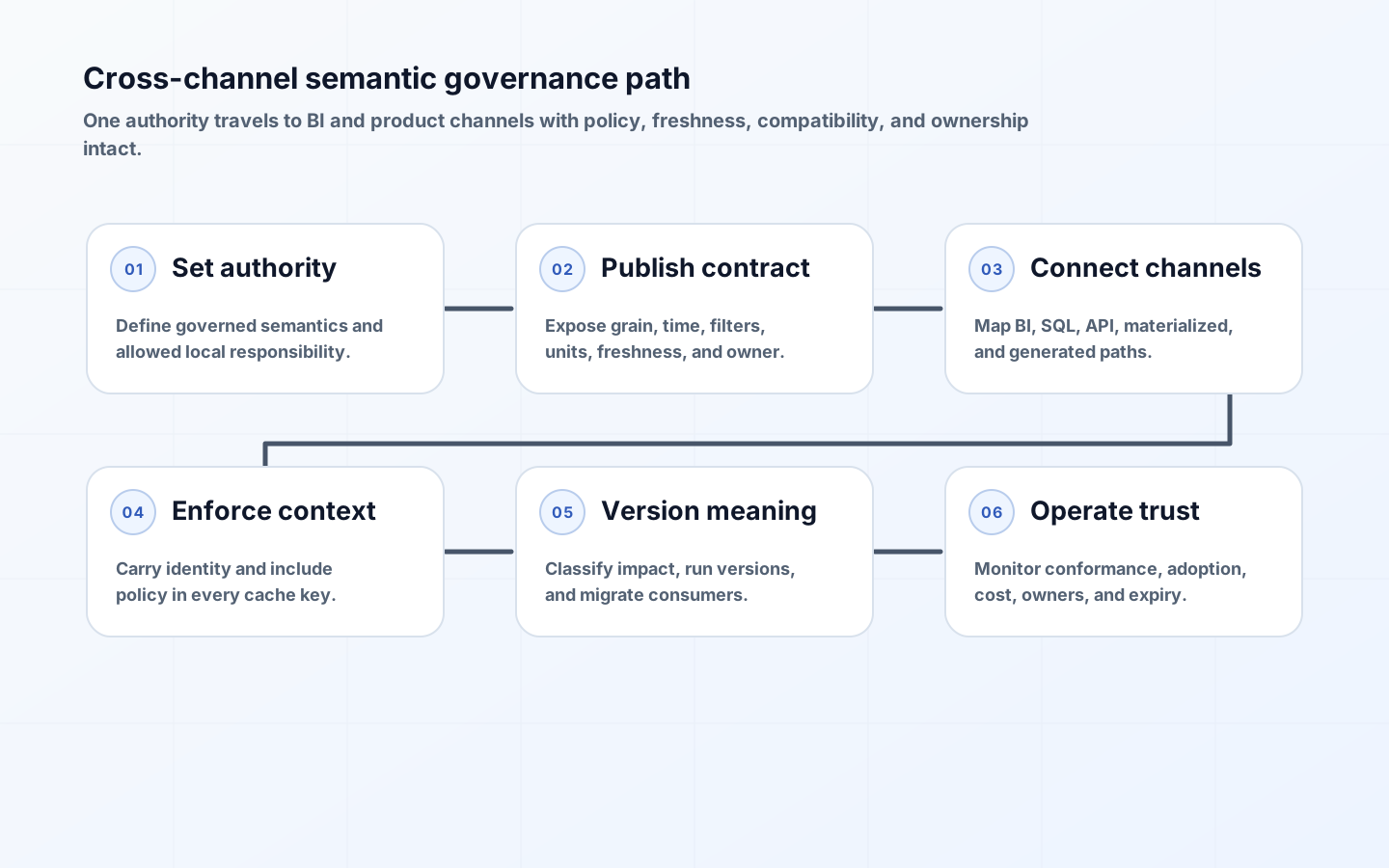
A semantic layer promises one governed meaning for measures, entities, dimensions, joins, and time across many experiences. The promise becomes harder when a finance metric appears in a BI dashboard, a notebook, an alert, a spreadsheet, an API, and a customer-facing product. Each channel has its own query language, cache, identity model, formatting, and release cadence. Semantic layer governance is the operating system that keeps those channels from turning one definition into several subtly different answers.
Centralizing SQL is not enough. A shared metric may still vary because consumers choose different grains, time zones, default filters, currency rules, row-level policies, or freshness states. Governance must define the authoritative contract, how tools access it, which logic may remain local, how changes are versioned, and who resolves discrepancies. The goal is controlled reuse with useful autonomy, not forcing every analytical question through one slow approval queue.
Define the semantic authority and its boundary
State what the governed layer owns: canonical metric calculations, approved entity joins, dimensions, time semantics, default filters, access classifications, and documentation. Also state what it does not own. Visualization layout, exploratory calculations, report interaction, and application workflow may remain with consuming teams. A local calculation can be allowed when it is clearly labeled and cannot masquerade as a certified enterprise metric.

Choose an authority pattern. In a central model, one team curates all shared semantics. In a federated model, domain owners publish contracts into a common registry and runtime. A hybrid may centralize cross-domain entities and financial measures while domains own product-specific metrics. Regardless of topology, every object needs a stable identifier, business owner, technical owner, description, grain, lineage, access class, quality status, version, and deprecation state.
| Layer | Governed responsibility | Local responsibility | Required evidence |
|---|---|---|---|
| Data model | Entities, join paths, dimensions, measures | Tool-specific presentation fields | Grain and join tests |
| Metric contract | Formula, filters, time, unit, owner | Display formatting | Reference results |
| Access | Classification and policy intent | Consumer authentication integration | Persona tests |
| Serving | Supported APIs and freshness status | Application interaction | Latency and cache SLO |
| Lifecycle | Version and deprecation policy | Consumer migration plan | Usage and dependency inventory |
Publish a cross-channel consumer contract
For each metric, publish numerator and denominator, aggregation, entity grain, allowable dimensions, event or processing time, time zone, calendar, currency, null handling, late-data behavior, default filters, exclusions, freshness, and revision policy. Provide examples at several grains. A metric named active customers is not portable until consumers know whether activity means login, purchase, or subscription; whether the period is rolling or calendar; and whether later-arriving facts restate history.
Expose machine-readable metadata where possible and render human documentation from the same source. Keep stable metric and dimension identifiers separate from display labels, which can be localized or revised. Return metadata with query results: version, generated time, source cutoff, applied filters, currency, and provisional or final status. Embedded products especially need this context because end users cannot inspect an internal model or ask the analytics team why a number changed.
Choose how each tool consumes governed semantics
A native integration may let a BI tool query the semantic runtime directly. Other tools may use SQL, JDBC, a REST or GraphQL API, exported tables, or generated model definitions. Evaluate whether each path preserves metric identity, filters, dimensions, access policy, query limits, and result metadata. A connector that only exposes generated SQL may preserve calculation but lose certification, version, and policy context.
Avoid duplicating logic to gain a familiar authoring experience. If a tool requires a local semantic model, generate or synchronize it from the authority and declare which features are unsupported. Maintain conformance tests that issue equivalent requests through each channel and compare normalized results. Differences can be legitimate when capabilities vary, but they should be documented as compatibility boundaries rather than discovered by business users.
| Serving pattern | Strength | Primary risk | Governance control |
|---|---|---|---|
| Direct semantic API | Consistent runtime calculation | Latency or vendor dependency | SLO, quotas, fallback policy |
| BI native connector | Rich authoring experience | Feature translation gaps | Compatibility test suite |
| SQL interface | Broad tool support | Metadata and policy may be lost | Approved views and query tags |
| Materialized metric table | Predictable speed and cost | Freshness and dimension limits | Versioned schema and cutoff metadata |
| Generated local model | Offline or tool-specific capability | Definition drift | Automated generation and diff checks |
Enforce access where queries are executed
A semantic layer does not replace source and warehouse security. Carry authenticated identity or a trusted service context to the enforcement point, apply row and object policy consistently, and minimize data exposed to each channel. Looker documents model sets, access filters, access grants, user attributes, roles, and content permissions as distinct controls. Power BI semantic models similarly combine model access with row-level security. Understand which actors can bypass model policy, including administrators, developers, service principals, exports, and direct database users.
Treat embedded access as a security boundary. The application must derive tenant and user context from its authenticated session, not from a client-supplied filter. Signed or tokenized requests should have narrow scope and short lifetime. Caches must include every security-relevant context value or be partitioned by tenant and role. Test negative cases through dashboards, drill-through, downloads, subscriptions, APIs, and error messages, not only the default chart.
Govern freshness, caching, and cost
Centralized semantics can centralize load. Define freshness classes, result-cache policy, pre-aggregation eligibility, concurrency limits, and expensive-dimension controls. A customer product may require predictable response time, while an analyst may accept a slower uncached exploration. Include the metric version, filters, grain, time zone, source cutoff, and security context in cache identity. Never share a result across users or tenants unless policy equivalence is proven.
Publish freshness separately from cache age. A response generated now from a source last refreshed yesterday is not current. Return source watermark and generation time, and decide how consumers behave during source delay: serve stale with a label, fail closed, or use a documented fallback. Allocate query budgets by product and consumer class so a popular embedded page cannot starve internal reporting or create an unowned warehouse bill.
Version changes by consumer impact
Classify changes as compatible, conditionally compatible, or breaking. Adding an optional dimension may be compatible; changing a metric's default time zone, entity grain, or exclusion rule is usually breaking even if the schema is unchanged. Create a new metric version or identifier for meaning changes, run old and new definitions in parallel, publish a difference analysis, and assign a migration window. Do not silently rewrite history to make dashboards agree.
Build a dependency inventory from API clients, BI content, saved queries, application releases, and query logs. Usage is evidence, not complete proof: a quarterly report may have no recent calls and still be legally required. Notify named owners, provide a compatibility view or translation where safe, and set an explicit removal date. Emergency corrections should retain an incident record and before-and-after results so users can explain changed decisions.
Operate governance as a product
Create a small semantic council with domain, analytics engineering, security, and major consumer representation. It should decide cross-domain identity, breaking changes, certification criteria, and disputes, while routine additions remain with domain owners under automated checks. Set review time targets so governance does not become a bottleneck. Provide templates, linting, reference queries, test fixtures, and a sandbox that make the governed path easier than duplication.
Monitor adoption, duplicate metric names, unowned objects, failed conformance tests, stale documentation, query latency, cache effectiveness, access-test failures, and deprecated versions still in use. Pair quantitative signals with user feedback. High usage does not prove the number is understood, and low usage may indicate poor discovery rather than low value. Retire unused definitions carefully and preserve historical metadata needed to interpret prior reports.
Key takeaways
- Define what the shared semantic authority owns and where local exploration remains acceptable.
- Publish grain, time, filters, units, quality, freshness, and version as a consumer contract.
- Test equivalent queries across every supported BI, API, and embedded serving path.
- Enforce identity-based access at execution and include security context in cache identity.
- Treat meaning changes as versioned contract changes with consumer migration.
- Run semantic governance as an enabling product with owners, tooling, and service targets.
Frequently asked questions
Must every tool use the same semantic runtime?
No, but every supported path should derive from the same authority and pass conformance tests. Materialized tables or generated local models may be appropriate for latency, offline, or feature needs if their freshness and compatibility boundaries are explicit.
Can analysts create local metrics?
Yes in a sandbox or clearly ungoverned context. Promotion to a shared or certified metric should require an owner, contract, tests, lineage, access review, and evidence that it is not an unnecessary duplicate.
Does a semantic layer eliminate vendor lock-in?
Not automatically. Models, APIs, caching, access features, and query languages can be vendor-specific. Stable business contracts, portable test fixtures, exportable metadata, and a measured exit path reduce dependency more than a portability claim.
Conclusion
One semantic layer across many channels succeeds when shared meaning travels with policy, freshness, version, and evidence. Clear ownership, explicit serving contracts, cross-tool conformance, identity-aware caching, and managed deprecation let dashboards and products reuse trusted metrics without becoming identical applications. Governance protects consistency while preserving the local design freedom that makes each analytical experience useful.