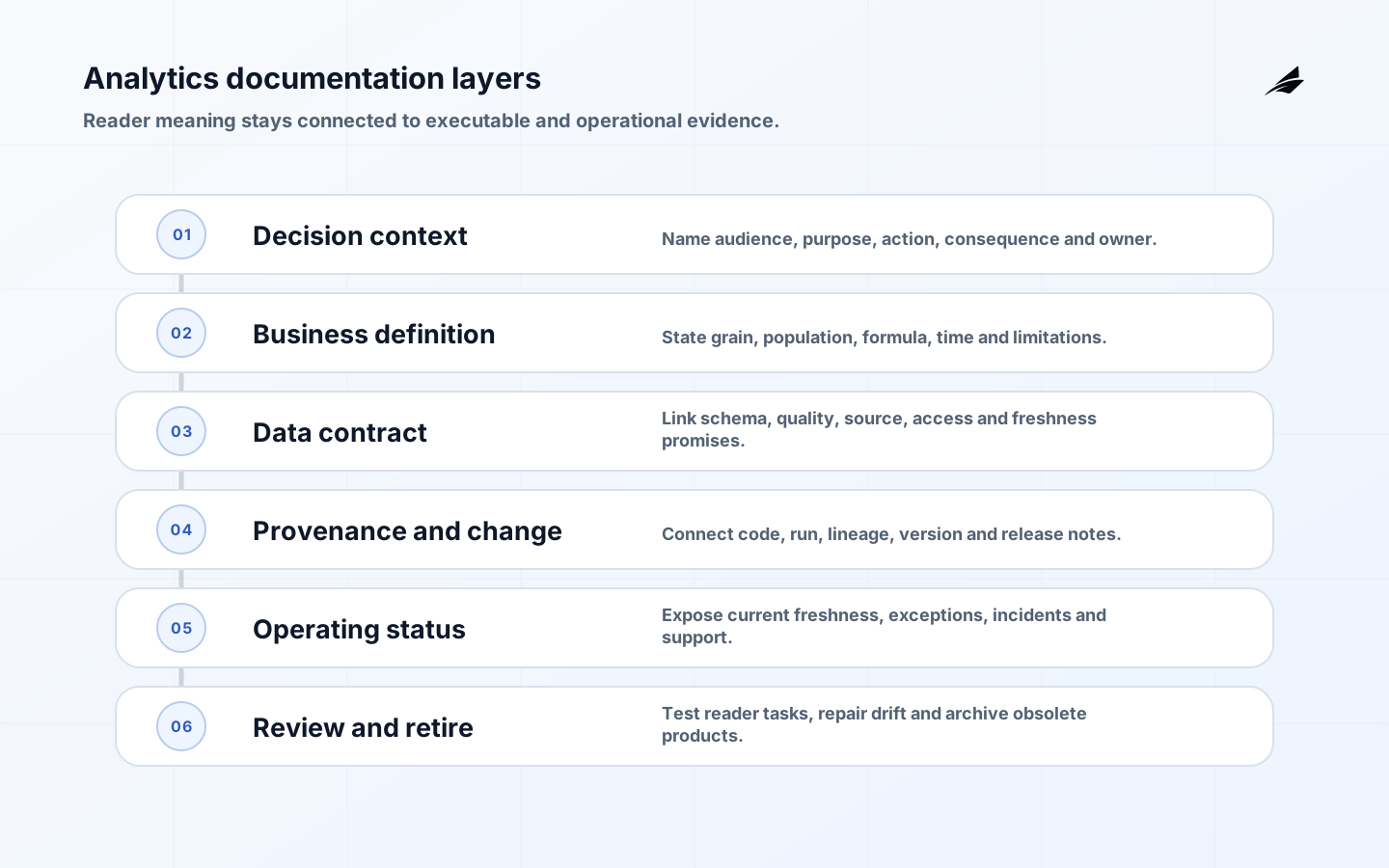
Analytics documentation should let a reader determine what a result means, whether it fits the decision, where it came from, how current it is, who owns it and what to do when it looks wrong. CTOs should treat that path as part of the data product. A catalog full of titles is insufficient, while a code repository alone excludes many decision makers. The goal is a maintained bridge between business meaning and executable evidence.
Connect this operating model to Edilec's guides on data contracts, BI dashboard decisions and dbt model ownership. Documentation should point to those live technical and decision surfaces rather than duplicate details that will drift.
Document decisions and products, not pages
Inventory analytics products: metric, dashboard, dataset, model, report, alert, experiment or API. For each, name the audience, recurring decision, accountable owner and consequence of error or delay. Set documentation depth by risk and reuse. A board metric and a temporary exploration do not need identical ceremony, but both should be distinguishable. Give each durable product a stable identifier so catalog, lineage, code, incident and change records can refer to the same thing.
Write the shortest decision record that prevents misuse: purpose, grain, population, formula, time basis, source, freshness, quality status, exclusions, access class, known limitations, owner and escalation. Add one realistic example and a counterexample. State whether values are final, provisional or revisable. A familiar metric name such as active customer can conceal qualification windows, account hierarchy, test users, cancellations and timezone choices that materially change the result.
| Reader | Primary question | Documentation surface | Proof link |
|---|---|---|---|
| Executive | What decision and limitation matter? | Metric or dashboard summary | Definition and status |
| Analyst | What grain, filters and sources apply? | Catalog and model page | Code, tests and lineage |
| Engineer | How is it produced and operated? | Repository and runbook | Build, run and telemetry |
| Steward | Who may use it and under what policy? | Catalog governance fields | Classification and access |
| Support | What failed and who responds? | Status and incident guide | Current run and owner |
Use a consistent analytics information model
Separate the conceptual product from its distributions and implementations. A customer dataset can be available as a table, export and API with different formats and timing. W3C's Data Catalog Vocabulary 3 distinguishes catalogs, resources, datasets, distributions, data services and catalog records, and adds versioning and dataset-series support. Teams need not implement RDF to adopt the useful distinction between the thing described, its access forms and the metadata record about it.
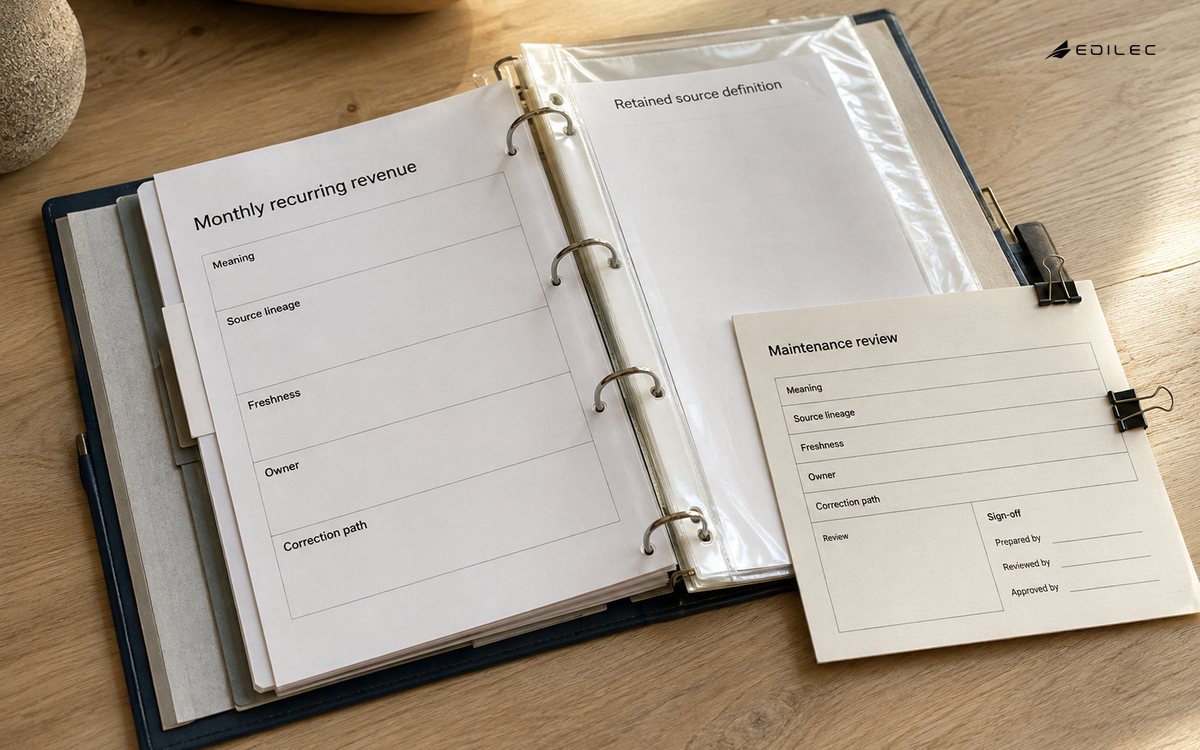
Define required fields by product type and lifecycle state. Draft products may lack service objectives; certified decision products should require owner, definition, lineage, quality, access, freshness, limitations and review. Use controlled vocabulary for domain, sensitivity, status and criticality. Keep free text for context, not for fields that must drive policy or search. Validate records in CI or catalog workflows and prevent publication of high-risk products with missing required metadata.
Connect definitions to lineage and change
Lineage should answer which source entities and activities produced an output, with versions and run context. The W3C PROV overview provides interoperable concepts for entities, activities and agents. OpenLineage facets attach extensible context to jobs, runs, inputs and outputs. Use stable identifiers to link a friendly catalog page to generated lineage rather than manually drawing diagrams that become stale after every model change.
Capture ownership and code change together. A pull request that changes a column, metric formula, source, access policy or refresh behavior should identify affected products and update their documentation. Generate schemas, dependencies, test results and run metadata where possible; require human review for purpose, interpretation and limitations. Publish release notes when consumer behavior changes, including migration date, compatibility and who must act.
Document access, freshness and failure honestly
State classification, permitted uses, retention, geographic constraints, row or column restrictions and access-request route. Documentation itself can expose sensitive table names, customer concepts or control details, so apply appropriate access. NIST's SP 800-53 control catalog includes access, audit, configuration, contingency and privacy families. Where a documentation page claims such a control, link to the governed process or evidence rather than asserting compliance in prose.
Expose observed freshness, last successful run, current incident and known quality exceptions where readers use the product. The status must distinguish zero from missing, delayed from failed, and provisional from final. OpenTelemetry signals can connect traces, metrics and logs for the producing service. Summarize operational evidence for readers while preserving detailed diagnostics under controlled access.
| Documentation test | Method | Failure revealed | Correction |
|---|---|---|---|
| Discovery | Search with a user's business term | Vocabulary or indexing gap | Add synonym or canonical route |
| Interpretation | Ask a new reader to explain a value | Ambiguous grain or limitation | Clarify with example |
| Traceability | Follow output to source and code | Broken identity or lineage | Repair generated links |
| Currency | Compare stated and observed freshness | Stale service promise | Update automation or objective |
| Ownership | Raise a realistic support question | Inactive or unclear route | Assign maintained group and escalation |
Build documentation into the delivery workflow
Start documentation during design, when producer and consumer can agree meaning. Store technical definitions near code and publish them to the discovery surface people already use. Give every fact a canonical home: the metric formula in a semantic definition, schema in its contract, ownership in a catalog and operating steps in a runbook. Link rather than copy. Use templates to create consistency, but keep fields relevant to the product type.
Add checks for missing owners, invalid internal identifiers, broken evidence links, obsolete source references and products past review date. Preview reader-facing changes with code changes. After deployment, verify that generated lineage and observed freshness match the page. When retiring a product, mark status, successor, last supported date and archival policy; do not simply delete it and leave bookmarks or downstream jobs unexplained.
Assign maintenance and measure usefulness
Use durable group ownership plus a current maintainer and escalation route. Product owners own purpose and interpretation; technical owners own implementation and operation; stewards own shared vocabulary and policy. Make review event-driven for material source, definition, access, ownership or reliability change, with a periodic backstop based on criticality. After an incident, ask which missing or misleading information delayed diagnosis or decision and correct the canonical record.
Measure tasks: time to find the current metric, determine whether it is fit, trace its source, request access, identify a failure and reach the owner. Track stale critical records, broken links, unanswered questions, repeated definition disputes and incidents where scope was unclear. Page views and document counts can show reach but not correctness. Sample records against live systems and retire low-value documentation that has no reader or authoritative role.
Example: documenting monthly recurring revenue
A metric record states the decision, account and contract grain, currency conversion date, included recurring charges, exclusions, close calendar, provisional period and owner. It links to the semantic definition, source contracts, model code, tests, lineage and dashboard. The page displays last successful refresh and a known late billing feed. A change from invoice-based to contract-based recognition updates the definition, compatibility note and affected dashboards in one release, while prior versions remain identifiable for historical reports.
Roll out documentation around high-value questions
Start with ten to twenty products used in recurring, consequential decisions. Interview their readers and record the questions that cause delays or rework. Build the common information model from those needs, then document each product with its owner. Avoid launching an empty catalog across thousands of tables; sparse, unowned entries teach readers that search results cannot be trusted.
For each pilot product, ask a new analyst to find it, explain the metric, identify freshness, trace a source, request access and reach support without coaching. Time the tasks and note false turns. Correct vocabulary, navigation, examples and ownership, then run the test again. This provides a practical baseline for discovery and trust before investing in broader metadata extraction or catalog licenses.
Scale by domain with an accountable steward and technical integration owner. Generate schema, lineage and run state, while domain teams curate meaning and limitations. Publish coverage and staleness for critical products, not a vanity count of all assets. Retire duplicate pages as canonical records become useful. Schedule quarterly sampling against live code and data so automation failures do not quietly turn generated documentation into another stale layer.
Set a service objective for the documentation platform itself where critical decisions depend on it. Monitor catalog indexing, lineage ingestion, broken links, ownership synchronization and status freshness. Provide an export or alternate route for essential definitions during an outage. Documentation that disappears whenever the data platform is impaired cannot support incident response, so keep core contacts, recovery dependencies and decision limitations reachable through the organization's continuity arrangements.
Key takeaways
- Organize documentation around decisions and durable analytics products.
- Use stable identifiers and a small required record for meaning, ownership and status.
- Link reader language to generated schema, tests, lineage and operating evidence.
- Keep access, limitations, provisional state and failures visible and specific.
- Update documentation through code and release workflows, then verify after deployment.
- Measure whether readers can complete tasks, not how many pages exist.
Analytics documentation FAQ
What is the minimum useful record? Purpose, audience, owner, definition, grain, source, timing, limitations, access and support route. Should documentation live in code or a catalog? Keep executable facts close to code and publish linked reader-oriented records in a catalog. How often should it be reviewed? On material change, incident or ownership transfer, plus a criticality-based cadence. Who owns metric definitions? A business or product owner should own meaning, with technical and steward support. Can lineage replace documentation? No; lineage explains production paths, not decision purpose, interpretation or limitations.
Conclusion: make documentation part of the product
Analytics documentation earns trust when it helps a reader take a safe next step and exposes the evidence behind that step. Give each important product a stable identity, accountable meaning, live provenance and honest operating status, then maintain the record through the same changes and incidents that shape the data itself.