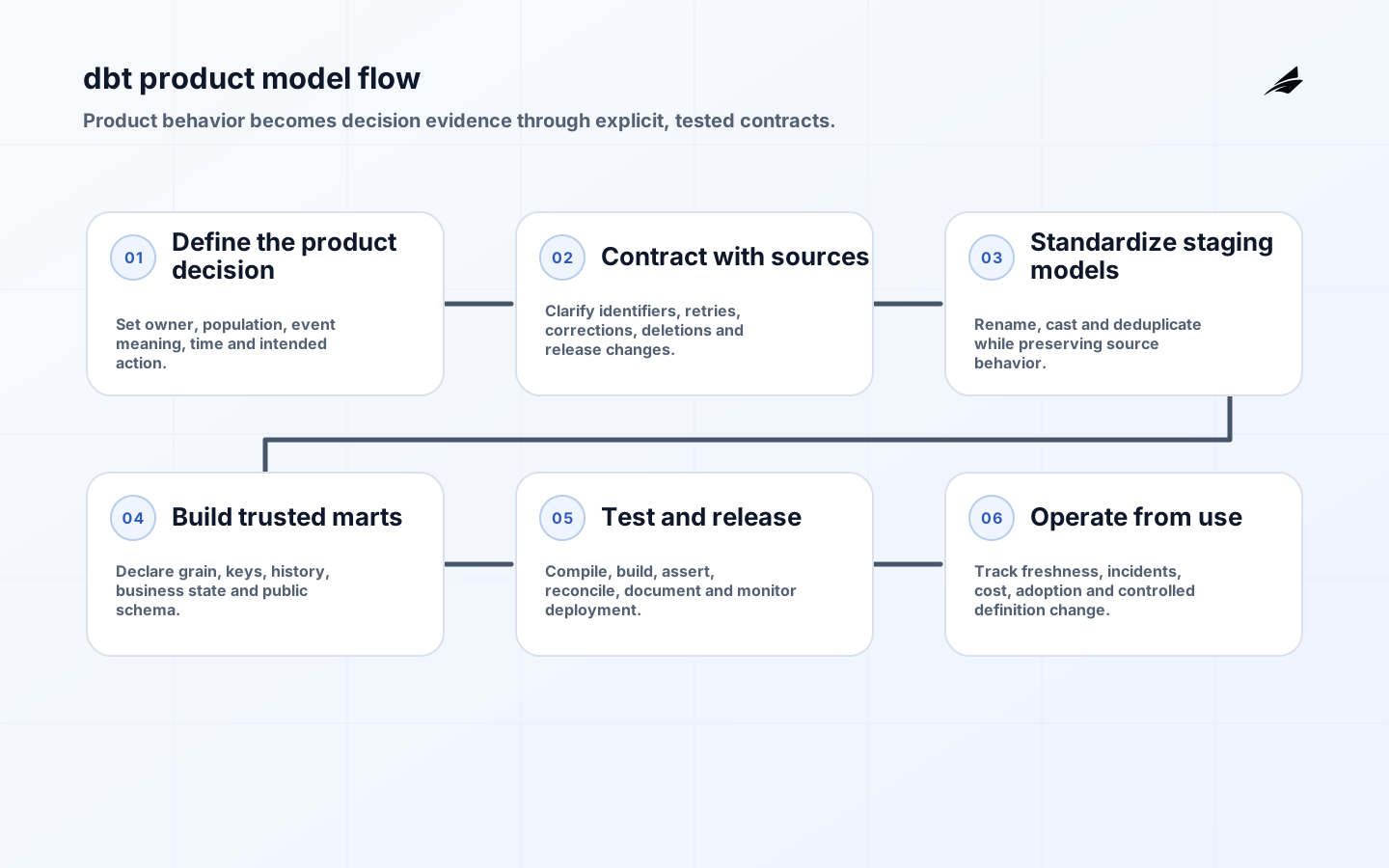
dbt models help product teams turn operational records into stable analytical facts, dimensions and decision measures. The value is not SQL files by themselves. It is a reviewable contract between changing product behavior and consumers who need consistent history. Product managers should understand model grain, source meaning, tests, freshness and change impact even when analytics engineers implement the code. This guide connects those concerns to a practical dbt workflow.
Use the warehouse modeling guide for broader dimensional choices, data contracts engineering notes for source responsibilities, and the metric layers guide for governed calculation. The semantic layer planning guide covers cross-tool serving.
Begin with the product decision and event meaning
Name the decision, owner and action before designing a model. A retention model may support lifecycle messaging, roadmap priority or financial planning; each needs different definitions and latency. Identify eligible population, entity, event, time window, segments and exclusions. Write examples from real product behavior. If activation means three different things to growth, product and customer success, resolve or version those meanings instead of hiding them in one column.
Document operational source semantics with the producing team. Determine when an event is emitted, whether retries duplicate it, which identifier is stable, how deletion appears, what timestamps mean and whether historical records can change. Product releases that alter tracking, status or identity are data-interface changes. Add analytics review to the release path for material events, while keeping the product team accountable for source correctness.
| Model question | Product evidence | Engineering rule |
|---|---|---|
| What is the grain? | One sentence and representative rows | Test the key is unique and non-null |
| What creates a record? | Product action or system transition | Encode source and state rules explicitly |
| Which time is authoritative? | Event, effective, processing or snapshot time | Preserve relevant timestamps and timezone |
| Can history change? | Correction, deletion and late-arrival policy | Choose rebuild, merge or snapshot behavior |
| Who consumes it? | Decision, dashboard, experiment or service | Set contract, freshness and change notice |
| Who owns failure? | Product source and data-model contacts | Route incidents to the responsible boundary |
Use layers to separate source cleanup from business meaning
The official dbt model documentation describes models primarily as SQL select statements materialized in the data platform. Organize them by responsibility. Source declarations name loaded relations. Staging models rename, cast, standardize and lightly deduplicate one source. Intermediate models implement reusable transformations. Mart models present business facts and dimensions at documented grains. Semantic definitions or BI models then calculate governed measures.

Keep staging close to source vocabulary so upstream change is visible. Do not embed a company-wide customer definition in many staging files. Intermediate models are justified when they clarify a multi-step transformation or support multiple marts; they are not a destination for every join. Marts should be understandable to consumers, with stable keys, explicit states and useful documentation. Avoid one enormous model that mixes source cleanup, identity resolution, allocation and final metrics.
Declare grain, keys and temporal behavior
Write each model's grain in plain language and encode a corresponding key. A fact can be one order line, experiment assignment or account-day. A dimension can be one current customer or a versioned customer state. Use source keys when stable; otherwise create deterministic surrogate keys from the complete grain with consistent null handling. Never use a row number as a durable business key. Test uniqueness at the actual composite grain.
Choose how models represent history. Current-state dimensions are simple but cannot answer what was known at an earlier time. Snapshots or effective-dated models preserve change and need valid-from, valid-to and current markers. Event facts should retain occurrence and ingestion time so late arrival is visible. Product teams must decide whether corrected history should restate prior reporting. That policy affects experiments, customer communication and financial reconciliation.
Choose materialization from behavior and cost
dbt's materialization documentation distinguishes patterns such as views, tables, incremental models, ephemeral models and materialized views where supported. A view is simple and current but transfers computation to every query. A table gives predictable reads at refresh cost. Ephemeral logic compiles into downstream SQL and can make generated queries harder to inspect. Select per model, not by project-wide habit.
Estimate source volume, transformation complexity, consumer concurrency, freshness and rebuild time. Small dimensions may be tables rebuilt fully. Thin staging may use views. Large append-heavy facts may justify incremental processing. Observe warehouse scan and run duration after release. Materialization is an operating decision: document owner, refresh schedule, recovery, retention and expected query pattern. Faster builds are not useful if consumer queries become unstable or expensive.
Make incremental models correct before making them fast
The dbt incremental model guide explains filtering rows during incremental runs and configuring a unique key to update existing records where supported. Define a lookback that captures late and revised data, and make the transformation idempotent. Filter source scans early without accidentally excluding rows required by joins. A timestamp greater than the destination maximum is unsafe when records arrive late or can be corrected.
Test the initial build, empty increment, normal increment, duplicate input, late record, changed record, deletion and full refresh. Reconcile incremental output against a full calculation on a bounded period. Define when a full refresh is required after logic or schema change and whether it fits the operating window. Partition and cluster from observed query and merge behavior. Keep a runbook for failed partial writes and downstream withholding.
| Change | Risk | Required release evidence |
|---|---|---|
| Add nullable column | Consumers may assume availability | Docs, value test and downstream compile |
| Rename or remove column | Queries and extracts break | Dependency inventory and versioned migration |
| Change grain | Counts and joins become invalid | New key, parallel reconciliation and consumer approval |
| Revise business rule | History may restate | Impact by period and owner decision |
| Change incremental filter | Rows may be missed or duplicated | Full-versus-incremental comparison |
| Alter source event | Meaning changes before transformation | Producer contract and coordinated deployment |
Use tests and contracts for different guarantees
dbt data tests are assertions over resources. Apply not-null, unique, relationship and accepted-value tests where they express real invariants, plus singular or custom tests for business rules. Classify failures by impact. A warning can monitor emerging drift; a blocking failure should prevent bad data from being promoted. Sample the failed rows in a protected location and route them to an owner. A passing test suite proves only the assertions written.
dbt model contracts can enforce declared column names and data types for supported materializations and platforms, with additional constraints depending on configuration. Use contracts for stable public models with known consumers. They do not define business meaning, row-level access, freshness or complete compatibility. Pair them with documentation, semantic tests, access policy and change notice. Introduce contracts after the model's purpose and grain stabilize.
Build a safe review and deployment path
Every change should receive code review that examines meaning, grain, SQL, tests, cost and downstream impact. In continuous integration, parse and compile the project, build modified models and affected descendants in an isolated schema, then run tests against representative data. Defer to approved production artifacts where the workflow supports it rather than rebuilding the entire graph. Protect production credentials and separate developer schemas.
Generate documentation and dependency artifacts with the release. Deploy on a controlled schedule, monitor the first run and withhold downstream publication on critical failure. Use environment variables and targets carefully so logic does not diverge silently. Pin package versions and review upgrades. Preserve invocation, code revision, target, timing and test result. A rollback may require restoring prior code, relation schema and data, so practice the path for critical marts.
Operate dbt models as product infrastructure
Assign owners at source, model and decision boundaries. Monitor source freshness, run success, duration, row volume, test failures, warehouse cost and consumer queries. Alert only when action is defined. Maintain incident playbooks for late source, schema break, partial build and incorrect published data. Communicate affected models, time range and consumer action. Backfill with approval when history or cost is material, and validate reconciliation afterward.
Review the model portfolio for reuse and dead assets. High fan-out models deserve stronger contracts and recovery. Unused relations add run cost and confusion; confirm dependencies before retirement. Product teams should review critical definitions as user behavior changes. Measure time from product event change to trusted availability, correction rate, freshness attainment, query cost and decision adoption. Model count is not a meaningful success metric.
Implementation example: activation funnel
A collaboration product defines activation as creating a workspace, inviting a teammate and completing one shared artifact within seven days. Staging models standardize events and remove exact retry duplicates while retaining occurrence and ingestion times. An intermediate identity model maps anonymous sessions to accounts under an approved rule. The mart has one account-signup grain with milestone timestamps, eligibility and activation outcome.
Tests cover account uniqueness, milestone ordering, known bot exclusions and impossible pre-signup events. Late mobile events are included through a lookback, and a bounded full calculation reconciles daily. The contract protects the mart's public columns. When the invitation flow changes, product and analytics update event meaning and deploy in parallel. The metric layer calculates activation from the mart, allowing experiments and dashboards to share one population without embedding funnel logic in each chart.
Key takeaways
- Anchor each model to an owned product decision and explicit source behavior.
- Separate staging cleanup, reusable transformation, consumer marts and metric calculation.
- Declare grain, stable keys, time semantics and history policy before optimization.
- Choose materializations from freshness, query, cost and recovery needs.
- Test incremental edge cases and reconcile them against full logic.
- Treat public models as operated contracts with review, observability and managed change.
dbt models FAQ for product teams
Should product managers write SQL? They do not need to implement every model, but should review definitions, examples, exclusions and decision impact. Shared understanding prevents technically correct but commercially wrong models.
How many model layers are needed? Use enough layers to make responsibility and reuse clear. Small transformations may go from staging to mart; complex domains may need intermediate models. Avoid layers created only by naming convention.
Are tests data quality monitoring? Tests are one part. Production operation also needs freshness, run health, volume, cost, lineage, consumer impact and incident response.
When should a model contract be added? Add it when a public model's schema is stable and consumers need compatibility guarantees. First clarify ownership, grain and meaning.
Conclusion
Product teams should view dbt models as the maintained translation between product behavior and decision evidence. Clear grain, layered responsibility, correct incremental logic, meaningful tests and controlled contracts make that translation dependable. When product and analytics teams govern source changes together and operate important models visibly, data becomes easier to trust and safer to evolve.