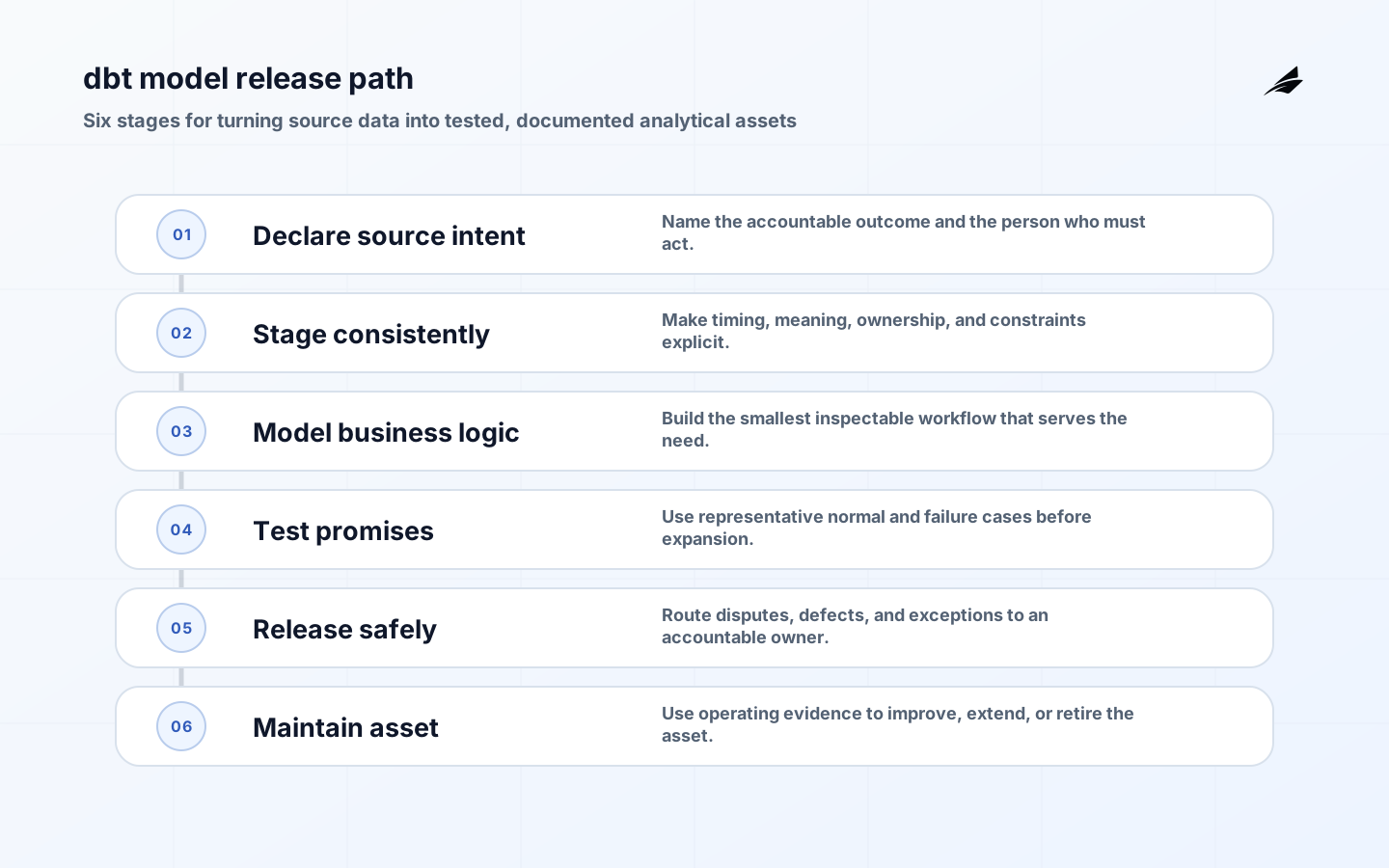
dbt models are a way to manage analytical transformations as reviewed, version-controlled code. Their value is not the templating language alone. A well-run dbt project gives a team named model boundaries, dependency order, repeatable builds, tests, documentation, and a deployable record of what changed. That is especially useful when the same source data feeds several dashboards and operational metrics. The practical question is not “should every query become a model?” It is “which transformations need a durable, testable home because people rely on their result?” Use dbt models to make those transformations understandable and safer to change.
Choose clear model boundaries
dbt models become operationally important when they feed pricing, planning, customer experience, or executive decisions. Treat them as maintained assets rather than convenient SQL files. For each model, state the intended consumer, upstream source, grain, owner, materialization choice, and the failures that would make its output unsafe to use. The dbt models documentation explains how models are the core unit of a dbt project, while dbt data tests show how assertions can document and verify assumptions such as uniqueness, accepted values, and relationships. A passing build is necessary but not enough: review changes for downstream impact, compare representative results, and give affected readers a clear migration path. Documentation should explain why a model exists and which definition it implements, not merely repeat its column names. When a source breaks or a metric moves, the owner needs a runbook that distinguishes correction, backfill, rollback, and retirement.
Structure models around a meaningful progression from source-shaped data to business-ready data. A staging model can rename fields, standardize types, and retain source identity without applying broad business logic. Intermediate models can combine or prepare entities for a defined purpose. Mart models expose stable facts, dimensions, or metrics to consumers. The exact folder names matter less than the contract at each boundary. A downstream dashboard should not depend directly on a fragile source-shaped model merely because it is convenient. Model names, descriptions, and ownership should tell a reviewer what a model represents, its grain, and which audience can rely on it.
| Model layer | Primary role | Avoid |
|---|---|---|
| Staging | Standardize one source with traceability | Hiding broad cross-domain business rules |
| Intermediate | Prepare reusable combinations or logic | Publishing unstable logic as a consumer contract |
| Mart | Expose decision-ready facts, dimensions, and metrics | Mixing unrelated grains in one convenient table |
| Snapshot or history model | Preserve change according to policy | Assuming every source change should rewrite history |
Test what can break a decision
Tests should be chosen because a failed assumption would damage a consumer outcome. Unique keys, required identifiers, accepted status values, relationships, and freshness are common starting points. Add custom tests where a business rule is material, such as an order total that cannot be negative or a completed appointment that must have a completion timestamp. A passing test is not proof that the source is truthful; it is evidence that a stated expectation held for a run. Store failures and run metadata long enough to investigate patterns. Pair tests with sample reconciliations when a model first becomes decision-critical or after a material source migration.
- Declare sources and their owners so a model failure can be routed to the team that can correct it.
- Test keys, relationships, accepted values, and freshness at the model boundary where failure is clearest.
- Write custom tests for high-consequence business invariants rather than relying only on generic null checks.
- Use a small set of representative data cases to review grain, filters, and historical treatment.
- Fail releases or clearly mark downstream outputs when a critical test breaches its agreed tolerance.
Operate dbt models as production assets
A production dbt project needs more than successful local runs. Use source-controlled changes, peer review, isolated development where appropriate, CI checks, controlled deployment, and an observable run history. Review changes that alter a model's grain, key, calculation, or published schema as interface changes. Give consumers release notes if their dashboard or data product could move as a result. Document model lineage and freshness so an incident responder can identify the affected path quickly. When a run fails, the runbook should state whether to retry, restore a prior result, hold publication, or communicate a data delay. That is how dbt contributes to a reliable analytics service.

| Change type | Review question | Release evidence |
|---|---|---|
| New model | Who will consume it and what is its grain? | Description, owner, tests, and sample output |
| Schema change | Will dependent models or consumers break? | Dependency analysis and compatibility plan |
| Logic revision | Will historical numbers change? | Impact comparison and reader-facing note |
| Source delay | Can a stale result be published safely? | Freshness state, decision impact, and response record |
Use documentation and contracts deliberately
Model descriptions should explain the business purpose, grain, source inputs, and material assumptions, not restate a filename. Where a published model needs a stable schema, model contracts can make expected columns and types explicit. They are most valuable at boundaries with several consumers or downstream systems, not as mandatory ceremony for every temporary model. Documentation, tests, and contracts work together: a description tells people why the model exists; a contract specifies a stable shape; tests check key expectations at runtime. Keep them close to the code so a change cannot be merged without confronting the promise it changes.
Work through a practical case
A software company needs a renewal-risk model. Staging models standardize subscription, product-usage, and support-ticket sources while retaining their native identifiers. Intermediate models link usage to a subscription-day grain and calculate a documented activity window. The mart model produces one row per active subscription per day, with a stable subscription key, renewal date, activity status, and source freshness. Tests prevent duplicate subscription-day rows, reject unknown plan statuses, and flag stale usage data. A dashboard consumes only the mart model. When the usage service changes an event field, the source test fails in CI, allowing the team to update the staging contract before a false risk list reaches customer-success staff.
Plan the next review
Run a regular project review that follows a model from declared source to consumer outcome. Inspect a recent pull request, its tests, generated documentation, deployment record, and the dashboard or extract that consumes the model. Then select a failed run or source delay and verify that the team can identify impact, communicate status, and rerun or restore safely. This turns dbt testing from a build gate into operational evidence. Use the review to prune unused models, upgrade weak descriptions, strengthen high-value tests, and identify contracts that deserve explicit enforcement. The healthiest dbt project is not the one with the most models; it is the one where maintainers can explain why important models exist and safely change them.
- Review new models for a stated consumer, business purpose, grain, owner, and durable test plan.
- Sample failed test rows to check that alerts are actionable and routed to the right source or domain owner.
- Compare CI and production results when environment or timing differences could hide a source problem.
- Require an impact note for changes that alter a published model's schema, grain, or historical output.
- Use run history and consumer feedback to decide which models need more observability or can be retired.
dbt projects also benefit from deliberate package and macro governance. Reusable code can reduce duplication, but an opaque macro can make a simple transformation impossible to review during an incident. Prefer explicit interfaces, version pinned dependencies, and a clear owner for shared utilities. Test an upgrade in a controlled environment and inspect compiled or generated behaviour for consumer-facing models. This balance preserves the productivity benefit of abstraction while keeping the transformation path understandable to the people responsible for data quality and release safety.
Connect the practice to the wider data system
The strongest dbt projects make modeling, quality, and producer agreements reinforce one another. dbt models field guidance covers model boundaries, data quality helps select checks that protect decisions, and data contracts clarifies what an upstream producer can change without breaking the model.
Key takeaways
- Use dbt models to give important transformations clear boundaries, lineage, and reviewable code.
- Describe the business purpose and grain of published models, not just their technical lineage.
- Test assumptions that could break a consumer decision and retain useful failure evidence.
- Treat grain, schema, and logic changes as releases with dependency and historical impact review.
- Use documentation and model contracts at durable consumer boundaries to make promises explicit.
FAQ
Is dbt only for data warehouses? dbt is commonly used to manage transformations in analytical data platforms, but the relevant question is whether its model, test, and deployment workflow fits the target system and team. Should every dbt model have many tests? Tests should be proportional to consequence. Start with constraints that protect keys, relationships, freshness, and material business rules for consumer-facing models, then add coverage where incidents or changes show a real need.
Conclusion
dbt models become valuable when a team treats them as production assets rather than a convenient query folder. Use clear layer boundaries, define and test the promises consumers depend on, review material changes, and keep documentation close to code. Those practices make analytical transformations easier to understand today and much safer to evolve when tomorrow's source systems or business rules change. Keep the project approachable for new maintainers by favouring explicit models and focused macros over clever indirection. A reviewer should be able to trace a consumer measure through its dependencies, understand its grain, and identify the test or source contract that protects it. Standard conventions for naming, ownership, and deployment help, but they should never replace an explanation of business intent. The payoff is practical: when a source changes at an inconvenient time, the team can find the affected model, judge the consumer impact, and make a controlled correction rather than improvising a hidden query.