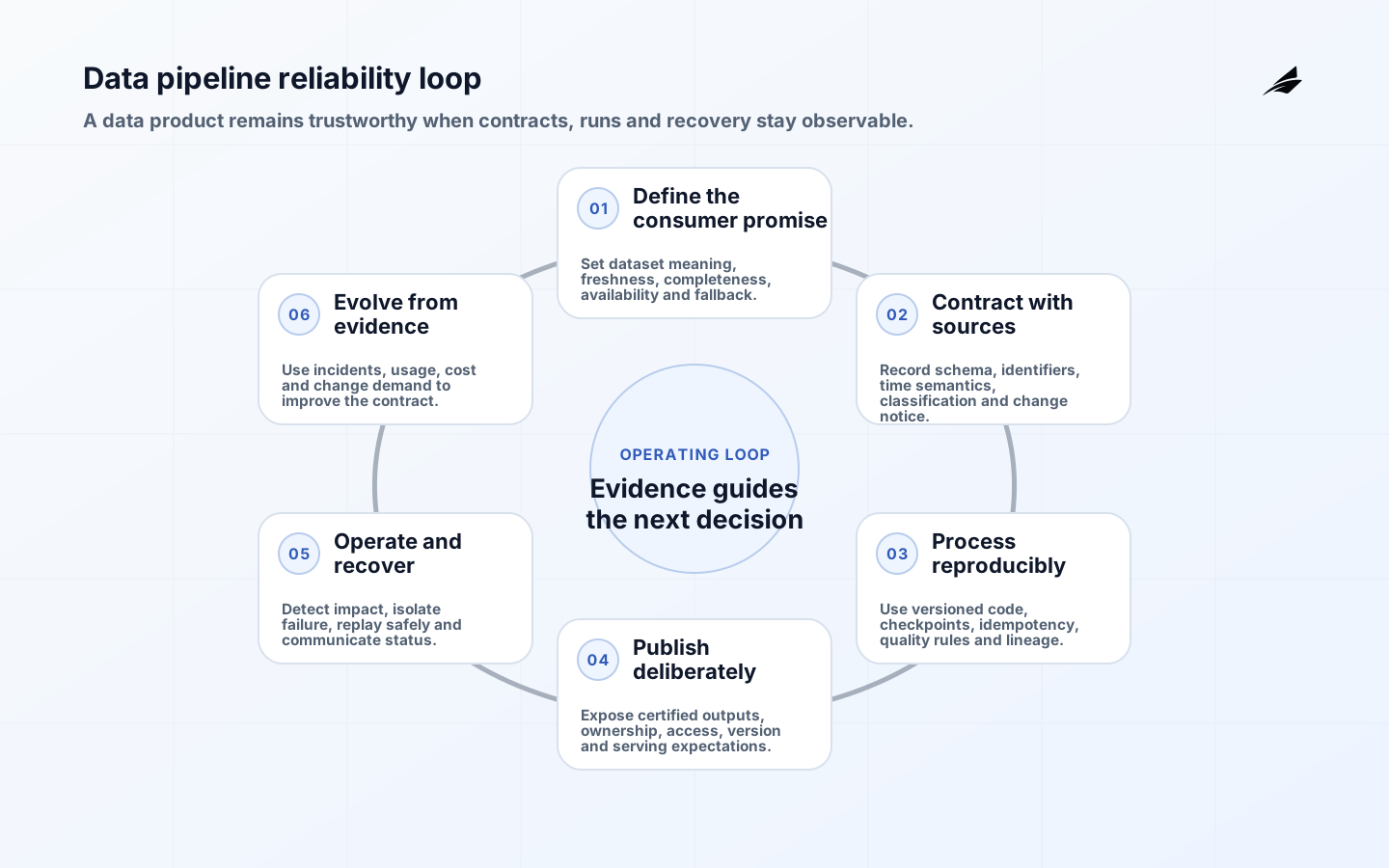
Data pipelines are production services that move, transform, validate and publish data for decisions, operations and products. A CTO should not govern them as successful merely because scheduled jobs are green. A pipeline can run on time while dropping records, using the wrong business date, exposing sensitive fields or publishing a result that consumers cannot interpret. Reliability begins with the consumer promise and extends through source contracts, provenance, recovery and ownership.
This guide gives CTOs a concrete operating model. Use the data contracts engineering notes for producer-consumer change design, the real-time analytics guide for latency decisions and the dbt model guide for transformation ownership. The objective is one traceable path from source event to accepted data product and a tested route back from failure.
1. Define the consumer promise before the architecture
Name the consumer, decision or product action, dataset meaning, availability, freshness, completeness, accuracy expectations, retention and fallback. Define time explicitly: event time, source update time, ingestion time, processing interval and publication time answer different questions. Identify how late or corrected data changes previous output. A daily executive metric, fraud feature, customer export and regulatory report can use the same source while requiring different guarantees and recovery.
Assign a business owner for meaning and a technical owner for delivery. Producers own source behavior and change notice; consumers own impact and fallback; platform teams own shared infrastructure; privacy and security owners define relevant controls. Publish support hours, escalation, known limitations and deprecation. Service objectives should describe what consumers can rely on, not an internal scheduler state that can be green while the output is stale.
| Promise dimension | Definition to record | Operational signal |
|---|---|---|
| Meaning | Population, grain, fields, units, exclusions and owner | Definition version and certification state |
| Freshness | Expected source interval and publication deadline | Age of newest complete interval |
| Completeness | Expected records, partitions or business totals | Missing and quarantined scope |
| Correctness | Rules, tolerances and reconciliation reference | Failed checks and material variance |
| Availability | How and when consumers can access output | Successful read or delivery objective |
| Recovery | Replay window, correction policy and fallback | Actual recovery time and reconciled output |
2. Separate data, processing, serving and control concerns
Create explicit boundaries for ingestion, durable source capture, transformation, quality, publication and orchestration. Preserve immutable or append-oriented raw evidence where purpose and retention permit, but do not confuse a raw zone with an ungoverned archive. Make checkpoints and partition identity durable. Separate processing state from published output so partial runs cannot appear complete. Publish through an atomic pointer, partition marker or equivalent contract appropriate to the technology.

Batch, streaming and hybrid choices
Choose processing mode from the consumer deadline and correction model. Batch can be simpler to reconcile and replay; streaming can reduce decision latency but introduces event ordering, state, watermark and continuous-operation concerns. A hybrid design may ingest continuously and publish certified intervals. The Google SRE data processing pipeline guidance emphasizes correctness, freshness and recovery concerns and the need to reason about repeated processing. Complexity should buy a measured consumer outcome.
3. Implement contracts, quality gates and provenance
A source contract should state schema, identifiers, null behavior, units, time semantics, update and deletion behavior, delivery expectations, classification, owner and change process. Test machine-verifiable parts at producer and consumer boundaries. Classify changes by compatibility and impact; adding a nullable field may be structurally compatible but semantically dangerous if consumers treat missing as zero. Maintain an exception process with owner, expiry and migration route.
Apply quality controls at the point where action is possible: schema and required fields at ingestion, referential and domain rules during transformation, and business reconciliation before publication. Quarantine bad records with reason and ownership rather than silently dropping them. Distinguish warning, partial publication and hard stop according to consequence. Version rules and thresholds. A data quality score that averages unrelated checks can hide a failed critical rule behind many easy passes.
Preserve provenance from output to source, transformation and responsible agent. W3C PROV-O represents entities, activities and agents and their relationships. The OpenLineage object model describes jobs, runs and datasets with extensible facets. A team need not implement either specification wholesale, but run identity, code version, input intervals, output version and ownership should be queryable for impact analysis and incident recovery.
| Failure scenario | Detection | Containment | Recovery evidence |
|---|---|---|---|
| Schema break | Contract validation at source or ingestion | Reject version or route compatible consumers | Change owner, affected runs and replay result |
| Duplicate delivery | Record or event identity and reconciliation | Idempotent write or deduplication quarantine | Duplicate count and retained canonical result |
| Late source interval | Freshness and expected-partition check | Hold certification or publish explicit partial state | Arrival time and corrected publication |
| Partial transformation | Run and partition completeness marker | Keep output unpublished or isolate affected partition | Successful rerun with same input identity |
| Bad business rule | Reconciliation or sampled consumer challenge | Withdraw certification and stop downstream action | Rule version, corrected outputs and notified users |
| Credential revocation | Access error and service telemetry | Stop affected connector without broad fallback access | New credential, missed interval and completed replay |
4. Apply security and privacy to every data state
Inventory classification, purpose, authorized roles, regions, retention, deletion and sharing for source, intermediate, quarantine, output, logs and backups. Minimize fields before ingestion when possible. Use workload identities and narrowly scoped service accounts, encrypt transport and storage, separate production from development and audit privileged access. Masking a published table does not protect raw files, failed-record queues or debug logs containing the same data.
NIST SP 800-53 provides a broad security and privacy control catalog that organizations can tailor. The NIST Privacy Framework helps connect data processing to privacy risk and organizational outcomes. Use these as structures, then apply applicable law, contracts and organizational risk. Lineage itself can expose sensitive topology and field names, so control its access while preserving accountability.
5. Instrument consumer impact and rehearse recovery
Observe infrastructure and data behavior together. OpenTelemetry signals cover traces, metrics and logs for software systems. Add data-specific context: source interval, run, partition, records read and written, quarantined count, quality result, publication version and consumer objective. Correlate orchestration and processing so an operator can move from a stale dataset to the failed component and affected source scope without manually joining several consoles.
Alert on breached consumer promises and actionable precursors. A failed task that retries successfully before the publication deadline may not need an urgent page; a green pipeline with no new source interval may. Route alerts to an owner with run context, affected outputs and next action. Track time to detect, time to contain, time to corrected publication and repeated cause. Give consumers a status and correction channel proportional to their dependence.
Test replay before relying on it. Select a historical interval, use versioned code and inputs, run in isolation, compare output and publish through a controlled correction. Exercise duplicate events, late data, unavailable dependency, corrupted checkpoint and revoked credential. Define whether reprocessing replaces, appends or restates downstream results. Notify consumers when prior decisions may have used superseded data. Recovery is complete only after affected outputs and dependent products are reconciled.
6. Govern change, cost and platform investment
Use code review and automated tests for structural and known semantic changes, then require business review where meaning or consequence changes. Maintain a consumer registry beyond automatically discovered jobs because spreadsheets, exports and manual processes may not emit lineage. Set deprecation windows according to impact, not convenience. Review orphaned datasets, unused pipelines, unsupported connectors and persistent exceptions. Retirement should remove schedules, credentials, storage, alerts and documentation together.
Measure platform value through objective attainment, incident burden, onboarding time, recovery success, consumer adoption and cost. Allocate compute, storage, orchestration, observability, egress and support to meaningful data products where feasible. Optimize after identifying the requirement: a slower refresh may be acceptable for one dashboard but harmful for an operational decision. Avoid converting every pipeline to a fashionable pattern before evidence shows a shared constraint.
Practical implementation example: an orders pipeline captures source changes durably, validates identifiers and event time, transforms with versioned code, reconciles order count and amount to the operational system, and publishes a certified daily partition atomically. A run record links source interval, code, checks and output. When one region arrives late, the partition remains visibly partial, consumers receive status, and a bounded replay produces a corrected version without duplicating downstream invoices.
Key takeaways
- Define freshness, completeness, meaning, availability and recovery from the consumer's decision.
- Separate durable capture, processing state and certified publication.
- Version source contracts, quality rules, code and output identity.
- Preserve provenance that supports impact analysis, correction and accountability.
- Instrument data promises alongside software signals and test bounded replay.
- Invest in shared platform capability only after repeated operating evidence shows the need.
Data pipeline FAQ for CTOs
Should a company standardize on one pipeline tool? Standardize contracts, evidence and operating expectations first. A smaller tool set can reduce burden, but different latency and processing needs may justify bounded engines behind shared controls.
Is exactly-once processing required? Often the business need is an effectively once outcome built from identity, idempotency and reconciliation. Evaluate end-to-end semantics; a platform guarantee at one stage cannot prevent duplicate external actions elsewhere.
Who owns data quality? Source owners own source behavior, domain owners own meaning, pipeline owners own delivery and consumers own impact evidence. Shared accountability needs explicit decision rights rather than saying everyone owns quality.
When is real-time justified? When reduced data age changes a valuable action enough to justify continuous complexity and operations. State the decision deadline and compare it with a simpler interval before selecting streaming.
Conclusion: manage pipelines as data services
CTOs should require every material data pipeline to make a clear consumer promise, preserve evidence and recover predictably. Start with meaning and decision timing, build explicit contracts and publication states, secure every copy, rehearse replay and let service evidence determine where architecture and platform investment go next.