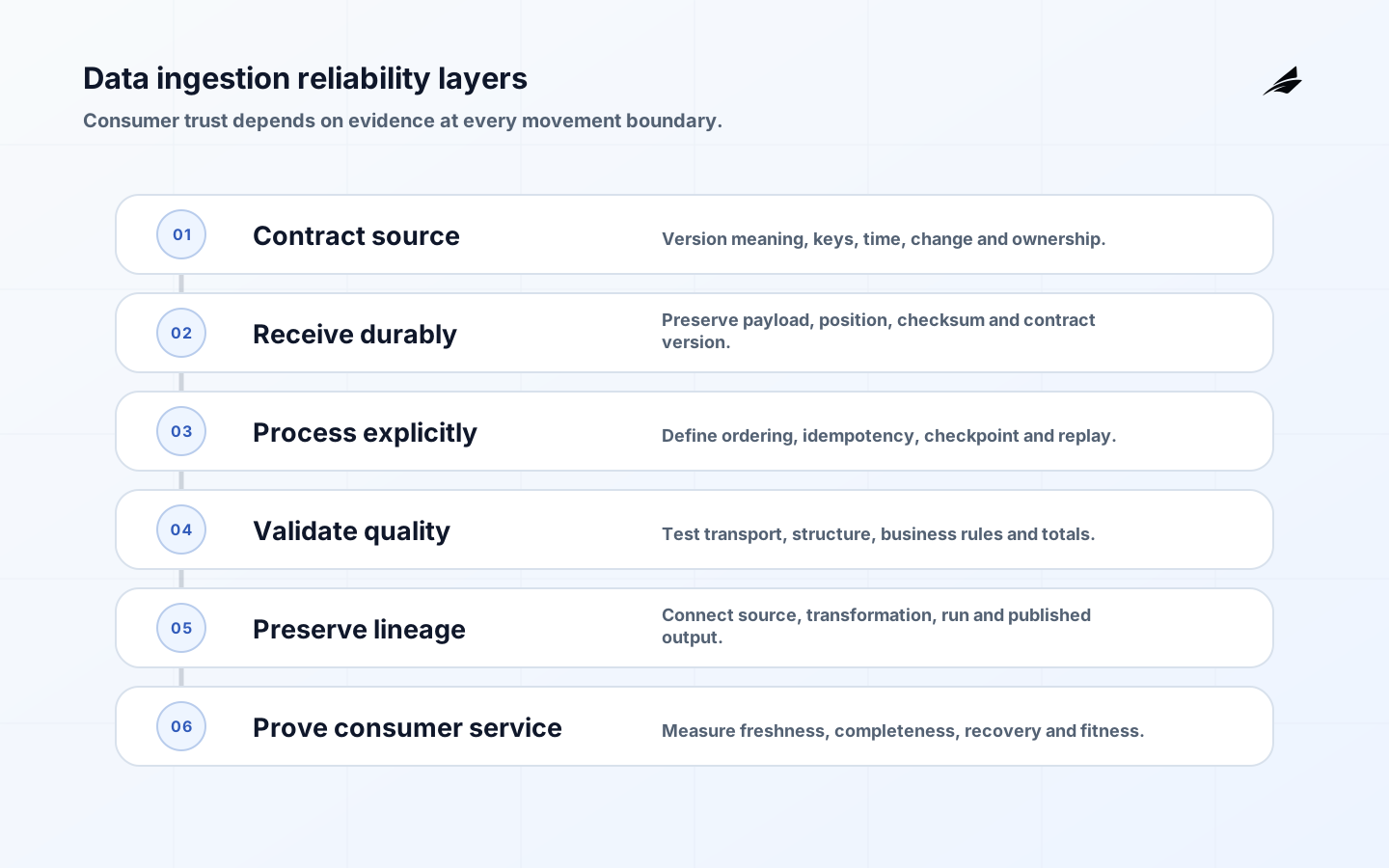
Data ingestion solutions move records and events from operational sources into destinations where people, applications and models can use them. Reliable ingestion is not proved by a green scheduler alone. It is proved when the destination contains the right data, with known meaning, freshness, completeness and lineage, and when operators can recover from change or failure without guessing. This checklist covers the decisions and acceptance evidence needed for batch files, APIs, database change data capture and event streams.
Begin with the data ingestion delivery plan and use the data ingestion FAQ for architecture comparisons. Programs that feed analytical or AI products should also apply the governance gates in the data and AI implementation checklist. The first objective is one trustworthy data product, not the maximum number of connected sources.
1. Define the consumer outcome and service level
Name the consumer, decision and tolerated delay. A fraud feature needed within seconds has different ordering and recovery needs from a finance close dataset loaded nightly. Specify freshness, completeness, availability, retention and correction objectives in business terms. “Real time” is not a requirement; “95 percent of approved orders visible within 60 seconds and all accepted orders reconciled within 15 minutes” is testable. Include a maximum acceptable age and a response when the target is missed.
Establish ownership on both sides. The source owner controls meaning and change; the ingestion owner operates movement; the data-product owner accepts fitness for use. Record who may pause a feed, approve a schema change, replay history and declare a correction complete. Without this authority model, pipeline incidents become negotiations while consumers continue using questionable data.
| Input characteristic | Design question | Likely pattern | Acceptance evidence |
|---|---|---|---|
| Daily immutable file | Can the source publish a complete manifest? | Scheduled batch with atomic landing | Counts, checksums and manifest reconcile |
| Mutable database | Are logs available and retained through outages? | Snapshot plus change data capture | Snapshot boundary and change positions reconcile |
| High-volume events | What ordering and duplicate behavior matter? | Partitioned durable stream | Load, rebalance and replay tests pass |
| Rate-limited API | How are cursors, quotas and corrections exposed? | Incremental polling with checkpoints | No gaps across retries and pagination |
| Sensitive telemetry | What can be minimized before landing? | Collector with filtering and routing | Approved fields reach each destination |
2. Create a source contract before the connector

Inventory each source field and event with business definition, type, units, allowed values, keys, event time, update behavior, sensitivity and owner. Distinguish event time from ingestion and processing time. Define whether null means unknown, not applicable or deleted. For files, specify naming, compression, encoding, delimiter, manifest and late-arrival rules. For APIs, specify pagination, cursor expiry, rate limits and error semantics. For streams, specify partition key, ordering scope and retention.
Version contracts and classify changes as compatible, conditionally compatible or breaking. Add automated compatibility checks, but keep business review for semantic changes that preserve the same type. A field named status can remain a string while its allowed values and meaning change. Require advance notice, representative fixtures and a rollback path. Quarantine unknown versions rather than coercing them silently into the previous schema.
3. Choose delivery semantics and idempotency explicitly
Define what may happen during retries. At-most-once delivery can lose records; at-least-once delivery can duplicate them; exactly-once claims depend on the full source, transport, processor and sink boundary. The Debezium documentation on exactly-once delivery is candid that its normal guarantee is at least once and that framework support has prerequisites and known considerations. Treat exactly once as a property to test within a named boundary, not a product checkbox.
Prefer deterministic identifiers and idempotent writes. A destination key can combine source system, entity ID and version or event ID. Store the source position or cursor with the committed output when possible. If a pipeline writes both data and a checkpoint, define atomicity so a crash cannot advance the checkpoint without the data. For side effects such as notifications, separate ingestion from action and maintain an action ledger. Test duplicate, out-of-order and replayed inputs deliberately.
4. Separate durable landing from processing
Land source data durably before expensive transformation when policy permits. Preserve the received payload or a governed equivalent, source position, retrieval time, checksum and contract version. This creates a replay point and distinguishes source defects from transformation defects. Restrict access and retention according to sensitivity; a raw zone is not permission to retain everything indefinitely. Make writes atomic so consumers never read partially delivered files or partitions.
Choose ETL or ELT according to control, scale and data risk. Microsoft’s ETL architecture guidance explains both patterns and emphasizes coordination, transformation and idempotent parallelization. Transform early when sensitive fields must not enter the destination or when strict validation protects a transactional target. Land then transform when preserving source fidelity and elastic target compute are more valuable. Document the tradeoff for each source.
5. Put quality checks at meaningful boundaries
Validate transport first: expected object, checksum, size, encryption and manifest. Validate structure next: schema, required fields and parse errors. Then validate business quality: key uniqueness, referential integrity, allowed transitions, value ranges and reconciliation totals. Finally validate consumption: freshness, partition availability and critical query results. A single “rows loaded” metric cannot distinguish a complete bad file from a partial correct one.
Define dispositions for failed records: reject the whole batch, quarantine records, accept with a warning or stop downstream publication. The choice depends on atomicity and impact. Never discard malformed records without a count and retrievable evidence. Set thresholds, owner and expiry for exceptions. A quarantine queue that nobody reviews is data loss with a friendlier name. Report quality by source and contract version so recurring defects are corrected upstream.
6. Preserve lineage, observability and privacy
Capture which source entities, pipeline activities and responsible agents produced each published dataset. The W3C PROV-O recommendation provides a standard model for interoperable provenance using entities, activities and agents. Teams do not need to implement the whole ontology to benefit from its concepts. At minimum, store source locator, version, transformation revision, run or trace ID, output identifier, timestamps and quality status.
Instrument lag, throughput, error rate, retry count, queue depth, checkpoint age, rejected records and destination commit latency. Correlate a source item across stages without logging its sensitive payload. The OpenTelemetry Collector illustrates a receiver, processor and exporter pipeline and supports batching, retries, encryption and filtering. If used, assess component maturity and protect collector credentials because telemetry infrastructure can reach many systems and reveal operational context.
| Control plane | Metric or test | Alert condition | Operator action |
|---|---|---|---|
| Source | Last successful cursor and change rate | Cursor stalls while source changes | Confirm source access and retention window |
| Transport | Lag, queue depth and retry age | Oldest item breaches freshness budget | Throttle producers or scale consumers safely |
| Quality | Reject count and reconciliation delta | Threshold or critical rule fails | Quarantine publication and notify owner |
| Destination | Commit latency and duplicate conflicts | Commit errors or conflict spike | Protect checkpoint and investigate sink |
| Consumer | Dataset age and critical query checks | Published state is stale or inconsistent | Mark product degraded and invoke fallback |
| Recovery | Replay duration and result equality | Exercise misses recovery objective | Repair capacity, retention or runbook |
7. Secure the pipeline and its operating identities
Give each connector and processing job a distinct identity with least-privilege access to specific sources, paths and destinations. Keep secrets out of configuration files and logs; rotate them without losing checkpoints. Encrypt transport and approved stores, restrict administration, and record changes to schemas, mappings and retention. Scan connector images and dependencies, pin versions and stage upgrades. Third-party connectors execute in a privileged data path and deserve the same review as application code.
Classify data before routing and enforce destination policy. Masking a direct identifier may not remove re-identification risk when detailed events remain. Record lawful purpose, retention and deletion propagation where applicable. The AWS Data Analytics Lens is a useful provider-authored review of security, reliability, performance, cost and operational considerations, but architecture owners must apply the requirements of their own jurisdiction and business context.
8. Rehearse backfill, cutover and replay
Backfills and live feeds must share clear boundaries. Record a snapshot timestamp or log position, load history, then apply changes from that point without gaps or duplicate final state. Test production-scale volume, rate limits, partition skew and destination contention. During cutover, compare old and new outputs over a representative period. Reconcile business totals and sampled entity histories, not only row counts. Freeze or version transformations so a changing rule does not invalidate the comparison.
Run a replay exercise before launch. Restore from the approved landing point into an isolated destination, apply the current or historically correct transformation, and compare results. Define when replay must preserve original logic versus apply corrected logic. Keep lineage for both. Measure recovery duration and downstream re-publication. A pipeline is operable only when the on-call team can determine the affected interval, stop unsafe publication, recover and communicate status.
Key takeaways
- Begin with a consumer service level and named data owners.
- Version source meaning, not only physical schema.
- Design duplicates, ordering, checkpoints and idempotency as one contract.
- Preserve a governed replay point and end-to-end lineage.
- Measure business reconciliation and freshness beside pipeline uptime.
- Prove backfill, cutover and replay at representative scale.
Data ingestion solutions FAQ
Should a team use ETL or ELT?
Use the pattern that best meets sensitivity, fidelity, governance and compute needs. ETL can prevent disallowed data from landing and protect constrained targets. ELT can preserve source detail and use scalable destination compute. Many platforms use both for different sources.
Does every data source need real-time ingestion?
No. Choose latency from the consumer decision and cost of delay. Streaming adds operating complexity around ordering, backpressure and replay. A predictable hourly or daily batch is often better when the business process does not act sooner.
Is exactly-once processing required for reliable ingestion?
Not always. At-least-once delivery with deterministic IDs and idempotent sinks is robust for many workloads. If exactly once is required, define the boundary and test failures across source, broker, processor and destination rather than relying on a feature label.
Conclusion
A reliable ingestion solution makes data movement explainable and recoverable. Contract source meaning, choose explicit semantics, preserve durable evidence and test the consumer result under failure. That discipline turns connectors and schedulers into a data service that people can trust when decisions depend on it.