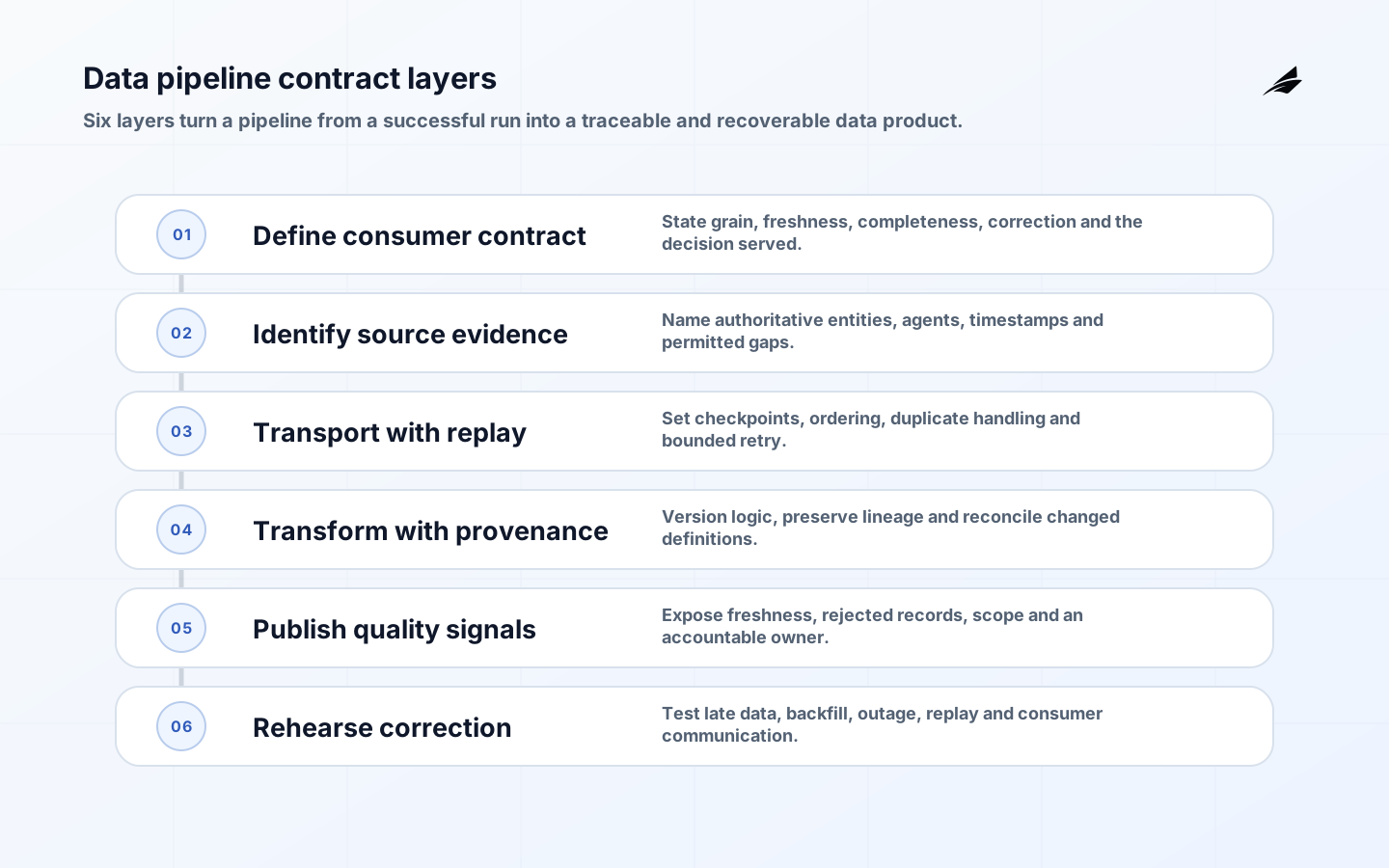
Data Pipelines Decisions That Matter before the First Build becomes a production concern when it makes inputs, transformations, failure behavior, and delivery expectations explicit before building a chain of jobs. A team should begin with what downstream users may rely on and when they must stop relying on it, rather than with a platform comparison or a backlog of fields. The useful unit of work is a decision service: it has a named reader, a deadline, evidence that can be inspected, and an action when the evidence changes. For data pipelines, the first design note should say what is included, what is intentionally outside the boundary, and what a reader should do when the result is incomplete. That framing keeps implementation choices connected to the work people are actually trying to perform.
Start with the data pipelines decision boundary
Write the boundary in plain language: input contract, schema behavior, time semantics, ownership, quality gates, and recovery route. This is not documentation after the fact; it is the agreement used to judge changes. The W3C PROV overview describes provenance as relationships among entities, activities, and agents. Applied here, a reader should be able to trace a result to its inputs, the transformation or interpretation that produced it, and the person or team responsible for correcting it. That trace does not require exposing every implementation detail, but it does require a visible path from an answer to the evidence behind it.

| Boundary question | Decision-ready answer |
|---|---|
| Who relies on it? | data producers, downstream model owners, and operations staff need a named use case and time limit. |
| What is the unit? | State the grain or observation that one result represents. |
| What can change? | Record schema, definition, timing, and policy changes that need review. |
| What happens on doubt? | Route an uncertain result to the pipeline service owner with source evidence. |
Make pipeline evidence findable
A useful record does more than define a label. It names purpose, owner, source, update behavior, access conditions, and limitations that could change interpretation. The W3C Data Catalog Vocabulary is a helpful model because it treats datasets and services as resources that can carry distribution, provenance, and related metadata. Keep the record near the tool or dataset where people make the decision, then link to deeper lineage and change history. A central catalog helps discovery, but a reader should not have to leave the work surface to learn whether the result is provisional, restricted, or based on a changed definition. Identify the producer handoff and the consumer deadline before choosing orchestration.
Build the data pipelines path in small, testable slices
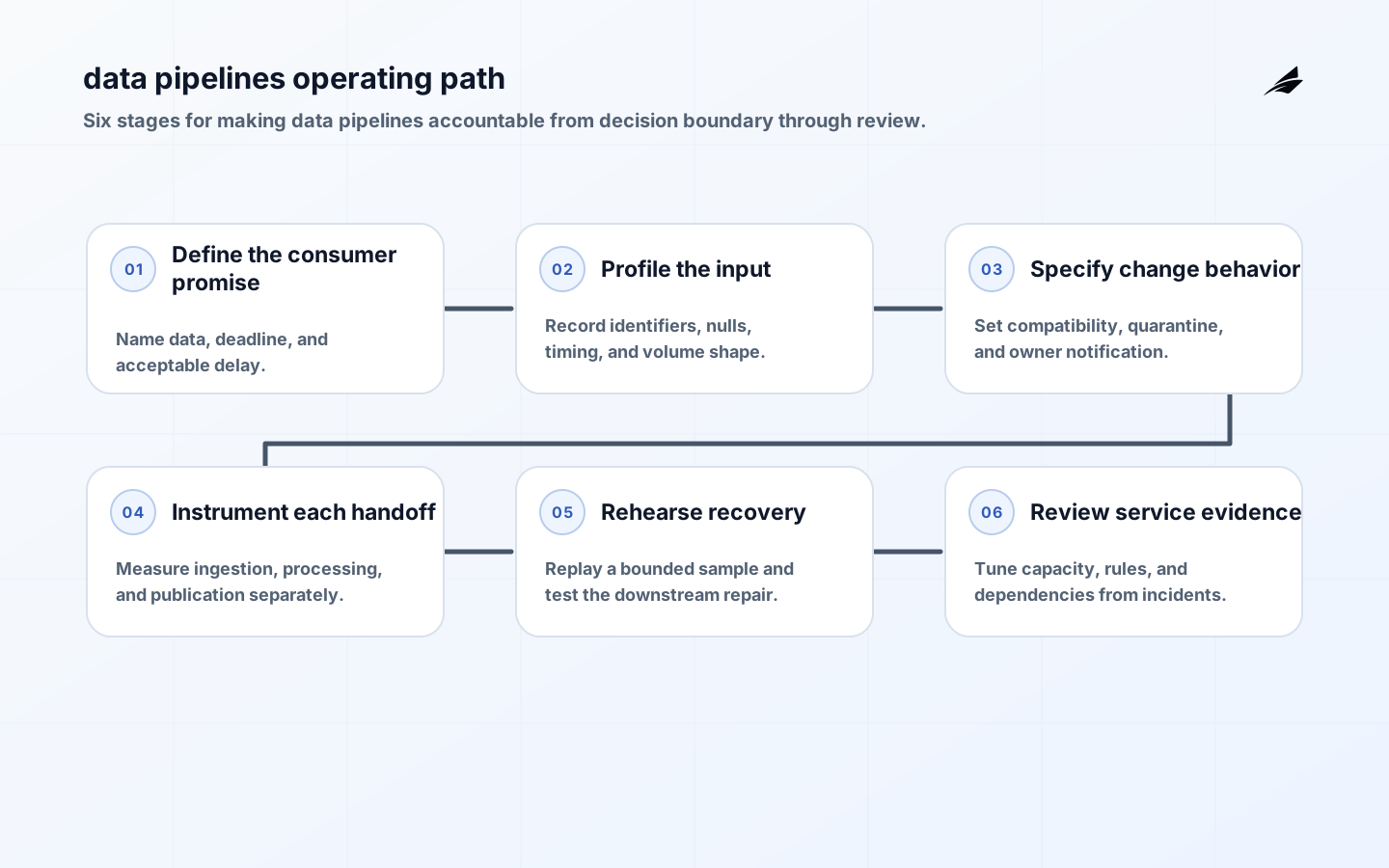
Choose one recurring decision with a known reconciliation cost and build only the path needed to support it. Give the pipeline service owner authority to approve the definition and its exceptions. Validate a small sample against a trusted control total or record set before scaling access. Document both the normal delivery rule and the degraded state. This approach exposes the awkward questions early: whether identifiers are stable, whether a filter changes the grain, which late records may revise an answer, and which users may see sensitive detail. It also makes a future migration less risky because the published behavior is explicit rather than embedded in a collection of dashboards or scripts.
- Name the decision, accountable role, deadline, and action threshold.
- Publish input contract, schema behavior, time semantics, ownership, quality gates, and recovery route.
- Test ordinary, empty, delayed, restricted, and corrected-data states.
- For data pipeline delivery, record the owner, change route, and evidence needed to investigate a disagreement.
Run data pipelines as an observable service
Operational measures should reveal whether the service can still support its stated decision. The OpenTelemetry Metrics Data Model distinguishes metric streams, timeseries, attributes, and aggregation behavior; that distinction is a useful reminder to define units and dimensions before collecting a number. Track freshness or lag, failure and recovery time, rejected or quarantined records where relevant, reconciliation requests, and the share of decisions made within the promised window. Avoid a single health score that hides a breach in the one field or time period that matters. Pair automated indicators with a short review of reader questions and action outcomes.
| Signal | What it can reveal | Review response |
|---|---|---|
| Freshness against promise | Whether the result arrived when the decision needed it. | Label the output, investigate the delayed handoff, and update affected readers. |
| Reconciliation demand | Where readers cannot reproduce or trust the answer. | Compare definitions, filters, lineage, and representative records. |
| Change failure | Whether a release altered expected behavior. | Roll back or correct, then add a regression example to review. |
| Use tied to action | Whether the published output changes a real decision. | For data pipeline delivery, refine the reading path or retire a surface without a decision owner. |
Set pipeline time and correction rules
Many disputes that look like calculation errors are actually time or change-management errors. Establish which timestamp governs the answer, how late data is handled, and whether historical outputs may be restated. The Apache Beam programming guide explains why unbounded data needs explicit windowing and triggers: aggregation cannot wait forever, so a system needs a declared trade-off between early results and completeness. Even where work runs in batches, the same discipline helps. Define the cutoff, correction window, and notification route before a late file or schema change forces an improvised answer.
Roll out data pipelines with real readers
Pilot with a small group that already performs the target decision. Observe how they find the result, which qualifiers they ask for, and whether they can follow the evidence path without private assistance. Review the change with data producers, downstream model owners, and operations staff; their questions often identify an ambiguity that a technical test missed. Use the pilot to agree a release checklist, escalation contact, and review cadence. The aim is not universal adoption on day one. It is a dependable first service with a clear owner, a measured decision benefit, and a route for bringing the next decision into the same discipline.
Signals to watch after data pipelines go live
Watch for the failure mode in which a successful run disguises late, duplicated, incomplete, or misinterpreted data. For data pipelines, also watch for widening access without an ownership model, emergency changes that bypass the record, unexplained shifts after a backfill, and users exporting data to reconstruct a familiar answer elsewhere. These are not merely adoption problems. For data pipelines, they are evidence that the promised contract is missing, hard to find, or no longer matches reality. For data pipelines, a short monthly review should look at incidents, unanswered questions, pending definition changes, and whether the original decision remains worth serving. The adjacent guides Data Pipelines in Production, ELT Workflows: Data Contracts, Controls, and Operating Ownership, ELT Workflows in Production, offer useful context when the boundary crosses reporting, modeling, or delivery work.
Key takeaways for data pipelines
- Data pipelines are dependable only when they serve a named decision with a reader and action threshold.
- Make provenance, ownership, limitations, and change behavior inspectable where work happens.
- For data pipeline delivery, measure the service against its promised timing and decision usefulness, not just technical completion.
- Treat late data, corrections, and definition changes as normal operating cases.
Data pipelines FAQ
What should be defined first for data pipelines?
Start with the decision, reader, population, time cutoff, and action threshold. Those facts determine which fields, controls, and explanations are necessary; implementation follows from them.
How much pipeline documentation is enough?
Provide enough context for an informed reader to understand purpose, owner, grain, source evidence, current status, and known limitations without relying on a private conversation. Link deeper technical detail instead of burying the working surface.
When should pipeline scope expand?
Expand after the first decision path is stable: readers can reproduce key results, exceptions have an owner, and releases have a tested review route. New consumers should not inherit an undefined contract.
Conclusion: make data pipelines accountable before scaling it
The durable question is not whether data pipelines can be implemented. It is whether a person can use the published result at the required time, understand its limits, and get it corrected when evidence conflicts. Begin with that promise, make the boundary and evidence visible, and test the recovery path as carefully as the happy path. A smaller accountable service earns trust more reliably than a broad rollout that leaves readers to reconcile results on their own.
Review the pipeline contract at every boundary
A pipeline contract should say what arrives, at what grain, under which identity, within what time window, and how a correction is represented. Review it at source, transport, transformation, publication, and consumption boundaries. A schema document alone is not enough: a consumer also needs freshness, completeness, nullability, ordering, duplicate, deletion, and replay expectations. W3C PROV provides a useful vocabulary for connecting an assertion to its activity, entity, and agent; use that idea in practical metadata so an analyst can trace a surprising number to the run and source records behind it.
| Boundary | Question | Evidence before promotion |
|---|---|---|
| Source to ingest | Can late or repeated events be distinguished? | Sample payloads and replay test |
| Ingest to transform | What is the watermark and retry rule? | Run log, checkpoint and duplicate result |
| Transform to publish | Which business definition changed? | Versioned model and reconciliation |
| Publish to consumer | How is freshness and scope shown? | Catalog entry, contract test and owner |
Use a deliberately awkward test set before calling a pipeline reliable: one event arrives late, one arrives twice, one has an unknown reference, one is corrected after publication, and one source is unavailable for a full run. Decide which cases are retried, quarantined, repaired, or published with a visible limitation. Apache Beam's programming guidance is a useful reminder that windowing, triggers, and state are part of the meaning of a result, not merely implementation details. OpenTelemetry's metrics model similarly helps separate a measurement's identity and attributes from the system that emits it.
Do not expand the pipeline because the happy path is fast. Expand only after the owner can explain the correction route, the consumer can find provenance, and the support team can distinguish stale data from a valid zero. A monthly review of late-arrival rate, rejected records, replay duration, contract changes, and unanswered consumer questions will reveal whether the system is becoming more dependable or merely more elaborate.
Pipeline operating decisions
A pipeline handover should include a consumer-facing example, not only an architecture diagram. Show one ordinary record, one late correction, one rejected record and one replay, with the expected published result for each. Ask the analyst or application team to locate those examples without help. If they cannot, the metadata is technically present but operationally undiscoverable. Keep the example close to the contract and update it when grain, timing or correction semantics change.
Plan decommissioning at the same time as expansion. When a new pipeline replaces a spreadsheet or an older feed, define the comparison period, final reconciliation, retention obligation, consumer notification and rollback boundary. Leaving the old path alive without an owner creates two competing truths; deleting it before consumers have moved creates a silent outage. A small, explicit cutover is part of pipeline reliability.